AI Turns One Coding Task Into Phase One
Why is this AI ML meme funny?
Level 1: The Two-Week Sandwich
It is like asking someone for a plan to make one sandwich and hearing, “Phase one, lasting two weeks: study bread and assemble the kitchen committee.” A plan can be useful, but this one makes a small job sound like the beginning of a huge adventure. The hand on the shoulder is funny because it looks comforting while delivering very bad news.
Level 2: Phase One of Forever
An AI coding assistant is a tool that generates or analyzes text and code from instructions and context. When asked for a plan, it predicts a useful-looking sequence based on the information provided. It does not automatically know a company's repository, deadlines, release process, or staff unless those facts are available in its context and correctly interpreted.
A task is a bounded piece of work. A phase groups related work in a larger project, often with a milestone or decision between phases. Calling something “Phase 1” suggests later groups already exist or will be invented. That is why the caption feels ominous: the user expected steps for one task and received the opening schedule for an expedition.
Several terms describe how the task can grow:
- Scope is the work and outcome included in the request.
- Scope creep is uncontrolled expansion after work begins.
- Overengineering means adding complexity beyond what the actual problem justifies.
- Effort estimate predicts labor, while a calendar estimate includes waiting and coordination.
- Acceptance criteria are observable conditions that say when the task is complete.
- A technical spike is a short investigation used to reduce an important uncertainty.
Suppose the request is “Add a character counter to this text box.” A minimal plan might identify the component, update the displayed count, define behavior at the limit, add focused tests, and run the existing checks. An inflated plan might propose a new counting service, analytics pipeline, internationalization audit, feature-flag platform, phased rollout, dashboard, and post-launch review. Some of those could matter, but only concrete requirements or system evidence should promote them into required work.
Better input improves the plan:
Goal: show the current character count in the existing editor.
Constraints: no new service or dependency; reuse current validation.
Done: count updates while typing, handles pasted Unicode text according to
the existing limit rule, and passes the repository's tests.
Output: minimal implementation plan, assumptions, and genuine blockers only.
This does not guarantee a perfect estimate, but it gives the assistant boundaries and a definition of success. The developer still reviews whether referenced files, risks, and tests are real. A roadmap is not trustworthy merely because Markdown makes it look employed.
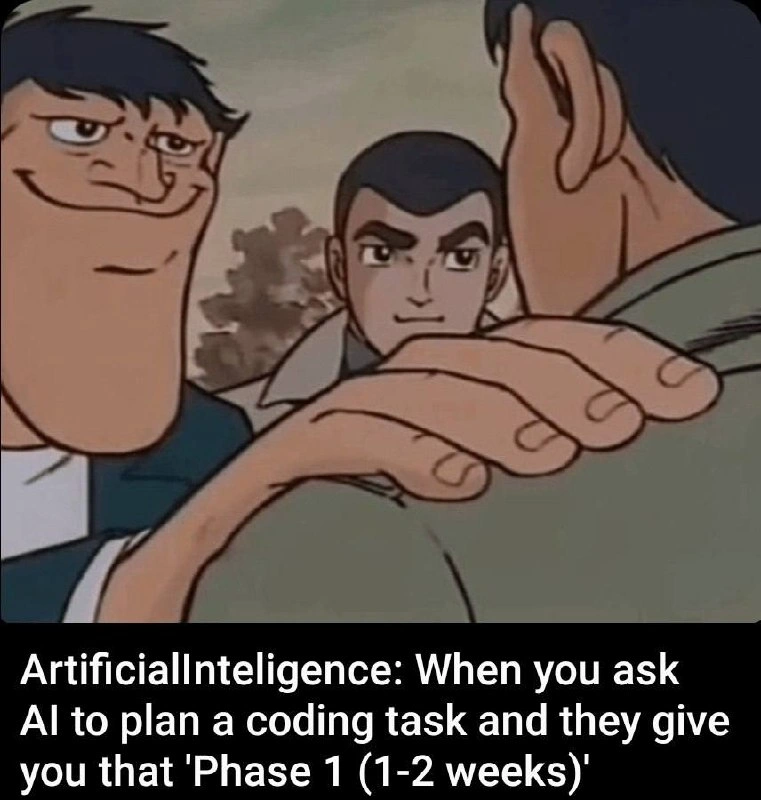
The visible shoulder-grab captures the social side of estimation. The answer is presented as reassurance—there is a plan—while the recipient realizes the supposed productivity tool has multiplied the commitment. The watcher in the background makes it feel as though the estimate has already been approved by people who will not be writing the code.
Level 3: Roadmap Ate the Patch
The caption contains one phrase that turns an ordinary coding request into an existential threat:
When you ask AI to plan a coding task and they give you that ‘Phase 1 (1-2 weeks)’
“Phase 1” implies that this is only the opening movement. “1–2 weeks” implies that even the opening movement has its own calendar allocation. The vintage animation frame supplies the emotional translation: a broad, smirking man reaches across the other character's shoulder with the reassuring physicality of someone about to explain that the “quick change” now requires a steering committee. A stern observer behind him confirms that this intervention has quorum.
The joke targets a basic mismatch between language-model fluency and software-estimation evidence. An AI assistant can generate a plan that looks like plans it has seen: discovery, architecture, implementation, testing, rollout, monitoring, documentation, and follow-up. The headings are plausible, the verbs are professional, and the schedule may be formatted with tremendous confidence. But unless the model has inspected the actual repository and received the team's constraints, it does not know code ownership, dependency behavior, deployment gates, test reliability, engineer availability, or how “done” is defined. It has generated the genre of an estimate, not measured the work.
Calendar estimates depend on far more than code volume:
$$ T_{calendar} = T_{effort} + T_{waiting} + T_{coordination} + T_{rework} + T_{unknowns} $$
An assistant may reason about likely tasks, but it cannot infer those terms from “plan this coding task.” One developer could make the change in an afternoon; another team could wait days for security approval, a schema owner, a test environment, or a release window. “1–2 weeks” also spans a factor of two while hiding whether it means one engineer's effort, elapsed team time, or a polite way of saying there be dragons.
Why do AI plans expand so readily? The request rewards completeness, and omission is more visible than excess. A model is safer, rhetorically, when it mentions tests, edge cases, observability, migration, rollback, and documentation. Those are genuine engineering concerns, but listing every respectable practice without ranking relevance produces overengineering by template. The assistant cannot be blamed for forgetting load testing if it proposes load testing for everything; the developer gets to explain why the settings-label patch now needs Phase 3: Regional Resilience Validation.
This mirrors a human organizational incentive. Detailed roadmaps create an appearance of control and give stakeholders artifacts to review. Engineers pad estimates when unknowns are punished but early precision is demanded. Project managers add phases so work can be tracked, while each tracking boundary creates meetings, handoffs, and status maintenance. AI does not invent this bureaucracy; it learns its language extraordinarily well and can reproduce a quarter's worth of ceremony before the coffee cools.
The meme is not saying short plans are always better. A request that sounds tiny may cross dangerous boundaries:
- Renaming a database field may require a backward-compatible migration.
- Changing authentication may affect sessions, clients, audit logs, and incident response.
- Updating an API response may break consumers outside the repository.
- Removing “unused” code may expose a hidden runtime dependency.
In those cases, a multi-phase plan can reveal complexity the requester missed. The correct reaction to Phase 1 (1–2 weeks) is not automatic rejection but a demand for traceability: Which observed repository facts justify each task? Which requirement creates each phase? Which assumptions could collapse the estimate? A surprising plan is useful when it points to evidence, not when it merely has excellent bullet indentation.
The strongest planning workflow treats the AI output as a hypothesis. First inspect the code, tests, dependency graph, and deployment mechanism. Then distinguish required work from defensive suggestions. Validate uncertain areas with a small technical spike. Estimate only after the scope and owners are visible, and keep ranges tied to explicit assumptions. An agent with repository access can help gather evidence, but it still cannot promise how quickly humans will review, coordinate, or approve the result.
A grounded plan might look less grand:
Required
- Change the parser in one identified module.
- Add regression tests for the two reproduced failures.
- Run the existing validation suite.
Conditional
- Add a migration only if stored records use the old format.
Unknown
- Confirm whether the mobile client consumes this field.
That structure separates scope from possibility. By contrast, “Phase 1” often bundles investigation, tooling setup, architecture review, and stakeholder alignment without explaining which uncertainty made them necessary. The label becomes a nesting doll: open the coding task and find a project; open the project and find a transformation program; open the transformation program and find a consultancy invoice.
Effort estimation is also vulnerable to false precision. Historical throughput for similar work, the people actually available, and known organizational delays usually predict better than a generic number emitted from prose. Teams can use optimistic, most-likely, and pessimistic cases or simple size categories, but every method should expose assumptions. An estimate is a forecast under conditions, not a property of the ticket like its ID.
The productivity irony is that reviewing an overgrown AI plan can cost more than planning the small task directly. Every speculative item demands a decision: keep it, reject it, clarify it, or investigate it. This is automation overhead—the tool produces material faster than the human can establish its relevance. AI assistance creates leverage when it compresses verified work; it creates administrative confetti when output volume is mistaken for insight.
Description
The upper portion is a vintage anime-style frame in muted colors: a broad, smug man places both hands reassuringly on another man's shoulders while a third man watches intently from behind. A black caption area below reads, "ArtificialIntelligence: When you ask AI to plan a coding task and they give you that ‘Phase 1 (1-2 weeks)’." The comforting-but-ominous gesture frames the estimate as a warning that the assistant has expanded a bounded coding request into the opening stage of a much larger program. The meme targets AI planning's tendency toward elaborate roadmaps, inflated effort estimates, and confident project-management ceremony before implementation begins.
Comments
1Comment deleted
The patch is three lines; the roadmap has a fiscal year.