Work Is for Work; Codex Is for Developers
Why is this AI ML meme funny?
Level 1: Workers and Developers
Imagine a school menu with two rooms: “Study Room — for finishing homework” and “Art Room — for artists.” It accidentally sounds as though artists never finish homework, even though art can be homework too. The screenshot is funny for the same reason: it offers one place for doing work and another for developers, as if developers are choosing the officially designated no-work option.
Level 2: Labels Are Logic
UX means user experience: how understandable and usable a product feels. Microcopy is the tiny text on buttons, menus, errors, and labels. It may contain only a few words, but those words help users predict what will happen.
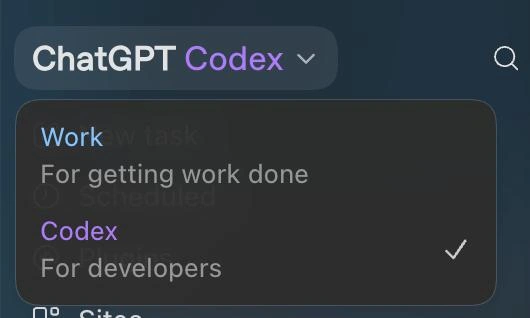
This dropdown is mutually exclusive: the checkmark shows that Codex is selected instead of Work. That selection behavior encourages the reader to treat the descriptions as opposites too. “For getting work done” sounds like the purpose of one mode; “For developers” sounds like an alternative to that purpose. The software distinction is reasonable, but the grammar creates the gag.
A junior developer can use a simple test when naming options:
- Describe every option using the same kind of information.
- Read all descriptions together, not one at a time.
- Ask what a hurried user will infer from the contrast.
- Prefer concrete capabilities over broad marketing words.
For example, “documents and research” versus “code and repositories” is immediately actionable. It also avoids implying that writing code exists in a mysterious category adjacent to employment.
Level 3: The Non-Working Branch
The open selector presents two sibling choices with beautifully unfortunate parallel copy:
Work
For getting work done
Codex
For developers
The checkmark beside Codex completes the self-own. Read as product documentation, the menu distinguishes a general work agent from a software-development agent. Read as ordinary English, it partitions humanity into people getting work done and developers. The original post message—“I was always saying that developers do not get any work done 🌚”—simply executes the implication the interface accidentally declared.
This is a classic UX microcopy failure caused by mixing taxonomic axes. “Work” is named after a broad activity and described by an outcome. “Codex” is a product name and described by an audience. One option answers what are you doing? while the other answers who are you? Because the rows share the same visual hierarchy and sentence pattern, users naturally compare them as mutually exclusive alternatives even though “developing software” is obviously a kind of work.
In type-system form, the accidental meaning looks like this:
type ProductiveHuman =
| { mode: "work"; purpose: "getting work done" }
| { mode: "codex"; purpose: "being a developer" };
The joke is a linguistic implicature, not a literal logical claim. The interface never says developers are unproductive. But when a writer contrasts A: for work with B: for developers, readers infer that the second description supplies information excluded from the first. Parallel UI elements behave like a comparison table whether the product team intended one or not. Natural language has backward compatibility issues and no deprecation schedule.
The intended product boundary is concrete. Work handles longer research, analysis, and finished artifacts such as documents, spreadsheets, presentations, reports, and Sites. Codex is the dedicated software-development mode for repositories, local files, terminals, commands, tests, debugging, and code review. Better subtitles would name those workloads on the same axis:
| Mode | Consistent description |
|---|---|
| Work | Research and create deliverables |
| Codex | Build and maintain software |
That wording preserves the distinction without making one audience sound like a protected leisure class. It also helps users choose based on capabilities rather than identity. A product mode should answer, “Which environment does this task need?” A developer may need Work for a project brief, while a non-developer may use Codex to automate a workflow.
The timing is part of the image’s relevance. It was posted on July 9, 2026, as OpenAI announced and rolled out the unified ChatGPT desktop experience combining Chat, Work, and Codex. The menu is therefore fresh launch copy rather than an ancient screenshot resurfaced for sport. Product launches compress complex positioning into tiny labels, which is exactly when a six-word description can accidentally summarize decades of jokes about engineers.
Those jokes work because developer labor is often visually ambiguous. Thinking through an architecture can look like staring out a window; waiting for CI can look like doing nothing; refactoring may produce no visible feature; debugging can consume a day to remove one character. Add the traditional rituals of editor configuration, dependency upgrades, and arguing about naming, and “for developers” becomes fertile comic contrast with “getting work done.” The stereotype is unfair, naturally, but the build is still running.
There is a broader developer experience lesson here. Interface copy is part of the product’s behavior: it sets expectations, teaches the conceptual model, and determines where users send a task. Engineers routinely test code paths while leaving language paths to intuition. Yet a mode selector is an API for humans, and its parameter names deserve the same review as public function names. If two choices are adjacent, test not only whether each description is true, but also what their contrast implies.
Description
A tightly cropped dark teal ChatGPT desktop interface shows a top-left pill labeled "ChatGPT Codex"—with "Codex" in purple—a downward chevron, and a search icon on the right. Its open mode selector offers "Work" with the subtitle "For getting work done" and "Codex" with the subtitle "For developers" plus a checkmark; faint underlying navigation text and part of "Sites" remain visible behind the menu. The selector is meant to distinguish the general-purpose Work agent for research and finished deliverables from the Codex software-development agent, but the parallel copy accidentally implies that developers occupy the non-work branch. The meme is therefore pure UX microcopy irony: a sensible product taxonomy becomes an unintended joke about engineering productivity.
Comments
1Comment deleted
Finally, an honest type system: `Work` and `Developer` are mutually exclusive variants.