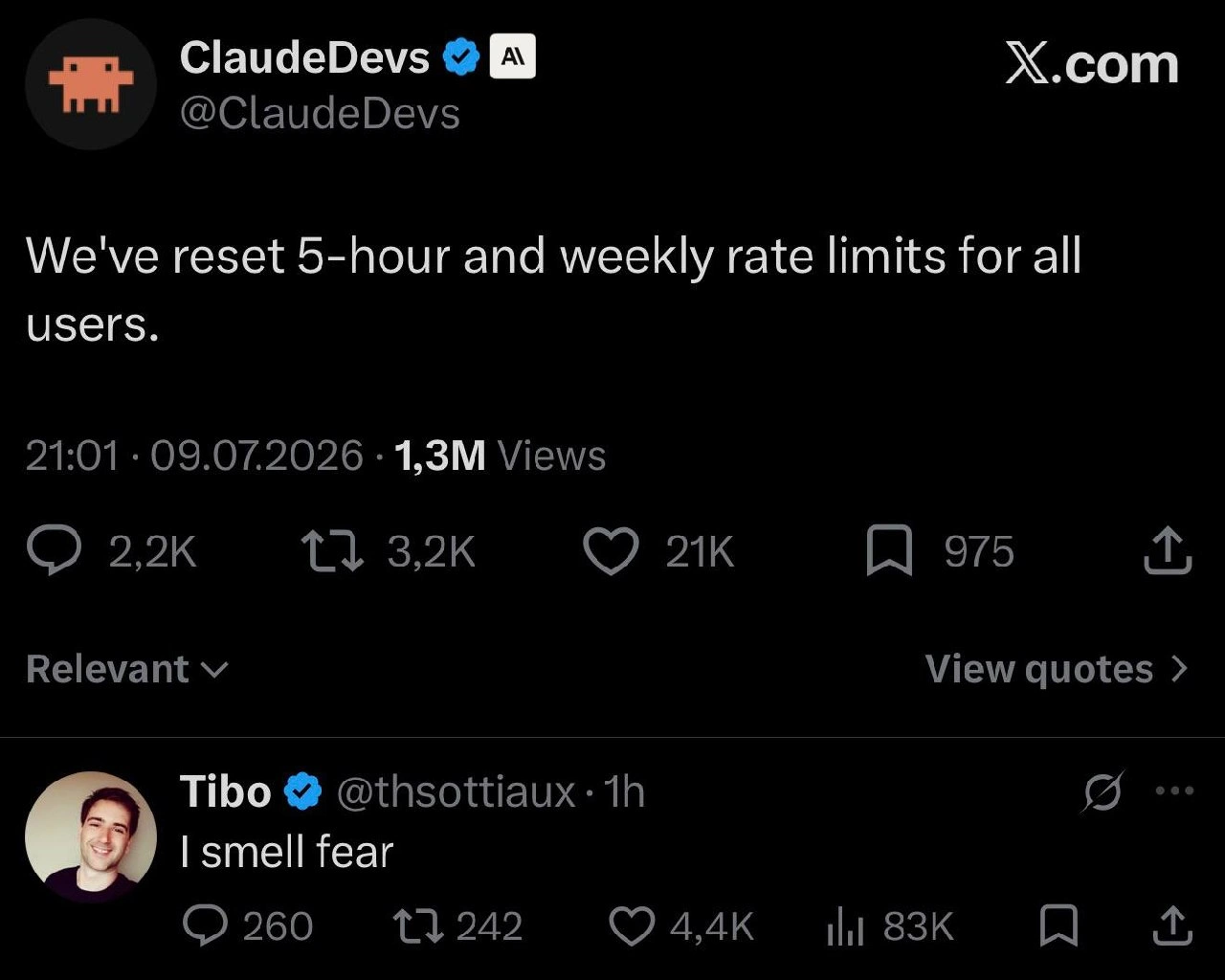
Claude Resets Limits; Developers Smell Competitive Fear
Why is this AI ML meme funny?
Level 1: Free Samples Next Door
Imagine two ice-cream shops beside each other. On the exact day one shop unveils a new flavor, the other suddenly wipes everyone’s punch-card limits and says they may have more scoops. Maybe the freezer really was fixed, or maybe the owner saw customers looking next door. “I smell fear” is funny because it treats the free refill not as kindness, but as the smell of a shopkeeper panicking behind the counter.
Level 2: What Got Reset
Claude is an AI assistant powered by a large language model, or LLM. Each answer requires servers to process the conversation and generate new tokens. Because those servers are expensive and many people share them, a provider can attach usage limits to an account.
- A five-hour limit controls how much someone can use within a moving short-term period.
- A weekly limit caps heavier use across several days.
- A reset clears accumulated usage so the person can start consuming the allowance again.
- Bandwidth throttling is the broader idea of slowing or stopping a user after a resource budget is exhausted.
For a developer using an assistant to inspect a repository, edit code, or run a long sequence of tool calls, these limits are not abstract. Hitting one can stop an active debugging session midstream. The announcement therefore promises immediate productivity relief. Tibo’s reply changes its meaning: instead of “the service recovered,” readers hear “the company would prefer you not test the competitor today.”
The blue verification marks, the Claude account’s visible AI label, and the precise engagement numbers make the exchange resemble an official corporate statement followed by an unofficial market verdict. That mismatch is the format’s engine: a carefully neutral operational sentence meets a reaction that says the quiet strategic part out loud.
Level 3: Quotas Meet Game Theory
The joke lives in the suspiciously perfect timing between two tiny pieces of text. ClaudeDevs announces:
We've reset 5-hour and weekly rate limits for all users.
Then Tibo supplies the entire competitive analysis in three words:
I smell fear
The screenshot is dated July 9, 2026, the day OpenAI broadly released GPT-5.6. That makes a mundane resource-allocation notice look like an emergency retention lever: give Claude users a freshly replenished allowance just as a rival gives them a shiny reason to leave. The image does not prove that Anthropic acted out of fear; the reply is funny precisely because it compresses correlation, suspicion, and platform-war theater into a mock diagnosis.
A rate limit normally protects a costly shared service from demand spikes. LLM requests consume scarce inference capacity—accelerator time, memory bandwidth, and power—and long agentic coding sessions can burn through far more compute than a short chat. Subscription products therefore meter access over several windows. A five-hour window restrains bursts; a weekly window restrains sustained heavy use. Resetting both counters is more consequential than clearing a single temporary lockout, but it is still not the same as permanently increasing capacity or changing the future quota.
That distinction creates the veteran-grade irony. Users experience the quota as a hard wall in the middle of real work, while the provider experiences it as a capacity-planning and unit-economics control. If a counter can suddenly return to zero during a competitive launch, developers naturally wonder whether “physical constraint” sometimes means “policy setting with executive approval.” The unflattering implied control loop is:
rival ships model
↓
switching risk rises
↓
customer quotas mysteriously become negotiable
There are less theatrical explanations—incident compensation, corrected accounting, spare capacity, or a scheduled promotion—and the screenshot establishes none of them. Yet developer experience is shaped by perceived fairness as much as backend reality. A reset after users endured limits can feel generous; a reset timed to a rival launch can also reveal that goodwill is being provisioned like burst capacity. The large visible engagement counts reinforce that shared reading: one terse reply becomes the community’s release-day postmortem, with considerably fewer slides than the official one.
Description
A dark-mode X.com screenshot shows the verified AI-labeled account ClaudeDevs (@ClaudeDevs) announcing, "We've reset 5-hour and weekly rate limits for all users." The post is timestamped "21:01 · 09.07.2026" and shows 1.3M views, 2.2K replies, 3.2K reposts, 21K likes, and 975 bookmarks above the "Relevant" and "View quotes" controls. A reply from verified user Tibo (@tbsottiaux, "1h") says only, "I smell fear," with 260 replies, 242 reposts, 4.4K likes, and 83K views. The terse reaction interprets the sudden restoration of Claude usage quotas as a competitive response to a rival model launch rather than routine capacity management, turning a developer-experience improvement into industry-game-theory humor.
Comments
1Comment deleted
Apparently the most reliable autoscaling signal is `competitor_model_released == true`.