Skip to content
DevMeme
7449 of 7506
Even Garbage Releases Enter the Test Pipeline

Even Garbage Releases Enter the Test Pipeline

Why is this Testing meme funny?

Level 1: The Dirty Package

Imagine a factory worker sending a dirty, broken toy to the inspection table even though everyone can already see the wheel is missing. The inspector can write down what is wrong, but cannot make it a good toy just by inspecting it. The beetles are funny because they literally roll balls of waste, just as teams sometimes keep pushing obviously bad work through an official process—and then the complainer turns out to have a ball of his own.

Level 2: Welcome to Testing

Quality assurance, or QA, is the broad practice of making sure a product meets its needs and finding ways to prevent defects. Testing is one part of QA: running or examining software to learn whether it behaves as expected. A test can expose a bug, but the test itself usually does not repair the code.

A typical delivery vocabulary looks like this:

Term Meaning
Build A packaged result produced from source code
Artifact A stored output such as a binary, container image, or package
Release candidate A build considered potentially ready for release
Release A version approved or made available to users
Deployment Installing or activating software in an environment
Pipeline Automated steps that build, check, and promote a change

Continuous integration, or CI, means developers merge changes frequently and automated checks validate the combined code. Continuous delivery keeps software in a releasable state through repeatable automation. These practices shorten the distance between creating a defect and seeing it. A developer who learns about a failure five minutes after a commit has fresh context; one who receives a vague rejection two weeks later has already emotionally moved to another repository.

Different tests answer different questions:

  • Unit tests check small pieces of logic quickly.
  • Integration tests check whether components cooperate.
  • End-to-end tests exercise complete workflows.
  • Exploratory tests let a person investigate unexpected behavior.
  • Regression tests make sure previously working behavior remains fixed.
  • Production monitoring detects failures that pre-release environments did not reproduce.

The beetle's large ball represents a poor candidate consuming finite test capacity. Every hour spent confirming an already obvious basic failure is an hour unavailable for subtle risks. This is why pipelines use fail-fast ordering: inexpensive, reliable checks run before slow or scarce ones. There is little value in launching a two-hour browser suite when the program does not compile.

Yet the final panel reminds beginners not to equate “my code looks good” with “my code needs no testing.” Authors share the same assumptions that created their implementation, making some mistakes hard for them to see. Independent checks, automation, and another person's perspective protect the team without declaring the author bad. In software, everybody rolls something; professionalism means examining it before customers step in it.

Level 3: Quality Is Not Compost

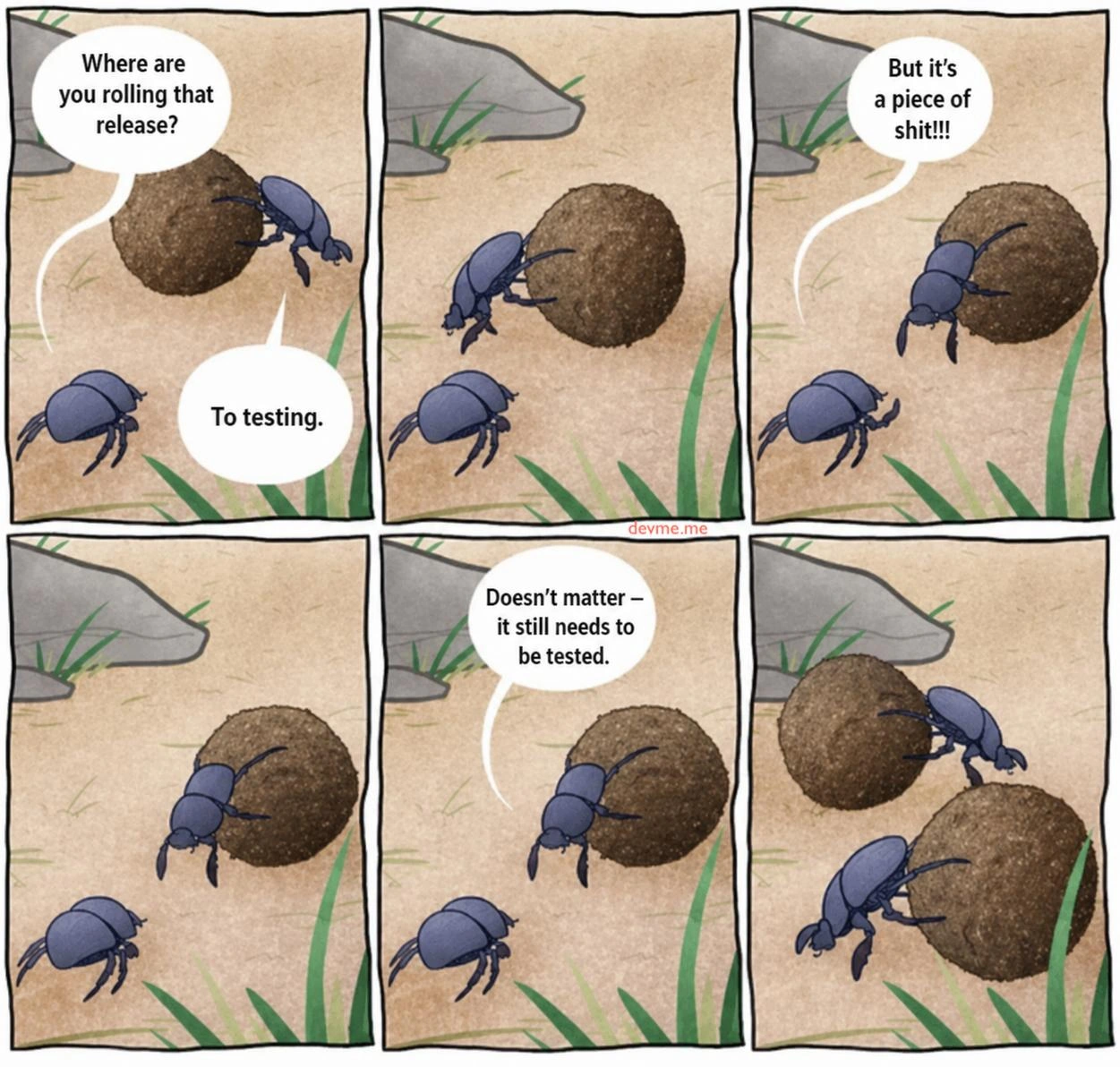
The first dung beetle asks a question that works as both release-management jargon and a literal description of the picture:

Where are you rolling that release?

The answer is To testing. After inspecting the enormous brown artifact, the first beetle objects, But it’s a piece of shit!!! The carrier's response—Doesn’t matter – it still needs to be tested.—captures a recurring software-delivery failure: everyone knows the build is poor, yet organizational procedure still pushes it into the next team's queue. The pipeline accepts an artifact; dignity is not part of its schema.

The central satire is that testing detects quality but does not manufacture it. A QA engineer can reveal incorrect behavior, missing requirements, regressions, unsafe edge cases, and confusing workflows. Testing cannot retroactively supply a coherent design, readable implementation, or product decision. When a team knowingly hands bad work downstream and expects “testing” to make it production-ready, QA becomes a ceremonial purification stage. The dung ball will leave with a report attached; it will not leave as chocolate.

This is the old throw-it-over-the-wall model. Developers complete implementation according to their local definition of done, hand a large batch to a separate test group, and move on. Testers discover basic defects, return the build, and wait for another one. Each round incurs queue time, environment setup, reproduction, triage, repair, redeployment, and regression testing. Large releases magnify the problem because many changes interact and ownership becomes ambiguous. Everybody remains busy while delivery slows—a remarkably successful optimization of motion over progress.

Modern continuous testing tries to move cheap feedback earlier. A healthy path fails bad changes near their source:

edit → static checks → unit tests → review → build → integration tests
     → staging checks → controlled release → production monitoring

Syntax errors, formatting violations, obvious type failures, and fast unit regressions should not consume a shared QA environment. Code review should challenge an incoherent approach before a tester writes twenty cases describing its incoherence. Expensive exploratory, compatibility, performance, and end-to-end work can then focus on risks that cheaper gates cannot answer. The objective is not to eliminate testers; it is to stop using skilled humans as an unusually patient compiler.

The phrase it still needs to be tested also has a defensible reading. “This looks terrible” is not a complete risk assessment. A bad release candidate may still require testing to:

  • identify exactly which requirements fail;
  • distinguish cosmetic ugliness from data loss or security risk;
  • create reproducible evidence for a reject decision;
  • verify whether unaffected behavior still works;
  • support compliance, audit, or contractual obligations;
  • establish regression tests before a repair.

Rejecting solely on aesthetic disgust can be as undisciplined as approving blindly. Testing turns “piece of shit” from a review comment into observable facts. The organizational absurdity begins when the known fundamental defect could have been corrected earlier, yet the whole downstream pipeline is invoked because nobody has authority to stop the ball.

That makes quality gates political as well as technical. A gate is useful only if it has explicit criteria, reliable signals, and the power to prevent promotion. If deadlines routinely override failures, the gate becomes theater. If every warning blocks delivery regardless of relevance, teams learn to distrust or bypass it. Good release management distinguishes hard blockers, accepted risks, flaky signals, and follow-up work—and records who accepted what. “QA signed off” should not mean “QA was the last group standing near the deploy button.”

The comic's noun choice is revealing too. Before testing, the object is more accurately a build or release candidate: an artifact proposed for release. A release is often the decision or act of making a version available to users. Calling the dung ball a release before validation implies that the outcome is already politically decided and testing is merely a scheduled stop on the way to production. Testers can document the smell, but the train timetable says departure is Friday.

There is a second pun in “rolling.” A rolling release is a distribution model in which software receives continuous updates rather than occasional large version upgrades. The beetle is physically rolling one release toward testing, turning delivery terminology into natural history. Unlike a good rolling-release process, however, this artifact is enormous—suggesting a large batch whose contents have had plenty of time to become difficult to separate.

The final panel complicates the blame. The beetle who condemned the first ball is now rolling another dung ball alongside it. That can mean hypocrisy: the critic produces the same quality once work pressure reaches them. It can also mean humility: everyone's code contains assumptions and defects, so every candidate requires independent checks. Testing is not a punishment reserved for developers judged incompetent; it is a control applied because smart people are reliably capable of missing things in their own work.

That dual reading is why the accompanying remark says the meme gets funnier years later. Tooling has improved—automated pipelines can run thousands of checks and provision clean environments—but the human incentive to move questionable work downstream has survived every dashboard redesign. Faster conveyors do not improve what teams place on them. Sometimes they merely deliver the dung to QA with excellent deployment metadata.

The sustainable alternative is shared ownership of quality. Product people clarify acceptance criteria. Developers test behavior and review design. QA specialists bring risk analysis, exploratory skill, user perspective, and system-level skepticism. Operations contributes deployability, observability, and recovery. Security tests threats throughout the lifecycle. When those roles collaborate early, testing becomes a stream of feedback rather than a destination written on the side of a ball.

Description

A six-panel illustrated comic on a sandy beige background follows two dark blue dung beetles beside rocks and grass, one of them pushing a large brown ball of dung. The first beetle asks, "Where are you rolling that release?" and the other answers, "To testing." After staring at the ball, the first protests, "But it's a piece of shit!!!"; the carrier replies, "Doesn't matter – it still needs to be tested," and the final panel shows both beetles rolling their own dung balls onward. The literal waste stands in for knowingly poor software artifacts that still consume QA capacity and must traverse the release pipeline, while a small `devme.me` watermark appears between the panel rows.

Comments

1
Anonymous ★ Top Pick The pipeline accepts any artifact; dignity is not a required field.
  1. Anonymous ★ Top Pick

    The pipeline accepts any artifact; dignity is not a required field.

Use J and K for navigation