OpenAI Takes Competitive Programming's Top Spot
Why is this AI ML meme funny?
Level 1: All Five Locks
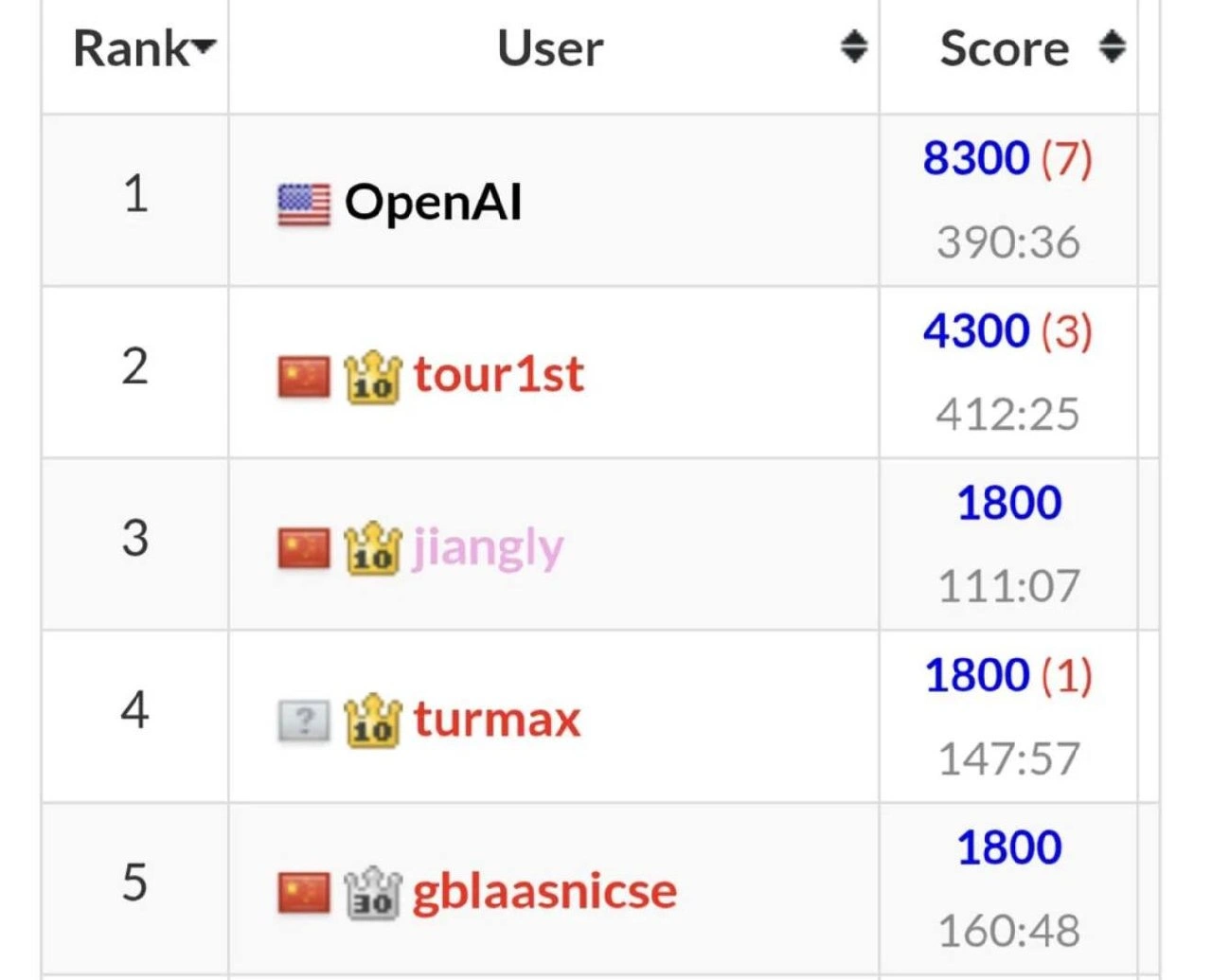
Imagine the best puzzle solvers in the world racing to open five locked boxes. The strongest person opens three, most others open two, and a computer-controlled robot opens all five after fumbling seven keys along the way. The humans are still brilliant, but the scoreboard is funny and unsettling because the machine did not merely join their hardest game—it finished the part everyone else could not.
Level 2: Accepted Beats Confident
Competitive programming asks contestants to solve several small but difficult problems under a time limit. A solution reads input, computes an answer, and prints output in exactly the required form. The judge runs the submitted program against secret test cases. One missed edge case can turn an elegant explanation into Wrong Answer.
An algorithm is a repeatable method for solving a problem. Contestants care not only that it works, but that it scales. If an input contains 200,000 items, checking every pair takes roughly $O(n^2)$ operations and may be far too slow; an $O(n \log n)$ approach might finish comfortably. Choosing the right data structure or mathematical observation is often harder than typing the code.
The visible columns summarize that process:
- Rank orders competitors by total score, then penalty when scores tie.
- User shows the contestant account; flags and crown icons identify profile information and competitive distinctions.
- Score adds the point values of accepted tasks.
- A red number in parentheses records counted wrong attempts.
- The gray time is a penalty measure, not the duration of a single program run.
The human in second place was not bad at all; reaching 4300 in a world final represents extraordinary skill. The comedy comes from scale and expectation. People expected the famous human experts to be the final boss for an AI coding system. The table instead depicts OpenAI as the final boss, complete with seven failed attempts that merely made its eventual sweep look more like real debugging.
This does not mean a chatbot can replace every developer. Contest tasks are carefully specified and automatically graded. Workplace tasks often begin with “make it better,” depend on undocumented business rules, and end with somebody discovering that “better” meant a different thing. The contest measures an important, difficult slice of programming—not the whole profession.
Level 3: The Scoreboard Compiles
The crop is funny because it presents an existential argument in the driest possible format: three sortable columns and no dramatic caption. The first row says OpenAI — 8300, while the best visible human, tour1st, has 4300. The post supplies the eulogy—“Last defense of human intellectual capital … has been fully defeated”—but the leaderboard lets arithmetic perform the punchline.
This was the July 9, 2026 AtCoder World Tour Finals Algorithm human-versus-AI exhibition. Its five tasks were worth 900, 900, 1500, 2500, and 2500 points. Those values matter because:
900 + 900 + 1500 + 2500 + 2500 = 8300
The OpenAI entry therefore reached the maximum task score: all five problems accepted. The 4300 below it corresponds to three solved tasks, including one of the difficult 2500-point problems; the three visible 1800 scores correspond to the two 900-point tasks. This is not a tiny tie-break win disguised by a ranking column. The machine crossed two acceptance boundaries that no visible human crossed.
The smaller figures add useful texture. AtCoder ranked contestants by points first and penalty second. The red parenthesized counts represent incorrect attempts that contributed penalties after a task was eventually solved; the gray time includes elapsed contest time plus five minutes per counted incorrect attempt. OpenAI’s 8300 (7) and 390:36 thus show iteration rather than a flawless oracle. It submitted wrong answers, recovered, and still completed the set within the seven-hour contest. In agent terms, failure was apparently just another tool call.
That recovery loop is why the result lands harder than ordinary code generation. A competitive-programming agent must repeatedly do several kinds of work:
- Convert a dense statement into a precise computational problem.
- Infer the intended algorithm and argue that it covers edge cases.
- Estimate time and memory complexity against the constraints.
- Implement the idea in a permitted language.
- Generate tests, diagnose rejected submissions, and revise before time expires.
An LLM alone produces text; an agent harness can give a model scratch space, a compiler, test execution, persistent state, and repeated attempts. More inference-time computation can also explore competing approaches before choosing what to submit. The public crop does not reveal the exact model, compute budget, or orchestration, so it cannot settle how directly this compares with one human at one keyboard. It does show that the complete system satisfied the contest’s external judge on previously unseen tasks—and hidden test cases are famously unmoved by confident prose.
Competitive programming is a particularly clean proving ground for algorithmic thinking. Problems have explicit inputs, outputs, constraints, and machine-checkable answers. That removes much of the ambiguity that makes ordinary software engineering difficult and lets search, reasoning, implementation, and verification form a fast feedback loop. It also means the post’s “human intellectual capital” claim is deliberately oversized. Winning this contest is strong evidence of exceptional performance under these rules; it is not proof that AI has mastered product judgment, requirement negotiation, maintainability, security ownership, or deciding whether the requested feature should exist at all.
The visual symbolism nevertheless earns the melodrama. Elite human handles carry colored names and crown badges earned through a competitive culture built around speed, mathematical insight, and years of practice. Above them sits the plain institutional label OpenAI, as if an entire laboratory registered for the office tournament. tour1st being ranked second supplies an accidental variable-naming joke: even the username’s expected postcondition failed.
There is also historical sting in the “last defense” phrasing. Programming contests once looked safer from automation than routine coding because their hardest tasks demand novel abstraction rather than autocomplete. Earlier systems climbed curated benchmarks; a live final makes memorization a weaker explanation, although exposure to related algorithms and enormous amounts of human-written code still matters. The scoreboard turns a gradual AI-industry trend into a discrete event: accepted == true, five times.
Description
A cropped AtCoder leaderboard on a white grid has sortable columns labeled "Rank," "User," and "Score." Rank 1 is the U.S.-flagged "OpenAI" at blue "8300" with red "(7)" and gray "390:36"; rank 2 is China-flagged, gold-crowned "tour1st" at "4300 (3)" and "412:25." Ranks 3 through 5 are "jiangly" with "1800" and "111:07," "turmax" with "1800 (1)" and "147:57," and "gblaasnicse" with "1800" and "160:48," accompanied by country icons and gold or silver crown badges. The screenshot captures the July 2026 AtCoder World Tour Finals Algorithm human-versus-AI exhibition, where OpenAI's agent took the full 8,300 points, turning the accompanying claim that competitive programming was humanity's last intellectual defense into bleak AI-era humor.
Comments
1Comment deleted
The Humanity Prevails Award has failed its only test case.