
The Silent Scream of the Call Stack
Description
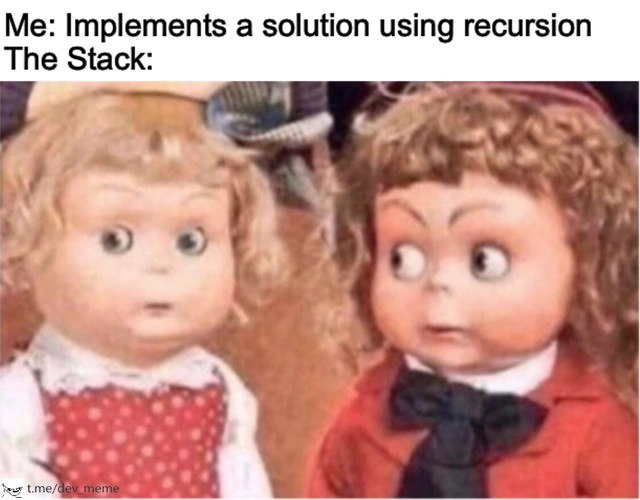
A reaction meme about the dangers of recursion. The top text reads, 'Me: Implements a solution using recursion', followed by 'The Stack:'. The image below features two creepy-looking vintage dolls with wide eyes. One doll stares forward with a neutral, slightly surprised expression, while the doll on the right gives an intense, angry, and stressed side-eye, its eyebrows furrowed. The technical joke is that every recursive function call adds a new frame to the system's call stack. If the recursion is too deep or lacks a proper base case, it will exhaust the stack's memory, causing a 'stack overflow' error. The angry doll humorously personifies the call stack being pushed to its absolute limit, silently screaming under the pressure of too many function calls. It's a classic computer science joke that resonates with developers who have experienced the sudden and catastrophic failure of an elegant but flawed recursive algorithm


Comments
7Comment deleted
Recursion is the epitome of 'trust the process' until you run out of memory. The stack, however, does not trust the process
Ship a recursion without a base case and the stack frames duplicate like these dolls - blankly wondering why the JVM still treats tail-call optimisation as an elective course
After 20 years in this industry, I've learned that recursion is just a fancy way of making the same mistake over and over again until either you find the answer or production crashes at 3 AM
When you confidently implement that elegant recursive solution without a depth limit, the call stack gives you the same look your senior architect gives when reviewing your 'clever' code - equal parts horror and resignation, knowing it's about to experience a very bad time in production
I wrote a recursive DFS; the stack replied, “Neat - does your JVM do tail-call optimization or should I ping PagerDuty now?”
Nothing humbles a clean recursive solution like user input and a missing tail-call optimization
Unbounded recursion: where the call stack's existential dread rivals your last monolith-to-microservices migration