The Hollywood Hacker Starter Pack
Why is this Security meme funny?
Level 1: All Talk, No Hack
Imagine a kid bragging to all his friends that he can open the toughest locked door in the school. He’s watched plenty of spy movies, so he dramatically says, “Stand back, I’m gonna break in!” and starts jiggling the handle and kicking the door with great flair. His little buddy is cheering him on, thinking he’s some kind of super spy. There’s lots of noise and commotion like he’s doing something really amazing. But after all that show, what does the “master lockpicker” do? He quietly pulls out his phone and searches, “how to pick a lock,” then stares at the screen and says, “Wow, this is harder than I thought.” 😅 The big joke here is that he talked a big game but didn’t actually know how to open the door at all. All that confident noise was just for show, and in the end he had to ask for basic help.
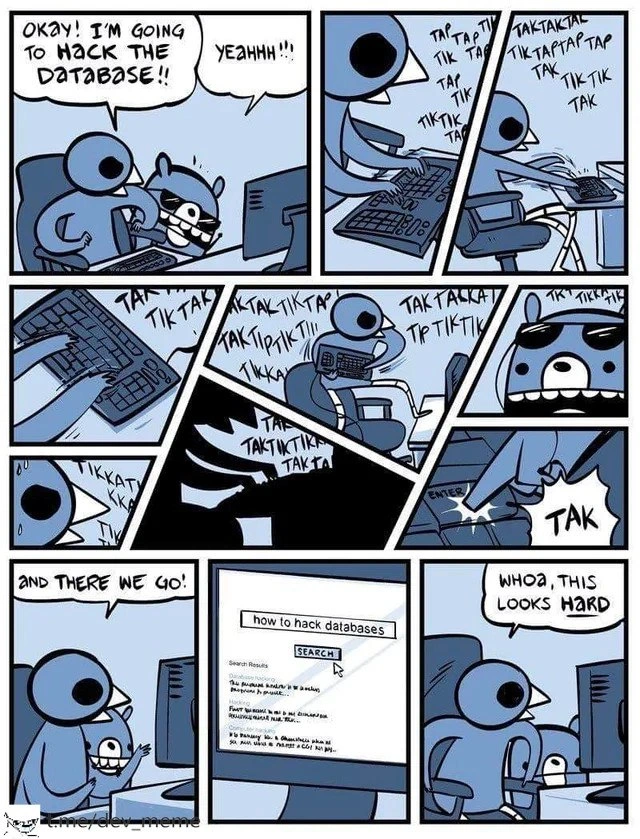
This meme is the computer version of that story. The blue character shouted he’d hack the database (like breaking into a high-tech safe full of secrets) and made a huge, frantic effort at the keyboard as if that would magically do it. But really, he was just typing nonsense and ended up simply asking Google how to do it. It’s funny in a very simple way: someone pretended to be an expert, but immediately proved they weren’t. We laugh because we’ve either done that ourselves on a smaller scale or seen others do it – like claiming you can solve a hard puzzle, then secretly looking up the solution. It’s a gentle reminder that doing something difficult usually requires real know-how, not just enthusiasm. In other words, don’t be all talk and no action (or in this case, no clue!). The big blue guy learned in that moment that hacking a database is not easy at all, just like the kid with the locked door learned that picking locks isn’t as simple as it looks in movies. The meme makes its point in a playful, silly way: boasting about a skill you don’t have will probably end in embarrassment and a Google search for “uh, how do I actually do this?”
Level 2: Googling for a Hack
Let’s break down the key concepts and jokes in this meme in simpler terms. The scene features two cartoon characters (drawn in blue) at a computer. The big one enthusiastically declares, “I’m going to hack the database!” and starts typing like crazy. The smaller sidekick cheers, “Yeahh!!”. Right off the bat, we have the idea of “hacking a database.” In real life, a database is a structured collection of data (like a big digital filing cabinet where websites or applications store information such as usernames, passwords, or messages). When someone says they want to “hack” a database, it means they’re trying to gain unauthorized access to that data – basically, break in and retrieve or mess with information they’re not supposed to. That’s a serious security issue known as a security flaw or breach if it succeeds. But notice what our cartoon hacker does: instead of performing some elite cyber-espionage trick, he just types nonsense frantically. The comic shows sound effects like “TAP TAP TAP” and “TAK TAK TIK” to indicate excessive keyboard typing. This is poking fun at how movies and TV often depict hackers – furiously hammering keys as if that alone magically cracks systems. It’s a huge expectation vs reality gag. The expectation (from Hollywood or from the overconfident character) is that if you type fast enough with enough intensity, something will happen. The reality is, computers don’t grant access because you typed with gusto – you have to enter the correct commands or find a real weakness in the system.
So what would actually be involved in “hacking a database”? Typically, an attacker would look for a vulnerability (a weakness or bug) in the system. For instance, one common database attack is called SQL injection. SQL (Structured Query Language) is the language used to query databases (like asking the database questions or giving it commands). In an SQL injection attack, a bad actor finds a way to sneak malicious SQL commands into an application’s inputs (say, a login form or a search box) so that the database runs those commands. It’s like tricking the database into revealing data or giving access by inserting a cleverly crafted phrase where normally only safe text is expected. Here’s a tiny example of what that looks like in code:
-- Imagine a login query that checks username and password
SELECT *
FROM users
WHERE username = 'Alice' AND password = 'mypassword';
Normally, only a user with the correct username/password gets in. But if the login form isn’t secured, an attacker might enter a special password like '||'1'='1 (that’s single-quote, OR 1 equals 1). The application might then build a query:
SELECT *
FROM users
WHERE username = 'Alice' AND password = '' OR '1'='1';
That OR '1'='1' part is always true, so the database might return all users, or at least bypass the password check. This is a crude example of SQL injection, one way real databases get “hacked”. The key point: actual hacking involves knowing tricks like this, not just pounding keys randomly. Our cartoon friend clearly doesn’t know any such techniques – he had to search online for guidance.
The final panels show exactly that: after the dramatic typing and a triumphant “And there we go!”, the monitor simply displays a browser with a search query for “how to hack databases” and a big SEARCH button. This is the meme’s punchline. It’s as if during all that frantic typing, what he actually did was open Google and type in this beginner question. In other words, he Googled it. This is funny for a couple of reasons. First, it reveals he didn’t know what he was doing at all – he’s basically asking the internet for help on the very thing he boasted he could do. Second, it’s a common trope in developer life that when we face something we don’t understand, the first step is often to search for it online (Stack Overflow, documentation, tutorials, you name it). So there’s a kernel of truth – developers often do quickly search for solutions – but usually we don’t announce we’re experts before doing so! The phrase “search_engine_hacking_fail” from the tags sums it up: he attempted hacking by using a search engine and it’s portrayed as a comical failure.
Let’s also talk about the characters’ reactions. Initially both characters are hyped – they think they’re about to do some uber-cool hacking. By the end, when the screen shows the Google results, the once-proud “hacker” has a dumbfounded look and admits, “Whoa, this looks hard.” This admission is pure comedy and relatability. It’s funny because he was so confident moments ago, and now even the search results (probably full of technical articles or warnings that hacking is illegal) overwhelm him. It’s relatable because many of us, even outside of technology, have experienced that moment when you dive into something new, quickly realize you’re out of your depth, and think, “Oh no, this is much harder than I thought.”
The meme falls under DeveloperHumor, and more narrowly under DatabaseHumor and Security humor, because it’s referencing a situation specific to computing folks: a database is a technical thing, and hacking is a technical skill. It also gently mocks HackerCulture – the subculture of hackers who sometimes are portrayed as these all-knowing wizards. Here, the “hacker” is the opposite of cool: he’s basically a newbie. The blue cartoon style and comic strip format make it lighthearted. Each panel builds up the story: bold claim, intense action, and then the reveal. The “blue cartoon characters” aren’t any specific characters you need to know; they’re just stylized figures used by the artist (perhaps to keep it funny and not too realistic). Using cartoons helps emphasize that this is a joke and not, say, a real security tutorial.
In simpler terms, the meme is showing an overly confident person trying to do something very difficult (breaking into a database) in a flashy way, but all he really does is ask Google for help, proving he had no idea how to do it. We find it funny because it’s a classic case of someone talking big but then immediately revealing their ignorance. For a junior developer or someone new to security, the takeaway is: hacking isn’t magic. It’s a skill (often an illegal one, if not done ethically) that requires knowledge of systems, vulnerabilities, and techniques. You can’t just muscle your way into a database by typing faster or harder. And if you ever catch yourself about to do something complex and thinking “I’ll just figure it out on the fly,” remember this meme – you might end up like this guy, sheepishly reading an intro guide while everyone’s expecting you to perform miracles!
Level 3: Clacking vs Cracking
The humor of this meme hits home for any seasoned developer or security engineer because it lampoons the classic Hollywood hacking montage. You know the scene: someone declares “I’m in!” after a blur of keystrokes and unintelligible code flying by. Here, our blue cartoon hacker does exactly that – excessive keyboard typing (“TAP TAP TAK… TIK TIK TAK”) with dramatic flair (even hitting the Enter key with a foot for that extra cinematic effect) – only to reveal the anticlimactic truth: he just opened a web browser and Googled “how to hack databases”. It’s a brilliant expectation-versus-reality gag. The setup screams “elite hacker at work” with the frenzied coding vibes, but the punchline is that he’s utterly clueless and resorting to the most beginner move imaginable. This contrast is pure DeveloperHumor: it pokes fun at the disparity between what outsiders (or movie directors) think hacking is and what actually happens when someone unprepared tries to do it.
We’re essentially witnessing a script kiddie moment. In hacker culture, a “script kiddie” is a derogatory term for an inexperienced person who wants to break into systems but lacks the skills – they just run pre-written scripts or search online for step-by-step instructions. The big blue character here embodies that: lots of swagger (“OKAY! I’M GOING TO HACK THE DATABASE!!”) but no clue under the hood. The HackerCulture reference is spot-on – many of us have seen forum posts or tweets where an excited newbie asks “How do I hack XYZ?” much to the facepalms of actual security pros. It’s the tech equivalent of shouting “I’m a race car driver!” because you found the ignition key, and then asking Google how to shift gears. The meme exaggerates it to great comic effect: after all the theatrics, the only “hacking tool” used was a search engine query.
Another layer of humor here is how relatable the scenario is to everyday developers (minus the illicit intent, hopefully!). We’ve all had moments of bravado followed by a humble Google search. Maybe you’ve boasted “Sure, I can implement that new framework by tonight!” then found yourself frantically searching “how to deploy [framework] app” at 2 AM. Or the classic scenario of furiously typing on your keyboard when a non-technical manager walks by, to look busy, when in fact you’re waiting for a Stack Overflow page to load. This comic taps into that shared experience by taking it to an absurd extreme. SecurityFlaws and DatabaseSecurity are serious topics, but the joke here is that the flaw is in the attacker’s understanding, not the database. It’s an “insider” laugh: developers know that real database breaches usually involve careful planning, known exploits, maybe some SQL injection or phishing – not a spontaneous keyboard assault. So when the character proudly says, “AND THERE WE GO!”, only to have achieved nothing but pulling up Google, it satirizes those security expectation vs reality scenarios we joke about at the office.
To seasoned eyes, a line like “how to hack databases” in a search bar is both funny and cringe-worthy. Funny, because it’s such a stark admission of incompetence; cringe-worthy, because it reminds us of actual questions you might see from overconfident novices. Any senior developer or ethical hacker reading that query knows that real bad actors don’t search the web for generic advice in the moment – they either already have a toolkit of exploits or quietly do extensive research (often on the Dark Web or specialized forums, not on Google’s front page!). The meme exaggerates it to make a point: database humor often revolves around how non-trivial it is to mess with a production database. In reality, if someone without knowledge tries to “hack” a production database, they’re more likely to bring it down by accident (like wiping data or crashing the server) than to elegantly extract secret information. The blue hacker’s final defeated stare and the quote, “WHOA, THIS LOOKS HARD.”, is something every experienced dev has felt at some point – that sobering realization that a task is way more complex than your initial gung-ho assumption.
The comic also slyly mocks the movie cliché where hacking scenes have dramatic progress bars, 3D graphics, or technobabble. In one tiny detail, the multiple angled panels and onomatopoeic “TAK TAK TIK” sound effects mimic how films try to make typing look visually intense. But all that excitement leads to a very mundane browser window. It’s a wink to those of us who know that actual hacking (or programming in general) often looks boring from the outside – a terminal screen, some code, maybe a SQL console – nothing like the flashy portrayal. We’re basically laughing at the contrast between clacking (the noisy, showy typing) and cracking (the real act of breaching security). The meme’s Security theme underscores that effective hacking isn’t about noisy theatrics; it’s about quiet understanding of vulnerabilities. By ending on a Google search, the comic reminds everyone that behind grandiose claims often lies a person frantically searching for guidance. It’s a gentle roast of anyone who has talked a big game without doing their homework. In a way, it’s also educational humor: it highlights that database security isn’t trivial – you can’t just wing it by hitting keys – you need to know what you’re doing (or at least how to find the right information, not a last-second “how do I hack” query!).
To put it in perspective, let’s contrast the Hollywood fantasy and the real-life hacking process side by side:
| Hollywood Hacking | Real-World Hacking |
|---|---|
| Instant, frantic typing yields instant access. | Slow, methodical exploration or likely outright failure without a known exploit. |
| Hacker magically knows exactly what to type. | Attacker researches, uses tools, or peruses documentation/blogs for hints. |
| One dramatic press of “ENTER” cracks the system. | Might require numerous attempts, understanding of SQL commands, or discovering a genuine security flaw. |
| Always a cool visual (green code rain, anyone?). | Mostly text consoles, error messages, and boring waiting periods – nothing cinematic. |
This table paints the expectation vs reality that the meme exploits for comedy. The would-be hacker believed in the Hollywood version (“I’ll just muscle through with epic typing”), but encountered the real-world version (“I need to actually know a vulnerability or technique, and I don’t”). It resonates in developer circles because we love to poke fun at these tropes. It’s classic DeveloperHumor to see a dramatic buildup crash into a wall of real-life truth. In summary, the senior perspective on this meme is a mixture of amused eye-rolling at the naïveté on display and an appreciation for how accurately it skewers the difference between hacker movie myths and practical reality. We’ve seen enough overconfident juniors, absurd movie scenes, or security goofs to instantly get the joke. And maybe, just maybe, it reminds everyone that before you announce “I’m going to hack the database” (or implement any tricky tech feat), you might want to do your homework – otherwise you’ll end up on Google, staring at results, muttering “this looks hard” just like our blue friend.
Level 4: Complexity of Cracking
At the deepest technical layer, this meme highlights the gulf between sensationalized hacking and actual computer security fundamentals. In reality, a database system worth “hacking” will be guarded by layers of cryptography and authentication protocols grounded in serious math. Randomly mashing keys (as our overzealous blue character does) has essentially zero chance of penetrating a properly secured database. Why? Because modern security relies on computational complexity – problems so hard that even a supercomputer would take longer than the age of the universe to brute-force them. For example, cracking a strong database password by blind guesswork means exploring an astronomically large key space. Think about a password of just 8 characters: if it can include letters (upper and lower case), numbers, and symbols, that’s roughly $10^{14}$ possible combinations! No amount of feverish “TIK TIK TIK” typing is iterating through that effectively. In security terms, a brute-force attack grows exponentially harder with each added character, so enthusiastic keyboard clatter is not an algorithm – it’s noise.
Real database security features like salted password hashing and encryption make the direct approach to hacking futile. If the database requires credentials, those passwords might be stored as cryptographic hashes (e.g., using a one-way function like SHA-256 or bcrypt). These are deliberately designed so that reversing them (finding the original password) is infeasible without tremendous computational effort. The meme’s punchline “how to hack databases” is ironically pointing at the truth: an attacker who doesn’t already know an exploit would have to research tactics, because there’s no magical keystroke combo to bypass strong crypto. In academic terms, they’re confronting the reality of hard problems—analogous to NP-hard challenges or mathematically intractable tasks. It’s a far cry from the Hollywood fantasy of a “superhacker” intuitively breaking RSA encryption in seconds with furious typing. In fact, robust encryption (RSA, AES, etc.) security rests on problems like prime factorization or discrete logarithms that have no known efficient (polynomial-time) solution. For instance, guessing a 128-bit AES key by brute force means trying up to $2^{128}$ possibilities (around $3.4 \times 10^{38}$) – an utterly mind-boggling number. No hacker is literally searching that space by hand; they’d sooner look for a weakness in the system’s implementation or configuration.
And that’s the crux: skilled attackers don’t rely on “Hollywood hacking” at all – they hunt for vulnerabilities. They study system documentation, scour for unpatched CVE entries (publicly disclosed security flaws), or craft a targeted exploit that takes advantage of a specific bug. It might be a SQL injection flaw, a buffer overflow in the database server, or leaked default credentials – but it’s never going to be achieved by sheer frantic typing. The character’s dramatic ENTER key stomp is a tongue-in-cheek reference to how movies depict a single heroic keystroke as the climax of a hack. In the real world, if the database’s defenses are sound, that Enter would simply return an “Access Denied” error or no response at all. Any actual penetration requires methodical strategy or discovering a loophole in the system’s logic that algorithmically bypasses security – not just overwhelming it with random keystrokes. The humor here is rooted in the absurdity: a serious security breach cannot be accomplished through improvisation and adrenaline alone. In information security, knowledge truly is power – ironically, our wannabe hacker’s first step is consulting Google, revealing he’s starting from square one. The meme deftly contrasts the complexity of cracking real systems (where you might need deep understanding of protocols, algorithms, and vulnerabilities) with the naive belief that enthusiasm and fast fingers are enough. The “WHOA, THIS LOOKS HARD.” realization is essentially a nod to the iron law of cybersecurity: breaking in is much, much harder than it looks in the movies.
Description
A multi-panel comic strip in shades of blue, depicting an anthropomorphic bird and a squirrel-like character at a computer. The first panel shows the squirrel with sunglasses exclaiming, 'OKAY! I'M GOING TO HACK THE DATABASE!!' and 'YEAHHH!!!'. Several subsequent panels show them typing furiously, with onomatopoeia like 'TAP', 'TIK TAK', and 'TAKKA TAKKA' filling the frames, culminating in a dramatic press of the 'ENTER' key. The climax reveals their effort resulted in a web search for 'how to hack databases'. In the final panel, the bird character looks at the search results and says, 'WHOA, THIS LOOKS HARD'. This comic humorously contrasts the cinematic portrayal of hacking with the mundane reality of a beginner's first steps. The joke lies in the anticlimax, where the intense, dramatic buildup leads to the most basic form of information gathering, highlighting the vast gap between perceived expertise and actual knowledge. It's a relatable jab at 'script kiddie' enthusiasm and the common experience of being humbled by the complexity of a technical subject
Comments
7Comment deleted
The most effective penetration test is often just asking the intern how they'd do it. The answer is usually 'Google,' which, to be fair, is also step one for a senior
Nothing shreds a CISO’s sleep like the dev who mashes the keyboard for cinematic effect, then on the actual prod bastion googles “how to hack databases” - the bravado-to-competence ratio should be its own CVE
Twenty years in, and I still type furiously before googling anything just to maintain the illusion that I'm not just a highly paid search query optimizer with commit access
The most dangerous SQL injection attack vector isn't Bobby Tables - it's the confidence of someone who just Googled 'how to hack databases' and is now three Stack Overflow tabs deep into understanding why 'SELECT * FROM users WHERE 1=1' isn't actually the master key to the internet they thought it would be
Nothing deflates a hacker montage faster than prepared statements and least-privilege IAM - the final exploit becomes a Google tab
The plan to “hack the database” usually becomes a Google for SQL injection, the realization the ORM uses prepared statements, and the pivot to the real exploit: prod DB creds hardcoded in config.yml since 2016
The elite hack: Tutorial that PoCs without nuking the schema on first run