Skip to content
DevMeme
1123 of 7435
ML Theory vs. Brute-Force Reality
AI ML Post #1260, on Apr 4, 2020 in TG

ML Theory vs. Brute-Force Reality

Why is this AI ML meme funny?

Level 1: Big Machine Goes Whirrr

Imagine you have a friend who just loves big, noisy machines. One day, you’re both thirsty and want to mix some chocolate milk. You grab a simple spoon and start stirring your milk, which works easily. But your friend has a different idea: he brings out a huge electric blender – the kind that makes a loud whirrrrr sound – just to mix one glass of milk. You look at him and shout, “No! You can’t use that big machine for every little thing! It’s doing the same stirring I can do with a spoon, just in a super complicated way!” But your friend just giggles and, with a cheeky smile, flips the blender to max power. The blender’s motor goes “WHIRRRRRR” loudly, and he says, “hehe, blender go whirrr.” In that moment, he doesn’t care at all about your logical point that a spoon would do the job. He’s just happy and amused that his cool machine is making a lot of noise.

This is exactly what the meme is like, but with coding. The crying character is like you, saying “why use such a complicated thing for something simple?” and comparing the fancy solution to just a bunch of basic steps hidden inside. The calm character is like your friend, delighting in the big machine making noise and ignoring the fuss. It’s funny because one person is being very serious and upset about doing things the sensible way, and the other person is basically going “Whee! I’m having fun with my big toy!” without addressing the actual issue. We laugh because we recognize both attitudes: the frustrated voice of reason, and the playful excitement of using a powerful gadget just because it’s exciting. The humor comes from that contrast and the silliness of the response. Even a kid can get it: it’s like arguing with someone who responds by making silly car engine noises – it’s absurd, and that’s why it’s amusing.

Level 2: Fancy Ifs vs GPU Brrr

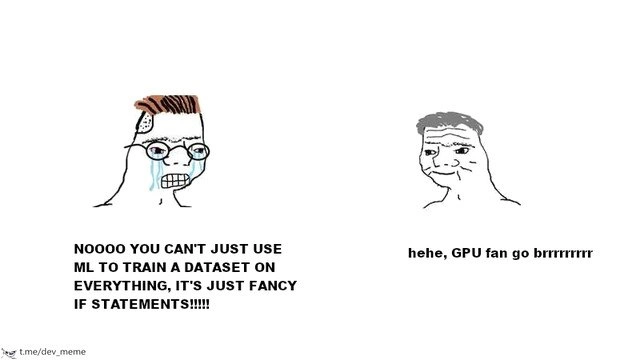
Let’s break down the meme in plain technical terms. On the left side of the image, we have a drawn character (a Wojak, often used in memes to represent a person) who is crying and yelling. His speech, written in bold text, says:

“NOOOO YOU CAN’T JUST USE ML TO TRAIN A DATASET ON EVERYTHING, IT’S JUST FANCY IF STATEMENTS!!!!!”

This is a dramatized way of saying: “It’s not okay to apply Machine Learning to every single problem. Machine Learning is basically just a complicated set of if-then rules, not some magical solution!” The character is upset because someone (the person he’s yelling at) is trying to use ML (Machine Learning) indiscriminately (“on everything”). He calls ML “just fancy if statements”, which is a snarky description. An if statement in programming is the simplest way to make a decision: for example, if a condition is true, do X, otherwise do Y. By saying “fancy if statements,” he implies that these ML models are nothing but a bunch of clever yes/no decisions chained together – in other words, nothing fundamentally new or intelligent is happening, just a more convoluted form of what regular code could do. The over-the-top crying face and the “NOOOO” at the start exaggerate his frustration, as if this isn’t the first time he’s had this argument. This reflects a common sentiment among some developers that MachineLearning is overused (the tag ml_everywhere fits here) and overhyped, and that people forget the basics of programming (like clear logic) in the rush to apply neural networks.

Now, the right side of the image shows another Wojak character, but this one looks calm, almost expressionless. Next to him, in smaller, non-bold text, he simply says:

“hehe, GPU fan go brrrrrrrrr”

In stark contrast to the left side, this character is unbothered and playful. The text “hehe” indicates a little chuckle, like he finds the whole situation amusing or isn’t taking the yelling seriously at all. The phrase “GPU fan go brrr” is meme-speak. Let’s unpack it:

  • GPU stands for Graphics Processing Unit, which is a type of computer processor originally designed to render graphics (like for video games) but now heavily used for ML computations because it can handle lots of calculations in parallel.
  • A fan is the cooling fan attached to the GPU (or any computer component) that spins faster and makes noise (“brrr”) when the GPU is working hard and heating up.
  • “go brrr” is an onomatopoeia (a word that imitates a sound) popular in memes, used to represent something operating at high speed or intensity, often with a sense of glib satisfaction. It originated from a meme (“money printer go brrr”) and has since been applied humorously to anything doing a lot of work noisily.

So when the calm character says “GPU fan go brrrr”, he’s essentially saying, “Haha, I’m making the GPU work really hard (training my ML model) and I love that sound of it whirring.” It’s a dismissive, carefree response to the serious complaint. He isn’t actually countering the argument about “fancy if statements” at all. Instead, he’s proudly (and a bit gleefully) focusing on the fact that he’s running an ML process so heavy that the hardware fan is spinning like crazy. This suggests that he’s either ignoring the complexity argument or he doesn’t care — he’s happy as long as the GPU is engaged and humming. The humor lies in this mismatch: one person gave a lengthy logical objection, and the other replied with basically “hehe, I’m having fun making my hardware loud.”

The meme uses the Wojak meme format, which is a common cartoon style on the internet for depicting stereotypes or emotions. The left side Wojak, sometimes called “Soyjak” or just the “screaming guy”, often represents an angry or emotional critic. The right side Wojak here resembles the “boomer” or “doomer” style face — calm, detached, often used to represent someone who is unfazed or just goes with the flow. By using these familiar meme characters, the image instantly tells a story: one side is freaking out, the other side is chill and maybe a bit smug. Developers online immediately recognize this format as a humorous portrayal of an argument or showdown.

In straightforward terms, this meme is highlighting a tension in programming and tech:

  • Machine Learning (ML): This is a field of AI where instead of coding explicit instructions, you feed data to a model so it can learn patterns. For example, rather than writing a bunch of rules to identify spam emails, you show a machine learning model thousands of example emails labeled “spam” or “not spam”, and it gradually figures out its own rules to predict spam. This approach is powerful for complex problems, but it can be overkill for simple ones.
  • “Train a dataset on everything”: The angry guy’s phrase isn’t perfectly worded (it’s a meme, after all), but he means “you can’t just train a model on data for every possible problem out there.” He’s complaining about the tendency to collect data and apply ML universally, even when it’s not necessary.
  • “Fancy if statements”: This phrase is the crux of his complaint. An “if statement” is the simplest decision-making code. By calling ML models fancy if statements, he suggests that all the complexity of neural networks or ML algorithms is just masking a bunch of simple condition checks. It’s a bit like saying, “Your super-sophisticated AI isn’t smart at all; it’s just doing a dressed-up version of what a long script of if this, then that would do.” It’s an insult to the complexity of ML, but it’s being used humorously here.
  • GPU fan: Many ML tasks (like deep learning) require a lot of computation. Engineers often use powerful GPUs to train models, because GPUs can perform many calculations at once. When a GPU is working hard, its cooling fan spins fast to prevent overheating. People working with ML are familiar with the sound of GPU fans whirring loudly during training runs.
  • “go brrr”: This is just a fun way to say something is running full throttle. If someone says “X goes brrr” (where X is, say, money printer, GPU fan, CPU, etc.), they mean “it’s working overtime and making noise, and I find that cool or funny.”

So, putting it together: The left side is effectively yelling, “Stop using machine learning for everything! It’s basically doing the same thing as writing a bunch of manual rules, just more complicated!” The right side responds with, “Hehe, I’m happily running my machine learning on a GPU at full blast; I don’t care about your complaint.” This captures a comedic scenario that many in tech have seen: one person thinks using AI for a given task is overkill or nonsense, and another person is just enthusiastic and ignores the criticism.

For a junior developer or someone new to this humor, the meme is saying: Some people in tech are annoyed that AI/ML is used even when unnecessary, while others are so hyped about AI that they’ll use it just because it’s cool (and they love seeing their powerful hardware in action). The tone is exaggerated for effect: the upset fellow with tears (clearly very passionate about coding sensibly) versus the deadpan guy who just likes hearing his PC’s fans roar. It’s a fun way to poke at the AI_hype culture.

In summary, the meme portrays a debate:

  • The skeptic’s side: “Machine Learning is not magic – at worst, it’s like an over-engineered bundle of rules. Stop applying it blindly to everything!”
  • The enthusiast’s side: “Powerful computer go BRRR! (I’m going to do it anyway because it’s cool and I enjoy it.)”

It’s a lighthearted jab at the ongoing conversation in tech about when to use machine learning vs. when a simple coded solution is best. And the visual of one guy screaming while the other just says “hehe” encapsulates that sometimes logic and hype just talk past each other. Even if you don’t catch every nuance, the image is clearly an argument – and the punchline is that the pro-ML guy’s rebuttal isn’t a logical argument at all, just a sound. That absurdity is what makes it MachineLearningHumor.

Level 3: Hype Train Goes Brrr

Now zooming out to a senior developer’s perspective, this meme nails a common AI_hype_vs_reality showdown in the tech industry. On the left, we have the seasoned skeptic (depicted by the crying Wojak) basically yelling: “Noooo, you can’t just apply Machine Learning blindly to every problem! It’s nothing magical, it's basically just a bunch of fancy if-else conditions!”. This captures the frustration many engineers feel when Machine Learning is treated as a silver bullet. They’ve seen the pattern: a team decides to replace a straightforward solution with a complex ML model because “AI is cool” or because management got enchanted by buzzwords. The skeptic’s viewpoint comes from experience: they know that under the hood, many ML models are doing pattern matching that, while powerful, can be brittle or opaque. In their mind, an over-hyped ML solution often ends up hardcoding the dataset’s quirks — effectively baking in rules from the training data (the so-called fancy_if_statements effect). They’ve likely endured projects where a simple algorithm would have sufficed, but instead there’s now a mystical neural network that’s harder to debug and maintain. This side of the meme channels the collective groan of developers who have heard one too many times, “Let’s just add AI to it,” when what the problem really needed was a basic script or a well-placed if statement. It’s a sarcastic reminder that not every problem is a nail just because you have a shiny new ML hammer.

On the right, we have the calm Wojak with the deadpan reply: “hehe, GPU fan go brrrrrrrrr”. This represents the unapologetic ML enthusiast who is in love with the process and power of Machine Learning. Instead of engaging in the nuance of the skeptic’s argument, they respond with a meme-y one-liner. Why? Because from their perspective, training models on huge datasets is just fun and impressive – it makes the GPU’s cooling fan spin like crazy (signaling heavy computation), which is oddly satisfying for many engineers. This phrase “X go brrr” is internet slang for “I do the thing full blast and ignore objections.” It’s the same energy as saying, “I don’t care, it’s cool and I’m doing it!” The ML enthusiast isn’t refuting the skeptic with facts; they’re basically saying “LOL, I’m gonna do it anyway – listen to my GPU roar!”. This humorously highlights a real scenario: sometimes developers (especially those caught up in a hot trend like AI) will push a tech solution just because it’s exciting or novel, not necessarily because it’s the most pragmatic choice. The GPU working overtime has become a status symbol in AI circles – it means you’re training a big model or doing heavy MachineLearning computations. It’s the hype train mentality: full speed ahead, substance be damned. The subtitle “Hype Train Goes Brrr” really captures it – the IndustryTrends_Hype around AI has some folks “full throttle” on deep learning, while others are waving a warning flag.

The combination of these two characters creates a comedic but oh-so-relatable scene for developers. We’ve got AI_hype embodied on one side and AI_skepticism on the other. Why is it funny? Because it’s true: in many tech discussions or online forums, someone will gush about solving everything with AI (“just collect a huge dataset and train a model!”) and a grumpy veteran will retort, “That’s overkill – your neural net is basically a convoluted way of doing what an if statement could do.” The meme exaggerates both personas: the skeptic is literally crying and screaming in all caps (representing exasperation at the absurdity), while the ML fanboy is disturbingly calm and only utters a monosyllabic “hehe” with an onomatopoeic “brrrr”. It’s a caricature of those discussions where one side is all logical argument and the other side is all hype and meme-speak. The humor comes from the absurd disconnect: one person is having a serious technical debate, and the other answers with a sound effect about a piece of hardware, as if that alone justifies the approach.

In real-world scenarios, this dynamic plays out when companies insist on using AI for marketing sizzle or when engineers are eager to try out the latest neural network they read about, even if the problem is straightforward. For example, imagine a team meeting: a junior dev suggests using a deep learning model to decide if an incoming log message is an error or not – they propose training on millions of past log lines. A senior dev rolls their eyes and says, “We could just check if the message contains the word ‘ERROR’ – why build a whole ML pipeline? That’s just… fancy if-statements at that point.” The junior, eager to flex their new PyTorch skills and watch the training progress bar race, just grins and murmurs “GPU go brrr” as they fire up a Tesla V100 instance. It’s funny because it happens. 😅

This meme also satirizes the AI_everywhere trend. In the late 2010s (around when this meme was posted), there was a pervasive attitude of “just add ML” to every software project — spam filtering, UI personalization, even deciding how to sort lists. Many IndustryTrends_Hype were fueled by success stories of AI beating humans at image recognition and Go; suddenly every problem seemed like it should be solved with ML. The left side of the meme is the voice of caution reminding us that many of these tasks have perfectly good deterministic solutions. The phrase “it’s just fancy if statements” is a tongue-in-cheek way to deflate the hype: it implies that behind the mystical veneer of “AI”, there isn’t a tiny genius homunculus thinking — it’s just a program executing conditional logic derived from data, nothing fundamentally mystical. It’s basically calling the ML emperor slightly naked: “All that hype, and it’s doing what a well-written bunch of if conditions could in principle do (just way more inefficiently).”

Conversely, the right side’s obsession with the GPU highlights another reality in modern development: hardware and tooling have enabled this hype. Ten years prior, you couldn’t casually train huge models in a reasonable time; now with cloud GPU instances and specialized hardware, you can. So the enthused devs are like kids in a candy store: “We have powerful GPUs that make cool fan noises and finish training overnight, why not use them?!” There’s an almost childlike glee in making the machine work hard — akin to overclockers or gamers marveling at fans spinning and heat emanating, proof that the system is maxed out. This speaks to a cultural aspect: part of the fun in ML projects is actually running them on beefy hardware — it makes one feel like Tony Stark crunching teraflops of data. The meme’s right side reduces that feeling to a simple meme phrase, “GPU fan go brrr”, implying “I enjoy this high-powered computation, and I’m going to do it, end of story.”

For seasoned engineers, this meme is a wink and a nod. It pokes fun at both extremes: the curmudgeon who might be oversimplifying ML out of annoyance, and the fanboy who might be dangerously ignoring valid criticism. In practice, the best solutions often lie in between – use ML when it genuinely adds value (patterns too complex for manual rules), but don’t use it as a hammer for every nail (especially not just to make your GPU work hard 😜). The meme’s showdown format (a crying Wojak vs a smug Wojak) is the perfect vessel for this conflict: it’s ML skepticism meets “GPU-go-BRRR” enthusiasm. Anyone who’s been in tech long enough has likely met both characters in meetings or online threads. That shared experience – of logical debates met with meme-level responses – is what makes the image instantly recognizable and hilarious.

Level 4: Symbolic vs Subsymbolic

At the deepest technical level, this meme riffs on a classic dichotomy in AI: symbolic vs subsymbolic approaches. The crying developer’s scream about “just fancy if statements” evokes the era of symbolic AI (think expert systems) where intelligence was painstakingly encoded as explicit rules (lots of if/else conditions). In contrast, the calm retort “GPU fan go brrrr” celebrates the subsymbolic approach of modern Machine Learning, where heaps of linear algebra on GPUs discover patterns without explicitly coded rules. It’s essentially logic vs statistics, or discrete rules vs continuous functions.

From a theoretical standpoint, any program – even a fancy neural network – ultimately boils down to mathematical operations that a computer can perform. Traditional rule-based systems explicitly enumerate conditions (if X then Y), whereas Machine Learning (ML) models learn a complex function $f(x) \approx y$ from data. The skeptic’s remark compares an ML model to a giant cascade of conditional branches, as if the model were literally doing: “if input looks like case #1, output this; else if like case #2, output that; …” ad infinitum. This isn’t entirely baseless: a fully trained decision tree, for example, is essentially a huge nest of if statements derived from data. And a sufficiently overfit neural network can degenerate into a massive lookup table – memorizing every example (like one gigantic, convoluted switch/case statement) rather than generalizing. In academic terms, if a model simply memorizes the training set (“train a dataset on everything” taken literally), it ends up doing something akin to a brute-force matching of inputs to outputs – precisely what the skeptic derides. The humor here is rooted in the AI_limitations of models that overfit: they might as well be a hardcoded dictionary of “seen input -> expected output” mappings, i.e. fancy if-else logic disguised by math.

However, modern ML – especially deep learning – isn’t actually implemented as a zillion explicit if/else statements. It usually relies on differentiable operations like matrix multiplications, additions, and non-linear activation functions (ReLUs, sigmoids, etc.) that allow training via gradient descent. The GPU-loving character is rejoicing in those continuous numeric computations: all those matrix ops keep the GPU’s thousands of cores busy (hence the “fan go brrr” as it works overtime). Notably, GPUs thrive on parallelizable math – they can perform the same operation on many data points simultaneously. A huge chain of random if/else checks would actually perform poorly on a GPU due to branch divergence (GPUs don’t like a lot of unpredictable branching!). Instead, neural networks are structured to minimize explicit branching: a layer of neurons computes outputs with uniform operations (multiply-add, apply activation), which GPUs can accelerate massively. In other words, the meme subtly highlights that real ML isn’t literally branching logic; it’s more like giant matrix multiplications shaping a complex multi-dimensional surface that approximates those “rules.” The skeptic’s outburst is a reductionist view: yes, under the hood even neural nets produce conditional-like behaviors (e.g. a ReLU is effectively an if (x<0) then 0 else x at each neuron), but these are not hand-coded logic statements—they’re learned parameters spread across many neurons. The “fancy” part is that instead of a human writing each rule, the algorithm tuned hundreds of millions of weights to approximate the decision boundaries. (The classic Universal Approximation Theorem even guarantees that a neural network can approximate any function – in theory, it could emulate any arbitrary set of if-then rules if given enough neurons and training data.) So, the skeptic isn’t entirely wrong, but they’re missing the elegance: ML achieves with gradient-based optimization what would be intractable to hardcode by hand as discrete conditions.

To illustrate, consider solving a trivial problem with explicit logic versus a learned model. The code below contrasts a straightforward rule with an overkill ML approach:

# Traditional approach: explicit rule for a simple task (e.g., parity check)
if x % 2 == 0:
    result = "even"
else:
    result = "odd"
# (Clear, human-written rule: uses modulus to check if divisible by 2)

# Machine learning approach (absurd for this task, but humor us):
result = parity_model.predict(x)
# (Imagine we trained a neural network on many examples of even/odd numbers.
# Internally it's doing matrix ops on x. It can work, but it's basically reinventing the rule.)

In the first part, one crisp if gives the correct answer for even/odd. In the second, we’ve deferred the logic to a model that had to learn what even and odd mean from data, likely by eventually mimicking that same rule in a roundabout way. The skeptic sees this and cries, “Why use a GPU and a complex model for something a few lines of code can do?” From a high-level, they equate the model’s end behavior to a bunch of hidden if-else gates on bits of the number. The enthusiast, on the other hand, just revels in the fact that the GPU churned through thousands of examples to figure out a solution automatically – the process (and the cool hardware noise) excites them more than the simplicity of the problem. This captures a core truth in computing: you can solve problems by hard-coded logic or by learned models – and under sufficient scrutiny, even learned models boil down to combinations of simple operations. The meme exaggerates this to make AI_ML experts chuckle: it’s the age-old tension between handcrafted knowledge and brute-force learning. One side emphasizes elegant, transparent logic, while the other is hypnotized by the power of general-purpose learning algorithms roaring away on advanced hardware. It’s a nerdy nod to the philosophical debate of what intelligence really is – a fixed set of rules, or an emergent pattern learned from data – cheekily summed up as “fancy ifs” vs “GPU go brrr.”

Description

A 'Money Printer Go Brrr' style Wojak meme comparing attitudes towards Machine Learning. On the left, a crying, bespectacled Wojak character exclaims, 'NOOOO YOU CAN'T JUST USE ML TO TRAIN A DATASET ON EVERYTHING, IT'S JUST FANCY IF STATEMENTS!!!!'. This represents a common, reductionist criticism of AI. On the right, a calm, smug-looking older Wojak character replies with dismissive simplicity, 'hehe, GPU fan go brrrrrrr'. The humor stems from the contrast between the nuanced, albeit naive, critique and the pragmatic, brute-force reality of ML development. The 'brrrrrrr' sound humorously personifies the immense computational power of a GPU working at full capacity to train a model, completely indifferent to the philosophical debates about its underlying nature. It's a joke that resonates with senior engineers who have heard such oversimplifications and appreciate the raw power required to make ML work in practice

Comments

7
Anonymous ★ Top Pick The difference between a junior and a senior ML engineer is that the junior calls it 'a complex neural network with stochastic gradient descent,' while the senior calls it 'the reason the office lights dim when I run my scripts.'
  1. Anonymous ★ Top Pick

    The difference between a junior and a senior ML engineer is that the junior calls it 'a complex neural network with stochastic gradient descent,' while the senior calls it 'the reason the office lights dim when I run my scripts.'

  2. Anonymous

    Call it glorified IF statements all you want - when each IF costs $3 an hour on rented A100s, the only model we end up training is the finance department’s anomaly detector

  3. Anonymous

    The same engineers who insist ML is just fancy if-statements are now asking ChatGPT to write their fancy if-statements

  4. Anonymous

    This perfectly captures the eternal ML debate: 'It's just glorified curve fitting with extra steps!' versus 'Yes, but my curve fitting has 175 billion parameters and makes the datacenter sound like a jet engine.' The real joke is both sides are right - ML models are fundamentally sophisticated statistical approximators, but the 'fancy if statements' critique conveniently ignores that human cognition might be the same thing, just running on wetware with better power efficiency. The GPU fan going 'brrrr' is the sound of throwing computational resources at problems until they submit, which is honestly a valid engineering strategy when you have the budget and the cooling infrastructure

  5. Anonymous

    Call it fancy if statements; Finance calls it “why does the if require a feature store, drift monitoring, and eight H100s?”

  6. Anonymous

    Say 'it's just fancy if statements' and the autoscaler spins up eight A100s to evaluate 175B of them, while the baseline heuristic still wins on ROI

  7. Anonymous

    Ah yes, backpropagating a ternary operator on a DGX cluster - because O(1) checks were never truly scalable

Use J and K for navigation