
Solving algorithms with TypeScript's type system
Description
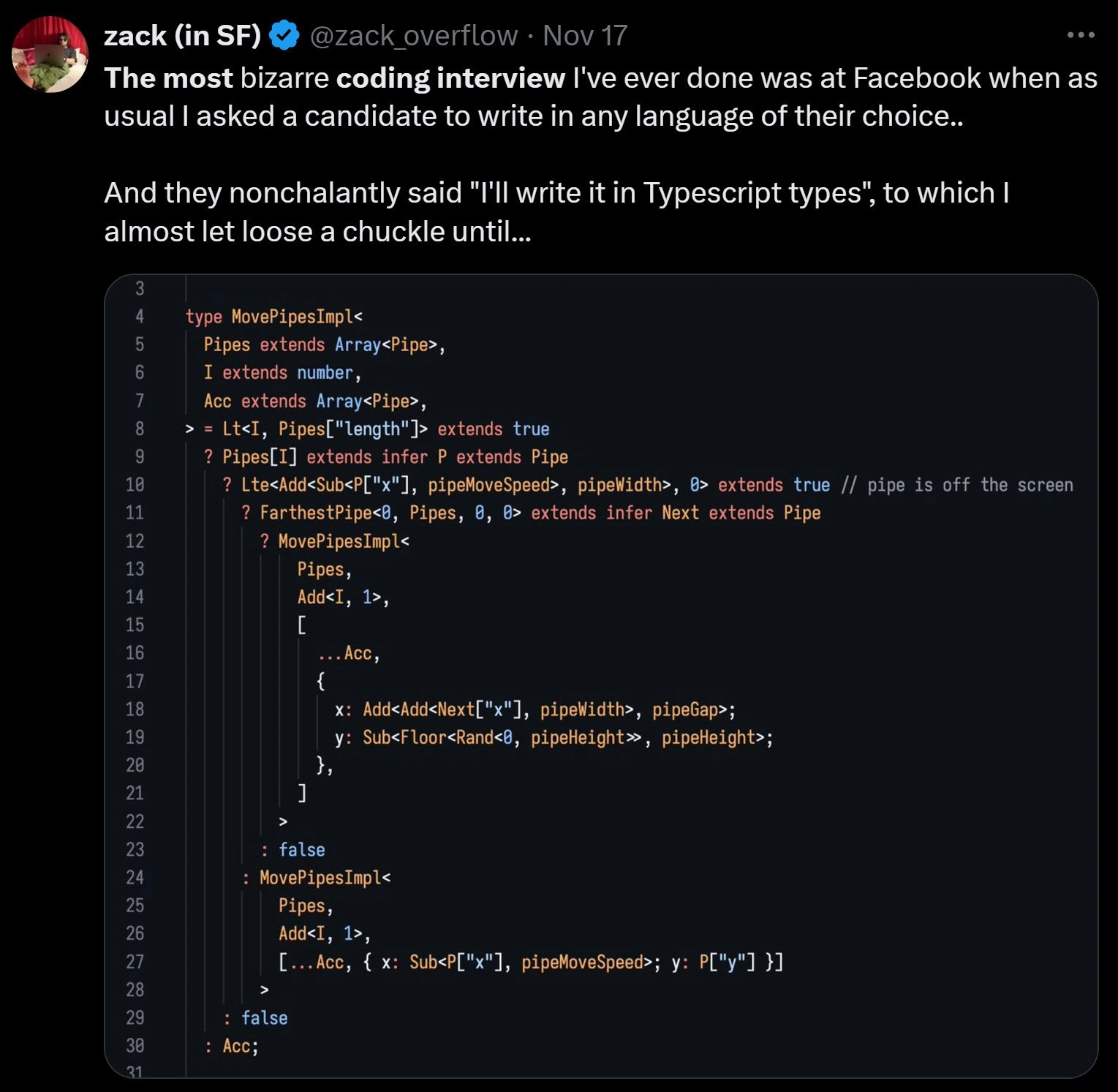
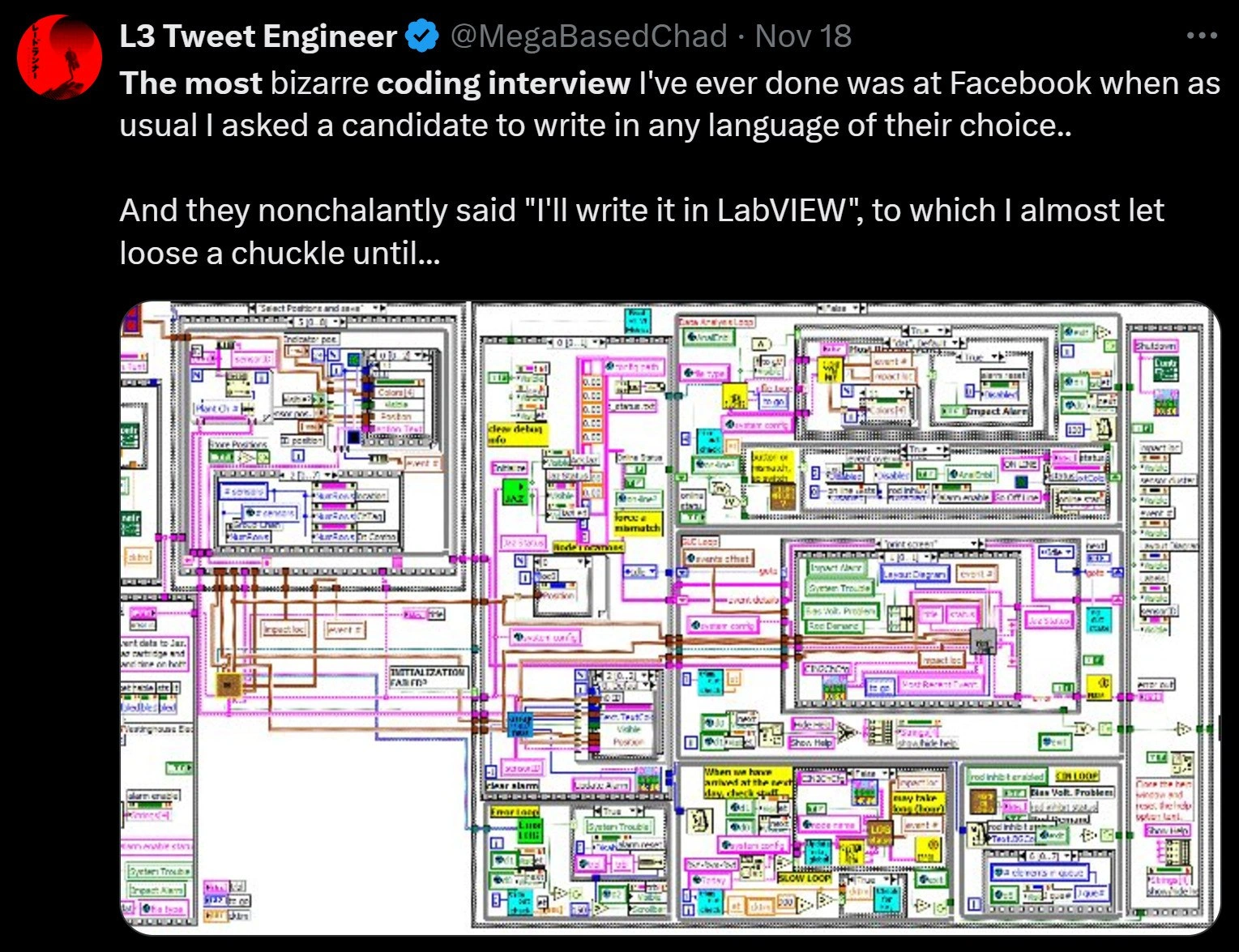
This image is a screenshot of a tweet by user 'zack (in SF)' (@zack_overflow), parodying a previous meme format. The tweet reads: 'The most bizarre coding interview I've ever done was at Facebook when as usual I asked a candidate to write in any language of their choice.. And they nonchalantly said "I'll write it in Typescript types", to which I almost let loose a chuckle until...'. Below the text is a snippet of TypeScript code in a dark-themed editor. The code is not typical runtime logic but is instead a complex, recursive type definition named 'MovePipesImpl'. It uses advanced features like generics, conditional types, and the 'infer' keyword, demonstrating type-level programming. The humor comes from the extreme and unexpected application of TypeScript's type system to solve a problem, a flex that demonstrates deep, esoteric knowledge. For senior engineers, it's a nod to the Turing-completeness of modern type systems and the kind of wildly clever, impractical solution that is both horrifying and impressive







Comments
7Comment deleted
The candidate's code has zero runtime exceptions, zero dependencies, and can calculate the heat death of the universe, but only if the answer is a type
I got worried when the entire game loop ran in conditional types - ship that to prod and our runtime becomes tsc and our pager is the compiler’s recursion-depth error
When you've spent so long arguing that TypeScript isn't a real programming language, you accidentally prove it's Turing complete at compile time while trying to make a point
When the interviewer said 'any language,' they probably weren't expecting a candidate to implement Flappy Bird in TypeScript's type system - a Turing-complete language where the 'runtime' is the compiler and your bugs manifest as 'Type instantiation is excessively deep and possibly infinite.' It's the ultimate power move: writing code that executes during compilation, ensuring your game logic is verified before a single line of JavaScript runs. The real question is whether the candidate's solution passed in O(compile-time) or if the TypeScript compiler needed a coffee break to resolve those nested conditional types
If your candidate can write Flappy Bird in TypeScript's type system, congrats - you just moved the runtime into the compiler and your latency into tsc
Nothing like discovering your “any language” policy includes a Turing-complete type system - runtime O(0), compile time O(nested_conditional_types), and tsc is now the VM
TypeScript at Meta: solving runtime problems at compile time, one infer at a time - until the types themselves need filtering