Skip to content
DevMeme
5838 of 7435
AI Interview Challenge: Building a Classifier in Minecraft's Redstone
AI ML Post #6403, on Nov 20, 2024 in TG

AI Interview Challenge: Building a Classifier in Minecraft's Redstone

Why is this AI ML meme funny?

Level 1: Building Blocks Surprise

Imagine you ask someone to solve a problem and tell them, “You can use any way you like.” You expect them to maybe write an answer on paper or use a calculator. But instead, they pull out a big box of LEGO blocks and build a gigantic machine that literally shows the answer when they’re done. 😮 It’s as if a teacher said “show me you can do math” and a student built a whole working calculator out of toy blocks in front of the class! It’s funny because nobody saw that coming – it’s a totally wild way to solve the task. The interviewers felt just like that teacher: completely surprised and impressed. The candidate’s creative solution was so over-the-top and clever that it left everyone speechless, kind of like watching a magic trick you never expected. In simple terms, the meme is funny because it shows someone solving a serious challenge in a playful, unexpected way – using a game’s building blocks to do a job normally done by regular computer code. It’s the surprise and creativity that makes us laugh and say, “Wow, they actually did it with blocks!”

Level 2: Crafting an AI

At a more approachable level, let’s break down what’s going on here. The meme is based on a tweet describing an AI job interview. The interviewer (at a company called Weights & Biases, a real ML tools company often abbreviated as wandb) asked a standard question: “Build an AI classifier in any language or framework you prefer.” An AI classifier is basically a program that can take some input data and categorize it or identify what it is. For example, a simple classifier might look at an image and decide if it’s a picture of a cat or a dog, or read handwritten digits and figure out which number (0-9) it is. Usually, candidates might choose a familiar programming language (like Python, which is very popular in machine learning) and use a library or framework (like TensorFlow, PyTorch, or scikit-learn) to quickly put together a model for the task. It’s sort of an open invitation to “use whatever tools you’re comfortable with to show you know how to make an ML model.”

In this story, though, the candidate’s answer was anything but traditional. They said, “I’ll write it in Redstone.” Now, for those unfamiliar, Minecraft has a feature called Redstone, which is basically the game’s version of electrical wiring and logic circuits. Think of Redstone components as the Lego bricks of computing inside Minecraft:

  • Redstone Dust acts like wires carrying power (signals).
  • Redstone Torches can power things and also invert signals (like a NOT gate, turning off when powered).
  • Repeaters extend the range of signals and add delay (they’re like amplifiers or timing circuits).
  • Comparators can do simple analog signal math (comparing strengths or subtracting, often used to make calculators or combine signals).
  • Using these pieces, players build all sorts of contraptions: doors that open automatically, simple calculators, music boxes, even rudimentary computers inside the game world.

So when the candidate said they’d use Redstone, they basically chose Minecraft itself as their programming environment! This is a nontraditional_language_choice to say the least – Redstone isn’t a conventional programming language like Java or C#, but it is a system where you can create logic and computations by physically arranging components. It’s like saying, “I won’t write code with text, I’ll engineer a machine that does the computing.”

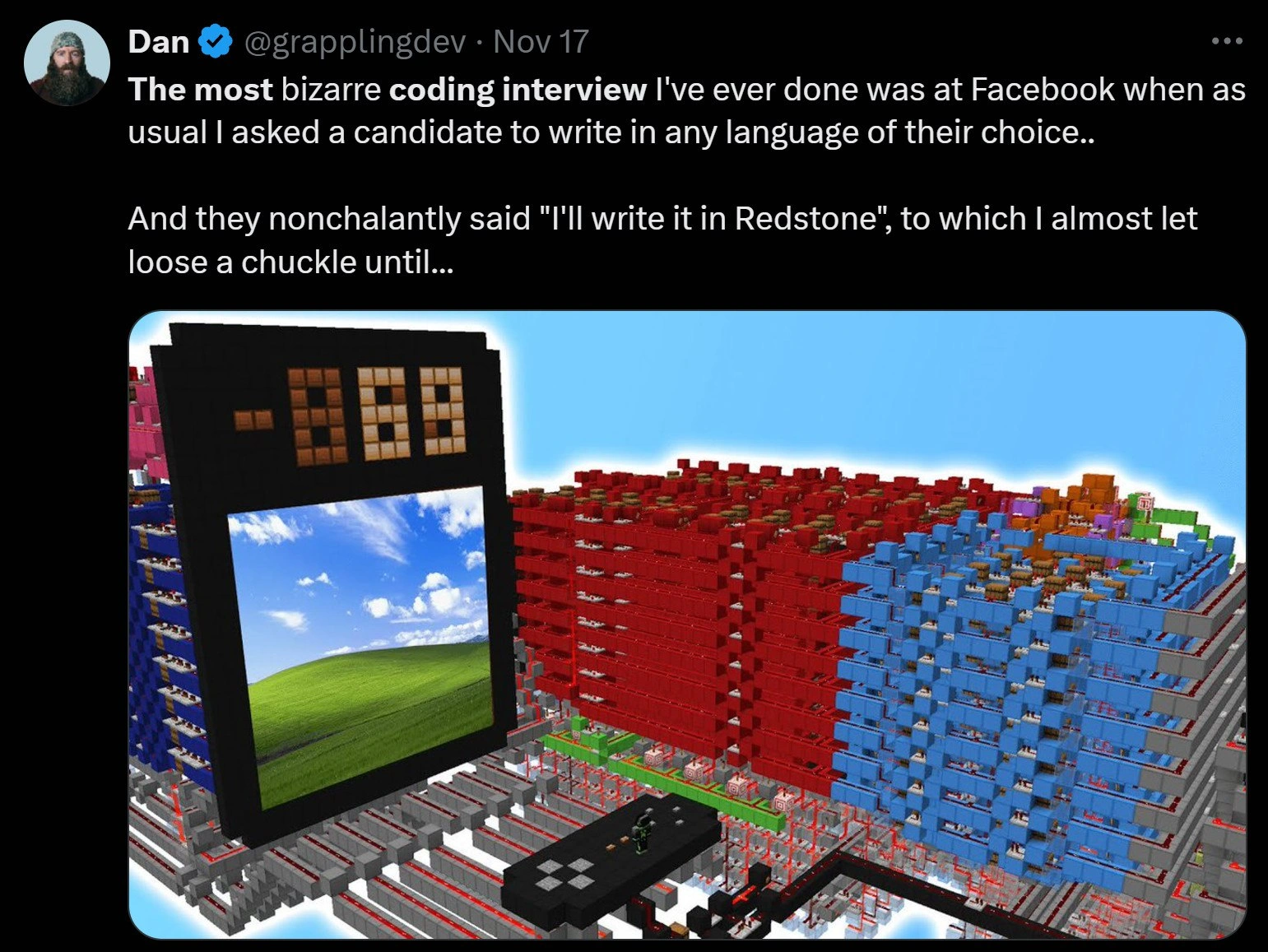
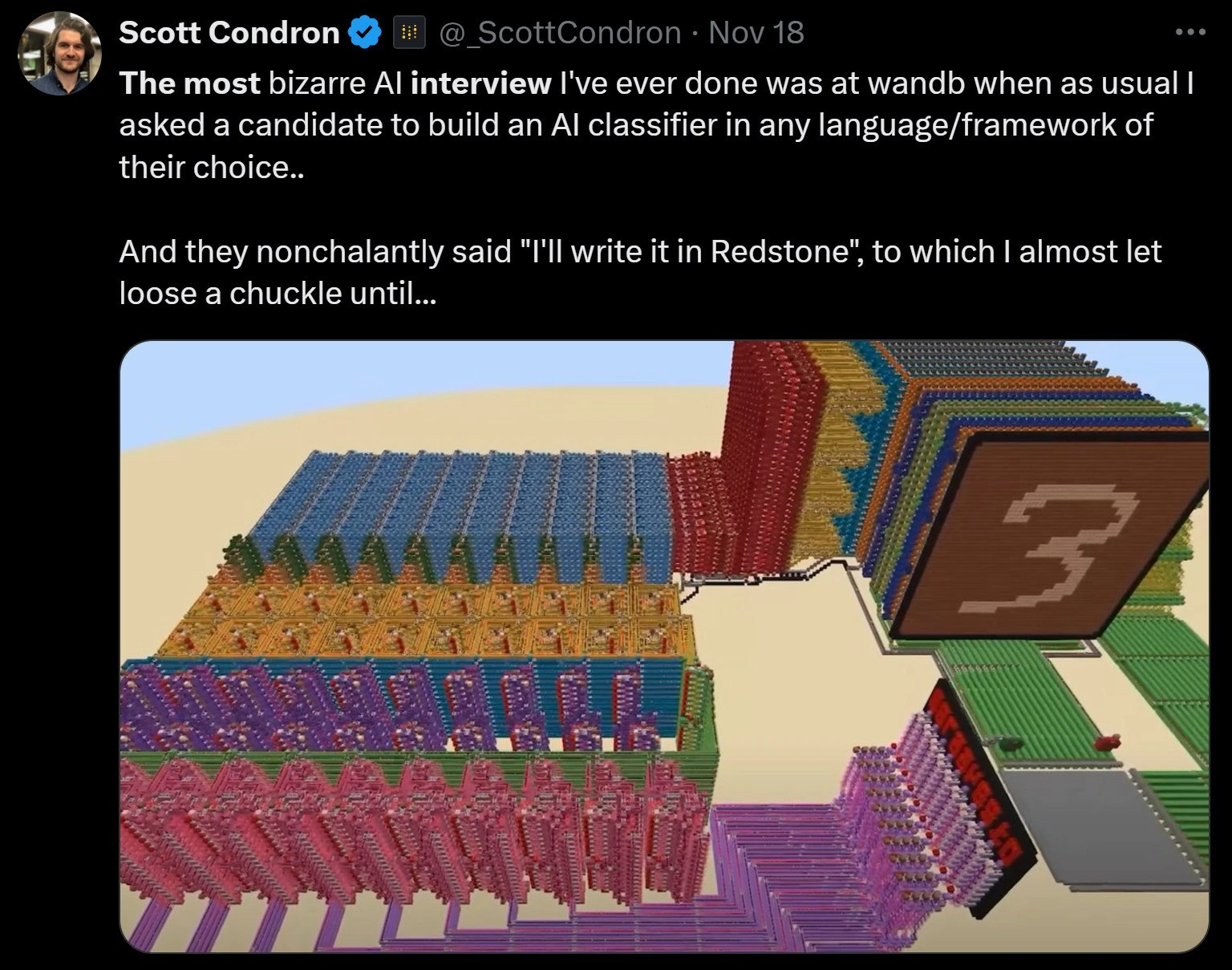
The tweet goes on to describe that the interviewer almost laughed, thinking the candidate was joking, “until…” – implying the candidate actually proceeded to do it. The image attached to the meme shows presumably what the candidate built: a screenshot from Minecraft with a huge Redstone circuitry contraption. There are rows and layers of colored blocks with Redstone components on them (pink, purple, orange, blue, green – the colors might be wool blocks used as a background to help organize the circuit). All these layers of circuitry lead into a tall structure on the right with red and blue vertical lines – that looks like a big data cable or bus carrying the signals – which then feeds into a large panel displaying the number “3”. That panel is likely made of a grid of blocks (possibly Redstone lamps or colored blocks) acting as a pixel display to show the output of the classifier. In other words, the candidate built a machine in-game that, when given some input (maybe using switches or preset data in the circuit), it runs a computation and then lights up the number “3” as the classification result.

To put it simply: instead of writing a few lines of code to create an AI model, this person literally crafted a digital circuit out of Minecraft blocks that does the same job. It’s like using an extremely manual method to achieve something computers normally do automatically. For a real-world analogy, imagine someone asking you to calculate something and you go build a whole calculator out of spare parts to get the answer – that’s the vibe here! It’s both comedic and impressive.

Why is it impressive? Because building anything complex in Redstone is hard. Redstone devices work on pretty basic principles (like binary logic). To make a classifier, you’d likely need to implement some math – maybe adding and comparing numbers, or even a simplified neural network. That means the candidate had to design a combination of logic gates to do each step of the calculation. Even a simple addition or multiplication in Redstone can take a bunch of components wired together. So the contraption in the image being so large makes sense: even a basic machine learning algorithm will explode in size when built gate-by-gate.

And why is it funny? Well, in an interview setting, nobody expects Minecraft to show up! The interview panel probably thought the candidate was joking or being cheeky. Typically, “any language/framework” is meant to give freedom but within reason (like, you could use Java, C++, maybe even JavaScript if you want to get creative – but all still normal programming tools). Using a video game to solve a programming question is just so out-of-left-field that it subverts the expectation completely. It highlights a kind of geeky humor: technically, Minecraft Redstone is a valid platform to implement logic (there’s no rule saying you can’t), but practically, it’s an insane amount of effort for an interview. The candidate must have been very confident in their Redstone engineering skills (and probably prepared – maybe they had this project built beforehand or at least practiced, because building something that enormous on the fly is nontrivial).

This touches on multiple communities: AI/ML humor (because it’s about building an AI classifier in a silly way), gaming reference (because Minecraft is the game used, connecting to those who know the game’s mechanics), and interview humor (because interviews are stressful and unpredictable, and here the unpredictability is cranked to max!). It’s the kind of story that both gamers and coders can appreciate. Gamers go, “Whoa, they actually built that in Minecraft!” and coders go, “Whoa, they actually did that for an interview!”

In the end, the meme is showing us a moment where an interviewer’s standard routine collided with a candidate’s wild creativity. The panel was left speechless – meaning they probably didn’t even know how to react. Do you applaud the ingenuity? Do you question the practicality? It’s definitely a conversation starter. And for those of us reading the meme, it’s a reminder that sometimes thinking way outside the box (or rather, outside the normal coding environment and into a sandbox game) can lead to spectacular and amusing results.

Level 3: Rube Goldberg Classifier

For seasoned developers and engineers, this story hits that sweet spot between hilarity and respect. In a typical AI/ML job interview, when you say “use any language or framework you like,” you’re expecting the candidate to pick something conventional – maybe Python with PyTorch, or perhaps a well-known framework like TensorFlow, scikit-learn, or at most a quirky choice like Julia or R. But Redstone in Minecraft? That’s way off any interviewer’s bingo card! The meme captures the collective jaw-drop moment: the interview panel nearly chuckles thinking it’s a joke – “Haha, sure, build it in a video game…” – and then realizes the candidate is dead serious and totally capable of doing it. This is the ultimate “be careful what you wish for” scenario. They said “any language,” and the candidate chose a literal sandbox game environment, turning a high-level coding challenge into a low-level digital logic project right before their eyes.

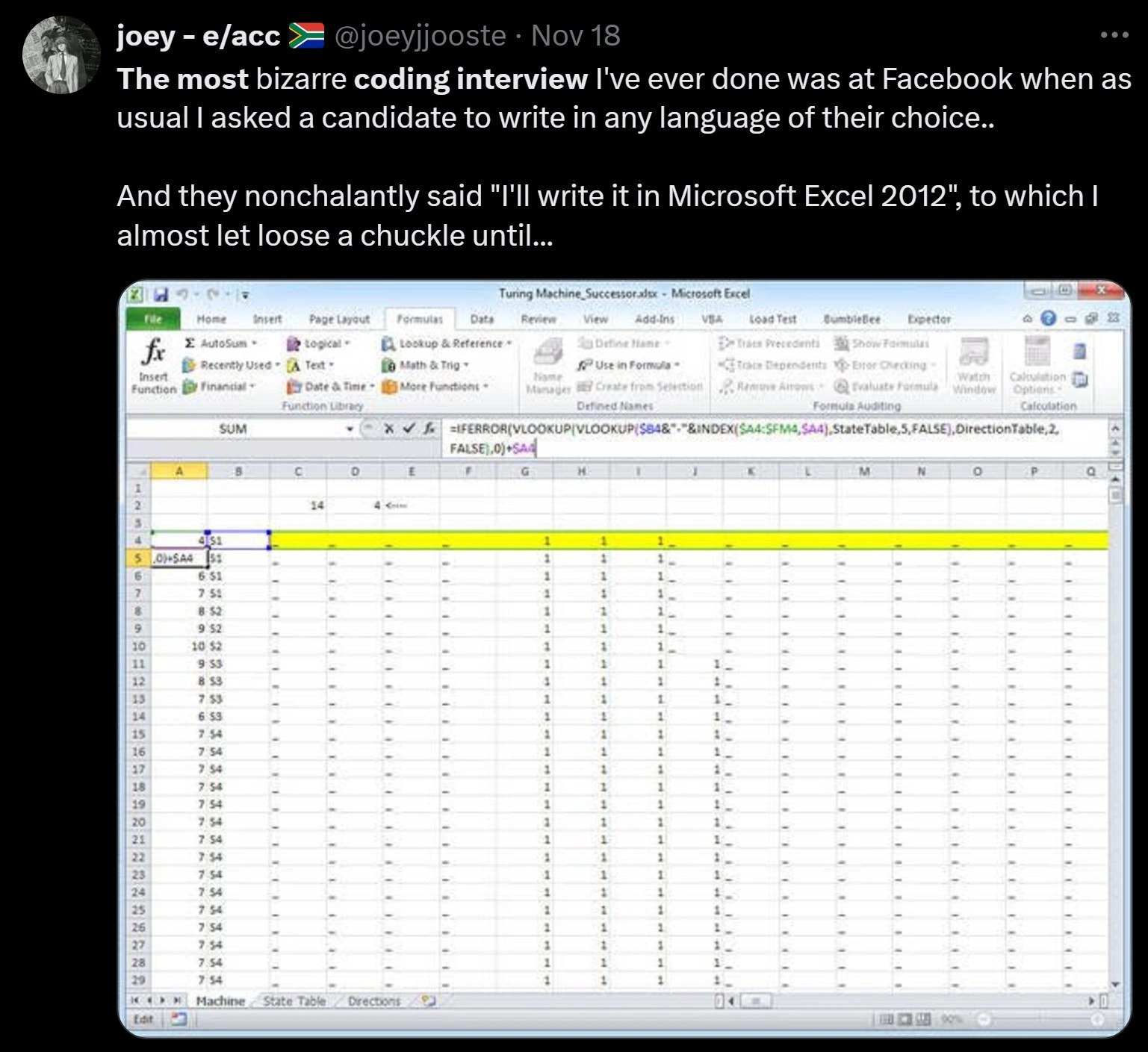
From a senior perspective, the humor comes from how over-engineered yet ingenious this solution is. It’s a classic Rube Goldberg machine approach: solving a problem in the most roundabout, elaborate way possible, just to prove you can. Everyone in tech has seen impractical demo projects or those legendary “I coded X in Y” stunts – like writing a web server in one line of bash, or implementing Tetris in Excel formulas. But creating an AI classifier in Minecraft elevates it to a new level of spectacle. It’s the kind of tale that immediately gets shared on developer Slack channels: “You won’t believe what this interview candidate did…”

Consider the real-time dynamics: The candidate likely whipped out their laptop, launched Minecraft, and started dragging wiring across a flat sandbox world. Picture the interviewers exchanging glances as pink, purple, orange, and blue Redstone circuits start stacking up on the screen. That multicolored behemoth isn’t just pixel art – each color module could represent parts of the logic (maybe each layer of an algorithm or separate functions like input processing vs. output display). The tall ribbon of red and blue lines in the image looks like a massive bus carrying signals from the “brain” of the contraption to the big brown display which reads “3”. At this point, the panel’s initial amusement turns into genuine amazement. This isn’t a joke; it’s a working solution, just not in the form anyone expected.

Why is this so relatable (and funny) to experienced devs? Because it perfectly skewers the technical interview process and our assumptions. Interviewers often pride themselves on open-ended problems and are ready for various coding styles or languages – but we implicitly assume a certain sandbox (pun intended) of normal choices. This candidate broke the frame of the interview. It’s as if someone in a coding test decided to literally build a CPU from scratch to run their code on, just because they can. It also pokes fun at the “whatever works” hacker mentality: sometimes developers do achieve tasks in the weirdest ways (running servers on gaming consoles, coding in Microsoft Excel, you name it). Here, the candidate demonstrated extreme creativity and a deep understanding of how computers work at a fundamental level. They didn’t just rely on a pre-built library; they constructed the mechanics of the classifier.

For senior folks, there’s an added layer of historical irony: early computers were built with physical circuits and wires, and programming used to mean rearranging plugs on a board or toggling switches. What this interviewee did is a callback to that era – except done inside a playful modern context (a game) to solve a cutting-edge AI task. It’s the old school meets new school in the most literal sense. We chuckle because it’s absurdly impractical for getting the job done in real life (imagine the performance – this Redstone AI probably classifies at one input per several seconds or worse 😅). But we also nod in respect: it’s a flex of technical skill, perseverance, and showmanship.

The meme’s punchline, showing the panel “speechless,” resonates with anyone who has been in an interview – on either side – where something wholly unexpected happens. It’s a mix of “This is insane” and “This is brilliant.” The candidate basically hacked the interview, turning a standard question into an unforgettable demonstration. In the world of AI_Humor and InterviewHumor, this story will live on as legend: the day someone said “sure, I’ll do it in Minecraft” – and actually pulled it off. One can only imagine the debrief after: “Well, they certainly showed mastery… not sure if it’s relevant to our tech stack, but wow!” In short, this meme tickles seasoned devs because it highlights both the absurdity of coding challenges and the boundless creativity of developers who take instructions very, very literally.

Level 4: Turing-Complete Sandbox

At the most theoretical level, this meme highlights computational universality in an unexpected medium. Minecraft’s Redstone system is essentially a sandbox for digital logic circuits. Each Redstone torch, dust line, and repeater can act like a transistor or logic gate (e.g., NOT gates using torches, AND gates by combining signals). In theory, a sufficiently complex Redstone contraption can simulate a entire computer – it’s what we call Turing complete. This means any computation or algorithm (yes, even an AI classifier) can be built from these fundamental logic units, given enough time and resources. Academic computer science meets playful creativity here: by building an AI in Redstone, the candidate is literally constructing a hardware implementation of a machine learning algorithm inside a video game world. This is akin to designing a custom circuit or an FPGA that performs the classification, rather than writing code in a traditional language. It’s a mind-bending demonstration of Church-Turing thesis in action – whether you use electrons in silicon or Redstone dust in Minecraft, the underlying logic can produce the same results.

To appreciate the absurd brilliance: an AI classifier typically involves math like multiplications of inputs by weights and summing them up (the essence of a neural network’s neuron or a logistic regression). In normal software, these operations happen abstractly on a CPU. Here, those operations had to be built physically with Redstone logic:

  • Logic Gates: The candidate likely crafted basic components like adders (to sum signals) and comparators (to compare strengths, analogous to weights or thresholds). Redstone comparators can combine signals in ways that mimic adding values – perfect for summing weighted inputs if cleverly arranged.
  • Memory & State: An AI classifier might need to store some learned parameters (weights). In Redstone, flip-flops or latches built from torches and repeaters could serve as memory bits to hold those values. Imagine a line of red and blue wires encoding a number – that’s the Redstone equivalent of RAM or registers storing the weights & biases (fittingly, the company is named Weights & Biases 😄).
  • Parallelism & Timing: Real hardware operates with a clock; in Minecraft, timing is managed by tick delays in repeaters. The candidate’s contraption with its stacked layers of multicolored circuits likely had to carefully synchronize signals. One tick off, and the whole calculation might output gibberish. It’s a synchronous circuit design challenge – in a job interview!
  • Output Display: The brown pixel display showing the number “3” is essentially a tiny pixelated monitor built of Minecraft blocks (often using Redstone lamps or pistons). Driving that display from the logical result means the Redstone machine not only computed the classification but also converted it into a human-readable output (the digit “3”). That involves binary-to-decimal conversion or a decoding circuit – an extra layer of complexity akin to building a small GPU to render the result!

From a theoretical lens, what’s funny is also profound: any computer program (even a sophisticated machine learning classifier) can be reduced to basic logical operations and implemented in surprising ways. It’s both ridiculous and awe-inspiring that a task normally done with high-level libraries (scikit-learn or TensorFlow in Python) was accomplished with virtual wiring and gates. The meme tickles our nerdy bone by pointing out that underneath all our fancy AI frameworks, it’s just ones and zeros flowing through logic gates – even if those gates happen to be made of pixelated Redstone dust. The absurdity lies in choosing such a low-level, labor-intensive path to solve a high-level problem, effectively hand-wiring an algorithm in a game world. This is a demonstration of ultimate programming fundamentals: if your medium is Turing-complete, you can build anything – even a neural network – out of it. It’s like witnessing someone prove a point from computer science textbooks in the most literal way possible. In short, this candidate harnessed the raw fundaments of computing in a toy universe to meet a modern AI challenge, blurring the line between play and cutting-edge tech.

Description

A screenshot of a tweet by Scott Condron. The tweet describes an AI interview scenario. Below the tweet text is an in-game screenshot from Minecraft, showcasing an enormous and incredibly intricate machine built from colorful blocks. This machine is a Redstone computer, featuring layered circuits, complex wiring, and a large block-based display screen showing the number "3". The structure is vast, covering a large area in a sand-colored landscape under a clear blue sky. The meme humorously contrasts a standard AI interview task with a wildly unconventional and massively over-engineered solution. Redstone is Minecraft's equivalent of electrical circuitry, and dedicated players have built fully functional computers with it. The joke lies in the interviewer's initial disbelief followed by implied astonishment, as a candidate proposing to build an AI classifier in Redstone is either joking or a genius. For senior engineers, it's a nod to the concept of Turing completeness in unexpected systems and an appreciation for the monumental effort required to build complex logic from primitive building blocks
Comments

7
Anonymous ★ Top Pick My first thought was 'that's insane,' but my second was 'I wonder if they used a block-based transformer architecture or a convolutional neural net for the logic gates.'
  1. Anonymous ★ Top Pick

    My first thought was 'that's insane,' but my second was 'I wonder if they used a block-based transformer architecture or a convolutional neural net for the logic gates.'

  2. Anonymous

    “Candidate’s explanation: ‘Gradient descent? Nah, I just route the error signal through a Redstone repeater loop until the torches stabilize - basically stochastic Creeper-dropout.’ At that point the panel quietly archived our entire MLOps roadmap

  3. Anonymous

    When your neural network has a 20-tick propagation delay per layer but at least the architecture is literally visible to stakeholders

  4. Anonymous

    When the candidate said they'd implement a neural network in Redstone, the interviewer realized they were about to witness either the most impressive demonstration of computational theory understanding or the longest 'compiling...' status in interview history. Turns out, when you ask for 'any framework,' some people take that literally enough to choose one where the garbage collector is a creeper explosion and the IDE is a pickaxe

  5. Anonymous

    When 'bring your own framework' means a 10k-block neural net running on observer clocks - no GPUs, just gravel traps for backprop

  6. Anonymous

    Finally, an interpretable model: every weight is a dust trail, backprop means relocating torches, and the throughput SLO is one prediction per loaded chunk

  7. Anonymous

    I said any language - they chose Redstone; now training runs at 20 Hz, inference latency is measured in chunks, and our only A100s are a hundred repeaters

Use J and K for navigation