Skip to content
DevMeme
5841 of 7435
The Unconventional Power Move: Solving a Facebook Interview in LabVIEW
Interviews Post #6402, on Nov 20, 2024 in TG

The Unconventional Power Move: Solving a Facebook Interview in LabVIEW

Why is this Interviews meme funny?

Level 1: Tangled Solution

Imagine you ask a friend to solve a simple puzzle, but instead of just telling you the answer, they cover an entire poster board with a crazy drawing full of lines and arrows going everywhere. It's like if your teacher said you could explain your homework any way you want, and one kid built a wild contraption of dominoes, strings, and toy blocks that eventually reveals the answer. You'd probably laugh because it's such an overly complicated way to do something so simple. That's exactly the feeling of this meme. In a coding interview (which is like a test for programmers), the person answering the question used a giant, tangled picture with tons of connected parts instead of writing the answer in a normal, simple way. It's funny and surprising because nobody expected them to do it like that – they turned a straightforward problem into a huge, messy maze of colorful connections, kind of like solving a small task with a big crazy drawing.

Level 2: Graphical Spaghetti Code

If you're a newer developer or just getting into coding, let's break down the humor here. First, a "coding interview" is when companies (like Facebook, in this case) ask you to solve programming problems to test your skills. Often, they let you choose "any programming language" you're comfortable with, as a way to help you showcase your abilities in a familiar setting. Typically, candidates pick common languages like Python, Java, or C++ which the interviewers also know well.

Now, enter LabVIEW. LabVIEW is not your everyday programming language for building websites or apps. It's a special kind of tool called a visual programming language, made by a company named National Instruments and commonly used in engineering and research labs. Instead of writing lines of text, in LabVIEW you create programs by dragging and dropping graphical blocks (which represent operations or functions) and then drawing wires to connect these blocks together. Each block does something (adds two numbers, controls a device, etc.), and the wires carry data from one block to the next. Think of it like building a flowchart or a diagram of your program, rather than writing it in sentences.

If you've ever seen or used Scratch (the block-based coding tool often used in schools to teach kids programming), you have an idea of what a visual language is like. LabVIEW is like Scratch on steroids, designed for professional engineers. It's especially good for tasks where you have to deal with real-world signals or parallel processes. For example, if you're reading temperature from a sensor and at the same time controlling a motor, LabVIEW makes it easy to have those two things happening in parallel by drawing two sets of blocks side by side. It was built for folks who do things like test electronics, collect data from scientific experiments, or control industrial machines.

But here's why it's funny in the context of an interview: Software engineering interviews usually involve problems like sorting a list of numbers, finding patterns in text, or maybe designing a simple game logic. These are things you can code with a few loops and if-else statements in a typical language. No one expects a candidate to break out a complex graphical IDE for that. When the interviewer said "use any language," they probably meant any normal programming language. The candidate took it very literally and chose a completely different kind of "language." It's like if a teacher said you can do a class project in any format, and one student decided to make an interpretive dance instead of a written report. Not against the rules, perhaps, but definitely not what the teacher had in mind!

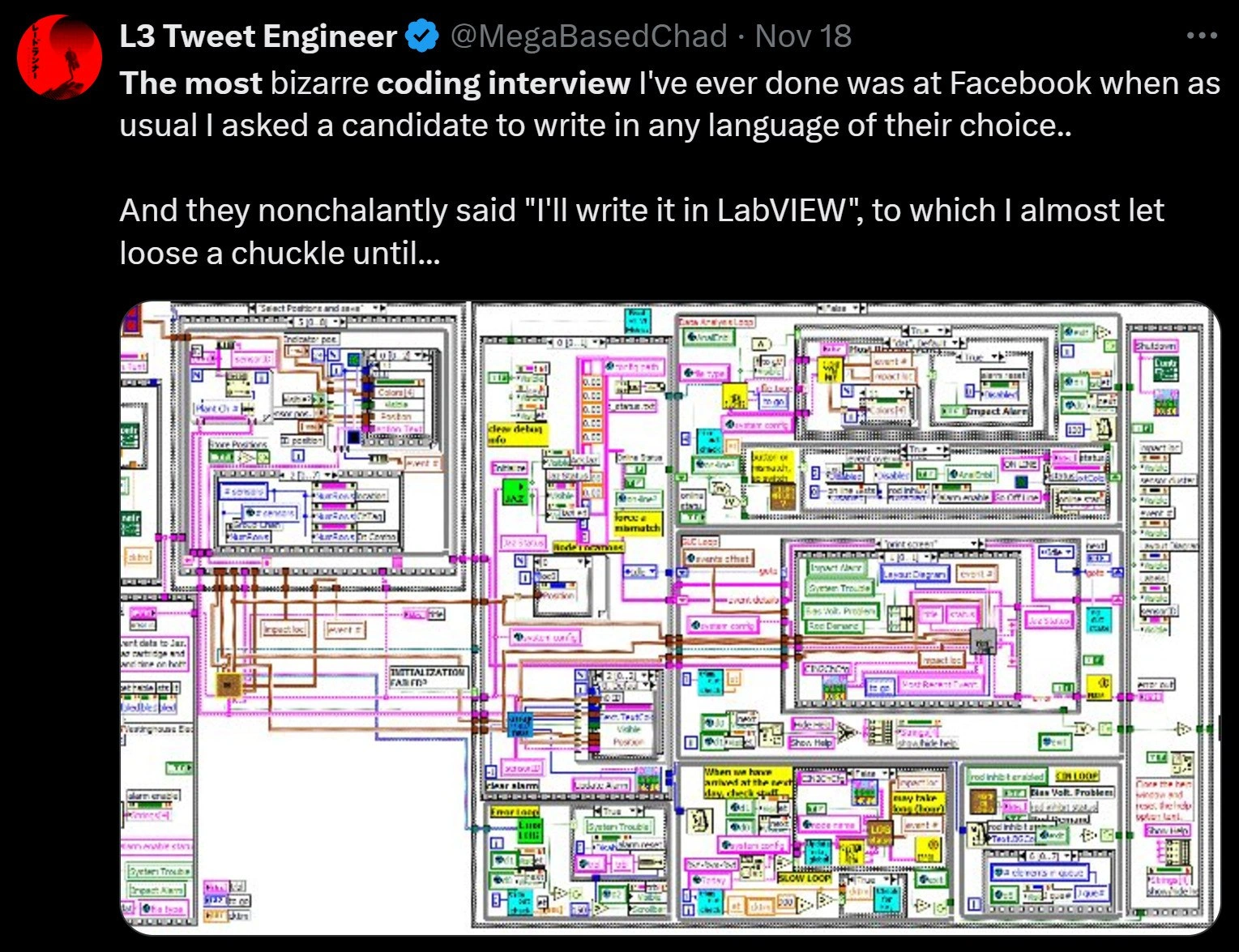
The image in the meme is a screenshot of what LabVIEW code looks like. See all those boxes and brightly colored lines? That's an actual LabVIEW program. Each of those little boxes is an operation (like a function call or a math calculation), and the lines connecting them are the data flowing from one step to the next. The different colors of the wires usually mean different types of data. For example, in LabVIEW convention, a pink wire might carry text strings, a blue wire might carry integer numbers, an orange wire might carry floating-point numbers (decimals), and so on. The idea is that you can tell at a glance what kind of data is moving through each connection. The large grey rectangles you see could be frames for loops or conditional sections (like a big loop that contains a bunch of blocks that will run multiple times).

When a LabVIEW program stays small, it actually looks quite neat and tidy – kind of like a simple circuit diagram. But as it grows, it can become really hard to keep track of. The screenshot here shows a program that has grown into a monster: hundreds of blocks and wires crammed together. To an untrained eye (and honestly, even to someone who knows LabVIEW), that image is overwhelming. The wires are zig-zagging everywhere, making a huge tangled mess. This is where we use the term spaghetti code. Normally, spaghetti code refers to text code that has become tangled and incoherent – imagine a bowl of spaghetti where it's hard to follow one strand from start to end. In a similar way, when code (or a diagram) is so messy you can't easily follow the logic from start to finish, we call it spaghetti code. Here, it's almost literally spaghetti code because those wires look like noodles running all over!

For a junior developer or someone new to these concepts, the humor is in the absurdity of using such a roundabout way to solve a problem. Usually, in an interview, you want your solution to be as clear and direct as possible so the interviewer can understand your thinking. If the problem was, say, "find the largest number in this list," most people would write a short loop or use a built-in function in whatever language. It might take 3-4 lines of code. If you did that in LabVIEW, you might have to place a loop block, wire the list into it, use a comparison block inside, keep track of the max value via a shift register wire, and so on – and you'd end up with a diagram that might cover a whole screen for that tiny task. It's a bit like using a huge machine to crack a peanut.

So, breaking it down:

  • Coding interviews aim to test problem-solving and coding skills, usually with normal coding.
  • "Any language" is meant to let you use one of the common programming languages you know well.
  • LabVIEW is a visual programming language usually used for specific engineering purposes, not general algorithm problems.
  • The candidate chose LabVIEW, which is very non-traditional for this setting.
  • The result was a spaghetti diagram: a super tangled visual program that is hard to read, much like really messy code.

The reason developers find this meme funny is because it's an extreme example of thinking outside the box (or maybe forgetting the box entirely!). It's as if someone asked for a ride to the airport and instead of driving a car, you assembled an airplane in your backyard to fly them there – technically a solution, but uncalled for in context. The interviewer certainly didn't expect to conduct a Q&A session about nodes and wires, and you can bet they were startled when confronted with that labyrinthine answer.

For you as a learner, it's also a gentle reminder: just because you can do something in a different way doesn't always mean you should, especially not in high-pressure situations like interviews where clarity is key. But as a one-off story, it's gold because it shows how wildly things can deviate from the norm. The image of a Facebook interviewer staring at a screen of neon spaghetti instead of readable code is just too good. And hey, credit to the candidate for knowing their niche tool well enough to attempt it! It's the kind of bold move that most of us would never dare, which is why we're amused to hear about it.

Level 3: Any Language, They Said

It's funny how a well-intentioned flexible interview policy ("use whatever language you're comfortable with") can backfire spectacularly. In typical coding interviews, "any language" usually means choose your favorite mainstream programming language – maybe Python for quick scripting or Java for the strict typers. No one expects the candidate to pull out a completely different paradigm of programming on the spot.

In this meme's story, the interviewer at Facebook was doing the usual routine: allowing the candidate to pick a language to solve the problem. Then came the curveball:

"I'll write it in LabVIEW."

Imagine being the interviewer at that moment. Most seasoned developers know of LabVIEW (perhaps from a college electronics lab or that one odd project at a prior job), but it's hardly something you'd see in a typical software engineering interview at a big tech company. It's as if someone in a cooking competition said, "I prefer to cook using a chemistry lab setup instead of a kitchen stove." The immediate reaction is a mix of bemusement and disbelief. For one, LabVIEW isn't just a little script or a standard coding language – it's a full-blown graphical IDE (Integrated Development Environment) specialized for engineering tasks. So instead of writing code in a simple text editor or on a whiteboard, this candidate likely had to fire up a hefty application and start dragging wires and blocks. It's as far from typing for (int i = 0; i < n; i++) on a whiteboard as you can get.

The meme captures that "blink, wait... are you serious?" moment. The interviewer almost let loose a chuckle – because who wouldn't? LabVIEW in a coding interview feels like bringing a paintbrush to a typing test. But then, the punchline: the candidate was completely serious and proceeded to construct their solution with node-and-wire diagrams.

For an experienced developer, this situation is hilarious and cringe-inducing at the same time. On one hand, you have to admire the candidate's audacity (or extremely niche confidence). On the other, you're thinking about the practical nightmare unfolding: instead of a few neatly written functions, you now have to stare at a chaotic LabVIEW block diagram and try to discern the algorithm within. It's a literal and figurative case of wires getting crossed in an interview. The screenshot under the tweet shows the result: a mad-scientist tapestry of colored lines and blocks.

This is spaghetti code in its most tangible form. Every senior engineer has encountered "spaghetti code" – systems where the logic jumps all over, everything depends on everything else, and there's no clear structure. Usually that's in text form (lots of goto statements, deeply nested conditions, or just poor organization can do that). But here we have actual spaghetti noodles (wires) running all over a GUI. It's the same feeling of dread and dark humor: "How on earth am I supposed to follow this?" And now imagine having to do it in real-time, in an interview setting, trying to check if the solution works!

The humor also comes from picturing the normal interview dynamics flipped on their head. Typically, the candidate is the nervous one, and the interviewer guides the process, possibly giving hints or asking questions. Here, the interviewer is the one caught off guard, grappling with a tool they likely never expected to see. The candidate, meanwhile, is nonchalantly wiring up logic gates and loops like it's just another Tuesday. The power dynamic shifts for a moment – the poor interviewer might be out of their depth, while the candidate is in their element (albeit an unusual element for a coding interview).

There's an unspoken rule in interviews about communication and clarity: you want to choose a solution approach that you can explain clearly and that the interviewer can follow. If you pick an exotic approach that leaves your interviewer scratching their head, you're not doing yourself any favors. So, one could say this candidate either had supreme confidence that they could explain LabVIEW clearly, or they were oblivious to the confusion it might cause. It's a fine line between a bold move and a self-sabotaging one. The tag LanguageQuirks is spot-on here: this is a quirk where the very choice of "language" (if we can call a wiring diagram a language) became the center of attention, rather than the problem-solving skills it was supposed to showcase.

Developers with a few years under their belt are likely chuckling because it spotlights a universal hiring lesson: be careful what you ask for. Tell people "any language is fine" and eventually someone will take you at your word in the most literal way possible. It's the kind of story that becomes tech interview legend. You can almost hear the interviewer later recounting it to their team: "You won't believe this – one time a candidate actually tried to solve the problem in LabVIEW!" Cue the groans and laughter from colleagues who can imagine the absurd visual complexity.

The Facebook context adds another layer. Big tech companies like to think they're ready for anything. They love to see innovative thinking. But this might be literally outside the box – outside the text box, that is. Facebook's interviewers are typically prepared for Python vs. C++ debates, not a full-on demo of a niche engineering GUI. If nothing else, this scenario probably prompted a review: maybe "any language" in the interview guidelines truly means almost any language (let's exclude the ones that require a gigabyte-heavy installation and an oscilloscope, please!).

In the end, beyond the immediate laughter, there's a sliver of respect hidden in the absurdity. The candidate found a loophole in the norms and strolled through it with a straight face. Every experienced engineer appreciates that interviews can be stressful, and in a weird way this person doubled down on what they knew best, even if it baffled everyone else. It's a memorable demonstration of overcommitment to one's favorite tool. And it leaves the rest of us with a great story and a reminder that the tech world is full of surprises. This meme brilliantly satirizes both the promise of flexibility and the reality of unpredictable outcomes – turning a straightforward coding test into a wild tangle of wires that nobody will soon forget.

Level 4: Labyrinthine Data Flows

At the deepest technical level, this meme highlights a clash of programming paradigms. LabVIEW is a visual programming environment built on the concept of dataflow programming. In dataflow systems, the execution of the program is governed by the flow of data between operations: each block (node) in the LabVIEW diagram performs an operation (like adding two numbers or iterating through an array), and it runs only when all the data it needs is available at its input wires. When it finishes, it sends data out through output wires to the next blocks. This is very different from how typical text-based languages work, where commands execute in a predetermined sequence, line by line. LabVIEW's model is inherently parallel – if two separate branches of the diagram don't depend on each other, they can execute simultaneously.

This dataflow approach can be incredibly powerful for certain tasks. For instance, in the world of hardware labs and instrumentation, you might be reading from multiple sensors at the same time, processing those signals, and controlling equipment concurrently. LabVIEW excels at that because you literally draw the flow of data from each sensor through processing blocks to outputs, and it all happens in parallel naturally. It's like a digital circuit diagram that's alive with data moving along the wires.

However, when you try to use a dataflow visual language to solve a more traditional programming puzzle (like one you'd get in a software interview), things can get complicated – literally and visually. Any algorithm can be implemented in LabVIEW (it's a Turing-complete language, meaning it can compute anything that a language like Python or C++ can, given enough time and memory), but the way you implement it in LabVIEW might require a lot more elements on the screen. For example, a simple loop in text code is just a few characters (for i in range(10): ... in Python, for instance), but in LabVIEW, a loop is drawn as a rectangular structure with an iteration count and a wire threading through it. A conditional (if/else) is drawn as a frame with True/False sub-diagrams. If you need to maintain state between iterations of a loop, you might use something called a "shift register" node on the loop's border to pass values around.

Now imagine an algorithm that uses multiple loops, nested conditions, or complex data structures. On paper, you could describe that in a few dozen lines of text. In LabVIEW, you'd have to meticulously place multiple loop blocks (possibly one inside another), draw wires to connect logic between them, and maybe sequence things with special nodes to enforce execution order (since in a dataflow, order isn't implicit). The visual diagram for that could easily balloon into a swarm of blocks and spaghetti-like wires. Every variable or intermediate result turns into a wire that has to snake its way across the canvas to wherever it's needed.

The term "labyrinthine" feels appropriate: trying to trace the logic in that final LabVIEW diagram is like navigating a maze. You start at one block, follow a wire to the next, then that might split into two paths, feed into some loop structure, come out the other side, and so on. Each colored wire in LabVIEW denotes a specific data type (for example, pink wires often carry text strings, blue wires carry integers, green wires are booleans, etc.). Those colors are meant to help, but when you have a rainbow of hundreds of wires, it starts to look like a chaotic tangle rather than an orderly circuit.

From a software architecture perspective, what's likely happening here is that the candidate translated an algorithm (which normally has a clear structure in text form) into a very flat, sprawling graph. In textual coding, developers would break a complex task into smaller functions and use indentation and logical structure to make it readable. In LabVIEW, it's also possible to organize logic by creating subroutines (called subVIs in LabVIEW) – basically grouping parts of the diagram into reusable blocks, similar to functions. Each subVI then appears as a single node in the main diagram, which could drastically simplify the big picture. But in this case, either the candidate didn't use many subVIs, or even if they did, the problem still required wiring together a ton of pieces. The end result is essentially one giant, monolithic block diagram. It's the visual equivalent of writing your entire program as one huge function: technically it works, but it's a nightmare to read or maintain.

There's a bit of computer history coming full circle here too. In the early days of programming, especially with some analog computers or early digital machines, "programming" often meant physically wiring components together or setting switches. LabVIEW's approach is like a modern, on-screen tribute to that era – a drag-and-drop version of plugging cables into a board to route signals. We moved away from that style of programming over the decades for a reason: as programs got more complex, it was much easier to handle that complexity with abstract text code and logical structures than with tangible wires. Yet this scenario shows someone who decided to effectively build a little hardware-style setup to solve an algorithm problem. It's both impressive as a demo of skill in a niche tool and a bit absurd from a modern software standpoint.

This brings to mind the concept of a Turing tarpit – languages or systems where everything is theoretically possible, but everything is painfully difficult to do. LabVIEW is certainly not a "useless" language (it's very good at what it's designed for), but using it in this context turns a straightforward coding task into a laborious graphical exercise. The meme drives that point home by showing just how unwieldy things can get.

In summary, on this advanced level, the meme is a commentary on how the choice of programming paradigm can wildly change the complexity of a solution. It reminds seasoned developers that just because two languages are equally powerful in theory doesn't mean they're equally convenient for a given job. Choosing the right tool matters. Otherwise, as shown here, you might end up building a convoluted maze of a solution for a problem that could have been a few simple lines. And while that maze of wires might work, it sure is a twisty, turny path to get to the answer!

Description

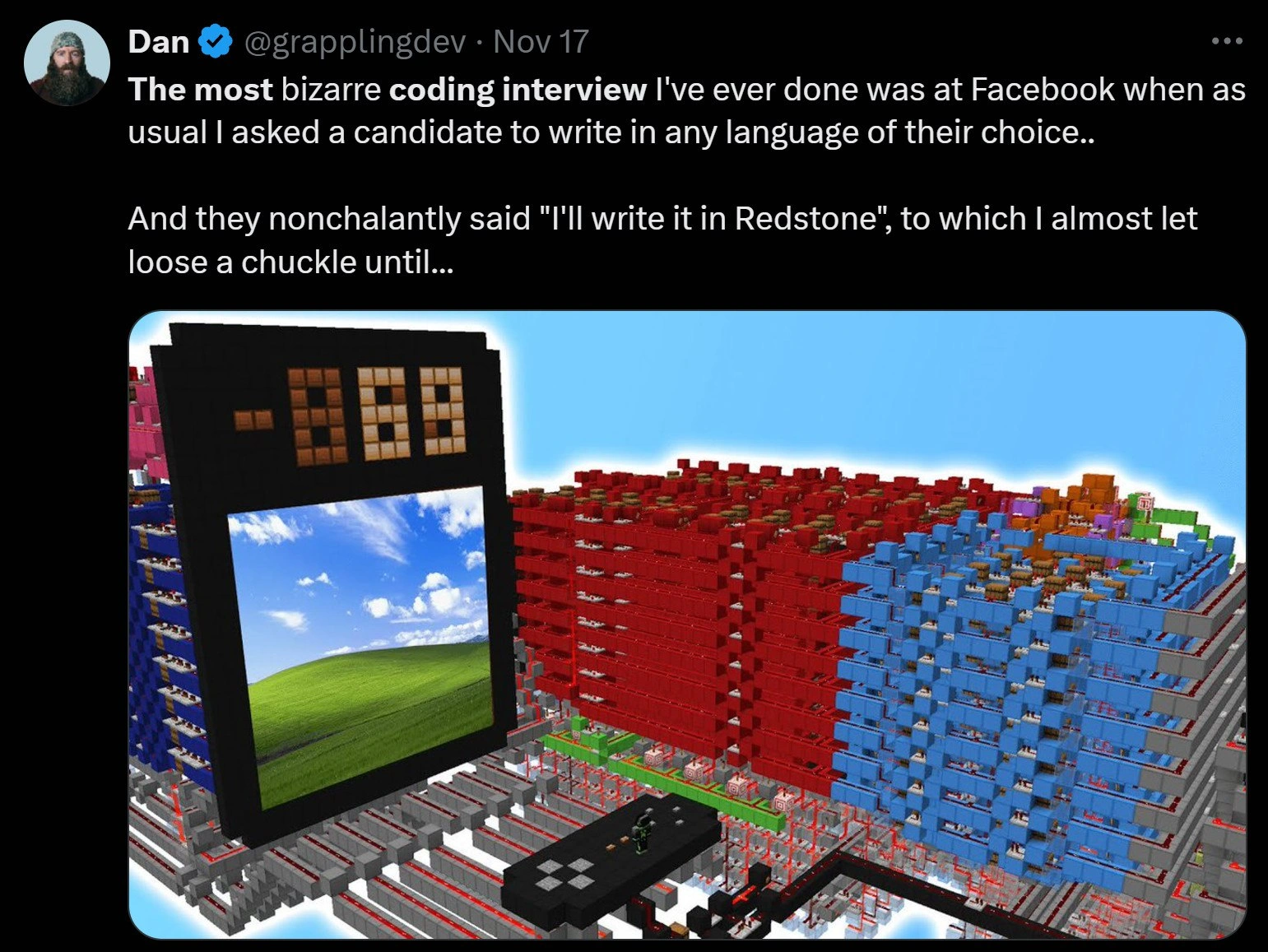
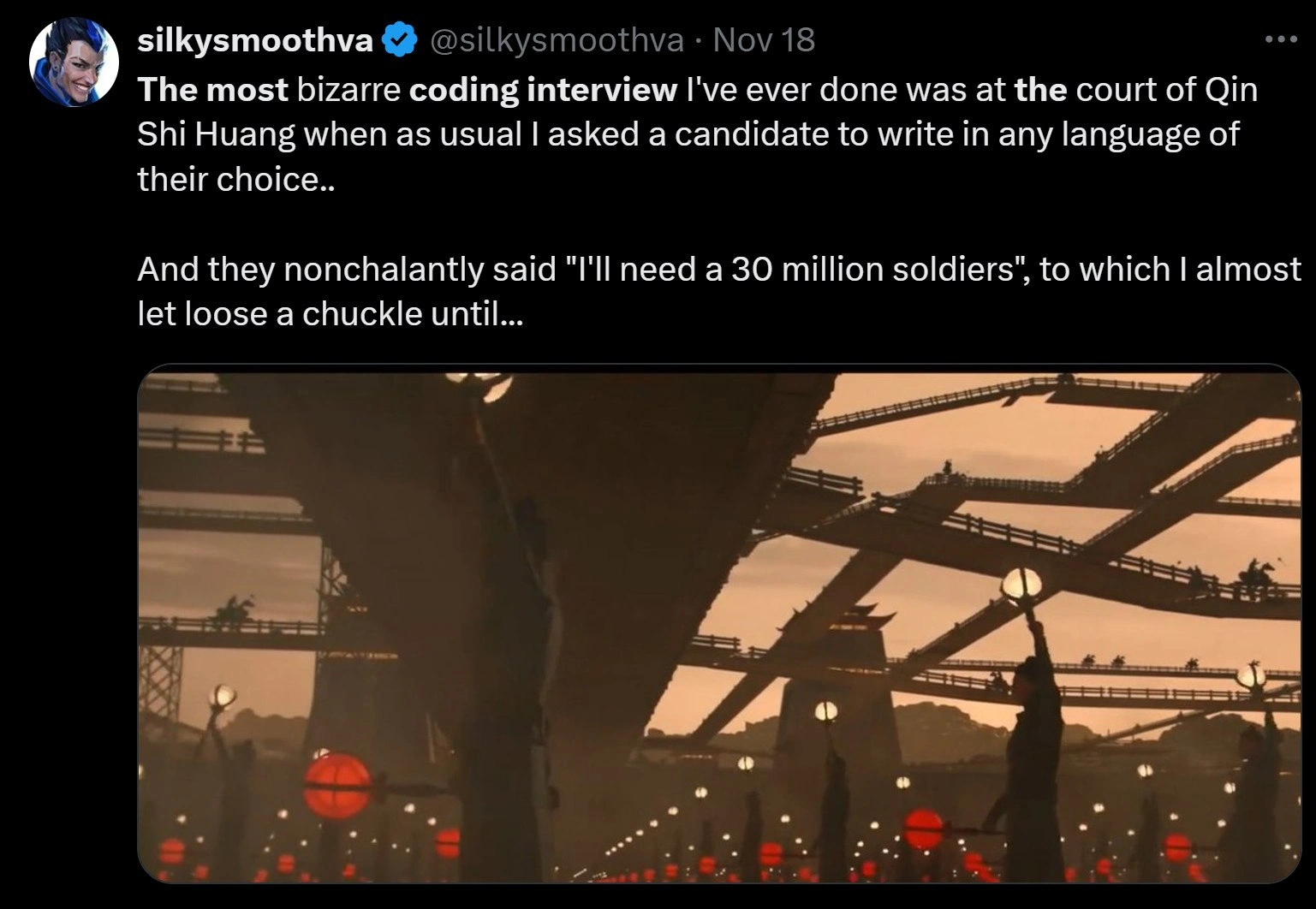
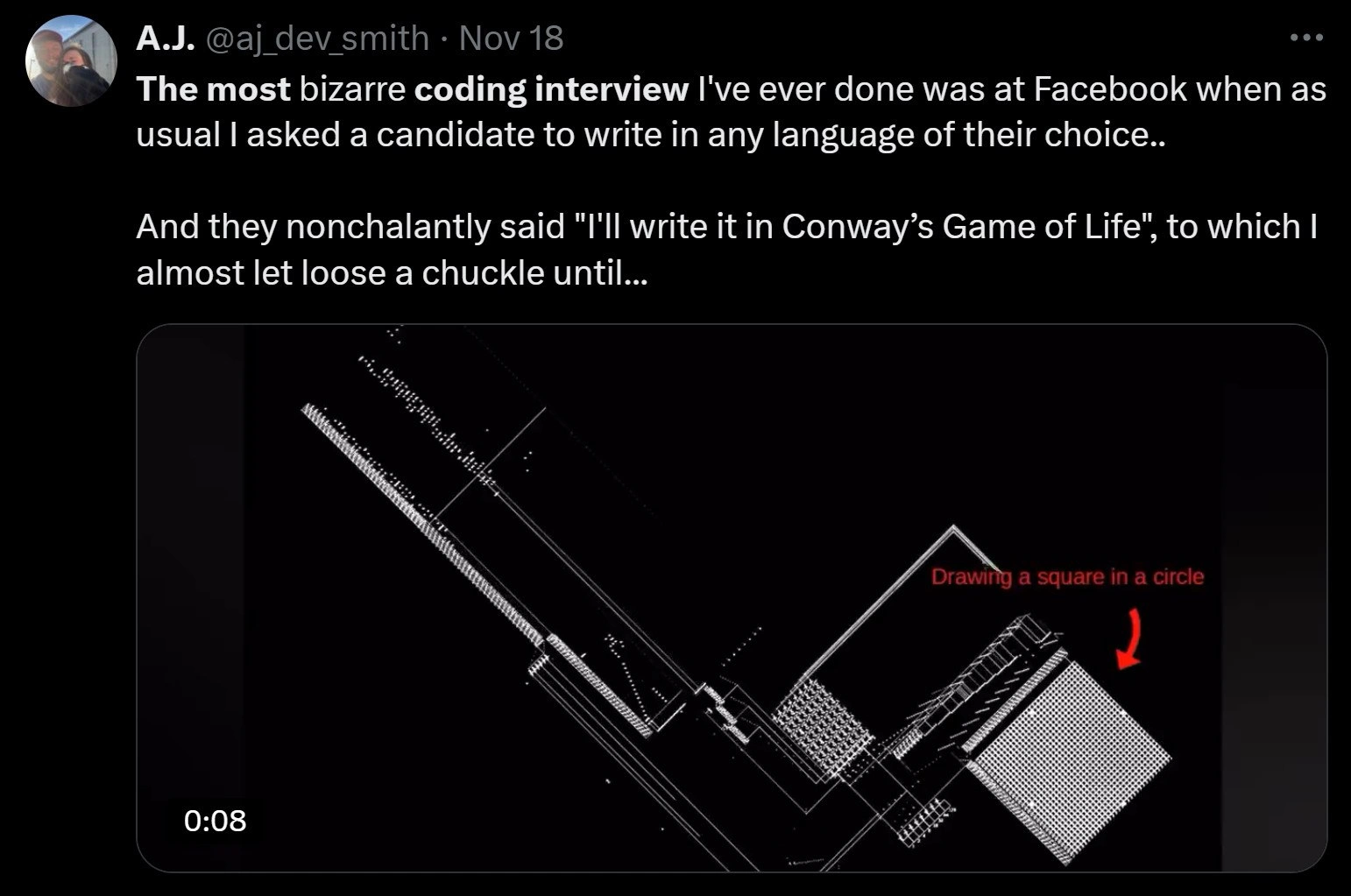
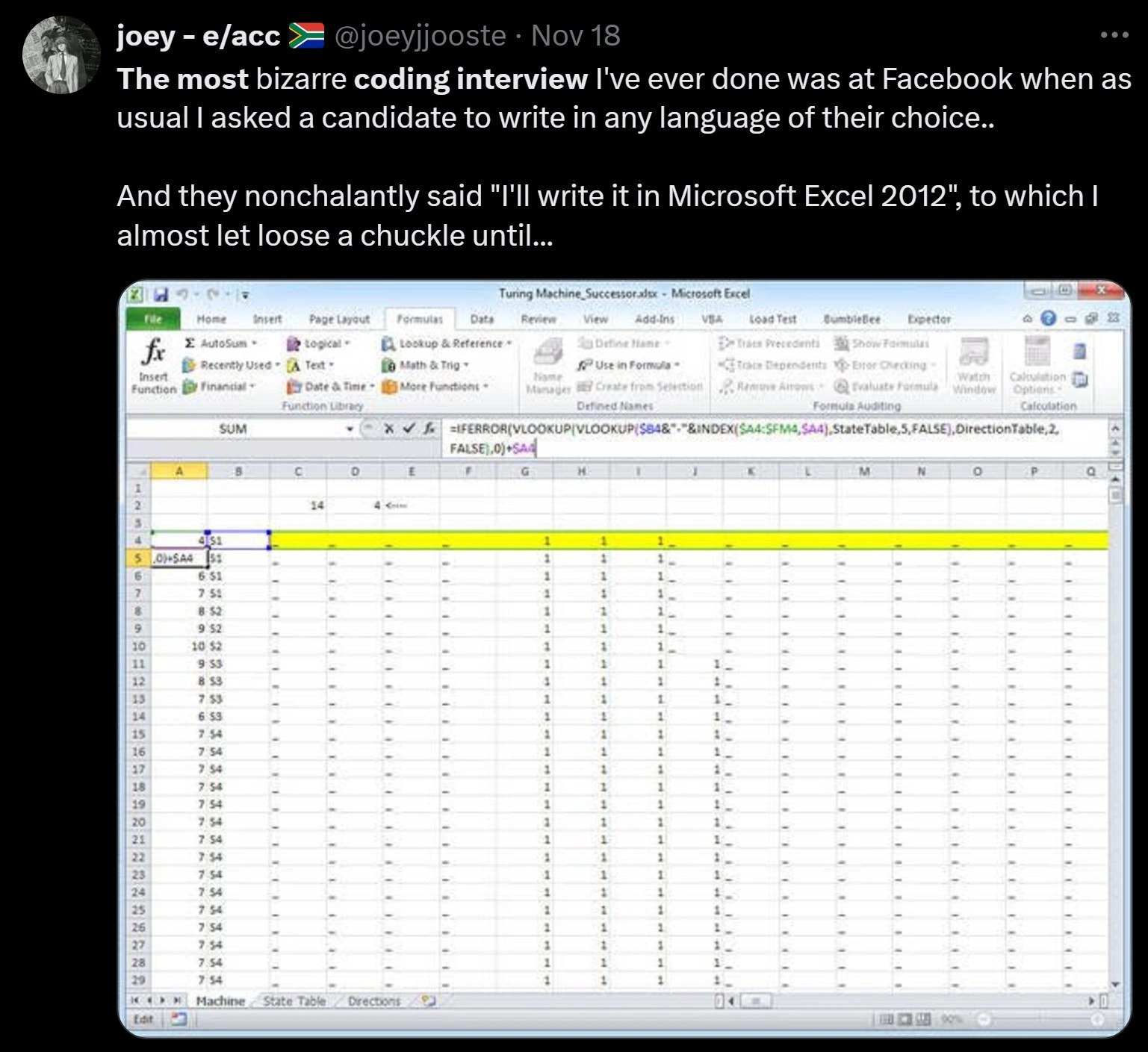
This image is a screenshot of a tweet from the user 'L3 Tweet Engineer' (@MegaBasedChad). The tweet reads: 'The most bizarre coding interview I've ever done was at Facebook when as usual I asked a candidate to write in any language of their choice.. And they nonchalantly said "I'll write it in LabVIEW", to which I almost let loose a chuckle until...'. Below the text is an image of an extremely complex LabVIEW program, which is a graphical programming environment. The screen is filled with interconnected blocks, wires, and nodes, creating a visually dense and chaotic diagram that resembles a convoluted electronic circuit schematic. The humor stems from the sheer absurdity of choosing LabVIEW, a niche language typically used for industrial automation and data acquisition, for a mainstream software engineering interview at a company like Facebook. The visual chaos of the diagram serves as the punchline, implying the candidate produced something incredibly complex and unreadable to the average developer, turning the interviewer's initial amusement into shock or awe
Comments

7
Anonymous ★ Top Pick The candidate who solves a graph problem in LabVIEW during an interview doesn't just get the job; they get a purchase order for a PXI chassis and a team of hardware engineers to maintain their code
  1. Anonymous ★ Top Pick

    The candidate who solves a graph problem in LabVIEW during an interview doesn't just get the job; they get a purchase order for a PXI chassis and a team of hardware engineers to maintain their code

  2. Anonymous

    We stopped the interview when his LabVIEW solution passed all tests but the pull-request diff just read “Binary files differ” - turns out our entire review process wasn’t type-safe for pixel art

  3. Anonymous

    When you've spent 20 years explaining to management that code complexity isn't measured by how colorful the IDE is, and then someone walks into your interview and proves you wrong

  4. Anonymous

    When they said 'any language,' they probably expected Python or Java, not a visual programming environment typically used for controlling oscilloscopes anddaq systems. The interviewer's suppressed chuckle perfectly captures that moment when you realize the candidate is technically correct - the best kind of correct - but you're now facing a whiteboard session that looks like a circuit diagram had a baby with a flowchart. Bonus points if they actually solved the problem, because debugging that spaghetti of wires would make any merge conflict look trivial

  5. Anonymous

    Pro tip: don’t say “any language” unless your rubric can score implicit parallelism and the number of pink wires - otherwise your big‑O talk becomes cable management

  6. Anonymous

    LabVIEW for LeetCode: dataflow execution so parallel, it short-circuits the interviewer's mental model faster than a floating-point wire

  7. Anonymous

    Say 'any language' in a coding interview and a LabVIEW veteran will turn your Big-O rubric into a wiring-density metric - suddenly you're grading patch panels instead of pseudocode

Use J and K for navigation