
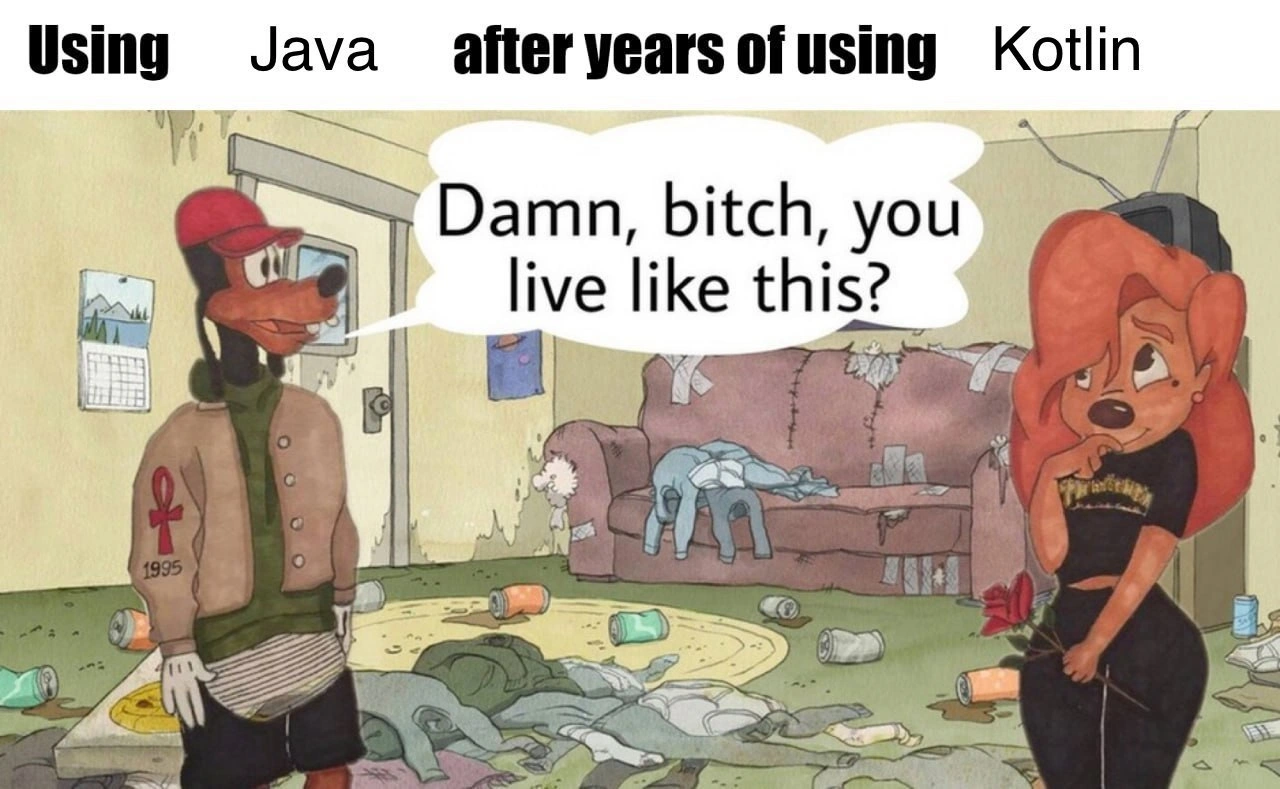
Kotlin Developer Revisits Java and Gets a Culture Shock
Description
This meme uses the 'Damn, Bitch, You Live Like This?' comic format to compare programming languages. The top of the image has text that reads, 'Using Java after years of using Kotlin'. The main panel illustrates a scene where a cartoon character, styled after Max from 'A Goofy Movie', stands in a doorway looking disgusted at a female character, Roxanne, who is in an extremely messy, garbage-strewn room. A speech bubble from the male character says, 'Damn, bitch, you live like this?'. The technical humor lies in the metaphor: the messy room represents a typical Java codebase, which is often perceived as verbose, full of boilerplate, and lacking the modern conveniences and safety features of Kotlin. For senior developers, especially in the Android or backend ecosystems, who have migrated to Kotlin, going back to a legacy Java project can feel like a significant downgrade in developer experience, hence the look of disgust




Comments
7Comment deleted
After years in Kotlin, opening a Java file feels like archaeology. You have to dig through five layers of boilerplate getters and setters just to find the fossilized business logic, all while praying you don't awaken a NullPointerException
Going from Kotlin back to Java feels like downgrading from a sealed class hierarchy to a 600-line visitor pattern the intern auto-generated with Lombok - the garbage collector isn’t the only thing wading through trash
Going back to Java after Kotlin is like explaining to stakeholders why you need three classes, two interfaces, and a factory pattern just to pass a nullable string between activities
After years of Kotlin's null-safe bliss, returning to Java feels like debugging a NullPointerException in production at 3 AM - except the production environment is your entire codebase, and the exception is every line that doesn't have '?.let { }'. You thought you escaped the getter/setter factory pattern, but Java's sitting there with 47 lines of boilerplate for what Kotlin does in one 'data class' declaration, asking if you want to manually implement equals(), hashCode(), and toString() again 'for old times' sake.'
After a stint in Kotlin, opening a Java monolith feels like SSHing into a legacy VM: builders, DTOs and checked exceptions stacked to the ceiling, with Lombok acting as duct tape on the torn couch
After years in Kotlin, opening a Java file feels like disabling -Xboilerplate - getters, setters, and three checked exceptions guarding every null
After Kotlin data classes, crafting a Java POJO with equals/hashCode/toString is like hand-rolling cigarettes in a tobacco-free world