TypeScript Developer's Culture Shock Returning to a Vanilla JavaScript Project
Why is this Languages meme funny?
Level 1: Messy Room Surprise
Imagine you have a friend who always keeps their room super tidy. Every toy is in the right place, the floor is clean, and you can find anything you need because it’s all organized. Now picture that your tidy friend goes to visit another friend, but this friend’s room is a complete mess – toys and clothes are thrown everywhere, soda cans and pizza boxes are on the floor, and you can’t even see the bed under all the junk! Your tidy friend walks in and immediately goes, “Whoa, you live like this?!” in shock.
This is just like what happens to a programmer who’s used to a clean and organized coding environment (that’s TypeScript) when they go back to using a messy, anything-goes environment (that’s plain JavaScript). In the clean room (TypeScript), everything has a label and a place, so you know where to find things and what they are. In the messy room (JavaScript), nothing is labeled and it feels chaotic, even though you can still play or live there. The meme is funny because it shows that shock in a very relatable way. Even if you’re not a coder, you understand instantly: going from a neat space to a super messy one is surprising and a bit overwhelming. For someone used to the neat space, the messy room is both amusing (“how do you even find things here?”) and stressful (“I hope nothing scary is hiding in that pile!”). That’s exactly how a developer feels switching back to untyped JavaScript – and why it makes for a great joke everyone in programming can laugh at.
Level 2: TypeScript vs JavaScript Mess
Let’s break down why this scenario feels so messy by explaining the tools and terms involved in this joke:
JavaScript is a dynamically typed language. This means a variable like
xcan hold any type of data (number, string, object, etc.), and the language won’t complain if you later assign a different type tox. You could start withx = 5(a number) and later dox = "five"(a string), and JavaScript just goes with it. There’s no compile-time check to prevent that kind of change. This gives you a lot of flexibility, but it also means mistakes (like using the wrong type of value) might only show up when you run the code.TypeScript is a language built on top of JavaScript that adds static typing. In TypeScript, you (or the compiler) specify what type each variable and function should be. If you say
let count: number = 5;, thencountis expected to always be a number. If later your code tries to docount = "five";, the TypeScript compiler will throw an error and refuse to compile the program until you fix it. This is called type safety – the language helps prevent you from mixing up types in ways that don’t make sense. It’s like having a set of rules that catch you if you try to put a square peg in a round hole.Type safety in practice means fewer bugs at runtime. If a function is supposed to return a string, TypeScript will enforce that it actually returns a string (not, say,
undefinedor a number). Think of it as clearly labeled bins for your data. If a bin says “toys” and you accidentally try to put a sandwich in it, someone will stop you immediately. TypeScript is that someone: “Hey, this variable should hold a toy (number), not a sandwich (string)!” In JavaScript, no one stops you – you might discover much later that there’s a sandwich where a toy should be, and by then, ants have gotten to it (yuck!).Implicit
anyis a concept from TypeScript. The typeanyessentially turns off type checking for a variable – it’s like saying “I don’t know what this is, could be anything.” If you don’t give a variable a type and TypeScript can’t infer it from context, it will default toany. For example,let mystery;(with no type and no value) becomes typeany. Using a lot ofanyis generally frowned upon in TypeScript because it undermines the safety net (you’re basically back to JavaScript’s uncertainty). That’s why there’s a compiler optionnoImplicitAnyto force you to explicitly annotate types instead of falling back toanyaccidentally. Now, JavaScript by nature is like implicitanyeverywhere – the language just doesn’t ask for type info. Every variable is amysterytype unless you do manual checks. This is why a codebase without TypeScript can feel so unruly to someone used to strict types: it’s as if every label is missing, and you have to figure out what everything is on your own.Runtime errors vs Compile-time errors: A compile-time error (TypeScript’s specialty) is caught while you’re writing or building the code, before you run your program. A runtime error (common in JavaScript) is when the program actually runs and then crashes or misbehaves at a certain line. TypeScript shifts a lot of potential runtime errors (like calling a function with a wrong type) to compile-time errors (so you catch and fix it early). For example:
function greet(name: string) { return "Hello, " + name.toUpperCase(); } greet("Alice"); // ✅ OK, returns "Hello, ALICE" greet(42); // 🚫 Compile Error: Argument of type 'number' is not assignable to parameter of type 'string'.In the TypeScript code above,
greet(42)is flagged immediately by the compiler – you’ll get a red squiggly in your editor and the code won’t compile, because you promised to only callgreetwith a string. Now, here’s the equivalent in plain JavaScript:function greet(name) { return "Hello, " + name.toUpperCase(); } console.log( greet("Alice") ); // "Hello, ALICE" console.log( greet(42) ); // ❌ Runtime Error: name.toUpperCase is not a functionIn JavaScript, you can call
greet(42)and the program will try its best to run. There’s no error at the call site. Only when the code actually executesname.toUpperCase()withnamebeing the number 42 does it throw aTypeError(because numbers don’t have atoUpperCasemethod). This would likely crash that part of your application or at least cause a nasty bug. So without TypeScript, you often discover type problems late, when the app is already running (or even in production if you didn’t test that scenario!). With TypeScript, you catch many of those problems early, during development.IDE autocompletion and better tooling is another big advantage of TypeScript. Because the editor knows the types of your variables and objects, it can help you write code faster and with fewer mistakes. For instance, if you have an object
let order: Order = { ... }, as soon as you typeorder.TypeScript can prompt you with suggestions (maybe.totalAmount,.items,.checkout()etc., whatever is defined on theOrdertype). It’s like an auto-suggestion that’s almost always accurate. In JavaScript, you might get some guesses, but the editor isn’t sure – it doesn’t have a guaranteed list of properties for a plain object. You might end up memorizing property names or constantly checking the documentation. Autocompletion is like having a cheat-sheet or an assistant handing you the right tool without you rummaging through the toolbox. Once you get used to it, coding without it feels slower and prone to typos (ever accidentally calltoUppercase()instead oftoUpperCase()? TypeScript would catch the casing mistake, JavaScript would not and just give youundefinedback at runtime).
In summary, working with TypeScript is like having a well-organized, labeled environment with safety checks at every turn. Working with plain JavaScript is more like improvising in a cluttered space – you can do a lot of creative things, but you have to be extra careful since there’s nothing to automatically catch your mistakes. So when developers say “returning to untyped JavaScript feels like moving into a code landfill,” they’re humorously expressing that it’s a messy step backwards in terms of code cleanliness and reliability. It’s the difference between having a guardrail versus free solo climbing – sure, you can do both, but one slip in JavaScript and you’re in trouble. The meme uses that messy room picture to get this point across in a way that’s instantly understandable even to less experienced devs: clean and structured vs. messy and unpredictable.
Level 3: Dynamic Disarray
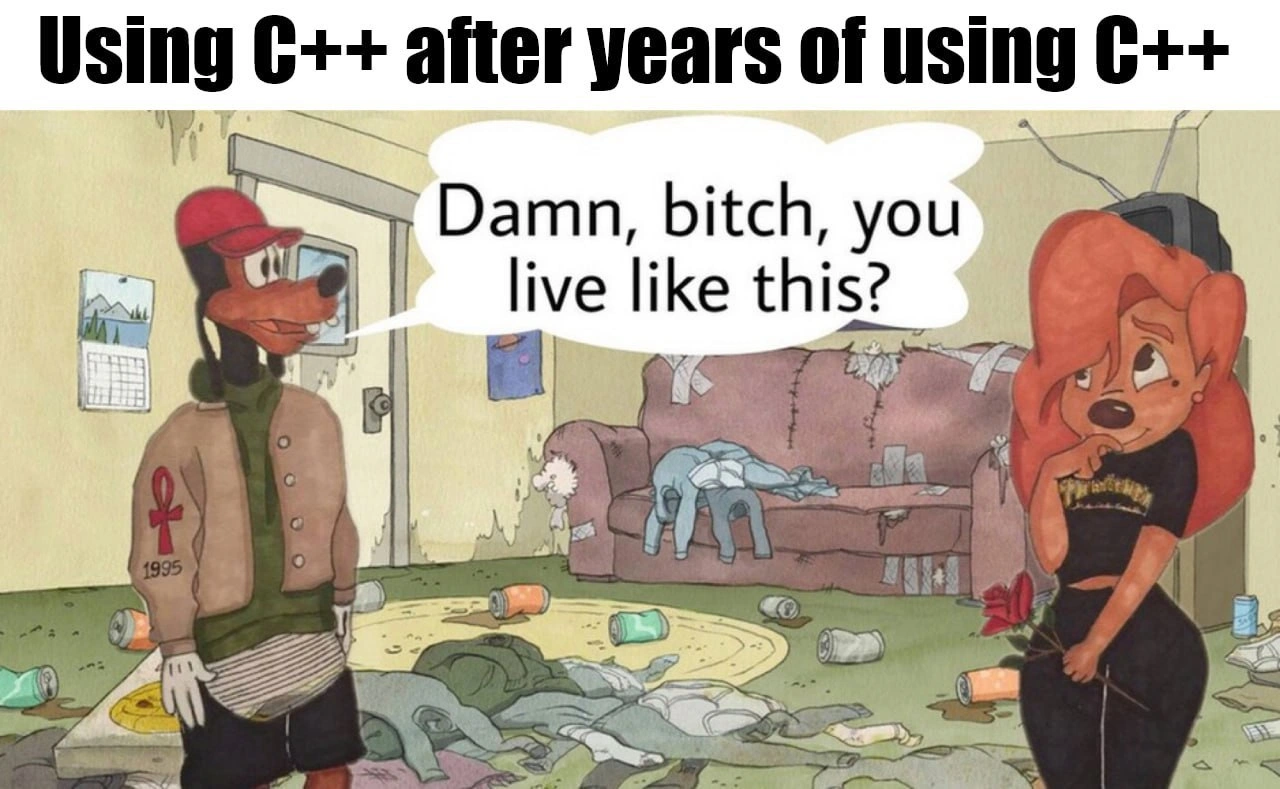
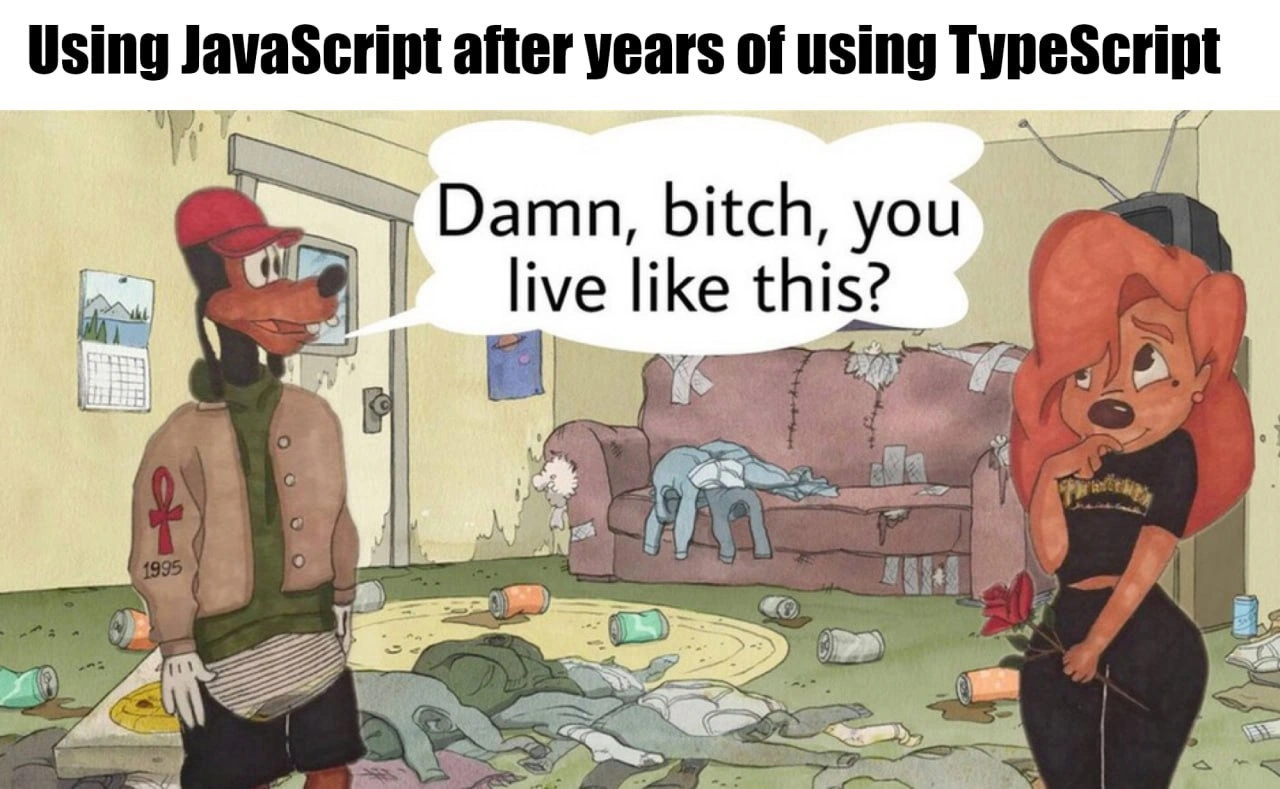
For a seasoned front-end engineer, this meme hits home hard. After years of enjoying TypeScript’s orderly structure, dropping back into a pure JavaScript codebase can feel like walking into a hoarder’s apartment. The top banner sets the scene: “Using JavaScript after years of using TypeScript.” Below it, in the cartoon, a Goofy-like character stands in shock at the doorway of a trashed apartment. Garbage is strewn everywhere – pizza boxes, soda cans, clothes on the floor, exposed wires hanging from the ceiling. He blurts out to the embarrassed resident:
“Damn, bitch, you live like this?”
in utter disbelief. This line perfectly captures the shock and disapproval a TypeScript aficionado experiences upon seeing a messy JavaScript project. It’s the exact reaction many of us have had looking at an untyped codebase: “Oh no... how do people manage in this chaos?”
The visual metaphor is especially telling to experienced devs. The messy room = a codebase with poor CodeQuality (no clear structure, everything thrown around). In TypeScript, every piece of data has a place and a label (a type!). But in vanilla JavaScript, it’s like every variable is a mysterious object on the floor – you don’t know if that soda can (variable) is empty, full, or actually a grenade waiting to explode (throw a runtime error). All the implicit any types in JavaScript are the clutter: nothing is explicitly labeled, so you’re constantly guessing “What is this and what can I do with it?”.
TypeScript vs JavaScript here is clean vs messy. With TypeScript, you had a nice cleaning routine: the compiler wouldn’t even let you build the project if something didn’t fit the right shape. Did you try to call a function with the wrong type of argument? Error, fix it before proceeding. It’s like having a strict house rule that every dish must be washed and put away immediately – no pizza boxes piling up. In JavaScript, there’s no such enforcer. Pass a string when a function expects a number? JavaScript just shrugs and tries to make it work somehow. Often that means it’ll convert the types in unpredictable ways. The result might be a weird bug that doesn’t show up until much later. That’s the equivalent of finding a rotten slice of pizza under the couch weeks after the party.
Seasoned devs also groan about losing IDE autocompletion and instant feedback. In a TypeScript project, your editor is like a GPS or a smart assistant: you type obj. and it immediately shows you obj’s properties and methods. It’s confident because it knows the type of obj (maybe obj is a User and it lists .name, .email, etc.). In a JavaScript project, typing obj. might give you nothing useful – the poor editor has no clue what obj contains, so you’re on your own. It’s like fumbling in the dark. You end up constantly manually checking or logging things to understand what you have. This loss of tooling support is painfully noticeable to anyone accustomed to TypeScript. You suddenly feel much less sure about every step, like walking on a wobbly floor.
Real-world war stories fuel this meme’s relatability. Many of us have inherited a large legacy front-end codebase written in plain JavaScript (perhaps built long before TypeScript became popular). Picture thousands of lines of jQuery spaghetti or an old AngularJS 1.x app with no TypeScript. You dive in to fix a bug or add a feature, and immediately vanilla_js_anxiety hits. What does this function expect? What does it return? You find variables like data or result being reused all over, holding different kinds of values at different times. There are no interfaces or types to guide you, so you must run the code or add console.log statements to see what’s happening. It’s slow and nerve-wracking. You’re basically doing detective work that the TypeScript compiler would have done for you. It really feels like moving from a well-organized workshop into a cluttered garage sale. You might literally exclaim, “How can anyone live (or code) like this?!” – which is the meme’s punchline.
Then there’s the concept of implicit_any_everywhere as a lifestyle. In TypeScript, using the any type is like leaving a banana peel on the floor – dangerous if overused. Good TypeScript codebases enable strict mode and noImplicitAny, effectively outlawing that chaos or at least highlighting every untyped variable so you address it. But JavaScript? JavaScript is all bananas, no warnings. Everything is any by default because the language doesn’t enforce types at all. The joke is that going back to JS is like disabling all those strict rules and seeing a codebase littered with what a TypeScript user perceives as booby-traps. It truly can feel like a ts_to_js_regression in maintainability: you’ve lost the guardrails that kept your codebase tidy.
The chaotic apartment imagery even maps to specific code smells:
- Clothes and trash everywhere: Variables and values of all sorts are defined wherever and whenever, with no clear structure. It’s like finding a pair of socks in the fridge – in code terms, maybe a function is adding properties to an object out of nowhere, or global variables are being modified from different places. A TypeScript project would usually organize and compartmentalize these things more cleanly.
- Peeling drywall and a torn couch: Signs of technical debt. Perhaps the code has outdated comments, deprecated APIs still being used, or hacks to get around missing features – similar to broken furniture that really should be replaced, but instead people just live with it. An example might be a function that catches an error and just prints “TODO: handle this properly” (but never does).
- Cables dangling from the ceiling: This brings to mind tangled control flow or asynchronous logic that’s not well managed. Maybe there are event listeners that never get cleaned up, or a chain of callbacks that’s prone to breaking – like wiring in a house that’s half-finished and dangerous. In a well-typed code, you might have more structured patterns (like using Promises or async/await with defined types for each step), whereas here it’s all just hanging loose.
- Bashful resident amid the mess: This could be the developer who’s been working in that code landfill, feeling a bit embarrassed when a newcomer sees it. Often teams know their codebase has problems (“yeah, we know it's kinda messy...”), but without time or resources to do a big refactor (like introducing TypeScript or cleaning up the architecture), they just live with it. That character’s face is exactly the look of a dev saying, “Heh, yeah, sorry about the mess, but it works... mostly.”
All these details land with a chuckle and a wince for experienced developers. The humor comes from recognition. Everyone knows some part of software development that’s messy or less than ideal, and dynamic JavaScript codebases are a classic example. The meme exaggerates it by comparing it to literally living in squalor, which makes us laugh. But it also motivates many of us to say, “Ugh, I do not want my code to look like that room. Time to add some types or cleanup!” It’s a comedic reminder of why we value structure and tools like TypeScript in the first place. After basking in TypeScript’s cleanliness, going back to untyped JavaScript really does feel like trading a nice, neat apartment for a dumpster. It’s hilarious and a little horrifying – and that mix of emotions is exactly why developers are sharing this meme.
Level 4: Dynamic Entropy
In theoretical terms, moving from TypeScript’s rigid type system back to plain JavaScript is like dramatically increasing the entropy of your code’s universe. TypeScript’s static type system imposes mathematical order: every variable’s set of possible values is constrained and well-understood before the program runs. This is akin to reducing uncertainty – the compiler acts as a kind of theorem prover, verifying that certain kinds of errors (like treating a number as a string or accessing a property that doesn’t exist) are impossible in a well-typed program. It’s a bit like having a detailed blueprint that guarantees all the parts will fit together.
When you strip those type annotations away and drop into vanilla JavaScript, the constraints evaporate. Any variable could hold anything at any time – a string today, an object tomorrow, undefined when you least expect it. The space of possible states for your program explodes combinatorially. In information theory terms, the system’s entropy skyrockets because the uncertainty about each value’s nature is at a maximum. What was once a tidy set of known possibilities becomes an unbounded sea of potential chaos. The code still runs, but now you’ve lost all the compile-time proofs that kept the chaos in check.
TypeScript essentially performs a form of lightweight formal verification at compile time. Its structural type system checks that functions and objects line up correctly, almost as if it’s solving a puzzle or proving small lemmas about your code. It’s not full formal correctness, but it’s a huge safety net. In fact, TypeScript’s type system is so expressive it’s Turing-complete – you can encode complex logic in the types alone, turning the compiler into a mini interpreter that ensures your program makes sense from a type perspective. This is like an entire subprogram running behind the scenes, guarding the consistency of your code.
Now imagine taking that subprogram – that guardian – and throwing it away. All the static guarantees are gone, leaving you with pure dynamic behavior. Computer scientists call TypeScript a form of gradual typing: it lets you opt-in to as much type safety as you want, mixing typed and untyped code. But going from “fully typed” back to “fully untyped” is jarring. In the theory of gradual typing, there’s a concept of blame – if a runtime type error occurs, it’s blamed on the boundary between the typed and untyped sections. In pure JavaScript, everything is untyped, so the entire program becomes this Wild West where any mistake reveals itself only at runtime (and there’s no type system to blame!). It’s as if the neat, governing laws of your program’s universe suddenly got repealed.
So from a high-level CS perspective, the humor here comes from that spike in uncertainty and disorder. A TypeScript veteran returning to JavaScript is like a scientist leaving a controlled laboratory (where experiments are predictable and governed by strict rules) and stepping into a chaotic bazaar (where anything goes and bizarre interactions abound). The fundamental entropy of the codebase has increased – and with it, the engineer’s cognitive load to reason about the program. No wonder it feels like walking into a dumpster fire of possibilities, where previously proven truths (about types) no longer hold. This is the deep theoretical backbone of why the lack of a type system can viscerally feel like a mess.
Description
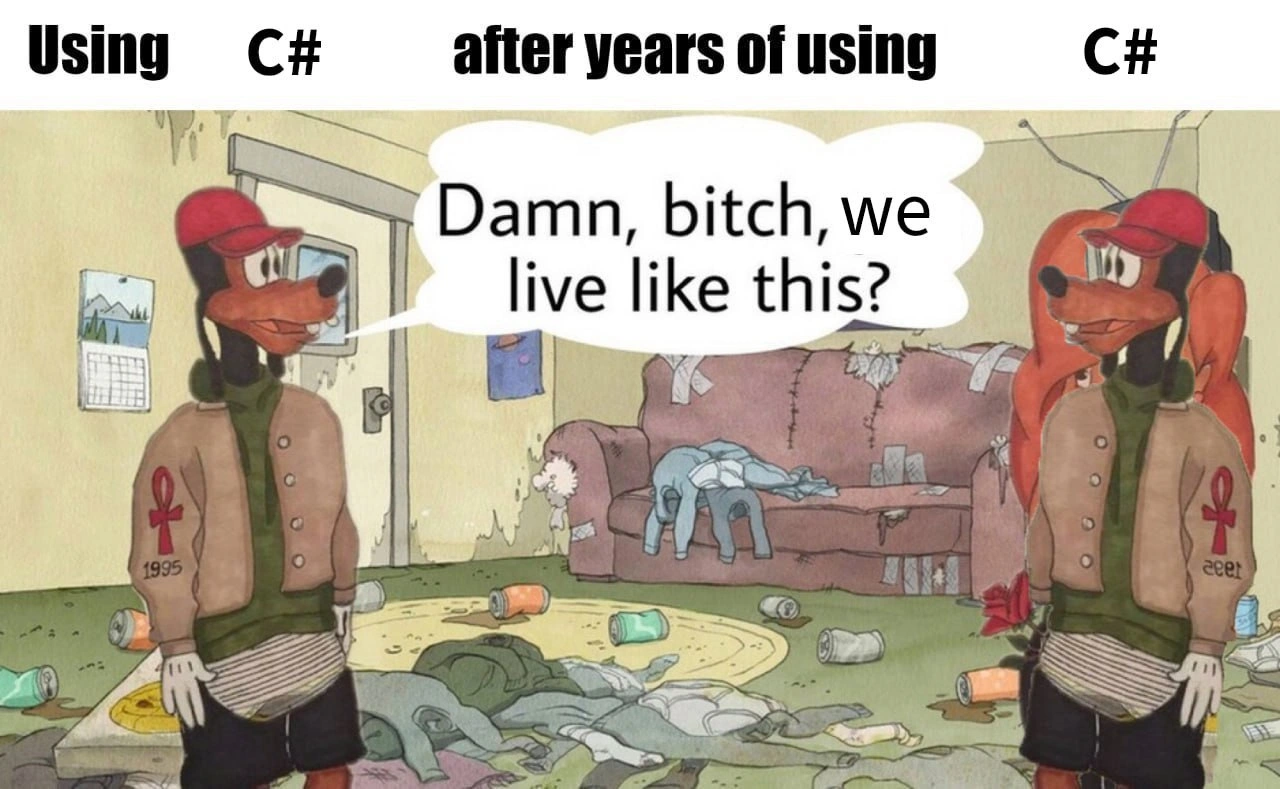
This is a two-panel meme using the 'Damn, Bitch, You Live Like This?' format, featuring cartoon dog-like characters. The top panel has a white banner with black text that reads, 'Using JavaScript after years of using TypeScript'. The bottom panel shows one character standing in a doorway, looking with disgust at another character who is in a very messy and dirty room. The standing character has a speech bubble saying, 'Damn, bitch, you live like this?'. The messy room, with clothes and trash strewn everywhere, serves as a metaphor for a chaotic, untyped JavaScript codebase. The technical joke is aimed at developers who have become accustomed to the structure, safety, and predictability of TypeScript. For them, returning to a vanilla JavaScript project, with its lack of static type-checking, can feel disorganized and prone to unexpected runtime errors, much like navigating a filthy apartment. The meme captures the jarring developer experience of losing the safety net that a strong type system provides

Comments
7Comment deleted
Going back to vanilla JavaScript after TypeScript is like swapping your IDE for Notepad. You technically have all the freedom in the world, including the freedom to pass a string to a function that's expecting an object and only find out in production at 3 AM
Going back to raw JS after TypeScript is like deleting your schema and trusting prod data to self-document - sure, it runs, but your pager just signed a long-term lease
Going back to JavaScript after TypeScript is like being a surgeon forced to operate with oven mitts on while someone keeps yelling "undefined is not a function" from the observation deck
After years of TypeScript holding your hand with compile-time guarantees and IntelliSense that actually knows what properties exist, returning to vanilla JavaScript feels like being thrown into a room where 'undefined is not a function' is just Tuesday, and the only type checking happens at 3 AM in production when a customer reports that checkout is broken because someone passed a string where a number was expected six months ago
Switching from TypeScript back to JS is like moving from strong consistency to eventual type consistency - everything ships, and your pager discovers the schema at runtime
Going from tsconfig strict: true to a legacy .js repo is like downgrading from zero-trust to chmod -R 777: every value has root and the pager only says "undefined is not a function"
After TS's type sentinels, JS feels like microservices without contracts - liberating until the undefined cascade in prod