Skip to content
DevMeme
7505 of 7506
Grandpa Recalls Java, C, Ruby, and Python

Grandpa Recalls Java, C, Ruby, and Python

Why is this Languages meme funny?

Level 1: The Toolbox Names

Imagine an old carpenter telling children that people once used many special tools named Coffee, C, Ruby, and Python. The children think those are a drink, a letter, a jewel, and a snake, while the carpenter remembers that each tool worked differently and inspired endless arguments. It is funny because the names sound completely made up—yet programmers use them every day with perfectly serious faces.

Level 2: What Makes a Language

A programming language is a structured way to describe data and instructions. It usually defines:

  • Syntax: which sequences of symbols are valid, such as where parentheses or indentation belong.
  • Semantics: what valid code means when it runs.
  • Types: rules for values such as numbers, text, collections, and user-defined objects.
  • Control flow: ways to make decisions, repeat work, and call reusable functions.
  • Runtime behavior: how memory, errors, concurrency, and external resources are managed.

A compiler translates source code into another form, perhaps native machine instructions or portable bytecode. An interpreter executes code through a runtime, often after some internal compilation. Real implementations mix these techniques: a virtual machine may interpret bytecode first and compile frequently used sections later. “Compiled versus interpreted” is therefore not a permanent personality test for the source language.

Names help humans remember and discuss these systems, but the computer ultimately cares about exact grammar and behavior. Java’s coffee-cup imagery does not make it more caffeinated, Python code does not slither, and Ruby programs are not priced by carat. The wordplay works because developers routinely use these strange names as if they were perfectly ordinary professional terminology.

Grandpa and the listening children add developer nostalgia. To an experienced programmer, a language name can evoke a first project, a painful build tool, or a beloved community. To the children in the frame, the same list sounds like an elder insisting that people once argued passionately over whether coffee, a letter, a jewel, or a comedy troupe had the best braces.

Level 3: Syntax from the Attic

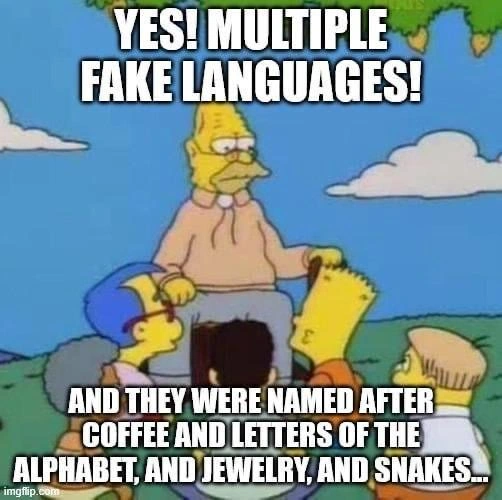
The image gives Grandpa Simpson the role of a programming-language historian addressing children who apparently come from a future with fewer ways to tell computers what to do:

YES! MULTIPLE FAKE LANGUAGES!

AND THEY WERE NAMED AFTER COFFEE AND LETTERS OF THE ALPHABET AND JEWELRY, AND SNAKES...

The objects are a compact developer roll call: Java, C and its relatives, Ruby, and Python. Described without technical context, decades of language design sound like four items pulled from a café gift shop. Grandpa’s solemn posture makes ordinary vocabulary resemble folklore from a civilization that solved distributed computing but remained unable to solve naming things.

The real etymologies are even better because the caption is only literally right at the surface:

Meme clue Language Naming history beneath the clue
Coffee Java The project began as Oak, then needed a new name; Java emerged from a naming process with a strong coffee association.
Alphabet letters C family C evolved from B and BCPL. Dennis Ritchie left open whether “C” continued the alphabet or the letters in BCPL. C++ later made the succession an operator joke.
Jewelry Ruby Ruby was deliberately named for the gemstone, partly in playful relation to Perl—another precious-material name.
Snakes Python Python was named after Monty Python’s Flying Circus, not the animal. The snake imagery is a later visual pun that became more famous than the source joke.

This is classic tech-history archaeology: a product name begins as an internal joke, trademark workaround, cultural reference, or convenient short word; the project survives; then the accident becomes a global technical noun. Millions of developers eventually say “Java” without thinking of coffee and “Python” without thinking of either comedians or reptiles. Adoption compiles whimsy into infrastructure.

Calling them “fake languages” creates a second layer. Programming languages are not natural languages that communities evolve for ordinary human conversation, but they are genuine formal languages: sets of valid symbols and structures with rules for what programs mean. Their syntax is deliberately constrained so software can parse it, check it, and execute it without relying on facial expression or conversational repair. A compiler will not infer that a missing brace was “basically obvious,” which is rude but excellent for reproducibility.

The whimsical names also conceal substantial technical differences:

  • C offers low-level control over memory and maps efficiently onto machine operations, making it foundational for operating systems, runtimes, and embedded software.
  • Java commonly compiles source into bytecode for the Java Virtual Machine, with static typing, managed memory, and runtime optimization.
  • Python prioritizes readable, high-level syntax and dynamic behavior; its common implementation compiles source to bytecode executed by a virtual machine.
  • Ruby is dynamically typed and strongly object-oriented, with language features designed to make expressive code pleasant for humans.

Those are families of implementations rather than immutable laws—languages can have multiple compilers and runtimes—but they explain why several languages coexist. Different domains value predictable latency, direct hardware access, portability, rapid development, library ecosystems, safety, or interoperability differently. A language choice is a bundle of trade-offs, not an allegiance to a beverage or gemstone, despite what conference merchandise suggests.

The generational joke is deliberately exaggerated. C dates to the early 1970s, Java and Ruby to the 1990s, and Python’s first public release to the early 1990s; all remained recognizable for decades. Programming languages often outlive the fashionable frameworks built on them because compatibility, libraries, training, and existing systems create enormous switching costs. Grandpa may be recounting an ancient world, but somewhere in that future a bank is probably still waiting for its Java migration to reach sprint planning.

There is also a plausible AI-era reading: perhaps future programmers express goals in ordinary language while tools select or generate the implementation, making today’s collection of hand-authored syntaxes seem quaint. Yet the image does not say that the old languages disappeared or what replaced them. Even if natural-language interfaces become dominant, generated programs still need precise semantics, execution environments, and verifiable behavior underneath. Ambiguity does not vanish; it merely moves to a different layer and gets a nicer chat box.

Description

A square screenshot from "The Simpsons" shows Abe Simpson sitting on a gray tree stump beneath a leafy tree, gesturing as four children, including Bart, listen on a green hillside under a bright blue sky. Bold white Impact-style text with black outlines reads "YES! MULTIPLE FAKE LANGUAGES!" across the top and "AND THEY WERE NAMED AFTER COFFEE AND LETTERS OF THE ALPHABET AND JEWELRY, AND SNAKES..." across the bottom; "imgflip.com" appears in tiny type at lower left. The objects point to programming-language names such as Java, C-family single-letter names, Ruby, and Python. Using the Grandpa-tells-the-children format makes ordinary developer vocabulary sound like an implausible story from a vanished civilization, poking fun at both arbitrary language branding and rapid generational turnover in tech.

Comments

1
Anonymous ★ Top Pick They called it C++ because the expression still evaluates to old C.
  1. Anonymous ★ Top Pick

    They called it C++ because the expression still evaluates to old C.

Use J and K for navigation