C# Developer's Self-Realization About Their Own Ecosystem
Why is this Languages meme funny?
Level 1: The Messy Room
Imagine you have a bedroom that you never clean. In the beginning, it was neat and everything had its place. But over the years, you kept tossing clothes on the floor, leaving toys out, dropping food wrappers, and never really tidying up. After a long time, the room looks like a disaster – there are piles of junk everywhere, a half-eaten sandwich under the bed, and you can barely see the floor. One day you walk in, look around in shock and say, “Oh my gosh, do I really live in this mess?!”
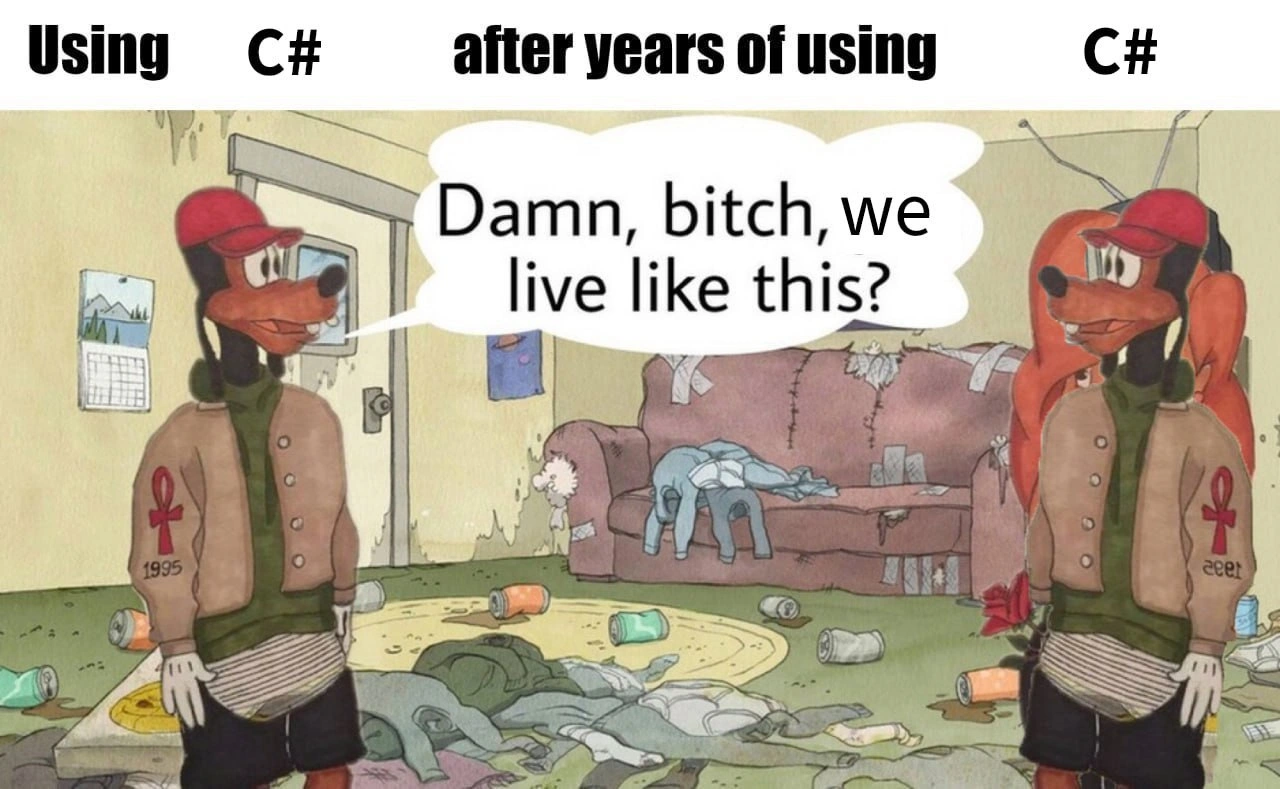
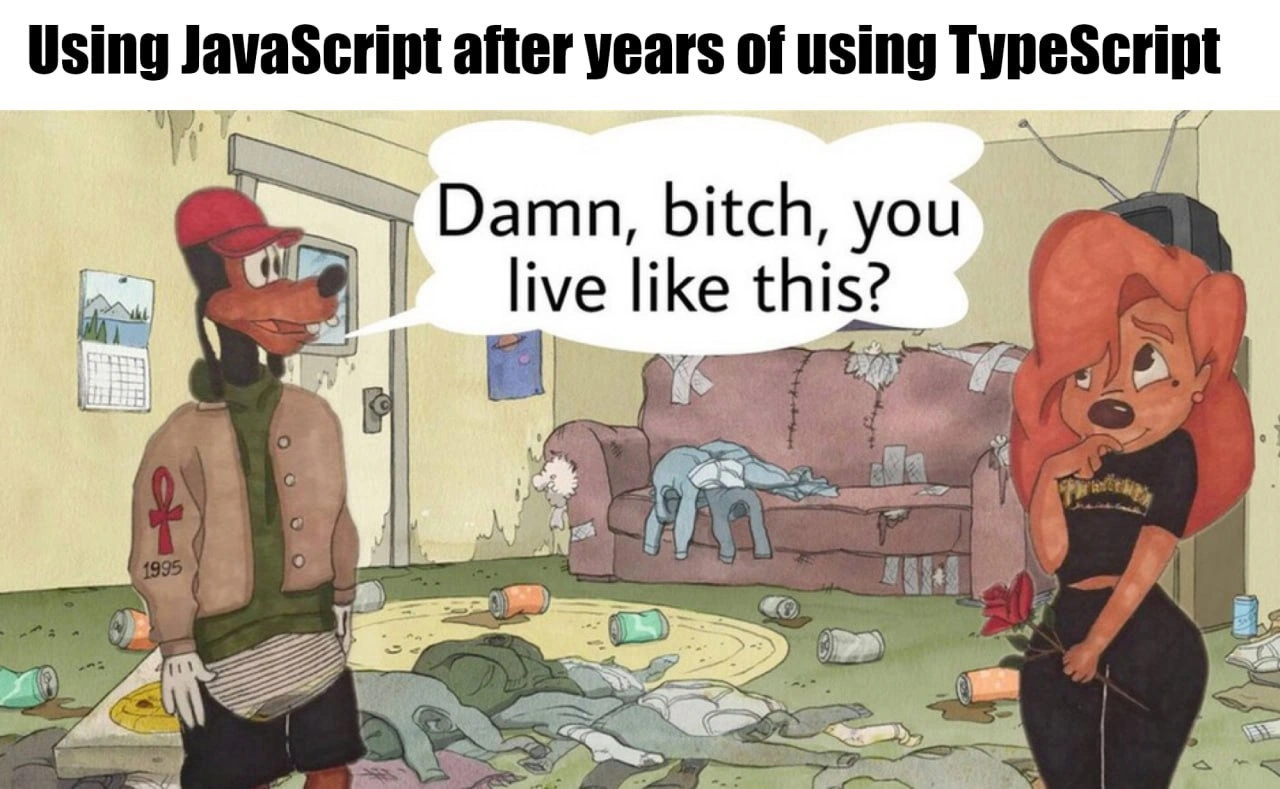
This meme is making the same kind of joke, but about a code project instead of a bedroom. C# is the programming language (kind of like the house), and the code that was written over many years is like all the stuff piled up in the room. In the picture, two cartoon dogs stand in a super messy living room. They’re basically the same character, just one is showing the other how they live. One dog says, “Damn, bitch, we live like this?” which in plain terms means, “Whoa… is our place really this dirty?” It’s funny because the two dogs are realizing the mess they’ve been living in, just like a programmer might suddenly realize how messy their long-term project has become.
So, think of it this way: writing code in C# was supposed to be like having a nice, clean house with someone to take out the trash (C# automatically cleans some stuff for you). But if you ignore all the other cleaning, you can still end up with a dirty house. The joke is that after many years, the programmer’s project became as messy as that cartoon living room, and even the programmer is surprised and a little embarrassed. It’s funny in a kind of “oops, that happened!” way. The meme uses the messy room as an easy-to-understand analogy: no matter how good your house (or programming language) is, you can’t just leave it unattended for years. You have to clean up regularly, or one day you’ll stop and say, “Wow, I’ve been living like this?” and laugh (or maybe cry) at how out-of-hand it got.
Level 2: Garbage Collected, Code Neglected
Let’s break this down in simpler terms. C# is a programming language (created by Microsoft around 2000) that a lot of people use to build big applications. One of C#’s selling points is that it’s a managed language – it uses a technology called a garbage collector to automatically handle memory. In plain terms, that means you, the programmer, don’t have to manually erase or free up memory; the system cleans up data you’re no longer using so your program doesn’t run out of memory. This is great for avoiding certain bugs (like the infamous memory leaks or crashes you might get in lower-level languages like C++). However, just because C# picks up the trash (unused objects in memory) doesn’t mean it keeps your whole project neat and tidy. It won’t organize your code for you or throw out old junk logic – that part is still up to the humans writing the code.
Now, consider a codebase (which simply means the complete collection of source code for a project) that has been around for 10 years. Ten years is a really long time in software! Over that period, many programmers might have worked on it. Requirements (what the software needs to do) probably changed, new features were added, old features became less important, and maybe the original developers moved on and new people took over. All these changes can make the code confusing. If the team isn’t careful to refactor (a fancy word for cleaning up and reorganizing code) regularly, the codebase can turn into a bit of a mess.
Technical debt is a term you’ll hear in this context. It’s a metaphor: imagine you take a shortcut to solve a problem quickly in code – that’s like borrowing time, similar to taking on debt. It’s not “bad” to do so in the moment, but eventually you’re supposed to “pay it back” by cleaning up the code later. If you never pay it back (never refactor or improve the quick-and-dirty code), interest builds up in the form of bigger problems down the road. After years, the “interest” on all those shortcuts is a codebase that’s cumbersome and hard to work with. In our meme’s scenario, the enthusiastic C# developer from years ago kept pushing out features and fixes quickly (incurring lots of technical debt), and now the project is what we call legacy code – that is, older code that has become brittle and full of quirks, but is still in production. Maintaining legacy code is like living in a house that’s gotten cluttered: you can do it, but it’s not pretty or comfortable.
The meme uses a messy living room as an analogy. Picture a living room with soda cans, dirty clothes, and trash everywhere, and maybe things in disrepair (like a couch with springs sticking out or a wall with cracks). This represents the state of the long-lived codebase. Each piece of trash in that room is like a bit of messy code or a “temporary” hack that was never cleaned up. For example, a developer might have left a comment like // FIXME: this is a quick hack in the code and then forgotten about it. That’s like leaving an empty pizza box on the floor and never throwing it away. One or two boxes isn’t a big deal, but imagine doing this for years – eventually, you’re wading through garbage. The code quality (how clean and well-structured the code is) degrades over time if no one tidies it. This is sometimes jokingly called code rot or bit rot – not that the bits literally go bad, but the design slowly decays as more stuff is piled on top without cleaning underneath.
Spaghetti code is another colorful term mentioned (it’s tagged in the meme’s context). Spaghetti code refers to code that’s tangled and twisted, hard to follow — like a bowl of spaghetti where everything intertwines. If a C# project has been patched and extended haphazardly for years, it might have a lot of spaghetti code. You’ll see functions that do too many things, or modules with circular dependencies (where Component A depends on B, and B depends on A, creating a confusing loop), etc. A newcomer opening that code won’t see the clear, logical structure one would expect; instead it feels like a maze.
Now, why C# specifically? C# is known for being a fairly organized language with a rich set of features and a philosophy of writing clean, maintainable code (think of practices like using interfaces, proper class design, etc.). Plus, it’s garbage-collected, which newcomers often interpret as “the system handles the dirty work for me.” The joke is that even with those advantages, you can still end up with a disaster of a codebase if it’s been long enough and not enough care was taken. In fact, sometimes having a garbage collector can give a false sense of security. For instance, a developer might ignore one type of cleanup (memory management) entirely – since C# does it for you – but then also start neglecting other cleanups (like code organization) because there isn’t the immediate pain of crashes. Years later they realize that while memory was automatically managed, their application logic was not. It’s as if you had a robot maid that only takes out the trash, so your garbage bins are always empty, but that maid doesn’t dust, doesn’t organize the shelves, doesn’t wash the dishes – eventually the house is filthy in every other way! The trash was never overflowing (memory was fine), but look around: there’s dirt and clutter everywhere else (the code is disorganized).
The context tags mention “garbage_collected_but_not_clean.” That’s exactly the scenario: garbage-collected means the programming language runtime cleaned up leftover memory, but not clean means the code’s design became dirty over time. The meme text “Using C# after years of using C#” suggests that after spending a long time in the C# world, the developer’s perspective has changed from excited to dismayed. It’s like someone who used to brag “I use C#, it’s so modern and clean!” walking into their own project after a decade and saying, “Oh no… is this what we’ve come to?” The two cartoon Goofy dogs are essentially the same developer at two points in time. Their catchphrase “Damn, we live like this?” is slang expressing shock and a bit of embarrassment. Imagine going away to college and coming back to your parents’ house, only to find your old room filled with junk you left behind – you might say something like that, like “I really left my room in this state?” Here the developer is having that realization about their code.
In simpler terms, the meme is a funny way for programmers to admit: “We started with a clean slate, but over the years our beloved C# project turned into a big mess despite all our fancy tools and managed memory.” It teaches a gentle lesson: no matter the language or how good the tooling is, you have to keep maintaining and cleaning your code. Otherwise, just like a room that never gets cleaned, a codebase will gather dust (bugs), clutter (old code), and garbage (quick hacks) everywhere. The result is that even the person who built it might step back one day and be surprised: “Wow, I can’t believe we’ve been living in this code all along.” It’s both humorous and a little cautionary – a nod to the importance of code quality and continual refactoring, delivered in the universal language of cartoon dogs and messy rooms.
Level 3: Living in Technical Debt
The humor here strikes right at the heart of every senior developer’s nightmares (and war stories). We start a project in C# bright-eyed and full of optimism – clean architecture diagrams, proper design patterns, everything neatly layered. Fast forward 10+ years: that once-elegant codebase has turned into a cluttered attic of quick fixes and forgotten “temporary” patches. The meme shows two identical Goofy-like dogs in a filthy living room, with one exclaiming, “Damn, bitch, we live like this?” It’s basically the developer’s internal dialogue when revisiting their own legacy code: part surprise, part horror, part dark comedy. The top caption sets up a before-and-after: “Using C# … after years of using C#.” In other words, the same developer who was once an enthusiastic C# user now looks around at the C# project they’ve been living in and is shocked by the squalor.
Why is this so funny (and painful)? Because it’s relatable. Anyone who’s maintained a long-lived software project recognizes that sense of dawning horror when you step back and see what you’ve been adding onto all these years. Sure, C# as a language gives you fancy features – garbage collection, strong typing, the whole using statement deal to manage resources – but none of that prevents a codebase from accumulating technical debt. Over time, teams make compromises to meet deadlines: “We’ll clean this up in the next sprint, promise!” – except the next sprint has its own new fires to fight, so the cleanup never happens. Multiply that by a decade and you get a codebase full of odd workarounds, outdated API usage, and maybe even a few spooky pieces of code nobody dares touch because “we’re not sure what breakage that might cause.”
The filthy living room in the image is a perfect metaphor for codebase rot. Notice the torn couch, the soda cans, the cracked walls – that’s basically a visual representation of spaghetti code and accumulated junk in a project:
- The torn couch could be that core module or class that’s been modified so many times it’s held together by duct tape (much like a heavily patched piece of code that barely resembles its original design).
- The trash on the floor – empty soda cans, clothes everywhere – mirrors all the dead code, unused variables, and leftover scripts lying around in the repository because nobody bothered to remove them. Perhaps there’s an old
Helpers.csfile with methods that half the application no longer calls, but it’s still hanging out like garbage on the carpet “just in case.” - The cracked, stained walls are like the fundamental design cracks: maybe the app’s original framework (say, an old ASP.NET WebForms core) is still lurking under layers of newer tech (like some newer .NET 6 microservice bolted on), and the seams are visible. Those cracks also remind us of quick-fix patches – like when something broke in production at 3 AM and the on-call dev slapped on a hotfix that “temporarily” bypasses a check. Years later, that patch is still there, brittle and ugly, but nobody has touched it because it “works” (albeit just as that taped-over hole in the wall works).
The speech bubble “Damn, bitch, we live like this?” is exactly how it feels when you finally pause to survey the codebase. Maybe a new developer joins the team, opens a file with 5,000 lines of monolithic code, and their fresh eyes prompt the veteran to say, “Wow… have we really let it get this bad?” It’s half-joking, half-ashamed. In the meme, Goofy is basically both the newcomer and the seasoned dev – the same person split in two, one asking the other how they could be comfortable in such a mess. It’s absurd and hilarious because it’s true: we do get oddly comfortable with our messes in software. Developers often develop a kind of nose-blindness to the stink of their own codebase over time. You’re focused on one corner at a time, putting out fires, and you stop noticing the growing piles of trash in the corners. Then one day you step back (or someone new points it out) and it’s “Oh man… we’ve been living in a dump!”
In a long-term C# project, you’ll see all the classic signs of this technical debt accumulation:
- Functions with names like
DoProcess_NewalongsideDoProcess_Old(and maybe even aDoProcess_Old2for good measure) because nobody removed the old paths when adding new features. - Comments that read
// TODO: refactor thisor// FIXME: temporary workaroundsprinkled throughout the code. These are the soda cans and pizza boxes of the coding world. They were supposed to be thrown out long ago, but here they are years later. In fact, it’s common to find a// TODO: clean this upin a 10-year-old codebase where the word “later” effectively meantnever. - Misused or outdated language features living side by side with modern ones. For instance, part of the app might still use .NET Framework 4-era patterns while newer modules use .NET 6. You might encounter an old-school
ArrayListor ancient XML config file right next to brand-newasync/awaitlogic and JSON settings. The code starts feeling like an archaeological dig: “Here’s a layer from 2010 with that old ORM, and right above it is the 2016 microservice attempt, and above that the 2020 cloud-migration scripts…” It’s no wonder things look patchy.
To really drive it home, imagine opening a monstrous method that’s hundreds of lines long, clearly built by accretion. It might even have kludgy flags and fallbacks that reveal its tangled history. For example, you stumble upon something like this in your legacy C# code:
// TODO: Remove legacy support after migration (planned in 2018... still here)
if (UseLegacyAuth) {
DoLegacyAuthentication(user);
} else {
DoModernAuthentication(user);
}
// Temporary hotfix for old data format (added 2017, never removed)
if (DateTime.Now.Year < 2025) {
data = FixOldDataFormat(data); // quick patch, supposed to be gone by 2020
}
ProcessData(data);
Looking at this snippet, you can practically see geologic strata of tech debt: a legacy flag that should’ve been retired years ago, and a date-based conditional for a “temporary” hotfix that got extended far beyond its original deadline. It’s both comical and tragic. The comment planned in 2018... still here might as well be a museum label on a fossil. This is the kind of thing developers eventually just sigh at and think, “Yup, we really code like this now.”
The meme hits a nerve because C# developers often pride themselves on using a robust, enterprise-grade language with good practices. There’s a bit of initial smugness – “we have automatic memory management, we enforce object-oriented design, we use unit tests (in theory), so our code will stay clean.” But a decade in the real world proves no language can save you from spaghetti code if the project is pushed to evolve chaotically. The phrase “Using C# after years of using C#” on the meme’s banner pokes fun at that disillusionment: you’re still using the same language, but all those years have turned your codebase into the equivalent of a hoarder’s house. It’s like the tooling and fancy features aged into a gnarled heap of versions, patterns, and half-implemented “new” approaches.
In the end, developers laugh (a bit bitterly) at this meme because we’ve all been Goofy in that scenario – looking at our own project and realizing we’ve been inhabiting a monster of our own making. It’s a shared understanding that writing code is easy, but maintaining code is hard, and without discipline, any long-running project can devolve into chaos. We chuckle and groan because “Damn, we live like this” isn’t just a catchphrase – it’s a truthful critique of our day-to-day reality in legacy codebases.
Level 4: Managed Memory, Unmanaged Chaos
Even a modern, garbage-collected language like C# can’t escape the creeping disorder of a decade-old system. In physics, entropy measures how everything inevitably slides into chaos unless energy is spent to maintain order. Software has an analogous concept often dubbed software entropy: as a codebase evolves, it tends to become more complex, chaotic, and downright messy unless developers actively tidy it up. This meme’s talk of “garbage-collected codebase entropy” wryly highlights that while C#’s runtime will clean up memory garbage for you, it won’t clean up architectural garbage. The .NET Garbage Collector might automatically free unused objects, but it’s not about to refactor your 10-year-old spaghetti code or delete that obtuse utility class from 2012. In other words, managed memory doesn’t equate to managed code quality – one can have perfectly freed memory and perfectly awful code at the same time.
This ties into a well-known principle from software engineering folklore: over time, code rots. Back in the 1970s, IBM researcher Manny Lehman observed that as programs are continually changed, their complexity increases unless effort is made to reduce it. One of Lehman’s Laws of software evolution basically says things fall apart (to borrow Chinua Achebe’s phrasing) – complexity and disorder always increase in large systems if you don’t actively fight it. This is the “Second Law of Thermodynamics” of codebases: add features, bug fixes, quick hacks, and over a decade you get a system that feels more like an aggregate of band-aids than a coherent design. The fancy term technical debt captures this idea: every quick-and-dirty fix is like borrowing time, and the “interest” accrues as the code becomes harder to change later. After enough years, that interest is so high that even simple updates feel perilous. It’s practically a law of nature in software development – call it codebase entropy – that a long-lived project will drift toward an entropic state of confusion and clutter.
Importantly, C#’s high-level features don’t grant immunity here. Yes, memory management is automatic (so you’re not leaking pointers all over the place as in unmanaged languages), but memory leaks are only one form of “garbage.” The garbage collector (GC) dutifully reclaims heap memory from objects you’re no longer using, but it has no clue what in your code is a hack, a kludge, or a deprecated subsystem begging to be scrapped. There’s no CLR service that says, “Hey, you haven’t called this function in 7 years, shall I throw it out?” All that logical junk stays in the house. In fact, a poorly structured C# program can even trick the GC: e.g. keep global static references or never unsubscribe event handlers, and you effectively create memory leaks on top of a memory-safe platform. The runtime will shrug and keep those objects around because your messy code told it to. In short, garbage-collected does not mean self-cleaning. A decade-long project can accumulate gigantic classes, circular dependencies, and weird config switches that no compiler or runtime will magically vacuum up.
Over years, this accumulation often results in a classic big-ball-of-mud architecture. The Big Ball of Mud is an infamous term for a system with “haphazardly structured, sprawling, sloppily structured, duct-tape-and-baling-wire, spaghetti code jungle.” It’s basically the end state of unchecked software entropy – a program that has no recognizable architecture anymore, just layers of patches upon patches. C# enterprise apps, despite all the object-oriented design principles we try to follow, frequently end up in this state after years of expedient compromises. Each new feature or bug fix might introduce a new global flag, a special-case if statement, or a duplicate method because nobody dared touch the old one. Over a decade, these ad-hoc additions fossilize into a tangled mess. The result is a codebase with dozens of [Obsolete] tags and TODO: remove this comments that never got addressed. The language isn’t at fault here – it’s the inevitable outcome of human habits and business pressures. You get a pile of legacy code that’s “managed” in the runtime sense but unmanaged in every other sense.
At some point, the chaos hits critical mass. The system becomes so fragile that fixing one bug might cause three side effects, like bumping a precarious Jenga tower. Seasoned devs half-joke about the heat death of software – when a codebase has so much entropy that no useful work can be done without a complete overhaul. In a decade-old C# product, you might find yourself constrained by mysterious couplings and ancient decisions at every turn. Want to upgrade a library? Oops, that breaks five other modules. Try to refactor a core class? Suddenly an out-of-memory error appears in a distant part of the app because some very implicit dependency got disturbed. This is the compounded technical debt coming due. It’s the grim conclusion of long-term code neglect: eventually, rewrite from scratch starts sounding like the only sane option because incremental cleanup feels like bailing out the Titanic with a teaspoon.
So here we have it: the meme paints this picture with two Goofy-looking characters in a trashed living room. It’s the same developer (or the same team) separated by years, confronting the messy reality they’ve created. One says, “Damn, we live like this?” As a deep truth, it’s acknowledging that after years of using C#, the codebase has decayed into disarray despite all the modern tooling, managed memory, and initial enthusiasm. In theory, C#’s managed environment fights certain kinds of chaos (no dangling pointers, fewer segfaults), but in practice, no tool or language can save you from software entropy if you’re not vigilantly cleaning up. Reality ensues: managed memory, unmanaged chaos. The entropy always wins in the end – unless you continuously invest effort to tame it.
Description
This is a two-panel meme using the 'Damn, Bitch, You Live Like This?' format, featuring two anthropomorphic dog characters resembling Goofy. The top panel has the text 'Using C# after years of using C#'. The bottom panel shows the two characters standing in a very messy, rundown room with clothes and trash littering the floor and a torn-up sofa. One character, looking around in disbelief, says in a speech bubble, 'Damn, bitch, we live like this?'. The character on the left has '1995' on his jacket, while the one on the right has '2001', suggesting a passage of time or long-term presence. The meme humorously captures the moment of sudden, harsh realization a long-time C# developer might have when critically re-evaluating the language, its ecosystem, or a legacy codebase they've worked in for years. The messy room serves as a metaphor for perceived clutter, technical debt, boilerplate, or accumulated complexities within the .NET framework that one becomes blind to over time
Comments
7Comment deleted
Some C# developers look at a 15-year-old enterprise solution held together by static classes and XML configs and finally ask, 'Damn, bitch, we live like this?' Then they quietly add another region and check in
Automatic garbage collection can’t save you when every release just adds another pizza box full of XML config to the floor
After 15 years in C#, you realize the real Stockholm syndrome isn't loving your captor - it's convincing yourself that IEnumerable<Task<Result<T>>> wrapped in a ConfigureAwait(false) inside a partial class is actually elegant
After two decades in the same C# codebase, you realize you're not maintaining legacy code - you ARE the legacy code. The real technical debt isn't the `goto` statements from 2002 or the God class with 47 responsibilities; it's the slow, creeping awareness that every 'temporary' workaround you've added has metastasized into the load-bearing architecture that three teams now depend on, and the only documentation is a commit message that says 'fixed stuff' from 2008
C# is fine - the 68‑project .sln with WCF, WebForms ViewState, and a homegrown DI container named 'ManagerFactory' is what makes you whisper, 'Damn, we live like this?'
Years in C#: LINQ feels like wizardry until a prod OOM hits - damn, bitch, this GC mansion's got roaches
After a decade of C#, you stop seeing a codebase and start seeing app.config binding redirects, IServiceCollection spaghetti, and an async/await deadlock politely branded as ‘enterprise architecture’