Skip to content
DevMeme
5754 of 7435
A Rust Developer's Continued Amazement with the Ecosystem
Languages Post #6308, on Oct 11, 2024 in TG

A Rust Developer's Continued Amazement with the Ecosystem

Why is this Languages meme funny?

Level 1: Favorite Toy Feeling

Imagine you have a favorite toy or video game that you’ve played with for years, and every single time you use it, you still get excited like it’s brand new. You never get bored of it – in fact, you might even love it more the longer you have it. That’s what this meme is showing. The programmer has been using the Rust programming language for a long time, and they’re still amazed by it every day. The picture with the cartoon Goofy and the bright pink, anime-styled room is a silly way to show that feeling. It’s basically saying, “Wow, I’ve been doing this forever, and it still blows me away!” It’s like seeing something awesome and never losing that sense of wonder. That mix of surprise and love, even after a long time, is what makes it funny and sweet.

Level 2: Why Rust Wows

Rust is a modern programming language that developers love for its combination of high performance and reliability. Unlike older low-level languages (like C or C++), Rust was designed with safety in mind. It has a strict ownership model for managing memory. In simple terms, this means each piece of data in a Rust program has an “owner” responsible for it. When that data goes out of scope (meaning it’s no longer needed), Rust automatically frees the memory for you. If you want to let another part of your code use some data without giving up ownership, you create a reference to it – this is called borrowing. Rust’s compiler includes a component known as the borrow checker that makes sure all these rules are followed. For example, it won’t let you use a piece of memory after it’s been freed, and it won’t let two parts of your program modify the same data at the same time in unsafe ways. Thanks to this, Rust programs have something called memory safety: they avoid common bugs that could crash your program or cause weird behavior. A classic problem in other languages is a segfault (short for segmentation fault), which happens when a program tries to access memory it shouldn’t. Rust’s rules and compile-time checks all but eliminate those kinds of errors in normal Rust code.

Rust developers often talk about fearless concurrency – this means writing multi-threaded programs in Rust without the usual fear of messing up shared data. In many languages, when two threads (two parallel tasks) access the same data, you have to be very careful to avoid conflicts or corrupting the data. Rust helps by checking at compile time that any shared data is properly protected (for example, by using a thread-safe wrapper or a lock). If something isn’t safe to do with multiple threads, Rust simply won’t compile the program until you fix it. This gives programmers confidence to use threads to make things run in parallel, hence the term “fearless” concurrency. Another term you’ll hear is zero-cost abstractions. This means Rust lets you write convenient, high-level code that doesn’t add extra overhead when it runs. For instance, you can use lots of helper functions, iterators, and nice language features, but when the code is compiled, it runs as efficiently as if you had written it in a low-level, manual way. There’s no heavy runtime or garbage collector pausing your program; Rust’s safety checks all happen during compile time, not while the program is running. So you get the benefit of safety and clarity without sacrificing speed.

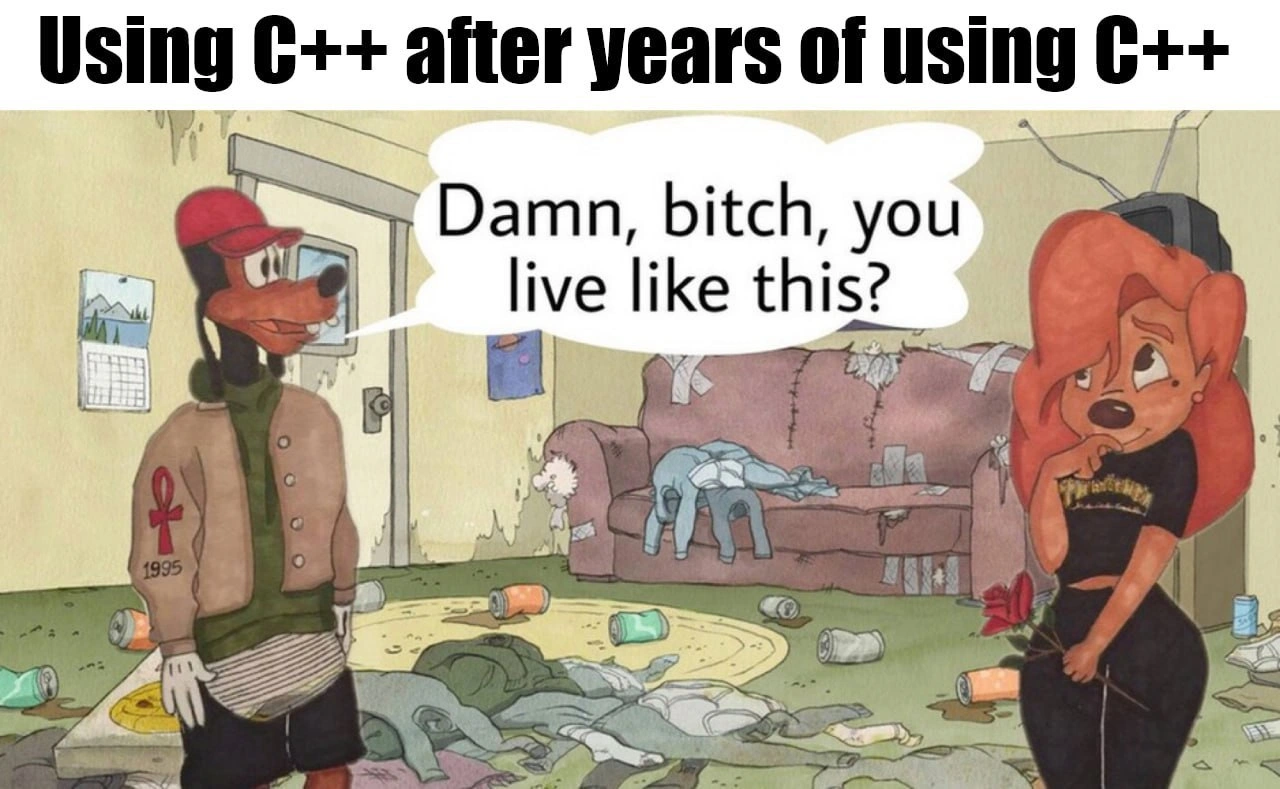
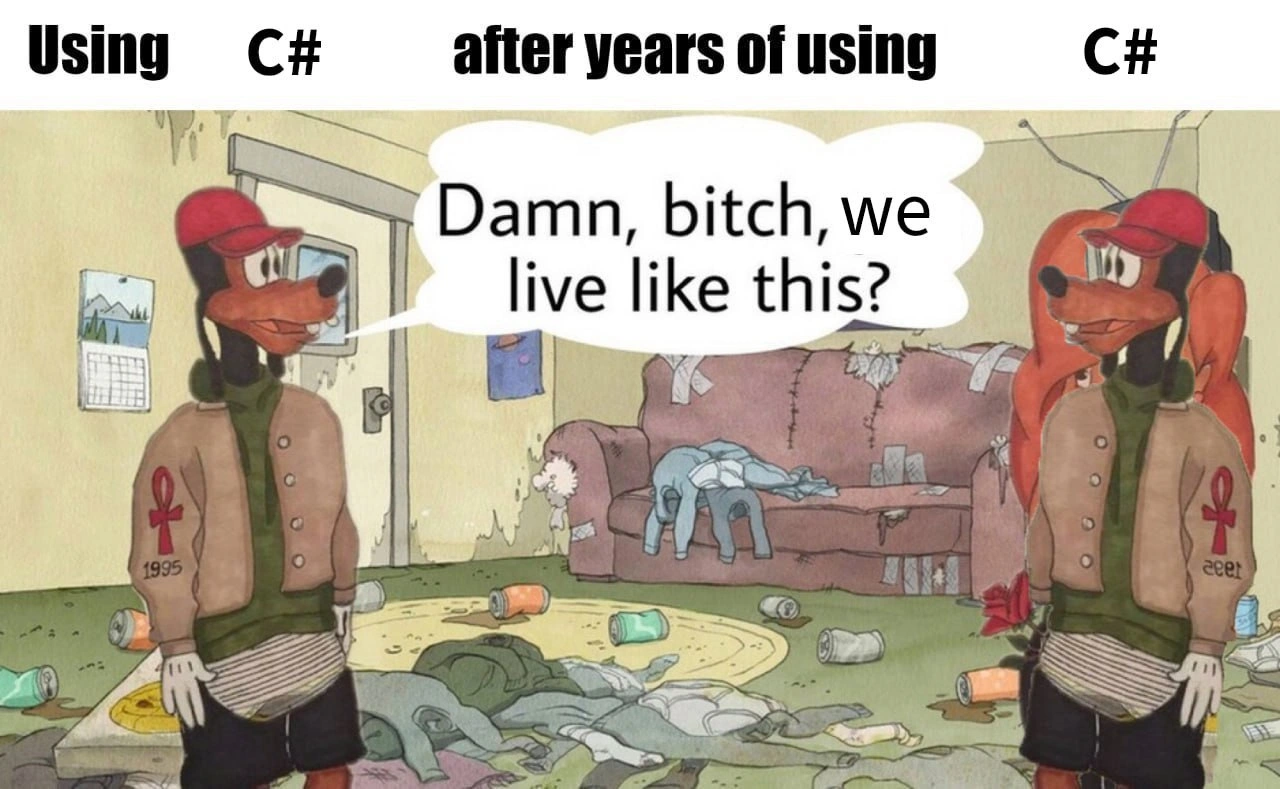
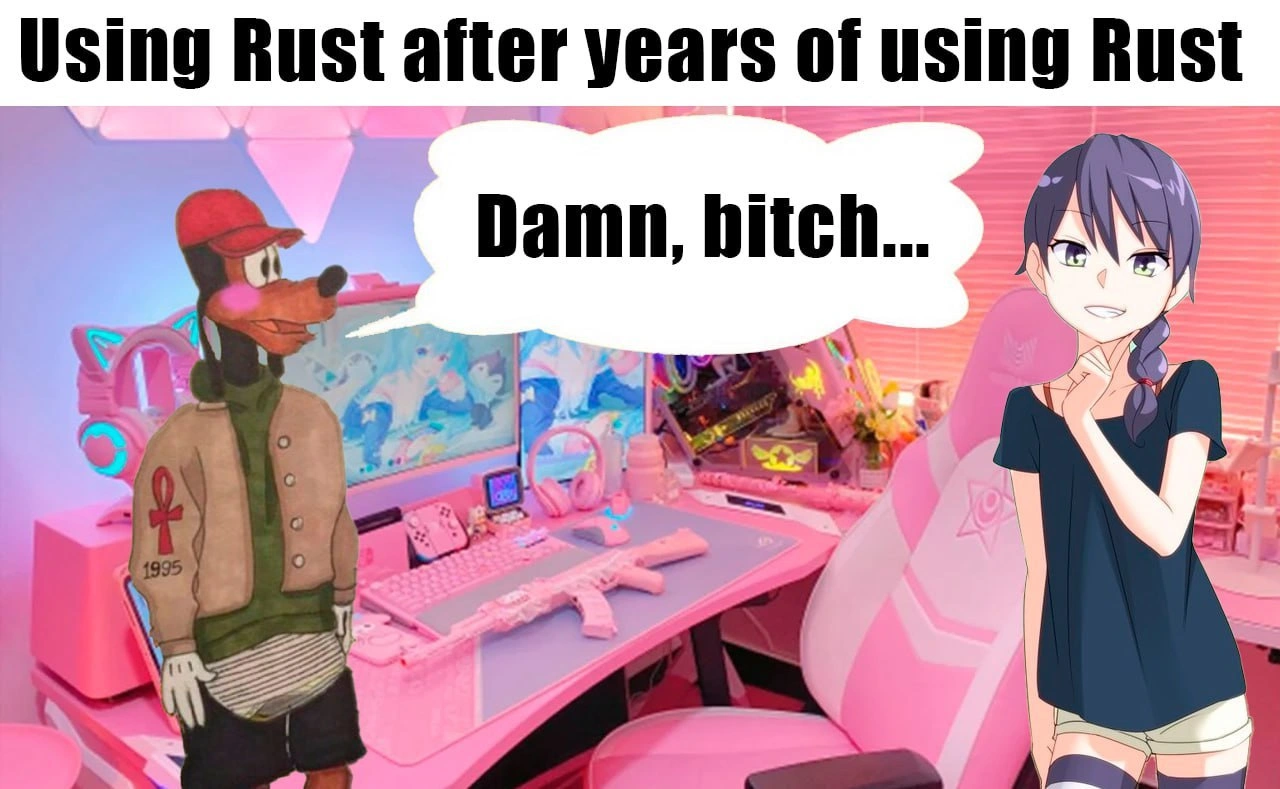
Now, what’s happening in the meme? The text at the top says, “Using Rust after years of using Rust.” The picture then exaggerates a scenario to show how a developer still feels amazed by Rust even after a long time. On the right side of the image, there’s an anime avatar girl in front of a crazy pink gaming setup (two monitors with cute pastel anime art, a pink keyboard and mouse, pink cat-ear headphones, and even a toy-like pink gun on the desk). Everything is colored bubblegum pink and looks super flashy and playful. This over-the-top scene represents something that is beloved and almost obsessively decorated. On the left, there’s Goofy (the Disney cartoon dog) cut out and pasted into the room, wearing a modern jacket and cap. He has a speech bubble that says “Damn, bitch...”. That phrase is internet slang (including a mild curse) basically meaning “Wow, girl, this is shocking...” It originally comes from a meme where someone says, “Damn, bitch, you live like this?” to comment on a ridiculous or messy bedroom. Here, Goofy is using it to express surprise at how extreme or fancy this setup is.

So, interpreting the meme in plain terms: the anime girl with the pink battlestation represents the programmer and their super enthusiastic environment — it’s like saying their world of Rust coding is as decked-out and special as this pink gaming room. The Goofy character represents an observer (or perhaps the logical side of the developer) walking in and reacting with astonishment. Essentially, Goofy is saying, “Dang… even after all this time, you’re still this in love with Rust?” The joke is that the developer’s “honeymoon phase” (the period when everything is new and exciting) never actually ended. Normally, people might get bored of a tool or stop being so impressed by it after using it for years. But in this case, Rust is such a satisfying language to use that the person remains a huge fan years later, almost like a die-hard hobbyist who has pinkified their entire room for their favorite thing. The meme’s imagery is absurd and funny — the bright pink, anime-themed setup is not what we typically imagine for a grizzled systems programmer, right? — and that exaggeration drives the point home. It says that Rust’s language features (like the borrow checker, memory safety guarantees, etc.) continue to “wow” the developer long after the initial hype. In short, the programmer is still star-struck by Rust’s strengths even after a long time together, and the meme uses a comically extreme gamer aesthetic and Goofy’s shocked catchphrase to make that feeling clear and entertaining.

Level 3: Rust Never Gets Old

This meme humorously captures a seasoned developer’s ongoing infatuation with Rust. The top caption sets the stage: “Using Rust after years of using Rust.” We expect that after so much time, the initial excitement would have worn off – yet the image shows the opposite. In the scene, we have a ridiculously pink gaming setup in view: think dual monitors showing pastel anime art, a pink mechanical keyboard, matching mouse pad, cat-eared headphones, and even a toy-like pink rifle on the desk. It looks like an over-the-top “gamer-girl” battlestation, the kind of saccharine neon setup you might see on a fun livestream. On the left stands a cut-out of Disney’s Goofy dressed in streetwear (his jacket even says 1995, a nod to an old-school era). On the right is an anime avatar girl, with her face pixelated. Goofy has a speech bubble that says:

"Damn, bitch..."

It trails off as if he’s simply at a loss for words.

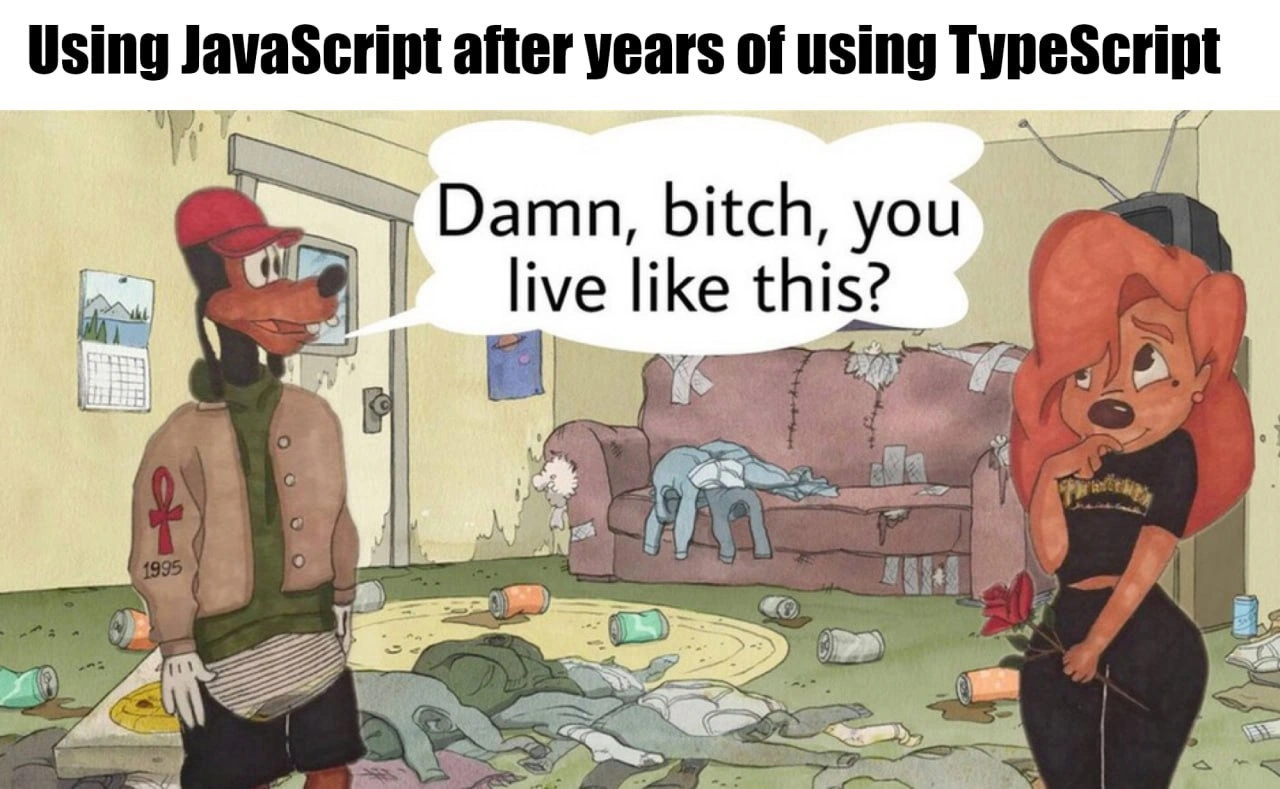
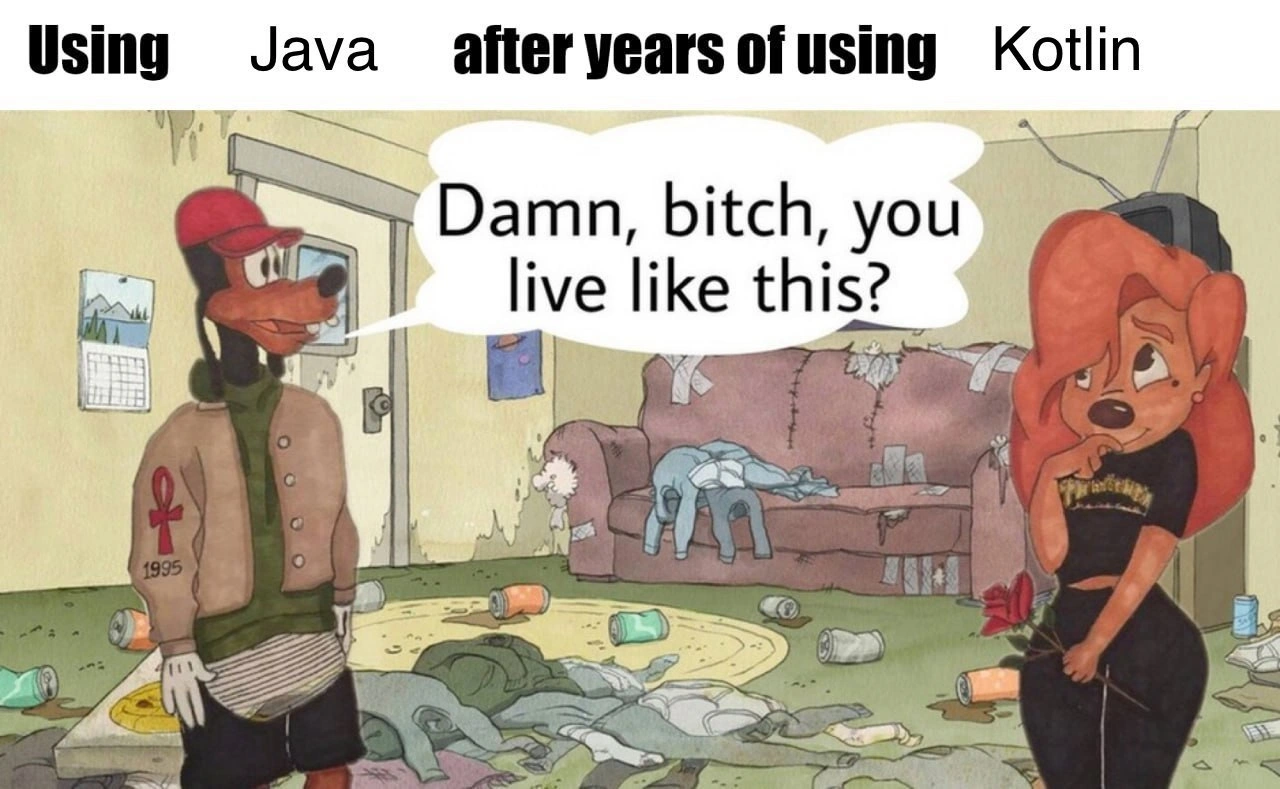
That line is a twist on a popular meme catchphrase (“Damn, bitch, you live like this?”) which is usually used when someone is shocked by another person’s extremely messy or wild room. Here it’s being repurposed for comedy. Goofy (either as an outside observer or the developer’s own incredulous side) is astonished at the dazzling setup. The implication is that even after years with Rust, the developer’s “world” is still as extravagantly enthusiastic as this pink anime-themed room. It’s as if Goofy is saying, “Dang... even now, you’re still this extra about Rust?!” And the Rust-loving dev, represented by the anime girl, is standing there a bit smug, with a pixelated grin, as if to say, “Heh, yeah, I am still obsessed, no shame.”

For experienced developers, the joke lands because it subverts the usual trajectory of excitement. We’ve all been through the honeymoon phase with a new technology or programming language – those first few months where everything about it seems amazing. Typically, after a few years, reality sets in: you encounter the rough edges, the limitations, and your enthusiasm cools off. But with Rust, this meme suggests the honeymoon never ended. That’s funny and a bit ironic, because veterans are famously hard to impress. You’d expect a grizzled programmer to become jaded or at least stop gushing about their tools over time. Instead, here they are — years later — still star-struck by Rust’s features. The Goofy character – a silly old-school cartoon figure – is like the old C/C++ developer in them, gawking at this ultra-modern, candy-colored Rust setup. The contrast between Goofy (representing the 90s era, note the 1995 on his sleeve) and the futuristic pink battlestation is comedic gold. It’s basically the old world encountering the new and going “Damn…”. It reflects how a long-time coder might feel stepping into Rust’s world: slightly stunned that this level of safety and performance is real, and not just anime fantasy.

The core of the humor is that Rust’s features still feel almost too good to be true even after extensive use in real projects. Think about it: a veteran dev who spent years wrestling with memory bugs in C or C++ can’t help but be in awe that Rust’s borrow checker just flat-out prevents those bugs. It’s almost disorienting (in a happy way) to realize that issues like use-after-free or null-pointer dereferences are non-issues now – the language won’t even compile code that tries anything shady. The meme captures that ongoing awe. The speech bubble’s crude phrasing – “Damn, bitch…” – exaggerates the surprise in a tongue-in-cheek way. It’s like the developer is so impressed that they’re moved to blunt, meme-worthy expletives each time they remember, “Wow, I don’t have to worry about dangling pointers or iterator invalidation anymore; Rust just takes care of it!” This feeling is very relatable for programmers who have migrated to Rust. Even after writing lots of Rust code, you occasionally get that grin when the compiler saves you from a mistake you know would have been nasty in another language. An engineer who’s been paged at 3 AM due to a segfault in a C++ service finds it almost magical that in Rust, whole classes of those nightmare bugs simply cannot happen (unless you go out of your way to use unsafe). That mix of relief and amazement — the “I can’t believe it’s this solid” feeling — gives off a clear Rust fanboy awe vibe in the meme.

There’s also a community in-joke here. Rustaceans (Rust fans) are known for being extremely enthusiastic about their language. It’s a running joke in the industry that Rust users can sound almost evangelical, singing praises about memory safety, the elegance of the ownership model, or the joy of fearless concurrency to anyone who’ll listen. Such over-the-top fandom inevitably feeds into language wars on forums and Twitter – if someone proclaims Rust as a cure-all for programming woes, fans of other languages (say, C++ or Python) might roll their eyes or counter with their own favorite’s merits. But this meme isn’t trying to start a fight; it’s more of a self-aware ribbing. It’s basically a Rust fan acknowledging, “Yep, I’m still head over heels for Rust, even now,” and having a laugh about it.

The anime avatar and ultra-pink aesthetic also poke fun at the culture around tech hobbies. Many developers online (not just Rust folks) like to use anime characters as profile pictures or deck out their PC setups with playful themes. By showing an anime girl in a flamboyantly pink room as the Rust-loving developer, the meme leans into that nerdy stereotype. It says: “Here’s this hardcore systems language that brings out someone’s inner kawaii gamer geek.” Meanwhile, the whole goofy meme format with Goofy’s blunt catchphrase adds another layer of irony. It’s as if the rational, seen-it-all side of the engineer (Goofy) is commenting on how over-the-top this love for Rust looks, while the passionate fan side (the anime character) just grins unapologetically. The two halves of the developer – one cautious and world-weary, one excited and dorky – are both present in this scene.

From a senior dev perspective, we chuckle because we know Rust has earned this kind of praise. It’s not a flawless tool (we’ve all grumbled about slow compile times, or spent an afternoon wrestling with a tricky lifetime error), but the benefits are undeniable. Shipping software with confidence that memory-safety bugs or data races simply won’t happen in production is a huge relief. We remember the “bad old days” of mysterious crashes and undefined behavior in C/C++, or the stress of meticulously guarding every shared variable in multi-threaded code. Rust removes so much of that anxiety by making it impossible (or at least really hard) to write those sorts of bugs in the first place. It’s like Rust basically scratched segfaults out of a veteran’s on-call vocabulary. So when we see a developer who’s been using Rust for a long time still reacting with giddy surprise, it resonates. It humorously validates that feeling we have inside: “Wow, this really does work as well as promised!” The meme’s exaggerated visuals (that absurdly pink battlestation) just amplify the point. Rust makes some of us as excited as a kid in a candy store, even after we’ve been doing this programming thing for ages. And that enduring joy is both funny and kind of heartwarming to see in a field where we usually expect hard-earned cynicism to take over.

Level 4: One Owner to Rule All

Rust’s core strength lies in a type system that essentially provides compile-time proofs of memory safety. Its famous ownership model isn’t just a gimmick – it’s rooted in deep programming language theory (influenced by affine types and linear logic from academia). The compiler’s borrow checker rigorously tracks lifetimes of references as if solving a puzzle of who owns what and until when. In effect, the compiler is performing a form of formal verification every time you hit build: guaranteeing that no reference outlives the data it points to (preventing the dreaded dangling pointer) and that mutable access is exclusive (eliminating data races in safe code). Academically speaking, Rust implemented at scale what researchers had pondered for decades: enforce memory safety without a garbage collector by using static analysis and lifetime tracking. The result is that seasoned systems programmers find themselves quietly astonished that entire classes of bugs (buffer overflows, use-after-free, double frees) are caught at compile time – something they might have only seen proven in papers before. It’s like the compiler silently conducts a mini proof for each pointer, before the program ever runs.

Beyond memory safety, Rust’s approach to concurrency is equally mind-blowing for veterans. The language leverages its type system to ensure thread safety: only types that implement the Send and Sync traits can be transferred or shared across threads, and the compiler verifies those conditions. This means the infamous problems of multithreading – race conditions where two threads clobber each other’s data – are largely ruled out by design in safe Rust. It’s as if Rust provides a built-in data race detector that’s always on. Many of us spent years carefully reasoning about locks, mutexes, and atomic operations, reviewing code for subtle concurrency bugs that might appear at 3 AM. Rust flips that script: if your code compiles, it’s basically guaranteed free of data races (in safe code). This aligns with the concept of fearless concurrency – the compiler won’t let you introduce those sneaky sharing bugs, giving you the confidence to use threads without losing sleep. For an experienced engineer, this feels almost magical, because Rust achieves with static guarantees what we used to rely on manual diligence or heavy runtime tests to catch.

And then there are Rust’s zero-cost abstractions, a phrase that still brings a spark to an old-timer’s eye. In Rust (following C++’s philosophy), you don’t pay a runtime penalty for using high-level constructs. Generics are monomorphized – the compiler generates optimized machine code for each concrete type, so calling a generic function is just as fast as if you hand-wrote a version for each type. Traits can compile down to static dispatch (and if you use dynamic dispatch, it’s explicit and as efficient as any vtable usage in C++), and iterators often get unrolled into tight loops by LLVM. In practice, you can have nice things – like iterator chains, closures, and rich type abstractions – without worrying about hidden heap allocations or virtual call overhead in your hot code paths. The Rust compiler is doing heavy lifting (inlining, optimizing, eliminating bounds checks when it can) so that abstractions truly become “zero-cost.” For someone who has worked at the assembly level or squeezed performance out of C, seeing a high-level loop in Rust compile down to the same efficient instructions you’d have written by hand is astonishing. It reinforces that the language’s promises aren’t just theory: they’re baked into Rust’s design and its LLVM backend optimizations. It’s a rare moment in software engineering where you get memory safety, concurrency safety, and C-like performance all at once. No wonder an engineer can use Rust for years and still feel star-struck – the language continues to deliver that wow factor through real technical brilliance.

Description

This meme is an ironic subversion of the 'Damn, Bitch, You Live Like This?' format. The text at the top reads 'Using Rust after years of using Rust'. The image features the Goofy-like character from the original meme looking shocked, with a speech bubble saying 'Damn, bitch...'. However, instead of a messy room, he is standing in an immaculate, hyper-stylized, pink-and-white themed gaming setup with anime wallpapers and a smiling anime girl on the right. The room is pristine, with high-end, color-coordinated peripherals, including a pink decorative rifle. The joke inverts the original meaning; the long-time Rust developer is not disgusted but rather in a state of perpetual awe at how clean, safe, and well-designed the Rust ecosystem is. The pristine, almost utopian room serves as a metaphor for Rust's strong compile-time guarantees, memory safety, and modern tooling, which prevent the kind of 'mess' (e.g., memory leaks, race conditions) common in other systems languages
Comments

7
Anonymous ★ Top Pick After years of defensive C++ programming, a Rustacean looks at their codebase with its fearless concurrency and lack of segfaults and whispers, 'Damn, we really get to live like this?'
  1. Anonymous ★ Top Pick

    After years of defensive C++ programming, a Rustacean looks at their codebase with its fearless concurrency and lack of segfaults and whispers, 'Damn, we really get to live like this?'

  2. Anonymous

    Five years in and the borrow checker still gives snarkier code reviews than your crankiest staff engineer - and you’re weirdly thankful for it

  3. Anonymous

    Five years in and my biggest production incident is still just the borrow checker rejecting my feelings at compile time

  4. Anonymous

    After a decade of Rust, you'd think the borrow checker would finally trust you with that mutable reference. Instead, it's still there at 3 AM, smugly pointing out that your lifetime 'a outlives 'b in a closure that captures 'c, and suggesting you 'consider using Arc<Mutex<T>>' for the fifth time this week. The real Rust experience isn't writing memory-safe code - it's the humbling realization that the compiler will forever know your codebase better than you do, and it's not afraid to tell you about it in 47 lines of error messages

  5. Anonymous

    After a decade in Rust, the borrow checker still opens with "cannot borrow x as mutable because it's also borrowed as immutable"; you don't outgrow it - you just get better at reaching for Arc<Mutex<T>>

  6. Anonymous

    A few years in Rust and even a throwaway CLI ends up Send + Sync + 'static with PhantomData and a pinned Future - then Clippy opens a PR asking why it isn’t no_std

  7. Anonymous

    Years in Rust: borrow checker's still the only bitch dropping truth bombs that prevent production heisenbugs

Use J and K for navigation