Skip to content
DevMeme
5750 of 7435
The Perennial Pain of C++ Development: A Self-Inflicted Mess
Languages Post #6306, on Oct 11, 2024 in TG

The Perennial Pain of C++ Development: A Self-Inflicted Mess

Why is this Languages meme funny?

Level 1: The Messy Room

Imagine you haven’t cleaned your room for a really long time. There are old pizza boxes, empty soda cans, dirty clothes, and dust everywhere. Now your friend comes over, walks in, and their eyes go wide. They might say something like, “Whoa, you live like this?” in disbelief. You suddenly feel a bit embarrassed because, well, it is a big mess and you kind of got used to it over time.

This meme is doing the same thing, but with computer code instead of a room. An old C++ program that hasn’t been cleaned up in years is just like that messy room. When the programmer (or anyone new) opens it up, it’s a shock – things are all over the place and it’s not tidy at all. It’s funny because usually the person who made the mess (the programmer who wrote the code years ago) is now the one shocked to see how bad it’s gotten, almost like they forgot how messy they were. It’s a mix of surprise (“I can’t believe it’s this bad!”) and a bit of embarrassment (“I really let it get like this”). Just like a messy room needs a good cleaning, that old code would need a lot of tidying up. The meme makes us laugh and cringe because we know keeping things clean is important, whether it’s your room or your code!

Level 2: Pointers & Pizza Boxes

Let’s break down the joke in simpler terms. This meme is comparing an old, messy C++ codebase to a filthy living room. If you’re a newer developer or just learning C++, here’s what all that means:

  • C++ – A powerful programming language that gives the programmer a lot of control, including manual management of memory. It’s great for performance, but if you’re careless (or if code is old), things can get messy. Think of C++ as a super customizable car: you can tweak anything under the hood, but you might end up with parts everywhere if you’re not careful.
  • Legacy code – Code that was written a long time ago (many years) and is still in use. It often wasn’t updated to follow modern practices. Working with legacy code can feel like inheriting an old house: it’s filled with design decisions and “stuff” from the past that you now have to deal with.
  • Technical debt – A metaphor for the extra work you have to do later because someone (possibly your past self) took shortcuts or made quick fixes earlier. It’s like choosing not to clean your room for a month – you “saved time” then, but now the cleanup is much harder. In code, skipping proper fixes or writing sloppy code adds up to lots of problems that must be paid back with interest.
  • Spaghetti code – A nickname for code that is tangled and disorganized, so much so that trying to follow its logic is like trying to trace one strand of spaghetti in a bowl. There’s no clear structure; everything is interconnected in confusing ways. Spaghetti code often happens in old projects where many changes were piled on top of each other without a rewrite. It’s hard to maintain, just like it’s hard to pick one noodle from a tangled plate.
  • Pointer – A variable type in C++ that holds a memory address (think of it as a note with a house address for data). A “raw pointer” (like int* p) is a low-level tool – it’s powerful because you can directly access and manipulate memory. But with great power comes great responsibility: if you lose track of it or misuse it, you can break things badly (crashes, leaks, security issues). C++ leaves memory management to you when you use raw pointers, which is flexible but error-prone.
  • Memory leak – What happens when a program allocates memory (e.g. with new or malloc) but then forgets to free it (delete or free). The memory stays occupied (like garbage that never gets taken out) and over time these leaks can accumulate, wasting memory. If it gets bad, the program or even the whole system can run out of memory. In our living room analogy, memory leaks are like all those empty soda cans and pizza boxes lying around that no one ever threw away. One or two might not be noticeable, but over years… yikes.
  • Macro – In C++ (and C), a macro is a preprocessor directive, usually defined with #define, that tells the compiler to replace some code with another piece of text before compilation. For example, #define MAX 100 will replace every occurrence of MAX with 100 in the code. Macros can do more complex things (even act like functions), but they don’t follow normal code rules and can make debugging tricky. They were heavily used in older C/C++ code for constant values or small inline functions before the language added better alternatives. Overusing macros can clutter a codebase because it’s not always clear what they do at first glance (imagine random sticky notes all over the house with cryptic messages – that’s what macros can feel like in code).
  • const_cast – This is a C++ keyword that lets you cast away the const qualification of a variable. “Const” means read-only; it’s a promise that “I won’t change this value.” Using const_cast basically says “Nah, I will change it anyway.” It’s generally considered bad practice to do that because it can lead to undefined behavior if you modify something that truly shouldn’t be modified (like a string literal or memory that was originally constant). Needing const_cast often means the code design wasn’t ideal – like forcing a piece into a puzzle where it doesn’t quite fit. It’s the code equivalent of breaking a lock because you lost the key.

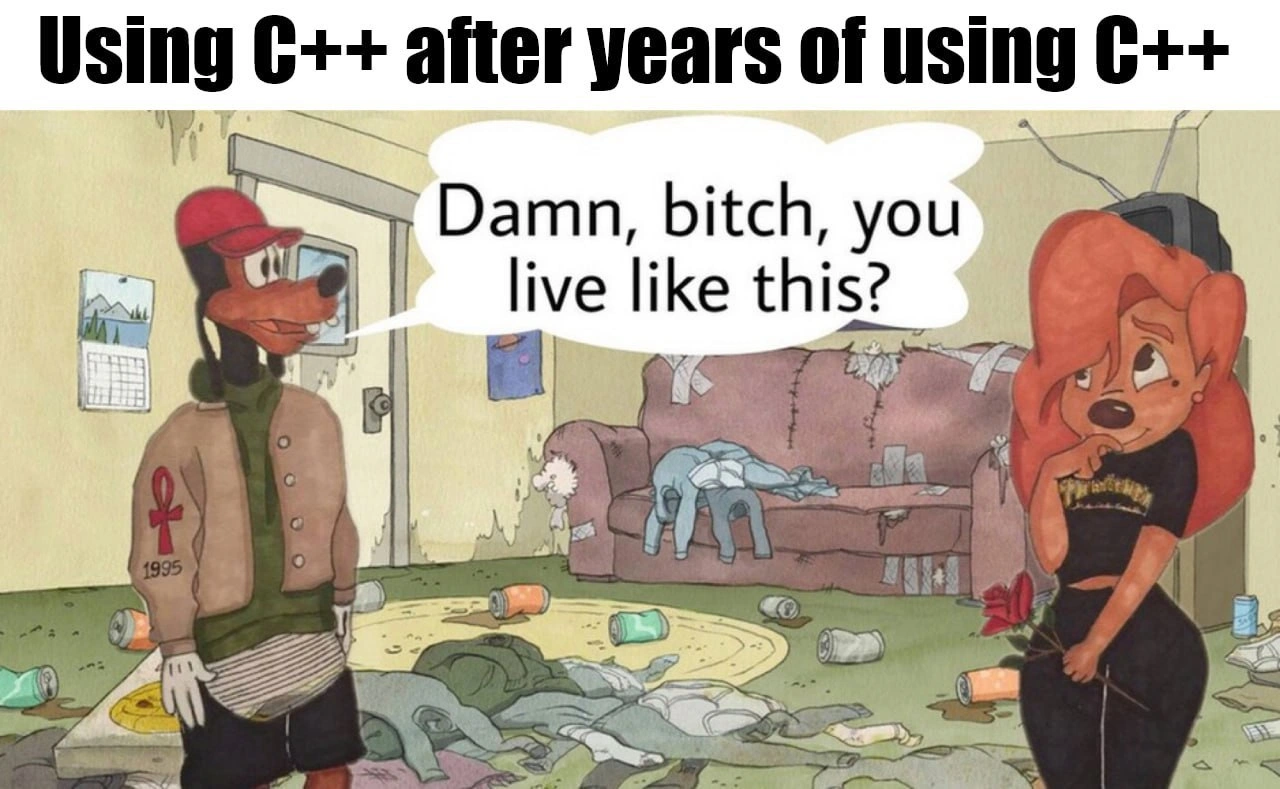
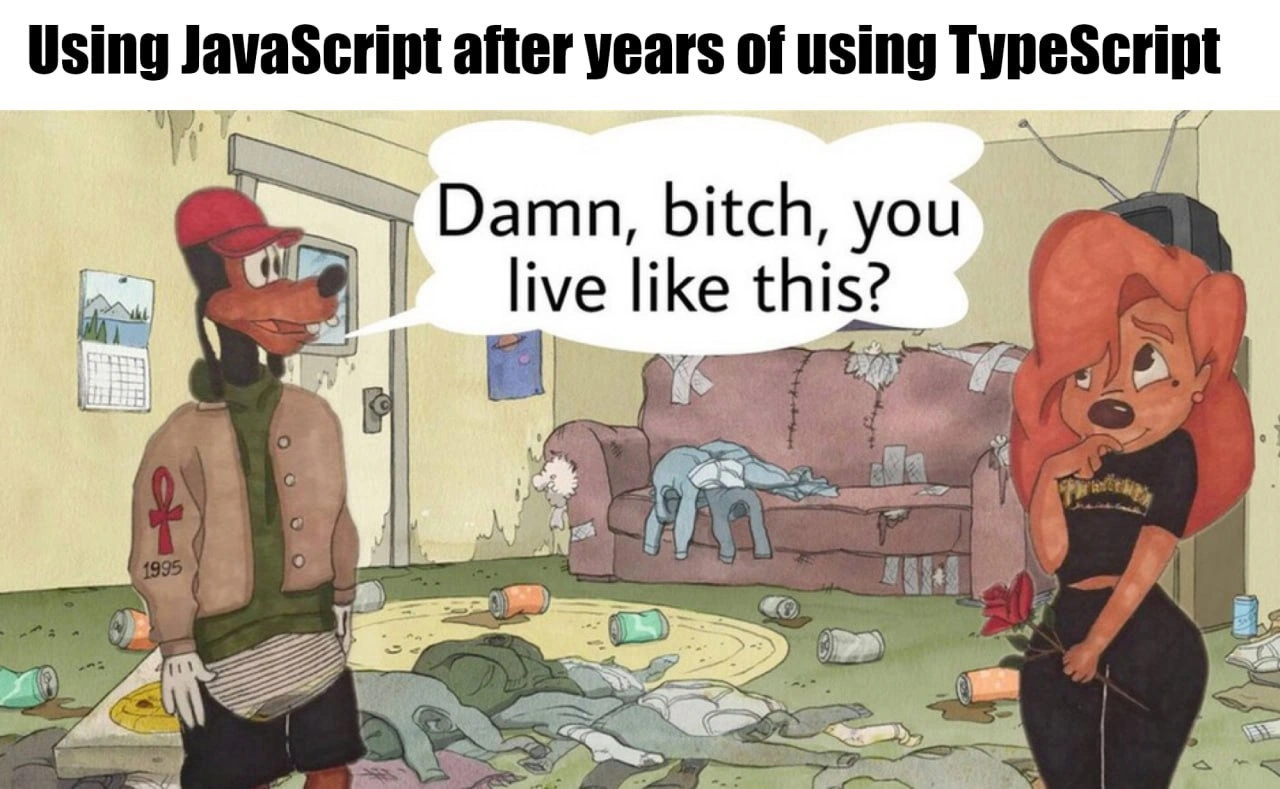
Now, why does the meme specifically show a dirty living room? It’s an analogy – each messy item in that room represents something in the code. Here’s how the pieces map out:

  • Empty soda cans and pizza boxes all over – These represent the leftover junk in the code: memory that wasn’t freed (memory leaks), temporary debug code or test functions that were never removed, and quick-and-dirty tweaks that piled up. Just like trash in a room, these should have been cleaned up as you go, but in a legacy repo they’re still lying around.
  • Dirty laundry and clothes on the floor – This is like variables and functions strewn haphazardly throughout the code, or global state being used everywhere. It’s the disorder in how the code is organized. Maybe the project has no clear structure or modules – everything’s in one big pile (one huge file or a few giant functions). Like laundry on the floor, it’s stuff that’s usable but definitely not where it belongs.
  • Stained carpet and water-damaged walls – These are the deep, long-term damages in the codebase architecture. For example, maybe the code has fundamental design flaws (like everything depends on everything else, making it hard to change one thing without breaking others). Or it relies on outdated libraries that don’t work on newer systems (kind of like water damage – it’s a big underlying issue that’s expensive to fix). Over the years, small problems compound into a big code rot issue, showing visible “stains” in reliability and maintainability.
  • Couch with duct-tape patches – The couch is an important piece of furniture, and in the code analogy, it’s like a core system or critical feature that broke and got patched with quick fixes. The duct tape represents all those ad-hoc solutions: maybe a bug surfaced, and instead of rewriting the faulty module, someone just added a condition or copied some code from StackOverflow and taped it on. It holds things together, but it’s not pretty or robust. If you look at the git history, you’d see many little commits like “temporary fix for crash” – that’s the duct tape.
  • Embarrassed character (right side) – This character stands for the developer who is responsible for (or stuck with) this messy code. In many cases, it might literally be you – revisiting code you wrote years ago. They’re blushing and hugging themselves, which is exactly how it feels to realize your old project is that messy. It’s a mix of shame and “I hope nobody else sees this.” If you’re a junior dev reading someone else’s legacy code, you might not feel personal shame, but you definitely sense the original authors would be embarrassed if they had to show this to others.
  • Shocked visitor (left side) – This is like a friend or a newer developer (or your future self) who comes into the project fresh and immediately reacts to the chaos. He’s basically voicing what we all think: “How can anyone live (or code) in this state?” This is the outside perspective that sees the mess for what it is. When you join a company and are introduced to their 10-year-old codebase, you often play this role initially – you’re stunned and asking the senior folks, “Why is everything so broken?” In the meme, he even has “1995” on his jacket and an ankh – a funny detail which could hint that he’s a product of the 90s (when such messy C++ practices were common), yet even he is surprised at how dirty this place is.

For a junior developer, the meme is a humorous warning and reality-check. Code quality matters in the long run. If you only ever write quick fixes and ignore cleanup (like never taking out the trash), your project will become a nightmare to work with. C++ gives a lot of freedom – you can manage memory manually, use low-level tricks, and so on – but with that freedom you can also create a giant mess if you’re not careful. That’s why modern best practices encourage things like using smart pointers (which automatically delete memory for you when it’s no longer needed), writing unit tests, refactoring code, and following consistent style. These are like cleaning as you cook, or tidying up your room regularly, so you never get to the shocking landfill stage.

The humor also comes from relatability: pretty much every programmer has opened an old project (their own or someone else’s) and had that “Oh my gosh” reaction. It’s equal parts funny and sad to see how bad things can get. The phrase “Damn, you live like this?” is a popular internet meme for any messy situation, and here it perfectly labels the feeling when confronted with an old, very messy codebase. Even if you don’t know C++ specifically, you can imagine the scenario in any language – but C++ is notorious because if you neglect it, you might literally have memory leaks and crashes all over, not just slightly messy indentations. So the meme exaggerates a bit (a living room landfill is an extreme), but honestly, not by much when it comes to some legacy projects!

Level 3: Landfill of Legacy

Stepping back into a decade-old C++ repository is a lot like opening the door to a hoarder’s den of code. It doesn’t matter if you’ve been writing C++ this whole time or took a detour with other languages – the shock hits the same. You flick on the light and see code piled with technical debt: cryptic macros, raw pointers dangling everywhere, and comments from 2012 scrawled like peeling wallpaper. In the meme’s top caption it says, “Using C++ after years of using C++” – an ironic way to say even experienced C++ devs can be horrified by old C++ code. The left character’s wide-eyed reaction and famous line:

“Damn, bitch, you live like this?”

captures that deeply horrified respect we feel toward such a codebase. It’s as if your modern coding self is asking your past self how you ever thought this was okay. The embarrassed friend on the right is basically the code (or the poor soul maintaining it) muttering “Yeah... I know it’s bad.” This is a meme version of a code review intervention.

Why is it so accurately painful? Because older C++ projects often accumulate messy codebase analogies just like a neglected apartment accumulates junk. Consider what you often find when re-opening that old repo:

  • Memory leaks everywhere: Just like the empty soda cans scattered on the floor, you’ll discover objects allocated with new that were never freed with delete. Each forgotten deallocation is a leak – memory that just piles up. Over years, these leaks become the dirty carpet stains of the program, causing performance issues or crashes if you run the app long enough. In our landfill house analogy, a memory leak is trash that never got taken out.
  • Raw pointers galore: In a modern C++ project you’d use smart pointers (like std::unique_ptr) or references to manage resource lifetimes. But a 10-year-old codebase might predates C++11’s conveniences, so it’s full of raw pointers (int* ptr) manually managing memory. Raw pointers are powerful but dangerous – mismanage them and you get dangling pointers (pointers to memory that’s been freed or went out of scope) lurking like booby traps. This repo probably has pointer bugs so old they’ve become part of the furniture.
  • Macro mayhem: The code likely abuses the C preprocessor with macros (#define) for everything under the sun. Before constexpr constants or generic templates were well-known, developers used macros to define magic numbers, utility functions, even debug prints. Overuse of macros leads to spaghetti code where it’s hard to trace what’s happening – just like a cluttered room where you can’t see the floor. You might find a macro expanding to a multi-line mess, akin to finding an old pizza box hiding something nasty underneath. One peek and you say “oh no, who thought this macro was a good idea?”
  • Duct-tape fixes: See that couch in the image, torn and held together by duct tape? In code terms, that’s all the quick hotfixes and hacks layered on over the years. Instead of refactoring properly, someone slapped an if (!ptr) return; here, a // TODO fix this there, just to keep things running a bit longer. Each band-aid fix was probably done under pressure (like a 3 AM emergency patch to stop a crash), and nobody came back to clean it up. Now the code is a patchwork of strange conditions and commented-out sections – it “works” but you don’t dare touch it because the whole couch might fall apart.
  • Outdated artifacts: The left character’s jacket has “1995” on it, which feels hilariously apt – parts of this repo might as well be from 1995. It’s not uncommon to find a decade-old C++ project still using antiquated practices. You might stumble on typedef’d custom types or even std::auto_ptr (R.I.P.) lurking in headers. std::auto_ptr was deprecated in C++11 and fully removed in C++17, so encountering it is like finding a fossil in the code – a sure sign this code hasn’t been touched in ages. It’s a language feature bloat situation too: C++ has added a ton of features since then (lambdas, auto, smart pointers, constexpr, ranges, modules…), but this legacy code hasn’t adopted them. Instead, it’s emulating things in an old-fashioned, clunky way. The result is bulky and verbose logic that a modern C++ developer finds unnecessarily complex.
  • const-cast regret: Ah yes, the const_cast. If you dig through a junkyard codebase long enough, you’ll find some function that takes a const Something* only to cast away the const with const_cast<Something*> and modify it anyway. That’s a big red flag. Using const_cast to mutate what should be unmodifiable is like disabling the smoke alarm because it kept beeping – sure, it shuts up for now, but you’re courting disaster later. The meme’s embarrassed character knows this shame. When you see a bunch of const_cast in your old code, you instantly regret whatever design led you to that hack. It usually means you couldn’t find a clean way to do something, so you went behind the type system’s back. Future-you (now-present you) is stunned: “I really did that?” Yes, you did, and now it’s your problem to clean up.

At this level of analysis, every element in the filthy room is a one-to-one metaphor for code quality issues in a legacy C++ project. The empty cans and pizza boxes strewn about represent accumulated garbage in the code: things like leftover debugging code, orphaned malloc allocations, and half-implemented features. The water-damaged wall and grimy carpet are the architectural rot – perhaps the codebase doesn’t even compile on a modern compiler, or it’s brittle because core pieces were hacked around instead of rewritten. The whole scene screams “spaghetti code”: nothing is where it should be, and everything’s tangled and dirty. Even an expert C++ developer, who’s used to C++’s pitfalls, walks in and is overwhelmed by the stench of legacy code gone wild.

To really drive it home, here’s a small treasure you might find in such a repo: a function that sums up the chaos in a few lines of C++ code. 👇

#include <iostream>
#include <cstring>

// A macro that allocates a buffer and zero-initializes it (old-school style)
#define INIT_BUFFER(buf, size) buf = (char*)malloc(size); memset(buf, 0, size);

char* loadData() {
    char* data;
    // Allocate 1KB buffer and never free it - memory leak
    INIT_BUFFER(data, 1024);
    // Using const_cast to modify a string literal (undefined behavior!)
    const char* msg = "Hello";
    char* writable = const_cast<char*>(msg);
    writable[0] = 'h';  // altering read-only memory, could crash
    return data;        // returning a pointer that the caller might forget to free
}

int main() {
    char* leak = loadData();
    std::cout << leak << std::endl;
    // Forgot to free 'leak' -> memory is leaked when program exits
    return 0;
}

Imagine dozens of functions like loadData() scattered across the codebase. This snippet compiles and appears to work (it might even print “hello”), but it’s a ticking time bomb of bugs. We have: a macro doing sneaky allocation (making the code harder to read and debug), a memory leak (data is never freed, like a soda can kicked under the sofa), and a const_cast that leads to undefined behavior (modifying a string literal could cause a crash or weird behavior later – it’s like messing with something labeled “do not touch”). This is the kind of thing you open a legacy project to find, and promptly whisper to yourself, “Oh no... what was I thinking?”

The humor in the meme hits so hard because every seasoned programmer has either seen or written a mess like this at some point. The longer a codebase lives without cleanup, the more it starts to resemble a garbage heap of quick fixes and outdated practices. C++ in particular is a language that “gives you enough rope to hang yourself” – its power comes with very few safety nets by default. If you’re not disciplined, you end up with a knot of dangling pointers, memory leaks, and macros tying the whole monstrosity together. Coming back to that after years (even years of using C++ professionally) can still make you recoil in horror. It’s a mix of surprise and self-inflicted embarrassment: surprise at just how bad it got, and embarrassment because, well, this mess has your name on the Git commit history. The meme nails that dual perspective: one part of you is the shocked friend saying “you coded like this?”, and the other part is the ashamed developer thinking “yeah... I know, it’s awful... let’s never speak of this.”

Description

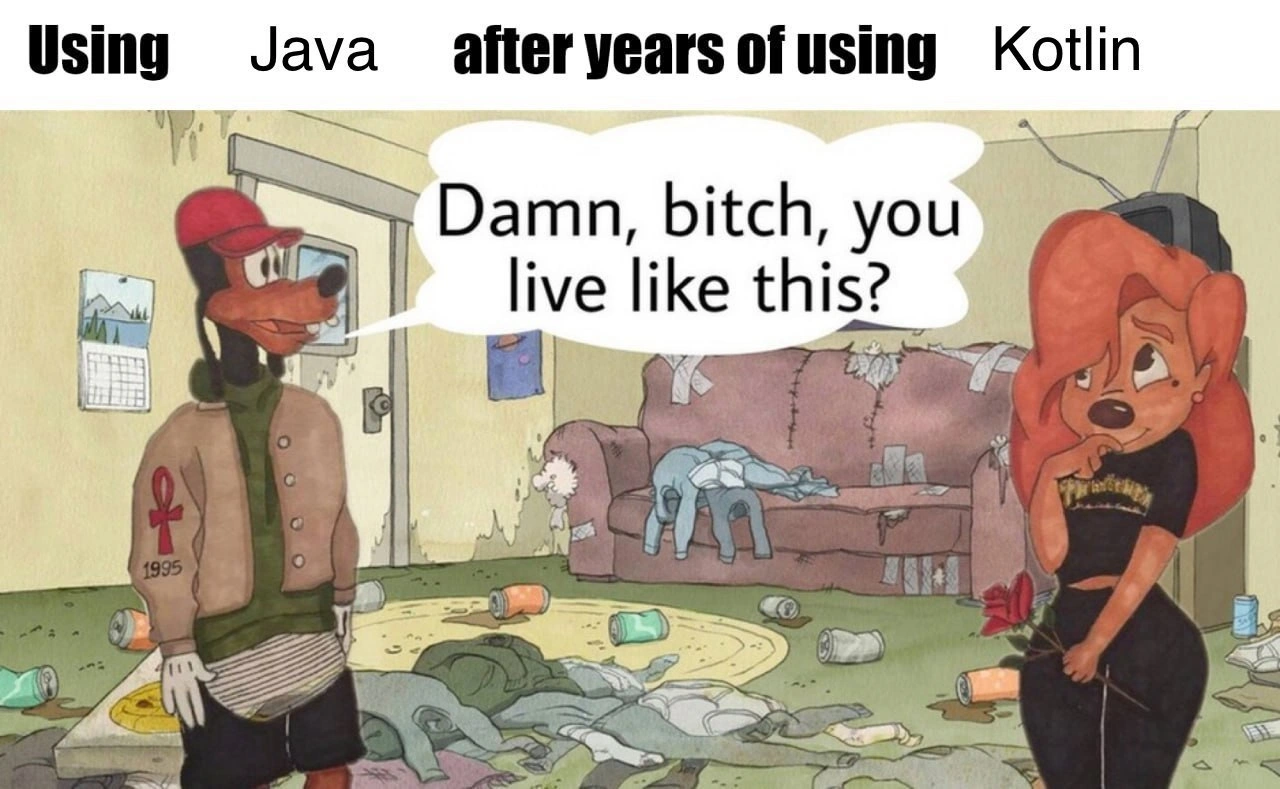
This meme leverages the 'Damn, Bitch, You Live Like This?' comic format to deliver a self-deprecating joke about C++. The image is captioned at the top with 'Using C++ after years of using C++'. The main panel shows a cartoon character looking in disgust at a deplorably messy room, with a speech bubble saying, 'Damn, bitch, you live like this?'. The humor is circular and directed inward: the C++ developer is both the horrified visitor and the resident of the chaotic environment. The messy room symbolizes the inherent complexity of C++, including manual memory management, convoluted build systems, and the ever-present risk of undefined behavior. The joke resonates with experienced C++ engineers who understand that despite their years of experience, the language's nature means they are perpetually wrestling with a complex, messy, and often self-inflicted state of chaos
Comments

7
Anonymous ★ Top Pick C++ is the only language where you look at your own code from six months ago and think, 'Who let this maniac near a compiler?' before realizing it was you
  1. Anonymous ★ Top Pick

    C++ is the only language where you look at your own code from six months ago and think, 'Who let this maniac near a compiler?' before realizing it was you

  2. Anonymous

    Every soda can on that floor is a malloc you never free’d - and the smell is pure undefined behavior

  3. Anonymous

    Every time you come back to C++, there's a new standard that deprecated half your codebase while adding seventeen ways to initialize a variable, and somehow the committee thinks concepts will fix everything but you're still debugging a template error that's longer than your mortgage agreement

  4. Anonymous

    After two decades of C++, you realize the language hasn't gotten easier - you've just developed Stockholm syndrome for segfaults, learned to love the smell of undefined behavior in the morning, and can now debug memory corruption while maintaining the same level of existential dread. The apartment's a mess because you're still cleaning up after that one time you forgot to implement the rule of five in 2003

  5. Anonymous

    Walking into a 1995 C++ codebase after years of modern C++ is realizing the garbage collector is you, the ownership model is comments, and UB is the chief architect

  6. Anonymous

    Opening a 2005 C++ repo after years of C++20 is like touring a flat where everything was constructed with new, ownership is “maybe,” deletes are in another file, and the landlord is a global singleton

  7. Anonymous

    C# spoiled you with GC luxury; C++ hands you raw pointers and whispers, 'use-after-free reunion incoming.'

Use J and K for navigation