Facebook's Unsettlingly Personal Data Insights
Why is this DataPrivacy meme funny?
Level 1: The All-Knowing Stranger
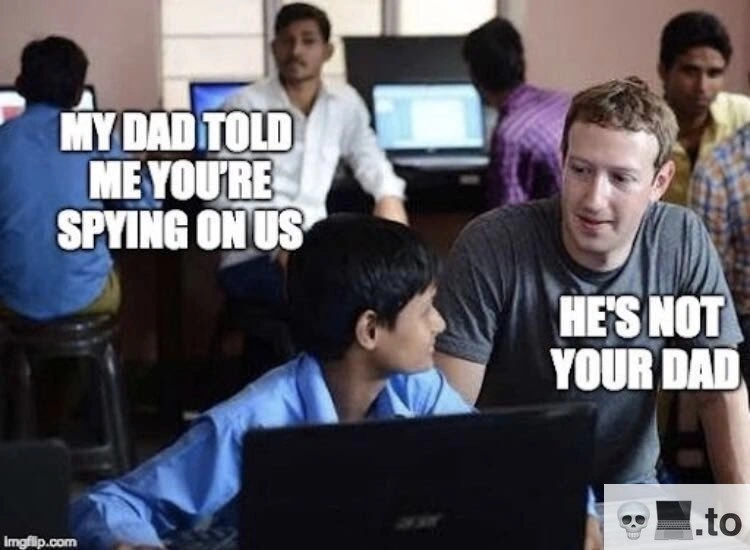
Imagine you have a very nosy neighbor who is always peeking through the curtains, watching everything that happens at your house. Now imagine one day that neighbor knocks on your door, and casually tells you a huge family secret that even you didn’t know — like that your dad isn’t actually your dad. 😲 Sounds scary and crazy, right? But also a little bit funny in a “I can’t believe they said that!” way. In this meme, the big social media website is like that nosy neighbor. The kid says, “My dad said you’re spying on us,” which is like accusing the neighbor of snooping. The website (as a person) replies, “He’s not your dad.” That’s the shocking secret. It’s funny because we don’t expect a website or app – something we usually think of as just a tool or a game – to know personal things that even a kid’s own family hasn’t told him. It’s as if the computer or app has become so smart and so involved in our lives that it knows everything, even things it really shouldn’t know!
This simple joke highlights a feeling many people have: that big websites and apps (like Facebook or Google) watch what we do as closely as a sneaky stranger might. It’s a bit like if you were whispering to a friend and didn’t realize Alexa (the smart speaker in your room) was kind of listening the whole time. The idea might make you giggle nervously because it’s absurd – we don’t actually think a website would announce a family secret – but it reminds us that these companies see a lot of our information. In real life, your dad is your dad, and no app is going to tell you otherwise! But the meme exaggerates to make a point: be careful what you share, because someone might be putting the pieces together. It’s a funny way to say “Hey, that free game or social site might know more about you than you think!”
Level 2: Spyware 101 (for New Devs)
If you’re a newer developer or just starting to wade into tech, let’s break down what’s happening in this meme. The categories DataPrivacy and Security are front and center. Data privacy is all about controlling who can see or use information about you. Security is about protecting that data from bad guys. Here, the “bad guy” is actually a big respected platform – think of a major SocialMedia site like Facebook – which is legally allowed (because you agreed to the Terms of Service, probably without reading them) to collect a boatload of data on its users. The joke plays on the idea that these platforms are “spying” on us. Now, they’re not literally James Bond with a telescope outside your window, but sometimes it feels like it. Ever wondered how after browsing for shoes on one site, you suddenly see shoe ads on Facebook? It’s not magic – it’s tracking.
Here’s how it works in simple terms: websites and apps routinely collect information about what you do online. This can include obvious things like what posts you like or share, and less obvious things like how long you look at a photo, what other sites you visit, or where your phone is located when using the app. Social media companies make money mainly through targeted advertising, which means showing you ads tailored to your interests. To do that effectively, they need to know a lot about you – your hobbies, shopping habits, who your friends are, even subtle stuff like whether you seem stressed or happy (yes, some algorithms try to guess your mood based on your activity). All that data collection is what the dad in the meme calls “spying on us.” It’s essentially surveillance, but for profit – hence the term surveillance capitalism (a big phrase meaning making money by monitoring people’s behavior).
So in the meme, a kid confronts an adult (the adult represents the tech platform, possibly Mark Zuckerberg of Facebook, who’s famously been accused of not taking privacy seriously). The kid says: “My dad told me you’re spying on us.” That reflects a common PrivacyConcern many people have: parents often warn kids, “Be careful online, those sites track everything you do.” The adult’s reply: “He’s not your dad.” Ouch! This is the punchline. Why is it funny? Because it’s so unexpected and extreme. The tech platform basically comes back with personal info about the kid that even the kid didn’t know – implying the platform’s data knowledge is so deep it uncovered that the man who raised the boy isn’t his biological father. It’s a jaw-dropping invasion of privacy (and a family secret!). This is a form of privacy_breach_punchline: the joke is the privacy violation. It exaggerates real-life issues to absurdity – obviously no social network is going around informing kids of their parentage. But it underscores how we sometimes feel: these companies know way too much.
Let’s connect this to real tech terms and newbie-friendly explanations:
Tracking cookies & pixels: Ever notice those cookie consent pop-ups? Cookies are small files that websites use to remember who you are. Third-party cookies (from other domains on the site, often belonging to ad companies) can follow you from site to site. For example, if Facebook has a “Like” button or an embed on a news site you visit, that button isn’t just for show – it can silently report back to Facebook, “Hey, user X visited this news article.” Similarly, a tiny invisible image (a pixel) can be used to log that you opened an email or saw a page. So your activity across the web can end up in one giant bucket of data.
Social Graph: This is a fancy term for the network of who-knows-who. When you add friends and family on a platform, it’s mapping out your relationships. Combined with profile info (like family members you list, or last names, locations, etc.), a company can often guess relationships even if you don’t explicitly tell them. (Ever seen a prompt like “Do you know John? You have 10 mutual friends” – that’s the social graph in action).
Data Brokers: Beyond what you do on the platform, companies also buy data about you from outside sources called data brokers. These guys compile information like public records, purchase histories, and more. So if something’s not in your profile (say, who your relatives are), it might be inferred from other data. It’s a bit scary: a social media firm could theoretically buy demographic data that includes a hint that your “dad” might actually be a step-dad or adoptive. Unlikely, but the point is lots of info circulates out there.
Now, in reality, companies have policies to prevent crazy breaches like “telling a kid his dad isn’t his dad.” 😂 They generally don’t want to alienate users or break up families – bad for business! The meme is using hyperbole (exaggeration) to make us laugh and think. It’s as if the platform proudly says, “We know everything, even stuff you didn’t know about yourself!” That’s why it’s funny in a nerdy way – it’s taking the common fear “Facebook is spying on me” to a wild extreme. It also has that twist ending feel: the kid thought he was just accusing the platform of bad behavior, but the platform turned around and dropped a bombshell on the kid.
As a new dev, it’s good to understand this humor comes from real issues in tech. Online privacy is a huge topic right now. Users are increasingly worried about how their data is used. Regulations like GDPR (Europe’s strict privacy law) and improvements in app privacy controls (like on smartphones asking “Allow app to track you?”) are reactions to these concerns. Inside companies, developers now have to think about data minimization (collect only what you need) and security teams watch for data leaks. But despite improvements, the general sentiment remains: big tech knows a lot about us – sometimes more than we’re comfortable with. Memes like this are a tongue-in-cheek reminder (and warning) of that reality. It basically says: “Be careful, that free platform might know you better than your own family does!”
Level 3: Zuck Knows Best
For experienced developers and industry veterans, this meme hits like a punch to the firewall. It combines two familiar tropes: a childlike trust in authority and the eerie accuracy of Big Tech surveillance. The kid says, “My dad told me you’re spying on us.” That’s a classic setup – a concerned parent warning about online privacy. It’s the kind of cautionary talk many of us heard (or gave) after news of yet another data breach or scandal. But the response, “He’s not your dad,” flips the scenario into a surveillance joke with a chilling twist. Suddenly the platform (imagine a certain social media giant with a CEO in a gray T-shirt) demonstrates it knows something incredibly intimate – essentially doxxing the kid’s own family secret. The humor is dark and extremely on point: it implies the platform has so much data it can replace your own father as the knower-of-truths. Developers who lived through the rise of Facebook, the Cambridge Analytica fiasco, and endless PrivacyConcerns instantly recognize this as a satire of surveillance capitalism and its overreach. It’s a privacy_breach_punchline that says: “We’ve collected so much about you, we might as well be family – in fact, we know your family better than you do.”
This resonates because it’s only a few degrees crazier than reality. We’ve seen social media platforms suggest suspiciously accurate friend connections – like when Facebook’s “People You May Know” feature outs a secret relationship or when an ad pops up for something you only spoke about in private. (No, you’re not paranoid; they really are tracking a ton of signals – maybe not your microphone 24/7, but pretty much everything else.) The dev community has countless tales of data_collection_humor like this. Remember the story of the Target analytics team that inferred a teen’s pregnancy and mailed coupons to her home? That one wasn’t even social media, just retail data crunching – and it still beat the actual dad to the news. So the meme’s scenario, outlandish as it sounds, is a logical extension of these real incidents. It satirizes the “God Mode” level of insight companies might have when they aggregate all our clicks, likes, and location pings.
From an engineering perspective, it’s also a sly nod to how our systems link data in ways we don’t always intend. A senior dev will recall that feeling of dread when an innocent feature suddenly revealed private info (like that time an update accidentally exposed hidden email addresses, or when a recommendation algorithm suggested your burner account to your coworkers). Oops. In corporate culture, especially at the big social media companies, there was a long period where “Move fast and break things” was the mantra – privacy often being the thing broken. Internally, some engineers raised red flags: “Hey, maybe auto-tagging people’s faces = creepy” or “Perhaps correlating a child’s DNA info from a third-party login might be a step too far?” But the incentive structures favored growth, engagement, and ad revenue over caution. In that environment, it’s not that absurd to imagine a data-driven system cheerily disregarding human boundaries – like confidentiality of parentage – in pursuit of maximum user insight. Thus the meme lands as both joke and critique: we laugh, then we wince, recognizing the reflection of tech’s worst TrustIssuesInTech. It’s making fun of Big Tech’s habit of saying “we care about your privacy” while acting like Big Brother with a UX degree.
The CorporateCulture angle here is strong, too. The adult in the meme (who, let’s be honest, looks a lot like Mark Zuckerberg) is emblematic of a tech CEO who has built an empire on knowing users deeply. The joke suggests he literally knows the boy more than the boy’s own parent does. That’s an exaggeration of the power imbalance between users and the companies that harvest their data. Developers in the industry share a collective grim laugh because we are acutely aware of how user data gets handled behind the scenes. We know that “personalization” often borders on outright spying. Those of us who’ve worked on analytics or ad tech have seen how a harmless-sounding Jira ticket like “Add event tracking for user interactions” can morph into code that logs every single click, pause, and scroll a user makes. Over time, that data paints an unnervingly detailed picture. It’s the frog in boiling water situation: one telemetry event is nothing, but millions of users’ events over years? That’s a database of humanity’s habits. No wonder a platform can eerily finish your sentences or, in this case, tell you your dad isn’t who he says — it’s got a godlike panoramic view of user information.
In summary, at this senior level we appreciate the meme as a sardonic commentary on how DataPrivacy gets trumped by data profit. It’s highlighting the absurd outcome of a system where everything about us is tracked: the social_media_spying_meme becomes literal, and the family_tree_data_leak isn’t just a glitch but almost a feature. The seasoned dev laughs, but it’s a knowing laugh. As the post caption says, “Olden AND golden,” indeed — this joke format might be old, but the issue it lampoons is as golden (and unsolved) as ever. In a world where tech companies often act like they know what’s best for you, this meme quips: “Zuck knows best.” And that’s both hilarious and harrowing for those of us in the know.
Level 4: Algorithmic Paternity Test
At the most granular data-mining levels, modern platforms behave like omniscient algorithms running a digital paternity test on our lives. Beneath the friendly UI, there’s a complex web of user data being correlated across countless sources. Social networks build a graph of our relationships – each person a node, each interaction or connection an edge. With enough data, that social graph can reveal patterns invisible to humans. In theory, an AI could detect an anomaly in a family pattern (say, a child’s profile shows no genetic markers or distinct lack of shared traits with the presumed father, gleaned from facial recognition or engagement data) and flag: “Potential non-paternal event detected.” This is obviously a hyperbolic scenario, but it highlights a real technical truth: given sufficient data, algorithms can infer deeply personal facts we never explicitly share.
Consider how machine learning models thrive on finding hidden correlations. One infamous example: a retailer’s predictive model guessed a teen was pregnant before her family knew, simply by analyzing shopping habits. It’s a real-world analogue to an algorithmic ancestry audit – the data didn’t lie. The meme’s punchline, “He’s not your dad,” reads like the output of a ridiculously over-powered family-tree AI service. It satirically imagines a platform cross-referencing everything – messages, photos, maybe even DNA data leaks – to deduce a truth that should have been private. In academic terms, this veers into surveillance capitalism taken to a near-sci-fi extreme, where user data is so exhaustive that the platform’s model of you might contradict your own understanding of your identity. The humor lands because we recognize a kernel of technical possibility under the absurdity: big data and AI, unchecked, could conceivably spill secrets like an overly nosy algorithmic detective. It’s an uncomfortable laugh at the theoretical endpoint of Silicon Valley’s data hunger – where personal secrets are just variables in a query result.
And there’s a deeper irony for the engineers in the room: protecting against this level of inference is a hard problem. In privacy research, they talk about how even “anonymized” datasets can be de-anonymized by cross-correlation. Here the “anonymous” behavior of a father not sharing DNA could be uncovered by correlating enough separate data streams. In other words, the more data you aggregate, the harder it becomes to guarantee privacy – a fact as unyielding as a cryptographic truth. The meme exaggerates it for effect, but it’s poking at a very real technical challenge: given today’s interconnected databases, can any personal fact stay truly hidden? The uneasy laughter from seasoned devs comes from knowing that, from a pure data standpoint, the notion of a platform inadvertently outing someone’s parentage isn’t entirely implausible (if wildly unethical). In the end, this level of analysis frames the meme as a darkly comic thought experiment about information theory and data aggregation: what happens when an application knows too much?
Description
The image is a meme featuring Facebook co-founder Mark Zuckerberg. It's set in what appears to be a computer lab or classroom, possibly in India, with Zuckerberg, in a grey t-shirt, leaning in to speak with a young person in a blue shirt sitting at a computer. The meme uses a two-part caption in a bold, white font. The first part, positioned over the young person, reads, 'MY DAD TOLD ME YOU'RE SPYING ON US.' The second part, positioned over Zuckerberg, delivers the punchline: 'HE'S NOT YOUR DAD.' The humor is dark and satirical, playing on widespread public concerns about Facebook's vast data collection. The joke implies that Facebook's knowledge of its users is so invasive and comprehensive that it extends to the most intimate family secrets, thereby confirming the spying accusation in the most shocking way possible. This resonates with experienced tech professionals who are acutely aware of the scale of data aggregation and the ethical questions it raises
Comments
12Comment deleted
That moment you realize the social graph is actually a family tree, and Zuck has admin rights
We’re not spying, kid - our cross-device attribution pipeline just did a left join on your Wi-Fi MAC, mom’s loyalty card, and “dad’s” Netflix history; the foreign key on parent_id returned NULL
The real irony is that Facebook probably knew the kid's actual biological father before running a paternity test - they just needed to correlate location data, photo metadata, and relationship status changes from 9 months before the birth date
When your product is free, you're not the customer - you're the feature set. This meme perfectly captures the cognitive dissonance of modern platform economics: we know Facebook's entire business model is predicated on surveillance capitalism and behavioral surplus extraction, yet we act surprised when the tracking pixels, shadow profiles, and cross-site data correlation come to light. The real joke isn't that Zuckerberg is watching - it's that we architected our entire digital infrastructure to make that surveillance not just possible, but profitable at scale. Every 'Like' button is a webhook to their data lake, every share a voluntary contribution to their training dataset. We're not users; we're unpaid data labelers in the world's largest ML pipeline
Adtech’s JOIN on hashed emails and device IDs is so strong it returned a foreign key violation on your family tree
When your OAuth scopes grant Zuck access to more than your graph - your family tree too
“My dad says you’re spying on us.” “He’s not your dad; that’s the ad-tech identity graph resolving your household ID from our SDK telemetry.”
Ahah Comment deleted
(G)old Comment deleted
G?old Comment deleted
Good one Comment deleted
Damn so good Comment deleted