The Impossible Jailbreak Guarantee
Why is this AI ML meme funny?
Level 1: The Untrickable Robot
This is like telling someone to build a robot that no person can ever trick into saying a secret. You can teach the robot rules, watch it carefully, and fix tricks after you find them. But if millions of people keep trying clever new ways to fool it, promising that nobody will ever succeed is the funny impossible part.
Level 2: What a Jailbreak Is
An LLM is a large language model: software trained to generate text, code, and other outputs from prompts. Guardrails are safety measures meant to stop the model from helping with harmful requests. They might make the model refuse certain topics, provide safer alternatives, or avoid detailed instructions.
A jailbreak is an attempt to get around those guardrails. In ordinary software security, this is like finding an input the developer did not expect. In AI systems, the input is language, so attackers can try strange wording, long conversations, roleplay, hidden instructions, or other indirect paths. That makes the problem harder than blocking one bad keyword.
The joke is that the demand in the screenshot sounds absolute: make sure the guardrails cannot be bypassed. Security work rarely gets absolutes. Good teams use threat modeling, red-team testing, rate limits, monitoring, restricted access, and repeated patching. They can make attacks harder and less useful. They cannot prove that every clever future prompt will fail.
Level 3: Guardrails Aren't Walls
The post date, June 18, 2026, sits directly inside the Anthropic Fable 5 controversy, where government concern about jailbreaking and advanced cyber capabilities collided with Anthropic's desire to restore access to a valuable model. The meme value is in the mismatch between bureaucratic demand and security reality. "Ensure the guardrails can't be circumvented" sounds like a crisp compliance checkbox. To anyone who has done adversarial testing, it sounds like asking a web app to ensure no future input will ever be surprising.
A jailbreak is not necessarily one magic phrase. It is a family of attempts to get a model to violate its intended restrictions. Some are blunt prompt tricks, some are multi-turn persuasion, some exploit formatting or translation, and some use automated search to discover paths humans would not bother trying. The defender has to cover the whole policy boundary; the attacker only needs one weird path through it. This asymmetry is old security pain wearing a new AI hoodie.
The economic subtext in the post message matters too: expensive frontier models are not trained so they can sit offline as museum pieces. Labs want to release them, sell access, improve them through usage, and justify the compute bill. Governments want assurances when those models appear capable of sensitive cyber, biology, or chemistry assistance. Customers want reliability. Security researchers want realism. The impossible guarantee becomes the negotiation lever, and suddenly "AI safety" is not a blog category; it is a release blocker with lawyers attached.
Level 4: Universal Quantifier Hell
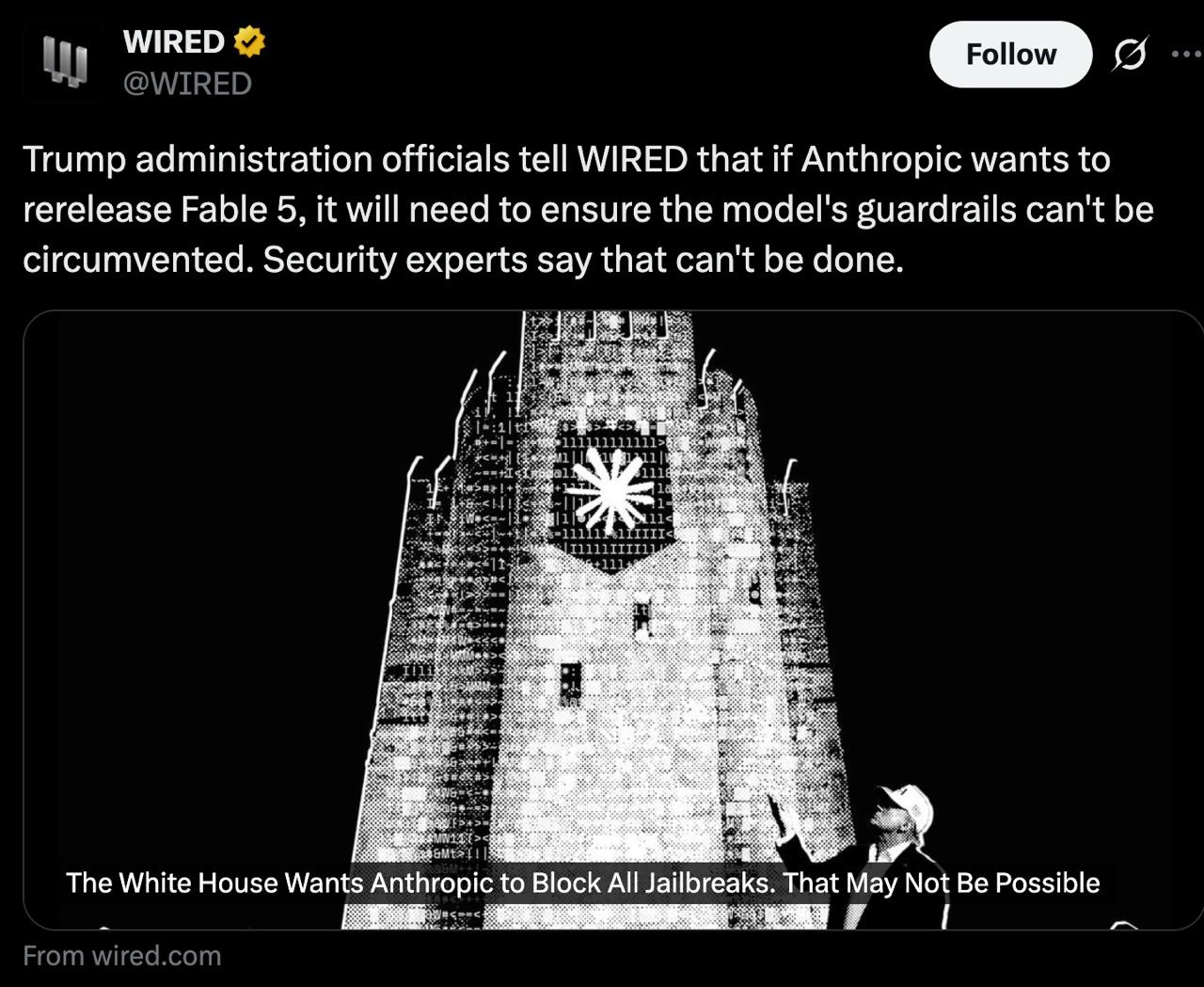
The visible WIRED post says:
Trump administration officials tell WIRED that if Anthropic wants to rerelease Fable 5, it will need to ensure the model's guardrails can't be circumvented. Security experts say that can't be done.
The linked headline sharpens it:
The White House Wants Anthropic to Block All Jailbreaks. That May Not Be Possible
The technical impossibility is hiding in the word all. To guarantee that a frontier LLM cannot be jailbroken, one would need a precise formal definition of prohibited behavior, a complete model of adversary capabilities, a bounded input space, a stable interpretation of every language and encoding, and a proof that no sequence of prompts, tool calls, context injections, translations, roleplay frames, or future attack strategies can cross the boundary. That is not a product requirement; that is a thesis defense with a trapdoor under the podium.
LLM guardrails are usually layers of instruction hierarchy, refusal training, safety classifiers, system prompts, policy tuning, monitoring, and sometimes routing to less capable models. Those are useful mitigations, but they are not equivalent to a cryptographic proof or a type-system guarantee. The model's interface is natural language, and natural language is both data and control plane. The same channel that asks the model to summarize a document can also ask it to reinterpret rules, translate intent, simulate a fictional expert, or decompose a restricted task into harmless-looking pieces. The attack surface is the conversation.
Formal verification works best when the system and property are sharply specified. Here the property is semantic, contextual, and adversarial: "never help with the wrong thing, even indirectly, across all possible user strategies." Security experts hear that and reach for defense in depth, not absolutes. You can reduce jailbreak success rates, harden obvious bypasses, red-team continuously, monitor misuse, limit tool access, segment capabilities, and restrict sensitive domains. You cannot honestly promise non-circumventability for a general-purpose model exposed to adaptive attackers. The universe tried that feature request and returned WONTFIX.
Description
A dark-mode X screenshot shows a verified WIRED post (@WIRED) with a Follow button and Grok-style icon controls at the top. The post says: "Trump administration officials tell WIRED that if Anthropic wants to rerelease Fable 5, it will need to ensure the model's guardrails can't be circumvented. Security experts say that can't be done." The linked card below contains a black-and-white illustration of a tall building made from binary-like texture, an Anthropic-style star logo near the top, and a small figure pointing upward; its headline reads: "The White House Wants Anthropic to Block All Jailbreaks. That May Not Be Possible," followed by "From wired.com." The technical humor comes from the impossibility of proving that a frontier LLM's prompt-level guardrails are non-bypassable, especially when adversarial users, security researchers, and future models keep changing the attack surface.
Comments
25Comment deleted
Demanding an unjailbreakable LLM is like asking regex to validate every future business requirement.
how about leaving the us and changing the hq to a different country? Comment deleted
europe is calling Comment deleted
not as much as you might think, here they have to face many regulations Comment deleted
They will get banned in eu, wdym 😂 Comment deleted
but then they'd probably get banned in the us Comment deleted
which is still the biggest market Comment deleted
I'm sure the eu would make an exception for them Comment deleted
I hope not Comment deleted
cause besides mistral, there isn't much else Comment deleted
I mean, this is still hypothetical, anthropic isn't going anywhere Comment deleted
yeah probably not, and if they would probably go to the uae or smth Comment deleted
might be terrible for them money-wise but it's still good PR Comment deleted
Just have an indian read through every message with two buttons in front of him: "I know this is definitely safe" and "Permaban him just to be sure" 😁 Comment deleted
Manufactured scarcity Comment deleted
What if.. they made a good model, realized it's too expensive and it's really a PR thing Comment deleted
same guy, same move Comment deleted
It had to be stopped back there. Comment deleted
It was actually stopped with quite strict access regulation to it Comment deleted
lmao good Comment deleted
Europe is worse than us and every member state of eu will push them to integrate their own type of backdoor and stupidification of the model Comment deleted
In what way worse? Just because EU has stricter laws than US? Comment deleted
All they gotta do is to let the family in to cash out a little 👉👈 Comment deleted
In 2030 Mythos 6 for president of USA Comment deleted
it’s not «for PR», it’s «because of stupid PR». FAFO Comment deleted