AWS Architecture: Cheaper Than Therapy?
Why is this DesignPatterns Architecture meme funny?
Level 1: Building Instead of Talking
Imagine you have a problem that’s bothering you, like feeling sad or worried about something. Now, instead of talking to someone about it (like a friend or a family member, or a counselor who can help you feel better), picture this: you go into your room, pull out every LEGO set you own, and decide to build the most outrageously complicated Lego city ever. You’re stacking blocks everywhere, making elaborate bridges that loop around in crazy ways, towers connected by string, little contraptions with gears—pieces all over the floor. It’s huge and super complex, taking up the whole room. It keeps you so busy that you don’t think about anything else.
Now, is all that building solving your problem of feeling sad? Not really. It might distract you for a while, and the city you built is really impressive (it’s okay to be proud of it!), but it doesn’t actually address why you were upset. In fact, when someone walks into your room and sees this insanely complex Lego masterpiece, they might scratch their head and laugh a bit, thinking, “Wow, instead of just telling someone he was sad, he did all this!” It’s a funny image because you took something relatively simple (feeling bad and maybe needing to talk or get help) and responded with something overly complicated (a Lego city of doom!).
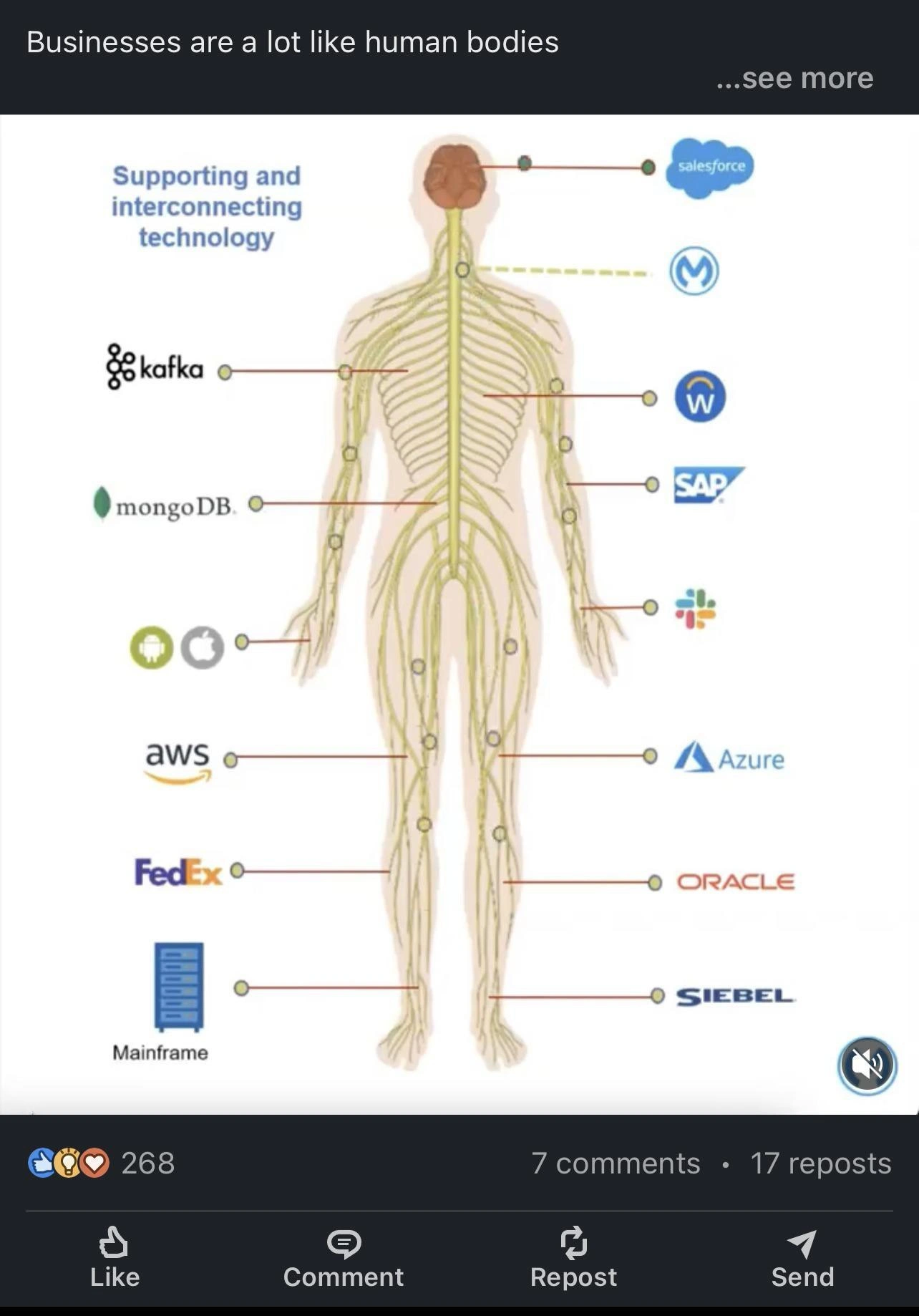
That’s exactly what this meme is joking about. It’s saying some people (specifically joking about men) will do something really complicated – like designing a super-intricate computer system (just like that Lego city, but with technology) – instead of doing something simple like going to therapy (which means talking about what’s bothering them with a professional). The picture in the meme is like the “Lego city” of computer stuff: it’s a big, tangled diagram of a gazillion cloud services all wired together. It’s both amazing and kind of silly. Amazing because it’s so elaborate, and silly because… did it really need to be that elaborate? Probably not, just like you didn’t need to use every single Lego to make a city to avoid talking about your feelings.
In everyday terms, the joke is highlighting a very human thing: sometimes we avoid our simple problems by focusing on complicated tasks. It’s like cleaning your entire house to avoid doing your homework – sure, the house is clean now, but your homework’s still not done. Here, the engineer built a super complex system (the equivalent of cleaning the house or building the Lego city) to avoid dealing with whatever simpler, maybe uncomfortable task was at hand (like asking for help, admitting something was hard, or just confronting a simpler solution). It’s funny because it’s true enough that we recognize the behavior, yet exaggerated enough to be absurd. Everyone can laugh and think, “He’d rather juggle a hundred tasks than do the one thing he probably should do… classic!”
Level 2: AWS Alphabet Soup
Let’s break down what’s going on in that crazy diagram, piece by piece, and why people find it both impressive and a bit absurd. The diagram is made up of a bunch of AWS (Amazon Web Services) icons. AWS is a huge toolkit of cloud services that companies use to build applications without having to manage physical servers. Instead of one big program running on one big server, modern systems often use lots of little programs and services working together – that approach is called microservices or, in this context, a serverless architecture. “Serverless” means you don’t worry about servers – you write small units of code and AWS runs them on demand. Cool, right? But it can also get complicated when you have many of these units.
In the diagram, the orange blocks with the lambda (λ) symbol are AWS Lambda functions. Think of a Lambda as a tiny program that does one task. For example, one Lambda might save a form submission to a database, another might resize an uploaded image, another might send a notification email, etc. These Lambdas don’t run all the time; they only run when triggered by something (like an event or an incoming message), and then they shut down – which is why it’s called serverless (you’re not running a server 24/7 for them).
Then we have those blue icons representing AWS Kinesis streams. Imagine Kinesis as a big, orderly line (a queue) where messages/events wait their turn to be processed. If a lot of data is coming in really fast (say, user actions or sensor readings), you don’t want to overwhelm a single process. Kinesis takes all those incoming events and writes them to a stream that other services can read from at their own pace. It’s kind of like a conveyor belt for data: producers put data on the belt, and consumers (like Lambda functions) pick data off the belt and handle it. It ensures data doesn’t get lost when there’s a flood of it – the data will sit in the stream until a Lambda can process it.
Next, you’ll see symbols for databases and storage. DynamoDB (likely the blue cylinder/barrel icons) is Amazon’s scalable NoSQL database. It’s where you store things like user info, preferences, receipts – basically any data that needs to be quickly retrieved and doesn’t fit neatly into a traditional table structure. DynamoDB is designed to handle a lot of traffic with very low delay (latency), but it has some quirks: for instance, it’s often configured for eventual consistency, meaning if you write something and then immediately read it, you might not see the update for a brief moment. This is normally fine and helps the system scale better, but it’s a trade-off.
There are also S3 buckets in there (the icon looks like a bucket). S3 is a storage service for files. If you need to store images, videos, backups, or any files, you dump them in an S3 bucket. It’s very durable and can hold a virtually unlimited amount of data. In architectures like this, it’s common that a Lambda might put or get files from S3. For example, a user uploads a photo -> it goes to S3 -> that event triggers a Lambda to run (maybe to create a thumbnail or scan the image).
SNS topics (Simple Notification Service – icon looks like a radio signal or hub) are kind of like a pub/sub messaging system. With SNS, one part of your system can publish a message to a “topic,” and many other parts of your system can subscribe to that topic and get a copy of that message. Think of it like sending a group text: one sender, many receivers. In the diagram, SNS might be used to broadcast events to multiple Lambdas at once. For instance, when a new user signs up, an SNS topic “NewUser” could fan-out a notification so that one Lambda sends a welcome email, another Lambda updates some analytics, and another maybe logs it to a monitoring service – all triggered by that one SNS message.
Then we have Step Functions (which usually have a stylized workflow icon). Step Functions are AWS’s way to orchestrate or coordinate multi-step processes. It’s like drawing a flowchart of steps that need to happen in order, some in parallel, some with decisions. Instead of trying to code all that logic inside a single Lambda (which can get messy), you use Step Functions to visually (and logically) lay out the sequence: e.g., Step 1 - charge credit card (Lambda), Step 2 - if successful, do Lambda for sending confirmation, if failed, do Lambda for logging error, Step 3 - update database, etc. It’s basically a managed state machine that keeps track of what step you’re on, what’s next, and what to do if something goes wrong at any step. In the diagram, Step Functions would be the thing tying together several Lambdas into a larger workflow.
Finally, “assorted service gateways” likely refers to API Gateway (an icon that looks like an arch or door). API Gateway is how external requests get into this system. For example, if you have a client app or a user with a web browser who wants to interact with your backend, the API Gateway provides a URL/HTTP interface. When someone hits a certain URL (say POST /createOrder), API Gateway can trigger a specific Lambda to handle that request. It’s basically the front door to a serverless backend.
So, putting it all together: The diagram is showing a system where lots of small pieces are doing specialized jobs:
- Someone (or something) makes a request via an API Gateway.
- That triggers Lambdas that handle the request, maybe write data to DynamoDB or S3, or push events into Kinesis streams.
- Kinesis streams then buffer and sequence those events; other Lambdas pull from Kinesis to do further processing (like real-time analytics, transformations, etc.).
- Some Lambdas publish to SNS topics, which notifies yet more Lambdas (fan-out) to do various tasks in response.
- Some processes are coordinated by Step Functions, so they go through multiple stages.
- Data gets stored or retrieved from DynamoDB tables, files go to or from S3 buckets.
- There might even be third-party services involved (the diagram mentions Twilio in one corner, which is for sending SMS or calls, so maybe one Lambda triggers an SMS via Twilio).
For a newcomer, this is a lot to digest. It’s like getting a bowl of alphabet soup where the letters are AWS service acronyms and you’ve got to make sense of the letters. Each service (Lambda, Kinesis, SNS, etc.) is powerful on its own, but when you use all of them, you’ve built a very complex machine. The reason an experienced engineer might chuckle (or groan) at this is because complexity has a cost. With so many moving parts, things can go wrong in many places. It’s hard to test such a system end-to-end on a laptop — you often have to deploy it to AWS to see how it really behaves. Debugging is tricky: a mistake might not throw a simple error; it might just silently drop a message or route data incorrectly through five different services. Imagine trying to follow a story where the plot jumps between 30 different characters – you’d need a notebook to keep track. That’s what this system is like for a developer: you need very good documentation and tooling to trace what’s happening.
The meme text specifically says: “Men will literally come up with architectures like these instead of going to therapy.” So why bring up therapy? It’s joking that building a system this complicated might be an avoidance mechanism. Sometimes, people immerse themselves in a complex project to distract from other problems. In tech, it’s not uncommon to see folks who seemingly live and breathe an ultra-complex setup (working late nights, obsessing over every detail) – possibly using it as an excuse to avoid other issues (stress, personal life, tough conversations at work, etc.). It’s a lighthearted jab; it’s not claiming anyone actually believes system design is a substitute for mental health care! It’s just humorously highlighting the absurdity: “Wow, instead of dealing with feelings or straightforward solutions, this person built a maze of AWS services.”
For a junior dev, the takeaway is not “don’t use these services” – it’s more “be careful of over-engineering.” It’s like if you needed to get from point A to point B, you could just walk, but you decided to invent a rocket skateboard with AI navigation – sure, it might eventually get you there and it’s a cool project, but it’s also unnecessarily complicated and might crash spectacularly. In software, a simple design is often better if it meets the requirements. You add complexity only when you really need to (for scalability, reliability, etc.), and even then, you try to keep it as understandable as possible. This diagram likely made sense to the people who built it at Yubl for a very specific set of needs (and they were proud of it, enough to present it). But out of context, it looks almost comically convoluted – which is why it became meme material.
So, in simpler terms: the meme is showing an absurdly complex cloud architecture and joking that some engineers (stereotypically guys) will create something like that as a sort of passion project or coping mechanism instead of doing something simpler (like getting help or talking about problems). It’s funny to developers because we recognize the pattern of over-engineering and perhaps the quirky ways our peers (or ourselves) avoid the non-technical issues by doubling down on technical ones.
Level 3: Serverless Coping Mechanism
At a senior engineer’s glance, this meme hits right in the gut (and the funny bone). It’s riffing on a popular joke format: “Men will literally do X instead of going to therapy.” In this case, X is “come up with architectures like these.” The tweet is poking fun at a certain kind of engineer (often male, as the stereotype goes) who pours all his time and mental energy into constructing an insanely complex system rather than addressing personal or organizational issues. It’s the kind of dark humor that makes seasoned devs smirk and think, “Yep, I’ve seen people build tech masterpieces as a form of escape.”
First, let’s talk about the architecture shown (the one titled “At Yubl, we arrived at a non-trivial serverless architecture where Lambda and Kinesis became a prominent feature...”). This thing is over-engineering on steroids. There are orange AWS Lambda icons scattered everywhere, meaning the system is chopped into dozens of tiny functions. There are blue Kinesis stream icons all over, meaning those functions are passing data around through streaming pipelines. Then you spot DynamoDB tables (for storage), S3 buckets (for files), SNS topics (to broadcast messages), Step Functions (coordinating multi-step processes), and likely API Gateways or other endpoints. All of these are connected by a spiderweb of arrows. To a veteran dev, this diagram screams “complicated distributed event-driven architecture.” To someone on an SRE/DevOps team, it whispers “Good luck keeping all of this running without something breaking every other deploy.” In other words, it’s impressive and kind of terrifying.
Why do we find this funny (and a bit painful)? Because it’s relatable. Many of us have worked on projects where the architecture slowly morphed into a Rube Goldberg machine. Perhaps it started simple, but over time more and more services and queues were bolted on, until one day the system map looked like an explosion in the AWS icon factory. There’s a shared understanding that some engineers love adding complexity – maybe out of genuine enthusiasm for new tech, or maybe because they’re avoiding a harder conversation, like “Do we really need all this?” or “What problem are we actually solving?”. Instead of therapy to sort out the human problems (unclear requirements, fear of simplicity, personal issues), they seek solace in architecture – as if crafting the perfect system will make everything OK. It’s tongue-in-cheek, of course; designing systems isn’t literally a replacement for mental health care, but the joke lands because it caricatures a real tendency in tech circles: hiding in our work.
From a senior perspective, there’s also a commentary here on cloud architecture culture. AWS provides a smorgasbord of services – hundreds of them – and it’s easy to go overboard. The diagram is practically a greatest hits of AWS serverless offerings. In the 2010s, especially around 2020-2021 when serverless was the hot buzzword, a lot of teams tried to go “all-in” on microservices and serverless designs. Some of us remember the case studies and conference talks (like the one from Yubl, which this diagram is from) bragging about how they built their entire platform using Lambda functions and managed streams. It was exciting and novel – “Look, no servers to manage, it auto-scales, and every piece is decoupled!” – but those of us with battle scars also thought, “This is going to be a pain to debug and operate.” The meme basically says: Sure, you could simplify or confront the real issue, but nah, let’s add another AWS service to our architecture chart!
Consider what it’s like to maintain a beast like this. Say something goes wrong – a user’s data isn’t showing up correctly. In a simple system, maybe you check one or two places: the app and the database. In this system, you have to ask, “Which Lambda along the chain failed? Did an event get lost in Kinesis? Did our Step Function state machine take the wrong turn? Is an SNS notification delayed? Or did it end up in the wrong S3 bucket?” It could take hours of combing through CloudWatch logs (AWS’s logging service) and tracing transaction IDs through multiple services to pinpoint the issue. It’s the kind of on-call nightmare that ages you prematurely. Seasoned DevOps folks have a dark joke: complex systems like these often require therapy for the on-call engineer after a particularly grueling incident. So there’s irony – the very system built “instead of therapy” can cause others to need therapy (or at least a stiff drink).
The tweet’s humor also lies in overstated contrast: literally doing this elaborate thing instead of a much simpler, healthier alternative. Of course, in reality building something like this isn’t an either/or with going to therapy – but it points out how disproportionately complicated the solution is relative to the problem it’s solving. It’s like noticing someone built a 100-step machine to butter toast and quipping, “Guess he’d rather do that than talk to a therapist.” For senior engineers, the subtext is also a critique: maybe the architect is avoiding something. Perhaps they’re avoiding dealing with legacy code or a tough design compromise, and instead keep adding new microservices hoping to paper over the issues. Or maybe on a personal level, pouring themselves into work to avoid burnout or personal matters – something many in tech have been guilty of.
Another aspect: “Men will literally…” – it’s calling out a gender stereotype in a playful way. Tech is male-dominated, and there’s a stereotype that some guys would prefer to focus on a technical challenge than confront emotions or ask for help. The meme isn’t saying all men do this, but it uses the stereotype for comedic effect. Many people reading this (of any gender) chuckle because they recognize a bit of truth in it: they know that one architect who keeps drawing ever-more-complicated diagrams, using every AWS service under the sun, when maybe a straightforward solution (or sometimes a frank conversation about scope and requirements) would do. It’s a form of cope – coping mechanism – to deal with uncertainty or anxiety by over-preparing and over-engineering.
We also see a nod to architecture astronauts (developers who get lost in abstract, grand designs). The diagram is so dense it’s practically art. In meetings, architects might proudly walk through a diagram like this, eyes gleaming while everyone else forces a smile and silently worries about how they’ll implement or maintain it. A senior engineer might joke, “This isn’t an architecture, it’s a cry for help.” – which is exactly what the meme is insinuating in a humorous way. Instead of literally crying for help (therapy), the person is “crying” by means of an uber-complicated AWS design.
Technically, this architecture likely works for its intended purpose (at least when everything’s running smoothly). It probably scales elastically, handles lots of events, and uses modern cloud best-practices. But the question experienced folks ask is at what cost? The cognitive load to understand it is huge. The number of failure points is huge. The amount of DevOps/SRE effort to keep it instrumented, monitored, and resilient is huge. In a FAANG-scale company with dozens of teams, such complexity might be managed. But for many projects, this would be overkill – solving problems you don’t even have yet. And “solving problems you don’t have” is a classic mistake; it often creates new problems (like complexity) of its own.
So, this meme resonates on multiple levels. It’s a jab at those of us in tech who, whether out of passion or avoidance, dive into over-engineering mode when we could be simplifying. It’s also a gentle reminder (wrapped in humor) that maybe, just maybe, some problems can’t be solved with YAML files, Lambda functions, and Kinesis streams – sometimes you gotta talk it out or address the human aspect. And for a senior engineer, it’s hard not to laugh and grimace at the same time, because we’ve been in the trenches of systems like this, and we know how easily a “non-trivial serverless architecture” can become a non-funny source of stress. In short: been there, done that, should have gone to therapy instead of adding another queue.
Level 4: Complexity as a Service
This diagram isn’t just a gaggle of icons; it’s essentially a blueprint of a massively distributed system pushed to its extreme. In cloud architecture terms, it's a textbook case of an event-driven microservices design built entirely on AWS serverless components. Each orange AWS Lambda icon represents a tiny ephemeral function (code that runs on demand), and each blue Kinesis stream is a firehose of events funneling data from one part of the system to another. What we’re looking at is a complex asynchronous workflow: dozens of independent functions and data streams all concurrently passing messages, like an orchestra without a conductor.
From a theoretical standpoint, this system behaves like a huge distributed state machine. Each Lambda is akin to an actor in the actor model, processing messages and spitting out new messages to other actors via streams or queues. The arrows criss-crossing the diagram form a sprawling directed graph of event flows. Ensuring that such a graph behaves correctly verges on solving a state explosion problem – the number of possible event sequences and states blows up combinatorially with each new Lambda or stream. Formal verification or exhaustive testing of all paths becomes almost intractable. In academic terms, reasoning about this design might invoke temporal logic or Petri nets to model the workflow – it’s that complex. Every AWS service here (Lambda, Kinesis, SNS, DynamoDB, etc.) has its own guarantees and failure modes, and coordinating them is a dance of CAP theorem trade-offs. For instance, data written to DynamoDB (a NoSQL database) is often eventually consistent, meaning different parts of the system might momentarily disagree on the latest data. Meanwhile, Kinesis provides ordered, durable event streams, but if a Lambda reading from Kinesis falls behind or fails, messages queue up or get reprocessed – introducing the need for idempotency (processing events in a repeatable way without side effects if duplicated).
Under the hood, this “non-trivial serverless architecture” is leveraging the fundamental scalability of cloud infrastructure – each Lambda can scale out horizontally, Kinesis can partition data into shards to handle massive throughput, and SNS can fan-out messages to multiple consumers in parallel. In theory, this yields a highly fault-tolerant and scalable system: there’s no single monolithic server that can become a bottleneck. Instead, you have many little pieces that can independently fail or succeed. But therein lies the rub – coordinating distributed computations is one of computer science’s classic hard problems. The system is loosely coupled (which is good for independent development and resilience) but also loosely controlled (which is bad for predictability and simplicity). It’s a living illustration of the first axiom of distributed computing: the network is unreliable. Each arrow is a network hop or an API call that could fail, time out, or introduce latency. A senior architect looking at this sees a chaos engineering playground: to gain confidence, you'd practically have to simulate failures of each component (e.g., what if one Lambda throws an exception, or a Kinesis shard gets throttled?) and ensure the whole system can self-heal or at least alert someone in time.
There’s also a hint of Conway’s Law embodied here: the architecture’s tangled structure might mirror a team’s communication paths or a developer’s thought patterns. In psychological terms (since the meme winks at therapy), one could say this system reflects a mind trying to impose order via intricate structure – every new Lambda is like a new compartment for a thought or concern, every Kinesis stream a channel to shuttle those thoughts around. It’s as if the architect tried to modularize every single concern into its own microservice as a way to stay in control. But in doing so, they’ve created an emergent complexity that no single brain can fully comprehend at once. In theoretical computer science, there’s an understanding that beyond a certain scale, systems exhibit emergent behavior – outcomes that aren’t explicitly designed but arise from many small interactions. This web of Lambdas and streams likely has all sorts of non-obvious behaviors (race conditions, timing issues, feedback loops) that only appear in production at 3 AM (naturally).
In essence, this “therapy via architecture” approach has resulted in something that’s both ingenious and fragile. Ingenious, because it uses cutting-edge cloud design patterns (the kind you’d see in AWS whitepapers) to achieve scalability and decoupling. Fragile, because to truly guarantee it works for every edge case is almost beyond human ability without extensive tooling. It’s like a complex adaptive system – more akin to an ecosystem than a traditional program. The humor of the meme, viewed in this deep context, stems from a truth in system design: you can offload servers to the cloud, split responsibilities into microservices, and pipeline your data streams, but you can’t eliminate complexity – you can only move it around. Here the complexity isn’t in any one piece, it’s in the relationships and interactions between all the pieces. And managing that feels less like engineering and more like group therapy for distributed components.
Description
This image is a screenshot of a tweet from the user 'supermassive backlog' (@FakeRyanGosling). The tweet's text employs a popular meme format, stating, 'Men will literally come up with architectures like these instead of going to therapy.' Below this text is an image of an extremely complex and sprawling system architecture diagram. The diagram is explicitly identified as a 'non-trivial serverless architecture' from a company called Yubl, featuring dozens of interconnected icons representing various AWS services, including Lambda, Kinesis, S3 buckets, DynamoDB tables, API Gateways, and more, as well as third-party services like Twilio. The humor arises from the suggestion that creating such a convoluted, and likely over-engineered, technical solution is a manifestation of avoiding personal emotional issues. For senior engineers, this is a deeply relatable joke about the tendency in the industry to overcomplicate solutions or use complexity as a distraction, creating systems that are as hard to navigate as the problems they are supposedly helping their creators avoid
Comments
7Comment deleted
This isn't an architecture diagram; it's an emotional dependency graph mapped to AWS services. The blast radius of a single emotional event could take out the entire prod environment
Why pay for therapy when you can shove every unresolved feeling into a Kinesis stream, have Step Functions retry denial with exponential backoff, and let a Lambda bury the root cause in Glacier at eleven nines of durability?
The real distributed system here isn't the Lambda functions - it's how we've distributed our emotional processing across 47 different AWS services, each with its own retry logic for avoiding feelings
Ah yes, the classic 'Lambda-driven development' pattern - where every function gets its own microservice, every microservice gets its own Kinesis stream, and every stream gets its own DynamoDB table. By the time you've finished drawing this architecture diagram, you've successfully avoided three months of actual emotional processing. The distributed tracing alone requires more therapy than the original problem, but at least now your anxiety is event-driven and scales horizontally. Nothing says 'I'm fine' quite like explaining to your therapist why your personal blog needs 47 Lambda functions and eventual consistency guarantees
This isn't over-engineering; it's emotional fortification via service boundaries tighter than repressed memories
We replaced therapy with event-driven architecture: feelings stream through Kinesis, denial runs in 200 Lambdas, and anything hard lands in the DLQ named 'Q4'
We replaced therapy with dozens of Lambdas and Kinesis; CloudWatch is our therapist and vendor lock-in is our attachment style