The Verification Data Breach Loop
Why is this DataPrivacy meme funny?
Level 1: Prove It Again
It is funny because the company keeps asking for more proof of who you are, then loses that proof, which makes it easier for someone else to pretend to be you. It is like giving a guard your secret password, the guard shouting it in the street by accident, and then the guard saying, "Now I need an even bigger secret password."
Level 2: Breached Proof
Authentication is how a system checks that you are really you. Passwords, passkeys, one-time codes, identity documents, and account recovery questions are all authentication tools. Data privacy is about limiting how much personal information is collected, stored, shared, and exposed.
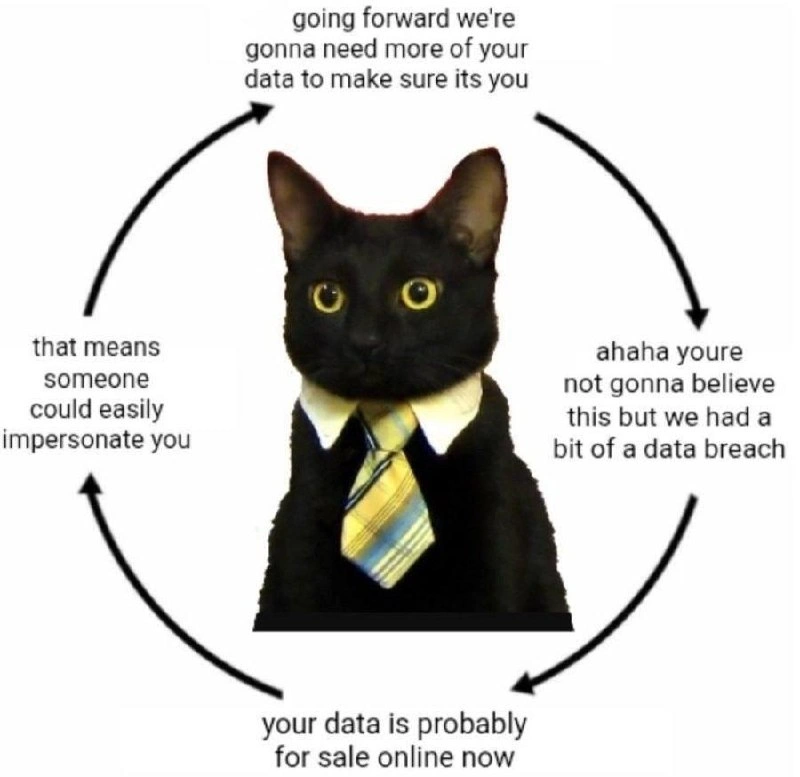
The picture shows a cycle. A company asks for more personal data to verify users. Then it has a data breach. That leaked data may be sold online. Because attackers can now use the leaked data to impersonate people, the company decides it needs even more data next time. The joke is that the "solution" keeps feeding the original problem.
For developers, this connects to product and security trade-offs. It is easy to add another required field to a signup or recovery flow. It is much harder to justify storing that field forever, protecting it correctly, rotating access, auditing usage, and deleting it when it is no longer needed. Early-career engineers often learn this the hard way: sensitive data is not just another database column. It is a liability with a UI label.
Level 3: KYC Ouroboros
The diagram is a perfect little indictment of identity systems that respond to privacy failure by collecting even more identity material. The visible loop goes:
going forward we're gonna need more of your data to make sure its you
then:
ahaha youre not gonna believe this but we had a bit of a data breach
then:
your data is probably for sale online now
then:
that means someone could easily impersonate you
and back around to demanding more data. That is the whole tragedy of digital identity in four arrows.
The senior-engineer pain here is that many authentication and fraud systems still treat static personal facts as proof of identity: legal name, birth date, address history, phone number, ID scans, last four digits, answers to "security questions," and other data that becomes less useful as a secret every time it is stored, copied, sold, leaked, enriched, or scraped. After enough breaches, "verify your identity by telling us your personal information" starts sounding like "prove you own the house by reciting the address painted on the front."
The worst part is the incentive structure. Companies want lower fraud, lower support cost, regulatory coverage, and a defensible audit trail, so they ask for more data. But every additional field becomes part of the breach blast radius. The product risk is shifted onto the user: if the company loses the data, the user now has to deal with impersonation, account recovery pain, credit freezes, replacement documents, and a permanent increase in background risk. The database gets a postmortem. The person gets a lifelong cleanup task.
This is why data minimization matters. Good security design does not ask "how much personal data can we collect to feel safer?" It asks what proof is necessary, how long it must exist, whether it can be tokenized or verified without retention, and what happens when the storage layer inevitably disappoints everyone at 2:17 AM. The meme's loop is funny because it is exaggerated only by typography; the strategy itself is depressingly recognizable.
Description
The image shows a black cat wearing a shirt collar and striped tie in the center of a circular flow diagram on a white background. Around it are four curved black arrows connecting the text: "going forward we're gonna need more of your data to make sure its you," "ahaha youre not gonna believe this but we had a bit of a data breach," "your data is probably for sale online now," and "that means someone could easily impersonate you." The meme visualizes a self-reinforcing identity-verification cycle where companies collect more personal data after breaches, even though that same data becomes more valuable and dangerous when leaked. For developers and security teams, it lands as a concise critique of authentication, KYC-style risk management, and privacy-hostile product defaults.
Comments
2Comment deleted
The strongest authentication factor is apparently a database dump everyone else already has.
Since admins sold most of reactions to get a dose of AI tokens, I have to put it here: 😡 Comment deleted