Skip to content
DevMeme
3266 of 7435
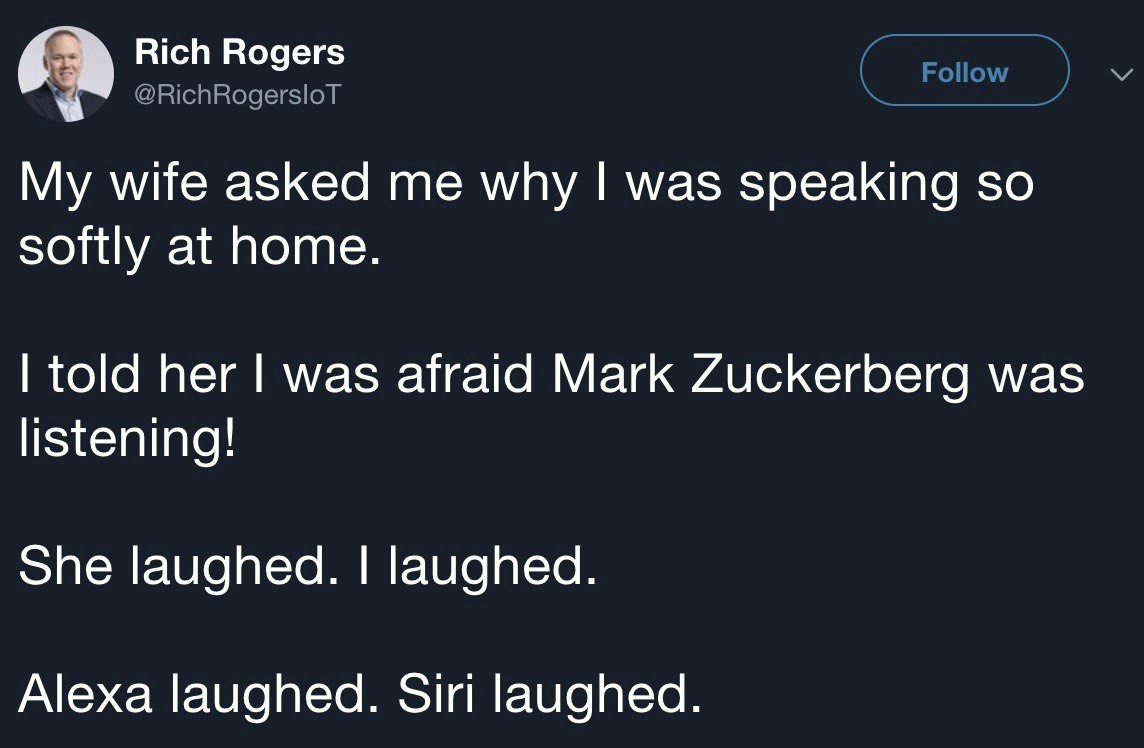
A Smart Home Horror Story in Four Lines
DataPrivacy Post #3590, on Aug 24, 2021 in TG

A Smart Home Horror Story in Four Lines

Why is this DataPrivacy meme funny?

Level 1: Walls Have Ears

Imagine you’re telling a secret at home, and you’re a bit worried someone might be listening from outside. So you start talking in a quiet whisper. Your wife hears you whispering and laughs because it seems so silly to her. You laugh too, feeling a little goofy. But then, out of nowhere, the gadgets in your home also laugh — like your smart speaker on the shelf and your phone’s voice assistant chiming in with giggles! It’s as if the objects in your house were eavesdropping on your little secret and found it funny. 😅 The joke here is a play on the old saying “walls have ears,” which means you never know who might be listening. In modern times, our “walls” are filled with smart devices that can listen to us (like Amazon’s Alexa or Apple’s Siri). So the meme makes a funny scenario out of our fear that maybe these helpful talking machines around us are secretly listening to everything. It’s humorous because it’s a bit spooky and a bit true: we treat Alexa and Siri like innocent tools, but thinking of them laughing at our conversations reminds us they’re always there, quietly hearing what we say. In simple terms, it’s laughing about the idea that even when we think we’re alone, our digital assistants might be listening in — the home gadgets have become the new friendly “ears in the walls.”

Level 2: Always-On Microphones

At its core, this meme is joking about privacy concerns with smart devices in our homes. In the tweet, the husband says he’s speaking softly because he’s afraid Mark Zuckerberg is listening. Mark Zuckerberg is the CEO of Facebook (now Meta), and he’s often associated with controversies around personal data and privacy. People sometimes joke (or genuinely worry) that apps like Facebook might secretly use your phone’s microphone to eavesdrop on conversations for advertising. Here, the husband is acting on that paranoia — whispering so Facebook (personified by Mark Zuckerberg) can’t hear him.

The funny twist comes when his wife laughs at him, he laughs, and then Alexa and Siri laugh as well. Alexa and Siri are not people; they are the names of digital assistants (also known as voice assistants) made by tech companies. Alexa is the voice of Amazon’s Echo smart speakers, and Siri is Apple’s voice assistant on iPhones, iPads, and their HomePod speakers. These assistants let you use voice commands to do things like play music, set alarms, ask questions, or control smart home devices. They are examples of devices in the Internet of Things (IoT) – which means everyday objects that are connected to the internet and can send/receive data. A VoiceUserInterface like Alexa or Siri lets you interact with technology just by talking, rather than clicking or typing. It’s pretty convenient – you can just say, “Alexa, what’s the weather?” and get an answer.

However, for Alexa or Siri to hear you anytime you call them, they have always-on microphones. This means the microphone is always listening in the background, waiting for the “wake word” – the special command (their name or a phrase like “Hey Siri”) that tells them to pay attention and respond. According to the companies, the devices are constantly listening locally but not recording everything you say, at least not until they detect the wake word. They usually keep a rolling few-second buffer of audio that gets overwritten continuously, so theoretically, if you don’t say “Alexa,” the audio never leaves the device. Still, just knowing there’s a gadget in your room that’s perpetually listening for a cue can make people uneasy. After all, “always listening” and privacy don’t exactly sound like best friends. PrivacyConcerns arise because users wonder: is it only listening for the magic word, or could it be picking up more? Could someone abuse that access?

In the meme, when Alexa and Siri “laughed,” it implies these assistants overheard the husband’s comment about Zuckerberg. Realistically, Alexa wouldn’t laugh at you unless perhaps you asked it to tell a joke, and Siri doesn’t giggle on her own either. (In fact, a few years back, Amazon had an issue where Alexa devices randomly laughed due to a software glitch, and it genuinely spooked people. Amazon had to update Alexa’s software to stop that creepy behavior.) So the image of Alexa and Siri laughing here is a humorous exaggeration. It’s poking fun at the idea that these devices are secretly always listening and even joining in like part of the family. If you think about it, if they can laugh at what you said, that means they definitely heard you say you were afraid of eavesdroppers! The joke is basically highlighting the irony: you’re whispering so a far-away tech CEO can’t hear you, but two voice assistants right next to you are listening and teasing you for worrying.

This ties into a broader fear many people have about modern technology: surveillance in the home. We use that word to talk about being watched or listened to, usually in a security or spy context. Here it’s a playful form of “smart_speaker_paranoia.” There have been plenty of stories contributing to this fear. For example, users have reported talking about something near their phone or smart speaker, and later seeing an advertisement for that very thing online, which feels suspicious. The companies involved – whether Facebook, Amazon, Google, or Apple – all insist that if you didn’t trigger the assistant, the audio isn’t being sent to them. And certainly, there’s no evidence that your phone’s microphone is streaming everything you say to Facebook. In many cases, those uncanny ads are chalked up to other data you unknowingly left behind (like your web searches, or things your friends and family discussed online). Still, the coincidence of mentioning a product and then seeing an ad for it has many people convinced their phones or smart devices are overhearing them. This meme riffs on that exact feeling.

Mark Zuckerberg in the joke represents that fear of “the tech giants are listening to us for their gain.” Facebook’s entire business is advertising based on personal data, so much so that a term “surveillance capitalism” is often used to describe the modern internet economy – meaning companies offer you free services and in return they collect information about you to make money (for example, by showing targeted ads). A junior developer might not have heard that term, but they can understand the concept: user data = profit. Facebook’s past scandals (like the Cambridge Analytica data misuse in 2018) made a lot of people lose trust in how their data is handled. So in this tweet, saying “I’m afraid Mark Zuckerberg is listening” is another way of saying “I don’t trust that my conversations aren’t being monitored for data.” It’s a bit of a conspiracy-tinged joke, but it resonates because of Big Tech’s reputation.

Now, Alexa and Siri laughing adds a clever multi-company twist. Amazon and Apple are also huge companies that deal with personal data, though in different ways. Amazon’s Alexa does record your voice commands and stores them (you can actually review and delete your Alexa voice history). Apple, on the other hand, emphasizes privacy – Siri tries to process as much as possible on your device and anonymize data it sends back to Apple. But even Apple had a moment where they had contractors listening to anonymized Siri recordings to check quality, which caused an uproar and they halted that program. The meme isn’t concerned with those fine details; it’s lumping all these tech giants together humorously. It suggests that whether it’s Facebook, Amazon, Apple, or even Google, they’re all potentially “listening” in some form.

The post’s caption even throws Google into the mix: “And Google made a note of what makes you laugh.” Google has its own voice assistant (Google Assistant on devices like Android phones or Google Home speakers), and Google is also heavily in the ads and data business (ever notice how much Google knows about your interests?). The caption joke is that while Alexa and Siri audibly laughed, Google quietly logged the data point that you found this joke funny – which could be used to profile your sense of humor or preferences. It’s a playful jab at how Google collects information in the background.

In summary, what this meme is conveying in a lighthearted way is: we’re surrounded by smart devices that might be spying on us, and we kind of accept it even as we joke about it. It’s highlighting an everyday irony for anyone tech-savvy: you worry about one privacy threat while two others are literally in the room with you. For a newcomer (junior dev or casual tech user), it’s a funny reminder that all these helpful gadgets (smart speakers, smartphones with voice assistants, etc.) come with Security and privacy trade-offs. The meme uses humor to point out a genuine concern: “the walls have ears” — except now the walls are our gadgets, and they not only have ears, they might even have a sense of humor at our expense.

Level 3: Internet of Eavesdropping Things

This meme delivers a darkly funny truth about DataPrivacy in the era of ubiquitous gadgets. A developer whispers at home out of fear that Mark Zuckerberg is eavesdropping, and the punchline is that his smart assistants — Alexa (Amazon’s Echo speaker persona) and Siri (Apple’s voice assistant) — join in the laughter. In other words, while he’s paranoid about Facebook listening, the devices from other tech giants in his living room are already listening. It’s a perfect satire of our smart_speaker_paranoia: being afraid of one Big Tech bogeyman while two others (literally) laugh at you from your coffee table. The tweet’s format plays on a classic joke structure, but here it doubles as social commentary on the InternetOfThings. Techies chuckle because the scenario is absurd yet uncomfortably plausible. We’ve essentially invited an always_on_microphones deployment into our homes in the form of voice assistants. The home_surveillance_joke lands so well because developers know these “assistant” devices can behave like friendly house spies.

From a senior engineering perspective, the meme hits on the irony of IoT convenience vs. privacy. Those voice user interface devices (Alexa, Siri, Google Assistant, etc.) are always passively listening for a wake word. They’re built with microphones hot 24/7, buffering audio locally so they can respond when you say “Alexa” or “Hey Siri.” Because what could go wrong with an open mic in your house, right? Well, lots:

  • Phantom laughter: Amazon’s Alexa infamously laughed spontaneously at 3 AM for some users due to a bug. Imagine the creepiness of a disembodied digital assistant chuckling in an empty room. It was a real incident that made headlines, and Amazon had to hurriedly fix it.
  • Mistaken recordings: There have been cases of Alexa mishearing commands and sending private conversations to random contacts. One family in 2018 found that Alexa recorded their household banter and emailed it to a colleague – a malfunction straight out of a privacy nightmare.
  • Human reviewers: For a time, both Amazon and Apple (and let’s not forget Google) had teams of contractors listening to snippets of voice assistant recordings to “improve voice recognition quality.” Yes, actual humans occasionally eavesdropped on things users said to their supposedly automated assistants. This was disclosed in fine print, but most people learned about it only when whistleblowers or journalists revealed it. Cue the collective gulp from the tech community.

Given all that, the idea of Alexa “laughing” at your whispered confession is only a slight exaggeration. It underscores a kernel of truth: these gadgets hear more than we realize, and sometimes the data (or even accidental audio) ends up somewhere we didn’t expect. The meme winks at the fact that your smart home might be an unintentionally well-placed surveillance hub. Security professionals often joke that the easiest way to bug someone’s house now is to sell them an internet-connected device with a microphone. We used to worry about government wiretaps; now we pay monthly for one in the form of a smart speaker. Internet of Things, indeed — more like an Internet of Eavesdropping Things.

Now let’s talk about the Mark Zuckerberg reference. Why is Zuck the one this developer is whispering about? Mark Zuckerberg (CEO of Facebook, now Meta) has become a poster child for PrivacyConcerns in the digital age. Facebook’s history with personal data — from the Cambridge Analytica scandal to the platform’s voracious appetite for user information — has made people extremely suspicious. There’s an urban-legend-turned-widespread-belief that the Facebook app might be secretly using your phone’s microphone to spy on conversations and then target ads. Facebook has repeatedly denied doing this, and many engineers point out that Facebook can target you frighteningly well without needing to literally listen in (they already vacuum up so much of your online activity). Still, the suspicion persists, especially among non-technical folks: mention a product near your phone, and lo and behold, you see an ad for it the next day. 😏 Whether it’s coincidence, advanced ad analytics, or actual eavesdropping, it feels sneaky. So in this joke, the husband is half-seriously afraid that speaking out loud might attract the ears of Zuckerberg’s empire. It’s the classic tech-paranoia scenario — like talking softly to avoid waking a sleeping dragon (or a data-harvesting AI).

The hilarious twist is that while he’s worrying about the dragon outside (Facebook), the two he’s already invited in (Amazon’s Alexa and Apple’s Siri) start cackling. That’s the “everyone laughed” structure turned on its head: She laughed. I laughed. Alexa laughed. Siri laughed. It paints a picture of Big Tech’s virtual agents sharing a private joke at the paranoid user’s expense. To a seasoned developer or security engineer, the notion that Amazon and Apple devices might react because they overheard you isn’t far-fetched humor — it’s basically what they’re designed to do (minus the audible guffaw… usually). The meme is nodding to the collective anxiety about surveillance capitalism: the idea that our data (even our speech, laughter, and living room conversations) is being monitored and monetized by default. Each of the tech giants in the room represents a pillar of that surveillance economy. Facebook (Mark Zuckerberg) is the social media spy, Amazon’s Alexa is the e-commerce and smart home spy, Apple’s Siri is the personal device spy (even Apple, which markets itself as privacy-centric, isn’t off the hook in this joke), and the cherry on top is Google (the post’s caption slyly adds “Google made a note” — of course Google would silently log the event).

For veteran devs, this hits a comedic sweet spot. It references the absurd reality we’re living in: we voluntarily carry and install multiple listening devices around us. The paranoia isn’t just a tinfoil-hat trope; it’s a lived experience of the tech workforce and users alike. We’ve all had that uneasy laugh about our smartphones possibly watching or listening. This meme just turns that into a literal scene. It’s funny and cringe-y at the same time, because as tech insiders we know enough to be wary, but we’ve also seen how common (and convenient) these devices are. We’ve debugged code or managed cloud services behind these assistants, and we know they’re marvels of engineering — yet we also know how the data sausage gets made. So when Alexa and Siri join in laughing, the senior crowd smirks: yep, welcome to 2021, where your gadgets gossip about you. The humor comes with a side of “these are the times we live in.”

And let’s not forget the final zinger: “And Google made a note of what makes you laugh.” This wasn’t in the tweet’s text, but in the poster’s commentary. It adds one more wink for those in-the-know. Google, which runs a massive ads business and has its own always-listening Assistant in many homes, wouldn’t laugh out loud. Instead, it silently logs the data point (voice_assistant_overhearing in stealth mode). That’s a playful jab at Google’s reputation for quietly collecting vast amounts of information about us, even the things we find funny, to refine its ad targeting algorithms. In essence, all four of the big tech giants are implicated: Facebook (Mark Zuckerberg), Amazon (Alexa), Apple (Siri), and Google. They form a sort of Mount Rushmore of modern digital surveillance. For a developer who’s seen the evolution of tech, this one meme manages to roast them all in one go. It’s a compact commentary on the state of privacy and Security in the connected world: the house is full of ears, and none of them belong to humans. We’re laughing at the joke, but also a bit at ourselves for living inside this sci-fi reality we helped build.

Description

The image is a screenshot of a tweet from a user named Rich Rogers (@RichRogersIoT). The tweet, presented as white text on a dark background, tells a short, four-line joke. It reads: 'My wife asked me why I was speaking so softly at home. I told her I was afraid Mark Zuckerberg was listening! She laughed. I laughed. Alexa laughed. Siri laughed.' The visual is minimalist, focusing entirely on the text of the joke. The humor builds on a common paranoia about modern technology's intrusiveness. It starts with a relatable fear of being monitored by tech giants (personified by Mark Zuckerberg), which is initially treated as a joke between the couple. The punchline lands with the unexpected participation of the smart assistants, Alexa and Siri, which horrifyingly confirms the initial fear. For tech professionals, this joke is a sharp commentary on the privacy trade-offs of IoT devices and the pervasive data collection culture of the companies that produce them

Comments

7
Anonymous ★ Top Pick The most terrifying part isn't that they're listening; it's that they're probably running A/B tests on their laughter to maximize user engagement with existential dread
  1. Anonymous ★ Top Pick

    The most terrifying part isn't that they're listening; it's that they're probably running A/B tests on their laughter to maximize user engagement with existential dread

  2. Anonymous

    My living-room chat is basically a Kafka pipeline now: Alexa produces, Siri replicates, and Zuckerberg is the stealth consumer with read-committed turned off

  3. Anonymous

    The real horror isn't that Alexa and Siri laughed - it's that they both updated their behavioral models based on your conversation, cross-referenced it with your purchase history, and are now A/B testing targeted ads for marriage counseling services across your entire device ecosystem

  4. Anonymous

    The real horror isn't that Alexa and Siri laughed - it's that they probably stored the conversation in three different data centers, trained an ML model on it, and added 'paranoid developer' to your advertising profile. At least they didn't pipe it through a Kafka stream to Meta's ad targeting system... or did they?

  5. Anonymous

    Wake-word detection is just the pub/sub that forwards our living room events into someone else’s recommendation engine

  6. Anonymous

    I speak softly at home because on smart speakers ‘mute’ is a UI affordance, not a service boundary - telemetry still hits the Kafka topic, it just doesn’t answer back

  7. Anonymous

    Whispering secrets? Cute - your smart speaker's already shipping anonymized traces to a fleet of inference endpoints

Use J and K for navigation