The Export Control One Weird Trick
Why is this AI ML meme funny?
Level 1: The Cheat Code Joke
It is funny because the post acts like there is a secret cheat code for avoiding strict AI rules: give a lot of money to the powerful side. It is like a kid saying, "I found one weird trick to skip detention," and the trick is being best friends with the principal.
Level 2: Influence-Driven Access
Export controls are government rules that restrict access to sensitive technology across borders. In AI, they can affect advanced chips, models, cyber capabilities, and who is allowed to use them. Compliance requirements are the rules a company must follow to avoid legal or regulatory trouble.
The tweet jokes that instead of solving export-control problems through technical safeguards, a company can use "one weird trick": political money. The embedded headline about an OpenAI executive becoming a major Trump donor makes the joke feel like a fake advertisement for regulatory favoritism.
The metadata caption points out that OpenAI also uses government-issued ID verification for cyber-related access. That means the real world is more nuanced than the meme. Companies can restrict dangerous tools by verifying users, logging access, and limiting sensitive capabilities to trusted groups. Still, developers understand why the meme lands: when rules are changing fast and giant companies are close to government policy, it can feel like access decisions depend on power relationships as much as clean security design.
Level 3: PAC as Policy API
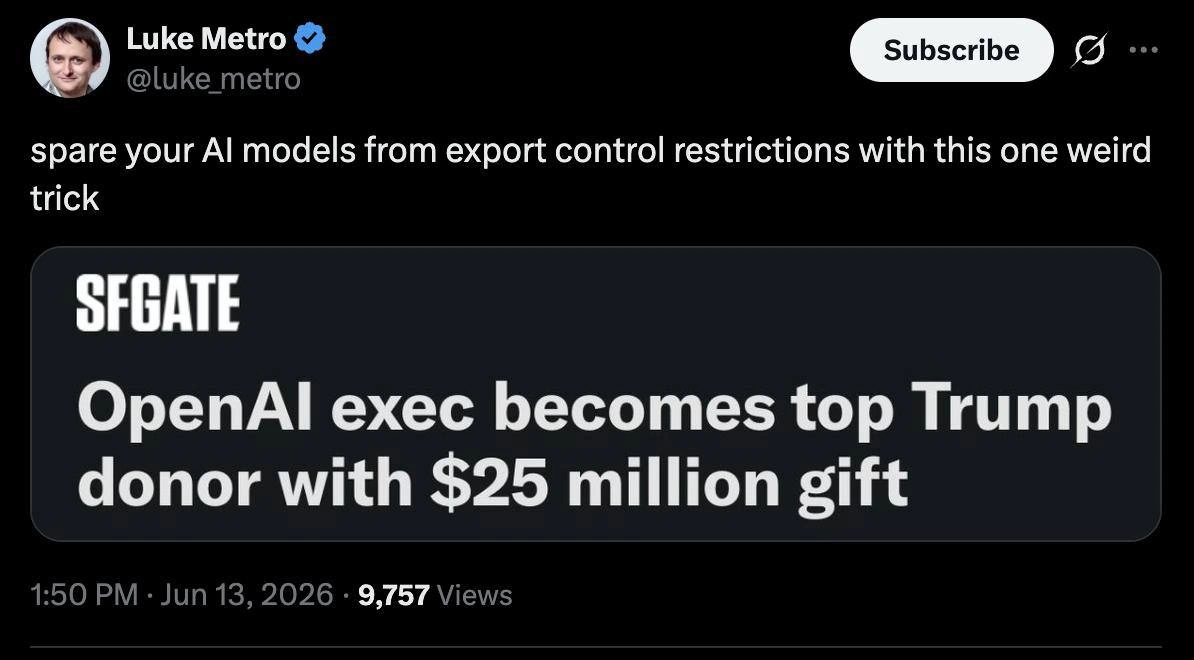
The visible post says:
spare your AI models from export control restrictions with this one weird trick
and the embedded SFGATE headline reads:
OpenAI exec becomes top Trump donor with $25 million gift
The joke uses the language of clickbait life-hack ads: "one weird trick" normally promises an absurd shortcut around some difficult constraint. Here the difficult constraint is AI export control, and the alleged shortcut is proximity to political power through a huge donation. The meme is not making a technical claim that money literally toggles a compliance flag. It is satirizing the perception that frontier AI policy is now close enough to campaign finance, lobbying, defense contracts, and national strategy that regulatory outcomes can look less like neutral governance and more like enterprise relationship management.
That is why the OpenAI angle matters. Export controls are supposed to manage national-security risk: who can access advanced models, chips, cyber capabilities, or dual-use technology, and under what conditions. But in the AI industry, the same companies seeking permission to deploy powerful systems are also funding policy efforts, courting governments, building public-sector products, and shaping the story of what "safe innovation" should mean. In that environment, even legitimate compliance decisions can become reputationally radioactive. The dashboard may say risk management; the meme reads it as "have you tried donating to production?"
The post caption adds a useful complication: OpenAI has government-issued ID verification for cyber and related access, so the joke does not work at full technical purity. That matters. Access control mechanisms like verified identity, trusted-user programs, cyber-specific gating, auditability, and usage monitoring are real safety tools. They are a serious alternative to simply banning capabilities for everyone or handing them out blindly.
But the satire survives because the meme is about political economy, not just authentication. Identity verification can answer "who is using the model?" It does not answer "who gets favorable policy treatment?" or "whose risk framing becomes the default?" The funny, cynical punchline is that in frontier AI, compliance is no longer just a checklist for lawyers and security engineers. It is also public perception, federal strategy, geopolitical leverage, and the uncomfortable suspicion that the best API key is a phone call.
Description
The image is a dark-mode X screenshot from verified user Luke Metro, @luke_metro, with a visible "Subscribe" button in the top right. The post text reads: "spare your AI models from export control restrictions with this one weird trick". Embedded below is an SFGATE headline card that says: "OpenAI exec becomes top Trump donor with $25 million gift," and the post footer shows "1:50 PM · Jun 13, 2026 · 9,757 Views." The sibling caption notes that OpenAI has government-issued ID verification for cyber-related access, but the main joke is political: model access, AI export controls, and regulatory favor are framed like an ad-tech life hack where campaign donations become a compliance strategy.
Comments
3Comment deleted
Apparently the enterprise tier for regulatory compliance is just OAuth with a super PAC as the identity provider.
That donation was made in 2025 to Trump's campaign, but you only need to go back a few years early to find out that Joshua Kushner (Jared's brother) is +20B-valuation-deep into OpenAI Add to that the "principle stand" that Anthropic took against the military/mic and co (and the cheap fucks they shown themselves to be when it comes to political donations) and there you go, if they don't behave and pay the toll accordingly they are royally fucked Comment deleted
lynch the AI corps Comment deleted