Data Privacy Showdown: Zuckerberg vs. Santa Claus
Why is this DataPrivacy meme funny?
Level 1: Secret Seller vs Gift Giver
Imagine two people who both know a lot about you. One is like Santa: a jolly old friend who watches what you do all year but only so he can give you a nice surprise if you’ve been good. He might note that you did your homework and helped your family, and then he rewards you with a gift you wanted. Importantly, Santa keeps this information to himself – it’s just between you and him (and maybe his elves). The other is like a tech boss: a clever but sneaky person who also watches everything you do, especially what you do online. But instead of giving you gifts for your good behavior, he takes that information about you – like what games you play or what toys you look at – and sells your secrets to toy stores and advertisers. So after he learns you love toy cars, you start seeing tons of ads trying to sell you toy cars whenever you use the computer. It’s as if this second guy turns your personal information into money for himself. The meme is funny (and a bit sarcastic) because it shows that we’d obviously trust the gift-giving Santa over the data-selling tech CEO. It’s pointing out in a simple way that knowing everything about someone should be used to help them (like Santa does), not to take advantage of them. Even a kid can understand that getting a present feels a lot better than feeling spied on for profit!
Level 2: Milk and Cookies
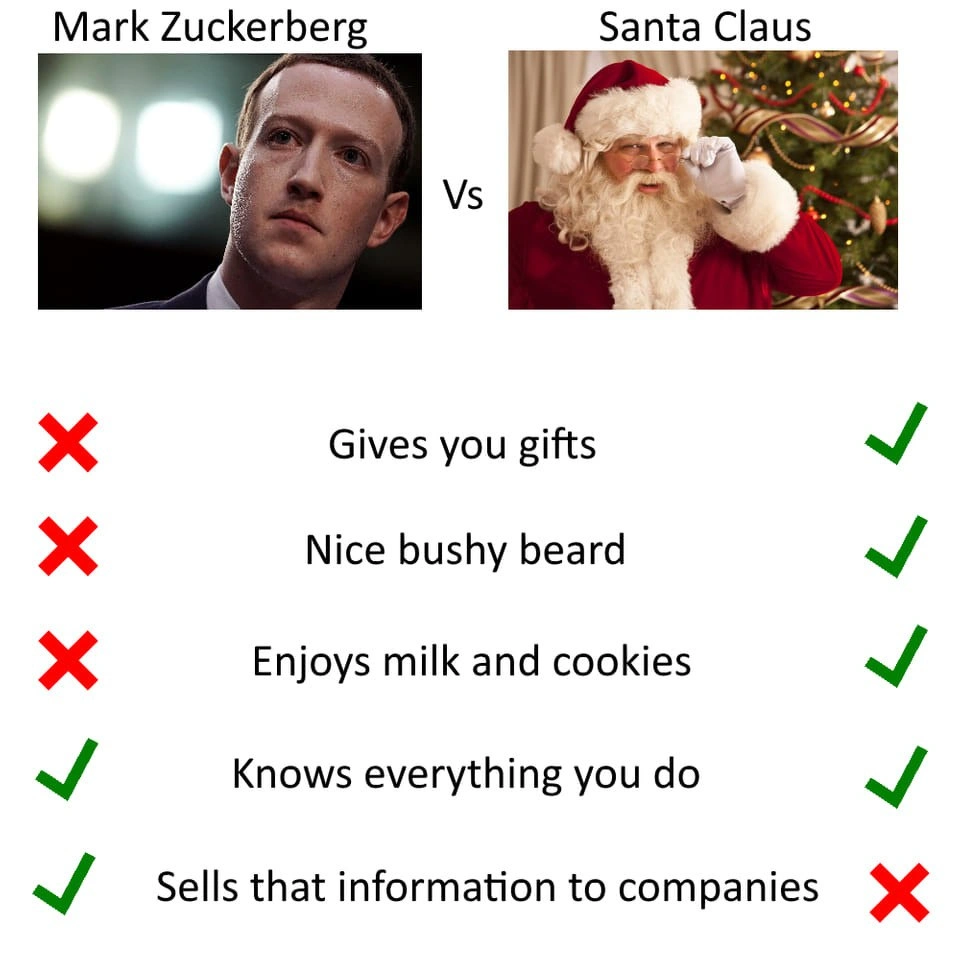
Let’s break this meme down in simpler terms and explain all the references. On the left side we have Mark Zuckerberg, the CEO of Facebook (one of the biggest SocialMedia platforms). On the right side is Santa Claus, the legendary figure who brings presents to children every Christmas. The meme compares them feature by feature using a checklist with red X marks and green check marks. Even without being a tech expert, you can see the humor: most of Santa’s qualities are positive (green ✓) while the tech CEO gets red X for those same qualities – except in the areas of knowing what you do and profiting from it.
For example, “Gives you gifts” has a red X under Mark and a green ✓ under Santa. Santa literally gives out gifts (toys, candy, etc.) out of kindness during the holidays. Mark Zuckerberg, in contrast, isn’t known for handing out free gifts to individual users. Facebook might be providing a free service, but you don’t get surprise presents from Mark in the mail or anything. Next, “Nice bushy beard” is X for Mark, ✓ for Santa. This one is just a lighthearted, visual joke: Santa is famous for his big white beard, and Mark Zuckerberg famously does not have a beard – he’s usually clean-shaven. The meme is being playful here; having a beard obviously has nothing to do with tech or privacy, it’s just for fun. Similarly, “Enjoys milk and cookies” is checked for Santa and marked X for Mark. In Christmas lore, children leave out milk and cookies for Santa to enjoy when he visits their home. It’s one of those warm, fuzzy holiday traditions – Santa loves his snacks. Mark Zuckerberg, as far as anyone knows, doesn’t have a public love of milk and cookies. This line is more for humor, but it hides a tech pun: in the internet world, “cookies” aren’t just treats, they’re pieces of data stored in your browser. Websites use browser cookies to remember who you are and track what you do online. Facebook, for instance, uses cookies (and similar technologies) to keep you logged in and also to follow your activity on other websites that have Facebook plugins or ads. So one could joke that while Mark might not crave edible cookies, he certainly likes Internet cookies for tracking. 🍪 (That little cookie you often have to “accept” on websites is working for guys like him!).
Now, the last two rows of the checklist get into the crux of the joke – the data privacy angle. “Knows everything you do” has a green check under both Mark Zuckerberg and Santa Claus. How does Santa know everything you do? Well, traditionally, “he knows if you’ve been bad or good”. It’s a fantasy: Santa magically keeps a “naughty or nice” list for every child. Of course, Santa knowing all your deeds is a fun myth meant to encourage kids to behave. In the real world, though, social media and tech companies actually do try to know almost everything you do online. Facebook tracks your likes, your posts, who your friends are, what videos you watch, and even which sites you visit outside of Facebook (thanks to those cookies and tracking pixels embedded on many websites). So in a sense, Mark Zuckerberg’s company knows a lot about your activities, just like Santa seemingly does. This is where we touch on DataPrivacy: all that data about what you do is personal information. There’s a huge ongoing discussion in tech about PrivacyConcerns, because users often aren’t fully aware of how much data gets collected. Developers who work on these systems know just how detailed the tracking can be.
Finally, the kicker: “Sells that information to companies” is marked ✓ for Mark Zuckerberg and X for Santa. Santa would never share your personal behavior info – in the stories, he uses it only to decide your gifts and keeps the naughty/nice list confidential. Crucially, Santa isn’t trying to make money off the fact that you didn’t clean your room or you helped your sister with homework. Mark Zuckerberg (and by extension Facebook) operates very differently. Facebook’s business model is based on advertising. It doesn’t literally hand over your entire browsing history to other companies (in fact, Facebook will say “we do not sell your data” in their policies). What they do is allow other companies – advertisers, marketers, or political campaigners – to use the information about you to show you targeted advertisements. In everyday terms, they’re kind of “selling access” to your attention, which is possible because of all the information collected on you. For instance, if Facebook knows you love basketball and often shop for sneakers, a shoe company can pay Facebook to show you a sneaker ad. Facebook doesn’t give the shoe company your name or phone number directly; instead, it uses your data to place the ad in front of you. From a user’s perspective, though, this feels like your information is being sold, or at least used for profit by third parties. It’s this practice the meme is mocking. Developers might think of it as monetizing user data. If you’ve ever wondered why an ad for something you just talked about or searched for shows up in your feed, it’s because of these behind-the-scenes data exchanges.
So the meme is contrasting an imaginary benevolent figure (who has total knowledge but zero profit motive) with a real tech figure (who has extensive knowledge of users and a strong profit motive). It highlights a key issue in modern tech: who owns and uses your data. Santa represents the ideal case – data used only to help/gift you – while the tech CEO represents the common reality – data used to make money off you. For a junior developer or someone new to tech, this meme is a humorous introduction to the concept of data privacy vs. monetization. It tells you that in the corporate world (especially with free online services), your data can be as valuable as gold. This is why you hear about privacy settings, terms of service, and even laws like GDPR – they’re attempts to protect users from having their “list of actions” shared or sold without consent. In short, Santa keeps your secrets, but social media might not. That’s the joke: one of these knows your secrets and treasures them, the other knows your secrets and trades them. And the next time you see a pop-up saying “This site uses cookies,” you might just remember Santa happily munching real cookies while tech companies quietly munch on your data in the background!
Level 3: Naughty-or-Nice Algorithm
On a more approachable level, this meme brilliantly juxtaposes a wholesome myth with the edgy reality of data privacy in modern tech. It’s a piece of sharp TechSatire embedded in a simple checklist. For developers and industry veterans, the humor lands because it’s uncomfortably accurate. Santa Claus and Mark Zuckerberg both know a whole lot about us – but why they do and what they do with that knowledge couldn’t be more different. The meme uses the familiar “Nice vs Naughty” lore of Santa (who “knows if you’ve been bad or good”) to poke fun at how social media platforms track user behavior. The checklist starts light and silly (gifts, beard, milk and cookies) to draw you in with chuckles, then delivers the gut punch about SurveillanceCapitalism: both Santa and Big Tech watch you, but only Big Tech monetizes that knowledge. By the time you hit the last line, you’re nodding along (or facepalming) at the reality that yes, the person who didn’t give me any gifts is the one profiting off my personal info. It’s corporate humor with a dark twist – essentially calling out how our CorporateCulture can betray user trust for profit. Every developer who’s sat through a privacy training or read a dense terms-of-service recognizes this trade-off being lampooned. This contrast encapsulates a common industry quip: if you’re not paying for a service, you (or your data) are the product. Santa’s “service” of giving gifts is free with no strings attached – he doesn’t even use your data for anything beyond a nice toy vs. lump-of-coal decision. Facebook’s service is free too, but behind the scenes user data is the currency. The meme’s punchline (Zuck sells your info, Santa doesn’t) underscores a real developer concern: user data being treated as a commodity.
The row about “Enjoys milk and cookies” is an especially delightful double entendre for those in tech. Santa enjoys literal cookies (the treats you leave out on Christmas Eve), whereas a tech CEO like Mark is associated with browser cookies – those small data files that websites use to remember you and track your activity. Cookies in the web sense are exactly what enable a platform to “know” you across the internet, following your trail from site to site. So when the checklist shows an X under Zuckerberg for enjoying milk and cookies, one can smirk that actually Facebook loves cookies – just not the edible kind! This subtle wordplay isn’t explicitly stated, but to a developer, it’s a clever subtext: Santa’s cookies are for goodwill, Mark’s cookies are for tracking. The meme also riffs on the omniscience parallel: we accept Santa’s all-knowing powers in song form (“He knows when you are sleeping, he knows when you’re awake…”), and we’ve grudgingly come to accept that social media knows an alarming amount about our lives (online status, preferred content, shopping cravings, you name it). One difference: Santa probably forgets your misdeeds after the holidays, while Facebook stores your misdeeds indefinitely in some database table for further “analysis”. 😅
Developers with some experience may recall high-profile scandals that give this joke extra bite. For instance, the Cambridge Analytica fiasco (which came to light a couple of years before this meme, in 2018) revealed that Facebook user data was harvested and used to influence voter behavior – essentially selling information about people’s personalities and preferences to a political consulting firm. That’s exactly the kind of real-world event that the final checklist row (“Sells that information to companies”) is pointing at. Meanwhile, Santa selling data is absurd – what would he even do, sell your gift wishlist to toy companies? Santa isn’t trying to maximize profit; he’s the definition of altruism in folklore. The contrast in motivations is what makes the meme so satisfying: it spotlights the ethical gulf between doing something nice for users and doing something profitable to users. In a developer’s daily life, this is reminiscent of those meetings where engineering teams debate user features versus monetization strategies. Every time an app asks for extra permissions or “phones home” user telemetry, some of us joke, “Santa wouldn’t need all this just to give me a present!”
To illustrate the core idea, here’s a bit of pseudocode comparing Santa’s approach to a Big Tech approach:
# Santa's algorithm (wholesome and transparent)
if user.is_naughty:
Santa.give_coal(user)
else:
Santa.give_gift(user)
# Big Tech CEO's algorithm (monetization model)
user_data = SocialNetwork.collect_data(user)
AdBroker.sell_profile_to_advertisers(user_data)
SocialNetwork.show_ads(user)
In the Santa snippet, notice there’s no data storage beyond a simple naughty/nice check – Santa doesn’t keep a detailed file on you (at least in the legend!). In the Big Tech snippet, the user’s actions are collected and then effectively sold (in practice, used by advertisers to target the user with ads). This is a tongue-in-cheek way to represent what the meme is conveying. DataPrivacy gets breached in the second case: the user might not even realize their activity log is being packaged for business partners. The code contrast also highlights the meme’s sentiment that one of these “all-knowing” entities operates on a principle of giving, and the other on taking (or at least taking advantage). For seasoned developers, this hits close to home, as many of us have written or integrated code for analytics, tracking, or those infamous cookie consent banners. We know that behind every innocent-looking app, there’s likely a stack of telemetry calls quietly reporting user behavior to some server. The meme’s humor is in exaggeration-but-not-really: Santa knowing everything and not exploiting it is the ideal we wish for, while modern tech practices feel a lot more intrusive.
In summary, this meme resonates on an industry level because it encapsulates a growing concern: the conflict between PrivacyConcerns and profit motives. It’s CorporateHumor calling out a truth that even developers inside big companies joke about. After all, who wouldn’t prefer an omniscient being who respects privacy and gives gifts over one that sends you targeted ads for the latest gadget you talked about near your phone? The checklist format with green ✓ and red X simplifies the comparison to almost childlike clarity, which just amplifies the irony: even a kid could see Santa’s approach is kinder than what some tech giants do. And that bit of truth, wrapped in holiday humor, is what makes engineers smirk and perhaps sigh – realizing that knowing everything comes with a lot of responsibility, and Santa seems to handle that responsibility far more honorably than a data-hungry CEO.
Level 4: Surveillance at Scale
At the deepest technical level, this meme hints at the massive engineering behind “knowing everything you do.” Santa’s mythical omniscience might run on magic, but social media CEOs rely on sophisticated data pipelines and analytics algorithms to achieve a real-world equivalent. Under the hood of a platform like Facebook, every click, like, and scroll you perform is instrumented and logged – often via lightweight tracking scripts embedded in web and mobile apps. These feed into distributed data stores (think of enormous clusters running systems like Hive or custom data warehouses) where your actions are aggregated. Over time, this yields a detailed user profile: your interests, habits, connections, and even subtle things like how long you hover over a photo. In computer science terms, they maintain a gigantic graph of social connections and a multi-dimensional feature vector representing you – a far cry from Santa’s simple naughty-or-nice boolean flag! The scale is mind-bending: billions of users, each generating data points every second, all collected through globally distributed servers. Ensuring this data is available and consistent across data centers involves advanced concepts like eventual consistency (since no single database could keep up with Santa-level global knowledge in real-time). It’s as if modern tech companies built a worldwide “Santa machine” with server farms instead of elves, using code instead of Christmas magic to observe user behavior continuously.
But unlike Santa’s one-way surveillance (no kid gets to peek at the North Pole database), tech platforms not only collect data but also actively process and monetize it. Sophisticated machine learning models churn through your data to predict everything from which posts you’ll like to which product ads you’re most likely to click. This is the era of surveillance capitalism in action: the data you unwittingly give away powers algorithms that keep you engaged and keep profits flowing. For example, if Santa’s magic lets him know you’re dreaming of a red bicycle, Facebook’s algorithms know you looked at a red bike online and will fill your feed with bicycle ads. The “sell that information to companies” part isn’t literally a file transfer of your personal data (modern platforms avoid directly handing over raw user data). Instead, they run a real-time auction behind the scenes: advertisers bid for the chance to show you a targeted ad based on what’s known about you. This all happens in milliseconds as a page loads – an impressive feat of distributed computing and network protocols that feels almost as instantaneous as Santa hopping down a chimney. The result? From a technical perspective, the platform has an almost omniscient algorithmic presence in your life. It doesn’t involve mystical lists but rather user tracking IDs, browser cookies, and cross-app identifiers that together act like Santa’s eyes, watching over your digital behavior across sites and devices. In short, big tech’s infrastructure has achieved a scalable, high-throughput version of Santa’s all-knowing gaze – except it’s optimizing for ad revenue rather than holiday cheer.
Description
A two-column comparison meme contrasting Mark Zuckerberg and Santa Claus. The top of the meme shows a serious-looking photo of Mark Zuckerberg on the left and a classic, jolly picture of Santa Claus on the right, with a 'Vs' in the middle. Below this, five statements are listed, with red 'X's or green '✓'s indicating if the statement applies to each person. For Zuckerberg, the checks are 'Knows everything you do' and 'Sells that information to companies'. For Santa, the checks are 'Gives you gifts', 'Nice bushy beard', 'Enjoys milk and cookies', and 'Knows everything you do'. The core joke is the humorous parallel drawn between Santa's mythical omniscience and a tech CEO's data collection, highlighting the sinister business model of surveillance capitalism. This meme resonates with developers who are acutely aware of the ethical debates surrounding data privacy and how large tech companies monetize user information
Comments
7Comment deleted
Santa's 'naughty or nice' list is a simple boolean flag with a clear retention policy. Facebook's user data model is a multi-petabyte graph database with a EULA written by lawyers who think 'ephemeral' means 'until the next ad auction'
I trust the guy who reverse-proxies through a chimney - he only grabs first-party cookies, unlike the other one running a global edge network just to auction them off
The real difference is Santa's data retention policy is only 365 days, while Facebook's shadow profiles persist even after you delete your account - and at least Santa's cookies are the edible kind, not the ones that track you across 2.8 million websites
The real difference? Santa's data retention policy is only 365 days, he doesn't have a third-party cookie infrastructure spanning the entire web, and his 'naughty list' algorithm doesn't get sold to advertisers. Plus, Santa's surveillance is at least transparent about its omniscience - no hidden trackers in your chimney, no shadow profiles of children who don't believe in him, and crucially, he doesn't A/B test which kids get coal. Zuckerberg's platform, on the other hand, has perfected the art of knowing when you're sleeping and when you're awake, then monetizing that sleep pattern data to mattress companies
Santa runs a yearly batch job; ad-tech runs a globally replicated real-time pipeline - both know when you’re sleeping, but only one turns it into retargeting
Santa runs an append-only, data‑minimization ledger with cookie‑based auth (actual cookies); the other runs IAB TCF v2 consent theater and a Kafka stream straight to data brokers
Santa's naughty list runs on eventual consistency; Zuck's powers real-time bidding auctions on your browser fingerprint