The Urge to Correct an Intern's 'HTML Programming' Claim
Why is this Juniors meme funny?
Level 1: Holding Back the “Actually…”
Imagine you’re at a family dinner and your little cousin proudly says, “I can cook now because I learned to make a sandwich!” Everyone smiles because making a sandwich is great for a kid, but it’s not exactly full-on cooking. You, who know how to cook a real meal, feel an urge to say, “Well, making a sandwich isn’t really cooking.” But you don’t say that out loud because you don’t want to burst his bubble. Instead, you just grin and say “That’s awesome!”
This meme is just like that, but in the world of computer people. The intern is like the little cousin proudly talking about something basic (HTML, which is like putting ingredients together on a plate). The senior developer is like you – they know making a sandwich (writing HTML) is just a simple step, not the whole cooking (programming) experience. In the picture, the senior’s brain is the hand covering the dog’s mouth. The dog represents the senior wanting to speak. So basically, the senior’s brain is telling their mouth, “Shh, not now.” It’s a funny way to show the senior stopping themselves from saying, “Actually, HTML isn’t real programming.”
Why is this funny? Because we’ve all been in situations where someone says something a bit off and we fight the urge to correct them. It’s a kind of self-control humor. The senior developer is holding back a correction to be kind and keep the conversation friendly. The dog with its mouth held looks a little naughty but also under control, which is exactly how it feels when you want to say something smart-alecky but decide to hold it in. The joke is really about patience and kindness: sometimes it’s better to stay quiet and let the other person be proud, especially when it’s something harmless. Everyone who sees this picture laughs because they know the feeling – it’s the laugh of “Oh boy, I’ve been there, I know exactly what that’s like!”
Level 2: HTML ≠ Programming (Explained)
Let’s break down the key technical and social pieces of this meme in simpler terms, especially for those newer to the dev world:
HTML, the Markup Language: HTML stands for HyperText Markup Language. It’s the standard language used to create the structure of web pages. Think of HTML as the skeleton or outline of a webpage:
<!DOCTYPE html>
<html>
<head>
<title>My First Site</title>
</head>
<body>
<h1>Hello, World!</h1>
<p>This is a simple webpage.</p>
</body>
</html>
In this code:
<h1>Hello, World!</h1>tells the browser “this text is a big heading.”<p>...</p>makes a paragraph.- There’s no real logic or decision-making here; it’s just a structured document.
When developers say HTML is not a programming language, they mean that HTML doesn’t have variables, conditional statements (if...else), loops (for, while), or functions – all the things that let you write algorithms or handle logic. HTML is declarative: you declare what the content is (a paragraph, an image, a link), and the browser just displays it accordingly. It’s like writing a recipe’s ingredients and steps clearly, but you’re not actually cooking anything yourself – the browser “cooks” (renders) it for you. In contrast, a programming language (like JavaScript, Python, or Java) lets you write instructions to do things – calculations, data processing, responding to user input, etc. For example, a simple JavaScript program might take two numbers and add them, or change the webpage content when you click a button:
// A simple programming example in JavaScript:
function add(a, b) {
return a + b;
}
console.log(add(2, 3)); // Outputs 5
This JS code has a function with logic (adding numbers), something HTML alone can’t do.
Why Do People Call HTML “Programming”? For someone just starting out (like a new intern), creating a webpage with HTML might feel like programming because you write code-like text and see a result in the browser. It is coding in a broad sense (you’re writing code to make something happen on a computer), so it’s easy to use the word "programming" loosely. Many of us did the same when we began! The intern in the meme likely wants to impress his new colleagues by mentioning any technical skill he has, and “HTML” is one of the first things he’s learned. From his perspective, building a webpage is an achievement to be proud of – and it is, for a beginner.
Senior Developer’s Perspective: Now, picture the others at the table, especially a more experienced developer (the person labeled "Me"). This senior knows that in the professional world, HTML alone is considered a basic skill, almost the starting point in web development. He’s probably used HTML for years and knows it’s just one tool among many in front-end development (which also involves CSS for styling and JavaScript for interactivity). When the intern calls HTML his "programming skill," the senior’s inner engineer might cringe a tiny bit or smirk, because technically it’s an incorrect classification. It’s a bit like hearing someone say, “I’m a chef because I can microwave pizza.” It’s kind of related to cooking, but not the full picture. However, the senior also remembers being a beginner once and how easy it is to misuse terms or brag about small wins. That’s why in the meme the senior’s brain is stopping his mouth – he’s holding back a quick correction to be polite.
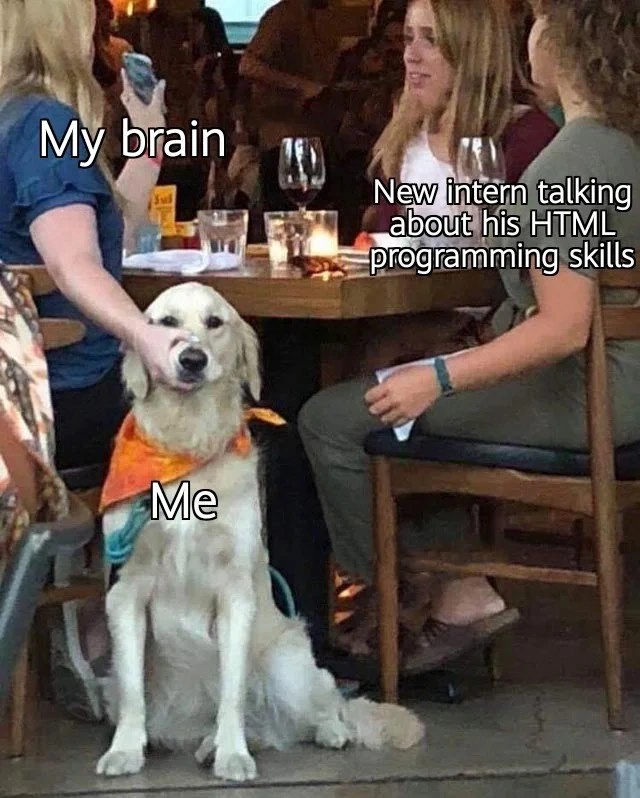
The Meme Format (Dog with Muzzle): The image is a clever visual metaphor:
- The dog labeled "Me" represents the outward self of the senior developer – friendly, potentially vocal (dogs bark, after all), and maybe itching to react.
- The hand labeled "My brain" is the rational mind of the senior, literally covering the dog’s muzzle. This means the senior is consciously keeping himself from saying something.
- The "New intern talking about his HTML programming skills" is the person across the table, cheerfully unaware of any mistake. This placement shows the intern is just chatting casually, possibly bragging a bit, while the senior is quietly having an internal struggle whether to correct him or not.
This dog meme format is popular in internet culture to depict someone restraining themselves. In developer humor, it’s often used when a technical person resists the urge to drop a truth bomb or a corrective comment. Here it’s about HTML not being a programming language, but the format could be used for any “I desperately want to say X, but I’m holding back” scenario. The reason it resonates is because self-restraint is a common experience, especially for seniors dealing with juniors. The senior_dev_patience on display is as much a part of a developer’s toolkit as any coding skill.
Junior vs Senior Communication: This meme also highlights a classic CommunicationGap:
- Juniors/Interns often don’t know what they don’t know. They might use terms incorrectly or boast about things that seem basic to others, simply because it’s new and exciting to them. And that’s okay – everyone starts somewhere!
- Seniors have to decide when to correct and when to encourage. If a senior jumps on every small error (like immediately saying “HTML isn’t programming!” in a smug tone), it can discourage the junior or come off as condescending. In a relaxed setting (like a dinner), calling out the intern’s mistake in front of others might embarrass him. Good mentors pick their battles and correct at the right time and place. Sometimes it’s better to just let the newbie be proud and later gently guide them, rather than turning a friendly chat into a technical lecture.
So, the humor is partially in the relief that the senior is doing the right thing by not being that person who says “Actually… 🤓” over something minor. A lot of developers can recall times when someone did correct them in public on a trivial issue and how awkward it felt – or vice versa, times when they themselves bit their tongue to keep the peace. This meme exaggerates that feeling in a fun way. Everyone at the table probably knows HTML isn’t a programming language, except the intern. The seniors share a knowing glance (maybe that’s why the woman on the right is smiling), and the senior with the “muzzled dog brain” is essentially saying, “Let’s just enjoy the evening; no need to turn this into Intro to Computer Science 101 right now.”
Summing up the tech details and context:
- HTML – a markup language for structuring web pages (not a full programming language on its own).
- Intern’s claim – calling HTML knowledge “programming skills” (an endearing but incorrect flex common in newbie talk).
- Senior’s reaction – internal correction vs. external silence (choosing patience over immediate pedantic correction).
- Frontend humor angle – front-end developers often encounter people who misunderstand what counts as coding (e.g., “I did a bit of HTML, so I’m basically a programmer now!”).
- Communication lesson – how seniors and juniors navigate conversations and learning moments. Sometimes not correcting someone instantly is part of good mentorship, letting them stay confident and open to learning more later.
Level 3: Muzzled by Experience
At the highest level, this meme pokes fun at the Junior vs Senior dynamic in a Frontend context, highlighting a tiny terminology battle that nearly every developer team has seen. The scene: a new intern proudly mentions his "HTML programming skills." The seasoned developer (the person labeled "Me") immediately recognizes the innocent mistake – HTML isn’t a programming language, it’s a markup language. But instead of jumping in with a pedantic correction, the senior’s brain (depicted as the woman’s arm firmly cupping the dog’s muzzle) restrains any impulse to blurt out, “Well, actually, HTML is not real programming.” This restraint is critical: the senior developer is symbolically muzzling themselves to maintain a polite atmosphere.
Why is this so funny to experienced devs? Because it’s relatable humor built on shared knowledge: technically, calling HTML a programming language is a common rookie mistake, and it triggers an almost reflexive urge in seasoned devs to correct it. We’ve all witnessed that Communication Gap where a junior’s enthusiasm meets a senior’s knowledge. If you’ve mentored newbies or interacted with interns, you likely recognize the exact internal struggle shown here: part of you wants to jump into teacher mode (or sarcastic mode, if we’re being honest) and explain the difference between markup and programming, but the wiser part of your brain knows it’s probably not the right moment to unleash a full HTML lecture over casual drinks. 🍷
This particular meme format – using a dog whose muzzle is held shut – perfectly conveys the concept of self-restraint. The golden retriever labeled "Me" looks calm (and maybe a bit amused), while the owner’s arm labeled "My brain" literally stops it from barking out the truth. It’s a visual metaphor for senior dev patience: holding back words that, while correct, might embarrass the enthusiastic intern or dampen his confidence. After all, the intern is excited, perhaps trying to impress colleagues with his new frontend knowledge. The senior brain is doing the quick calculus: “Do I correct him now and risk looking pedantic, or let it slide and encourage his enthusiasm?” More often than not, seasoned devs choose to just smile and nod along, saving the detailed explanation for another time (or never). This delicate social dance is a hallmark of effective communication in tech teams – knowing when to correct someone versus when to let minor flubs go for the sake of team harmony.
From an industry perspective, the humor also taps into the subtle hierarchy of technical skills. HTML (HyperText Markup Language) is fundamental for web pages, but by itself it’s static and declarative – it defines content structure (like headings, paragraphs, links) but doesn’t include logic or algorithms. It’s often one of the first things new developers learn, so interns or juniors might proudly tout it as “programming”. Meanwhile, seniors who have battled complex JavaScript code, backend logic, or cloud deployments might inwardly chuckle when someone equates writing HTML tags with full-blown programming. It’s a bit of an eye-roll moment – not because HTML isn’t important (it is!), but because calling it “programming” oversimplifies what coding usually implies (conditions, loops, data structures, etc.). The FrontendHumor here is that front-end veterans know the real challenges often lie beyond just HTML – in CSS quirks, JavaScript frameworks, state management, browser compatibility – so hearing an intern flex about HTML feels adorably naive. Yet, nearly every dev remembers being that proud beginner at one time. The meme’s comedy comes from this shared experience where knowledge meets naivety, and the choice is made to respond with patience instead of pride.
In sum, this level reveals a lot of inside baseball about developer culture:
- Terminology Pedantry: Developers care about precise terms. (Markup vs Programming is a classic debate, akin to correcting someone that “SQL is declarative, not procedural,” or “CSS isn’t a programming language either.”) The meme’s humor bankshots off this nerdy exactness.
- SeniorDev Patience: The ability to hold one’s tongue is almost a soft skill in tech. Great senior devs know when a correction would help or when it would just be gratuitous gatekeeping. Here the senior chooses diplomacy, which is sometimes harder than solving a coding bug!
- Relatable Scenario: Anyone who’s worked in a dev team can recall a moment of either being corrected on something minor or resisting the urge to correct someone else. It’s basically a rite of passage in the JuniorVsSenior journey.
The meme’s setting – a casual after-work hangout with wine glasses – underscores that this isn’t a critical code review or sprint planning meeting. It’s an informal conversation, making it even more comical that the senior’s brain activates the “let’s not do this now” restraint. The communication gap is evident but handled gracefully. A Cynical Veteran might joke that the intern will learn soon enough when a real programming task hits, but here the vibe is more Enthusiastic Educator holding back an involuntary chuckle. It’s a perfect snapshot of tech office life: senior dev silently laughing inside, junior dev completely unaware, and everyone else quietly smirking into their drink because they know.
Description
This is a meme using the 'Woman Holding Dog's Mouth Shut' format. In a restaurant or social setting, a woman's arm, labeled 'My brain', is physically holding the muzzle of a golden retriever, labeled 'Me'. The dog looks patient but constrained. In the background, another person is captioned 'New intern talking about his HTML programming skills'. The visual gag represents a senior developer's internal struggle. The 'Me' (the dog) wants to instinctively react - likely to correct or scoff at the intern's statement - while 'My brain' forces restraint and professionalism. The humor is rooted in a common piece of developer pedantry: HTML is a markup language, not a programming language. For experienced developers, hearing this mistake is a familiar, if slightly amusing, rite of passage when dealing with newcomers, making the meme highly relatable
Comments
10Comment deleted
My brain's interrupt handler has a special case for 'HTML programming' that pipes the output to /dev/null to avoid a kernel panic at the team lunch
I don’t correct interns who call HTML “programming” anymore - after they spend a sprint trying to center a div in three design systems, they’ll be begging for the simplicity of distributed consensus
After 20 years of explaining that HTML is a markup language, not programming, you realize the real skill is maintaining that golden retriever smile while your brain compiles a list of all the Turing-complete CSS implementations you could show them instead
When the new intern proudly lists 'HTML programming' on their resume, experienced developers experience what's known as a 'context switch to /dev/null' - their brain simply refuses to process the input and instead contemplates the heat death of the universe, much like this golden retriever contemplating absolutely nothing while maintaining perfect composure
I’ve learned the “HTML is programming” argument is Turing-complete - the conversation never halts, and nothing ships
Biting my tongue as the intern brags about his HTML “programming” - because our prod deploy hinges on a 700-line GitHub Actions YAML, and I’m not convinced that’s any more of a language
Intern calls HTML 'programming' - adorable, like claiming crayons qualify you for shader pipelines
we had an intern try to format a drive to "re-install the OS" Comment deleted
you mean, on a work PC? Comment deleted
yup Comment deleted