Two Kinds of Void: The Junior vs. The Senior
Why is this Juniors meme funny?
Level 1: Big Letter, Big Difference
Think about how just one big letter can change a word’s meaning in everyday life. For example, imagine you love the fruit apple. One day, you see the word “Apple” on a store sign. You get excited and say, “Apple! I know that word – it’s my favorite fruit.” But your dad gently explains, “Apple with a capital A is actually the name of a company here, not the fruit.” Oops! Just that capital A at the start made the word mean something completely different. It’s the same kind of mix-up happening with the code. The kid saw a word he recognized, but he missed that it started with a big letter, which meant it wasn’t actually the same thing he thought it was. It’s funny and kind of sweet because it’s a little misunderstanding that comes from overlooking a tiny detail. The dad correcting the kid is like saying, “It’s okay, you were close – just notice that small difference next time.” Even a single letter change can mean something new, whether you’re reading code or reading ordinary words.
Level 2: I Know That One
Imagine you’re just starting to code, and you peek at some of your dad’s program. In the meme, the student says, “ahh void, I know that one!” They recognize the word void from their classes and get excited. This makes sense: if you’ve taken a C or C++ class, you learn that void is a special word (a keyword) that indicates “nothing” or “no value.” For example, a function might be declared with void if it doesn’t return any result. So the student sees something familiar in a sea of unfamiliar code and feels proud — kind of like spotting a familiar landmark when you’re in a new city and saying, “Hey, I know what that is!”
But here’s the catch: the code Dad is writing has Void with a capital V, not void. In programming, uppercase vs. lowercase letters matter a lot. Python, C++, Java, and many other languages are case-sensitive. This means void and Void are treated as two completely different names. The student thought they saw the exact keyword they learned, but actually, Dad’s code is using Void (capitalized) as something else – probably the name of a class or a type. It’s a subtle difference that a newcomer could easily miss, but it changes the meaning entirely. It’s as if the student was reading in a hurry and didn’t notice that one letter was capitalized.
Let’s break down why that capital V is such a big deal in code:
- Keyword: A keyword is a word reserved by the programming language because it has a special purpose. You cannot use a keyword as the name of a variable or function because the language has it set aside for its own use. In C++ for instance,
voidis a keyword (as are words likeint,if,while, etc.). The language decides what its keywords are, and they’re usually all lowercase in C/C++ (and in many other languages). Sovoidin C++ specifically means “no value here” as a return type or “no parameters.” You can’t name something elsevoidin your code, because that would confuse the compiler. - Identifier: An identifier is a name that a programmer chooses for something like a variable, a function, or a class. For example, if you write
int score = 0;thenscoreis an identifier you came up with to label a piece of data. Identifiers can usually be almost any word that isn’t a keyword, and importantly, they are case-sensitive. So you could have a variable namedresultand another namedResultin the same program, and the computer would treat them as two unrelated things (though doing that would confuse human readers!). The point is, capitalization is fair game for making separate names. - Case-sensitive: If a language is case-sensitive, it means that uppercase and lowercase letters in names are considered different characters. The name
appleis not the same asAppleorAPPLEin a case-sensitive language – you have to match the exact capitalization. Most programming languages today (like Python, C++, Java, JavaScript, etc.) are case-sensitive. A few languages (and older systems) are case-insensitive, meaning they don’t care about capitalization, but those are the exception. In the world the student is in (Python and C++), case sensitivity is the rule.
Now, in our situation, the dad’s code likely uses Void (capital V) as an identifier. Perhaps it’s a class name or a type defined in a library. The key is that Void is not one of the language’s keywords, because the language doesn’t reserve the capitalized version. (By convention, many programmers start class names with a capital letter, which might be exactly why Dad’s code has something called Void.) So to the computer, void and Void might as well be totally unrelated. The student didn’t realize this at first glance and understandably so — when you’re new, you sometimes focus on the letters and ignore the uppercase/lowercase distinction unless it’s pointed out.
To illustrate how case sensitivity can trip you up, let’s look at a quick example. Suppose we try to use void as a variable name in C++ versus using Void as a variable name:
// C++ example of case sensitivity:
int voidValue = 42; // ❌ Error: cannot use 'void' as part of a name (it's reserved by the language)
int VoidValue = 42; // ✅ Okay: 'VoidValue' is a different identifier (capital V makes it a completely different word)
int Void = 7; // ✅ Also okay: 'Void' by itself is just a user-defined name (not a keyword)
In the first line, the compiler would error out because void is reserved and can’t be used in a variable name like voidValue (the moment it sees void followed by something that isn’t a valid use of the keyword, it gets confused). In the second and third lines, the compiler is perfectly happy, because VoidValue or even just Void with a capital "V" doesn’t mean anything special by itself; those are just custom names. We’re allowed to choose those names since the language only reserved the lowercase void. This shows how simply changing the case of a letter can flip something from “illegal” to “legal” in code.
We see the same kind of thing in Python too. Python doesn’t have void as a keyword at all (in Python, if a function doesn’t return a value, it just returns None by default). But Python is also case-sensitive with its identifiers. For instance:
name = "Alice"
print(name) # This will print "Alice"
print(Name) # This will cause a NameError, because 'Name' (capital N) is not defined (it's different from lowercase name)
In that Python example, name and Name are treated as two distinct variables. If you only defined name (lowercase) and then try to use Name (uppercase), the interpreter will complain that it has no idea what Name is. The computer won’t assume “oh, you must have meant name with a lowercase n” – it simply looks for an exact match and, not finding one, throws an error. The rule is simple: you must use the exact same spelling, including upper/lowercase, when referring to something.
So, coming back to our meme: The student sees Void in their dad’s code and immediately associates it with void that they learned. It’s a case of mistaken identity caused by a mere capital letter. The dad, being an experienced programmer (and in this scenario, a patient teacher), gently corrects the child by emphasizing the difference: “Void.” It’s as if he’s saying, “I know you recognize the word, but notice the capital V – it’s not the one you think.” No one is angry or anything; it’s a teaching moment. In a way, this captures a very common experience for beginner programmers. You learn a concept in class and you’re eager to spot it “in the wild.” When you do, you get excited – I know this! – but sometimes what you think you know isn’t exactly what’s happening, because real code can be more nuanced. It’s like a puzzle where a piece almost fits, but not quite.
This is a gentle lesson about paying attention to detail. When you’re new to coding, you eventually realize that computers are exact and literal. A program won’t do what you mean unless it matches what you wrote character for character. Many of us learned this the hard way by, say, typing a variable name with the wrong capitalization and then scratching our heads when the program crashed or wouldn’t compile. It might feel a bit pedantic at first (“ugh, why does one letter matter so much?”), but it’s just how programming languages work. Over time, beginners become more vigilant about these things. The meme is funny to developers because it shows this learning process in a sweet, silly scenario: a kid excitedly shouting “I found something I understand!” and the dad smiling and correcting a one-letter slip. It captures the essence of developer humor in the context of a family moment. Everyone in software has been that enthusiastic beginner at some point, so we can all empathize and laugh along, remembering our own early slip-ups with syntax and language quirks.
Level 3: Case of Mistaken Identity
The humor in this meme comes from a subtle but classic programming gotcha: the importance of capitalization in code. A student developer proudly spots the keyword void in their dad’s code and exclaims “ahh void, I know that one!” Seasoned devs instantly see the punchline coming: the father’s code actually uses Void with a capital V. That one-letter case difference means it’s not the void the student thinks it is. For experienced folks, this joke nods to how easy it is for a beginner to recognize a familiar token but miss the nuance that completely changes its meaning. We’ve all seen juniors latch onto a known term and get overconfident, only to be gently corrected by a senior saying “look again, it’s not what you think.” Here the dad (a senior engineer figure) is literally gently holding the kid’s head and saying one word: “Void”, emphasizing the capital V. It’s a tongue-in-cheek reminder that in programming, small details like letter case can make a world of difference – something every coder learns sooner or later.
From a technical perspective, this meme plays on the difference between a keyword and an identifier in languages like C++ (and many others). The student knows void as a keyword. In C/C++, void is a reserved word that indicates “no type” or “no value here”. For example, a function declared with void as its return type returns nothing. You can’t use void as a variable or class name because the language has claimed it for its own use. However, Void with an uppercase V is not a reserved keyword – it’s just another name a programmer could use. That means the dad could have a class, struct, or type alias named Void in his codebase. In fact, many coding standards use capitalized names for user-defined types (classes, structs, etc.), while language keywords (int, class, void, etc.) are lowercase. So when the kid sees void in dad’s code, they assume it’s the same built-in word they learned in class. But dad’s gentle correction (“Void”) hints that it’s actually something else – likely a custom type or a language/library feature that just happens to have a similar name. The capital V is the only clue, but it’s crucial.
For instance, consider a snippet of code one might encounter in a typed language like Java:
// Dad's code snippet (Java example):
public void doSomething(Void input) {
// ...
}
In this code, void (lowercase) is a keyword indicating the method returns nothing, whereas Void (uppercase) is the type of the parameter input. They look nearly the same, but to the compiler they're completely unrelated tokens. The child in the meme recognizes “void” and feels excited because they learned that keyword. But what Dad wrote was Void – here, likely referencing Java’s java.lang.Void class (or a similar concept in another language). In Java, Void is a class that essentially stands in for “no value” when you need an object type (for example, using Void in generics to represent a function that returns nothing). Other languages have similar quirks: C# has System.Void behind the scenes, and some functional languages like Haskell even have a type called Void (an uninhabited type used when a value should not exist at all). So, Void can be a valid identifier or type name, distinctly different from the void keyword. The key point is that the computer differentiates them by capitalization.
The broader concept here is case sensitivity in programming languages. Most modern languages, including Python and C++, treat identifiers in a case-sensitive manner: apple, Apple, and APPLE would be three different names. Recognizing this is a big step in a programmer’s learning journey. Many of us have spent time chasing a bug, only to discover we capitalized a letter wrong in a variable name. 😅 In this meme, that case sensitivity forms the crux of the joke. The student’s brain sees a match on the letters “v-o-i-d” but glosses over the capital “V” – a tiny detail to human eyes, but a critical distinction to the computer (and to experienced devs). Computers are extremely literal; to a compiler, void and Void might as well be cat and dog – they’re totally unrelated because of that one uppercase character. The dad knows this, but the student is just learning it.
This scenario also highlights the learning curve of jumping between languages and the classic Junior vs Senior perspective. The student is learning Python (a high-level, dynamically-typed language) and “a bit of C++” at school. Python doesn’t even have a void keyword – if a Python function doesn’t return anything, it simply returns None (which, funnily, is a capitalized word in Python, but it’s a singleton rather than a keyword). Meanwhile in C++, every function’s return type must be specified, and void means “returns nothing.” So void was probably one of the first fancy C++ terms this student learned, and it stuck in their mind. Now, looking at Dad’s more advanced code, they finally see something familiar amid all the unfamiliar syntax and think, “Hey, I recognize that word!” It’s cute because it reflects how beginners often grasp at anything recognizable as proof they understand what’s going on. But the poor kid doesn’t realize Dad’s code is using that word in a different way (or possibly he’s coding in a different language altogether). This little misunderstanding is a rite of passage in learning – a classic case of false familiarity where you think you know what you’re seeing, but you’re a letter off.
For seasoned developers, the meme resonates on another level: it brings back memories of our own early screw-ups and the quirky language surprises that tripped us up. It’s common for beginners to conflate things that look alike. Maybe you once mistook a variable named List in someone’s code for the concept of a list you learned in another language, or you puzzled over why calling RenderWindow didn’t work until you realized the actual function name was renderWindow. We chuckle because we’ve been that kid, confidently pointing at something in code saying “I know this!” when we really didn’t. The capital-V gotcha in the meme underscores how one tiny detail can make a huge difference. Experienced devs have internalized this: we know to double-check capitalization, spelling, and punctuation in code, because missing any of those often leads to errors. The dad’s gentle head-holding in the meme is wonderfully relatable – it’s the patient mentor or parent lovingly correcting the eager newbie. Not in a scolding way, but in a “I see why you thought that, and it’s adorable, but here’s the truth” way. It captures a wholesome teaching moment. In the end, the meme is funny to developers because it highlights a simple truth in both a humorous and heartwarming way: in programming (as in language), even the smallest details matter. One capital letter can turn your certainty into a misunderstanding – and that’s a lesson every developer learns, usually with a smile (and maybe a facepalm) along the way.
Description
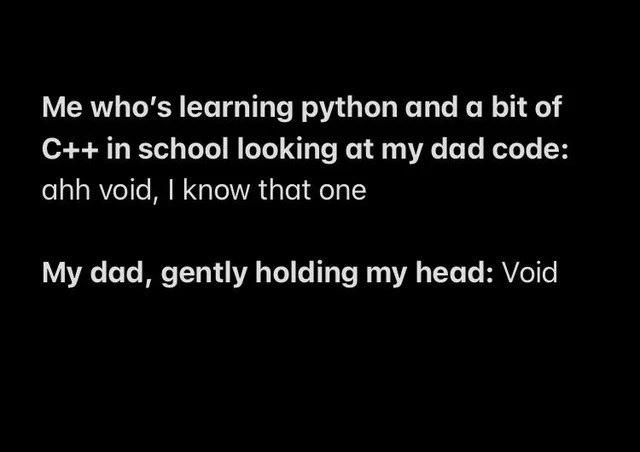
A text-only meme presented as white text on a black background, describing a poignant interaction between two generations of programmers. The first part reads: 'Me who's learning python and a bit of C++ in school looking at my dad code: ahh void, I know that one'. This line captures the naive confidence of a student recognizing a basic programming keyword. The second part delivers the punchline: 'My dad, gently holding my head: Void'. The humor derives from the deep chasm of experience between them. The student sees `void` as a simple return type. The father, an experienced developer, invokes the word's other meaning - the vast, empty, soul-crushing abyss - as a commentary on the complexity, emptiness, or technical debt of the code he maintains. The gentle head-holding is an act of paternal pity for the difficult road his child has just begun to walk

Comments
13Comment deleted
The junior sees a function signature. The senior sees a Purgatory from which nothing, not even a return value, can escape
In enterprise Java, we wrap “nothing” in java.lang.Void so our CompletableFuture can return it - because at scale, even nothing must implement Serializable
The real void* is the null pointer we dereference along the way - and the segfaults that teach us why senior devs have trust issues with junior PRs touching anything near memory management
The beautiful irony here is that the student thinks 'void' is just another keyword to memorize, when in reality, the parent is gently introducing them to decades of type system philosophy, memory management implications, and the existential question of 'what does it mean for a function to return nothing?' - a concept Python developers blissfully ignore with their implicit None returns while C++ developers lose sleep over whether to use void, void*, or std::nullptr_t
It’s not “void,” it’s “Void” - the uninhabited type we stuff into generics so CompletableFuture compiles; nothing says enterprise like modeling nothing with a type that can only hold null
Kid spots 'void' and thinks guru status; dad knows it's the void* that gently segfaults your career
School teaches “void” means no return; production teaches “void” means side effects via globals, singletons, and a 3 a.m. pager
The head Comment deleted
so basically the dad is telling the son to shut up by declaring his head as void Comment deleted
He says that there's nothing inside the head Comment deleted
https://youtu.be/cdX8r3ZSzN4?list=PLVRdENGkV5VcGg-YvdcBS-k4V6EfKHYGF Comment deleted
My daddy, who uses assembler: there-there, my sweet summer child Comment deleted
Me who's learning python and a bit of C++ in school looking at my dad code: ahh void, i know that one My dad, gently holding my head: Void Comment deleted