Skip to content
DevMeme
372 of 7435
Zuckerberg's Unsettling Paternity-Based Deflection
DataPrivacy Post #435, on Jun 5, 2019 in TG

Zuckerberg's Unsettling Paternity-Based Deflection

Why is this DataPrivacy meme funny?

Level 1: The Friendly Spy

Imagine you have a teacher or babysitter who watches you all day long. They see what you eat for lunch, who you play with at recess, what games you like — everything. Now picture your dad warning you, “I think that teacher is watching you too closely.” Instead of denying it, the teacher smiles and says, “Actually, I know you so well that I’m basically your dad now!” That sounds crazy, right? It would be both funny and a little creepy. In the meme, the big tech platform is like that over-involved teacher. The joke is showing how weird it feels if someone who’s not your parent knows so much about you that they act like they’re in charge. It uses a silly, exaggerated situation to point out a real feeling: sometimes these apps and websites know us really well — almost too well — and that mix of familiar and spooky can end up being pretty funny.

Level 2: The Platform is Watching

At its core, this meme is about data privacy and how much information big tech companies gather about their users. The scene shows a boy in a computer lab accusing a platform (the adult in the meme) of “spying on us.” For a newer developer or casual tech user, let’s unpack that. Online platforms like social media sites and phone apps routinely watch what you do: which posts you like, what links you click, how long you look at something, and even which other websites you visit (thanks to things like tracking cookies or embedded “like” buttons). All this quiet monitoring is essentially social media surveillance – the platform is observing you, often without you realizing it. They do this to build a profile of you. Why? Mostly to personalize content and show you targeted advertisements — basically, to make money by showing you stuff you’re more likely to click on or buy. This whole business model of making profit from user information even has a nickname: surveillance capitalism (meaning companies earn money by surveilling, i.e. monitoring, users and selling or using that data).

So when the kid says “My dad told me you’re spying on us,” he’s voicing a common concern people have about privacy. Parents often warn their kids to be careful online, suspecting that websites or apps might be collecting data on everything they do. Here, “spying” refers to all that data collection happening in the background. For instance, if you’ve ever wondered how an app knew your location, or why you suddenly see ads for a product right after you searched for it — it’s not magic. The platform tracked some part of your activity (like your GPS or your web search) and shared that info across its services. As developers, when we add user analytics or tracking features, it can feel a bit like we’re helping a spy, even if the goal is just to improve the app.

Now the punchline: the adult responds, “He’s not your dad.” The humor here is that the platform knows the kid so well from all that data gathering that it’s jokingly claiming to be more of a parent than the real father. In other words, “I (the app or site) know everything about you, so I’m basically your dad now.” That’s a silly and exaggerated idea, which is why it’s funny. It highlights privacy erosion – the idea that personal privacy has worn away in the digital age. It’s the kind of joke that makes you laugh a bit and then think, “Wait, do these companies really know that much about me?” Often, the answer is yes, kind of. We’ve all had that feeling that Google or Facebook might know us better than we’d like, almost like a parent who sees all we do.

For someone new to this topic, it helps to know that big tech companies (think Facebook, Google, Instagram, etc.) have gotten a lot of criticism for how much user data they collect. This led to privacy laws and consent regulations designed to give users more control. You might have noticed every website now asks you to accept cookies or read new privacy policies – that’s because of laws like GDPR in Europe, which force companies to be more upfront. A cookie isn’t just a snack; it’s also a tiny piece of data a site stores on your computer so it can remember who you are and what you did. It’s one of the main ways sites track you across the internet. Those pop-ups asking you to accept or manage cookies are basically the site saying, “We might watch what you do here, is that okay?” Most people click “Accept” and move on, often not realizing just how watched they still are. There’s a saying in tech: “If you’re not paying for the product, you are the product.” This means when you use a free service, the company is making money by using your data for ads – effectively, your attention and info are what they’re selling.

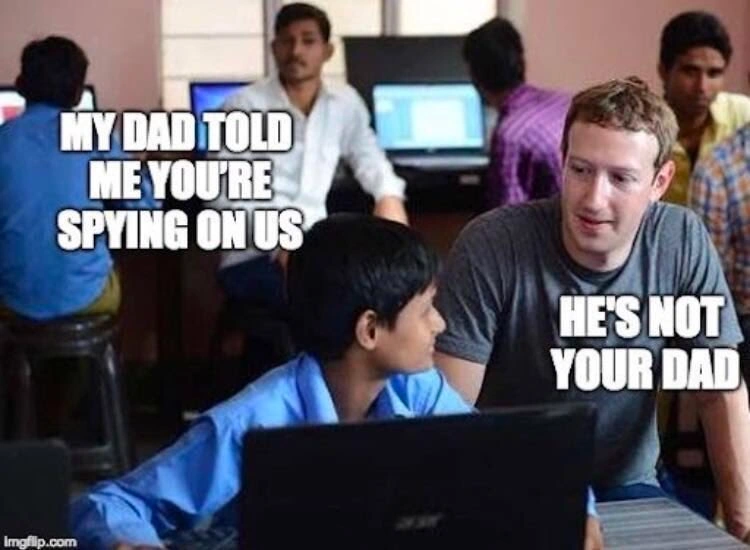
The meme’s setting — a kid at a computer and an adult leaning in — looks a bit like a teacher or a computer lab supervisor talking to a student. That visual sets up a kind of corporate culture joke: the platform acts like a caring grown-up, but it’s overstepping boundaries. Some tech companies have a culture of wanting users to stay in their app ecosystem like it’s a cozy clubhouse, sharing everything and trusting the platform with all their info. It’s convenient, but it also means the platform is constantly observing (kind of like a teacher who never takes their eyes off the class). So the meme basically says: “This website knows me so well, it might as well be my dad!” It’s pointing out the trust issues with platforms in a funny way. People aren’t sure if they should trust these companies, because sometimes it feels like the company knows more about you than even your family does.

Even junior developers get exposure to these issues. The first time you work on an app and have to write a privacy policy, or include an analytics library, you realize, “Whoa, we’re collecting user data (names, emails, locations, etc.) — we’d better handle this carefully.” You learn about encrypting personal info, honoring settings if a user says “don’t track,” and so on. Memes like this are a lighthearted reminder of why those precautions matter. It’s saying in a jokey way that tech companies have become so good at watching us that they act a bit like parents. It’s funny because it’s an exaggeration, and it’s a little scary because it’s closer to true than we’d like. In simple terms: the meme highlights how big tech platforms have gotten so nosy and knowledgeable about us, it’s as if they’ve taken on a parent-like role — and that mix of truth and absurdity is exactly why we laugh.

Level 3: Who's Your Data Daddy?

To a seasoned developer, this meme hits that sweet spot between ha ha and oh no. It’s poking fun at how deeply big tech platforms entrench themselves in our personal lives. The kid in the bright blue shirt represents the everyday user (maybe even literally a kid on the family computer), and the adult leaning in — bearing a striking resemblance to a certain social media CEO — is the embodiment of the platform itself. The exchange, “My dad told me you’re spying on us” / “He’s not your dad,” lands as a tech insider’s dark joke. Why? Because we’ve all seen how Big Tech companies collect user data so aggressively that they practically raise users on their services. It’s the ultimate privacy gag turned punchline: the platform knows you so intimately, it one-ups your actual parent.

Many of us in software have implemented the very surveillance this meme lampoons. Ever added a tracking script or analytics SDK to an app? You watch user interactions pour into your logs: page visits, clicks, session durations, geolocation pings — a constant stream of digital footprints. In corporate culture, there’s a mantra of being “data-driven.” That often translates to “record everything about the user’s behavior.” Marketers and product managers beg for more metrics (“just toss in a few more event trackers for when the kid clicks the cupcake icon”). Before you know it, your codebase is riddled with hooks reporting user actions back to HQ. It’s not malicious on the dev’s part – it’s just how modern platforms operate. But it does mean the app might know a user’s habits in minute detail.

The humor here exaggerates that dynamic: the platform figure basically gaslights the kid about who his real guardian is. It’s riffing on the famous “No, I am your father” trope from Star Wars, except in a data context. Facebook Vader, if you will, calmly asserting paternal authority via surveillance. For developers who lived through scandals like Cambridge Analytica (where Facebook data on millions was misused for political profiling) or who’ve had to debug a data breach at 3 AM, the meme’s scenario feels uncomfortably plausible. It reminds us of all those times we had to assure friends or family, “Yes, those apps are kind of spying on you,” after yet another headline about leaked user information.

On the flip side, this scenario highlights tech’s paternalistic streak. Big platforms often act like they know what’s best for users. Have you ever been frustrated by an app that changes your timeline algorithm or privacy settings without asking? That’s a company playing parent — “trust us, it’s for your own good (and our engagement metrics)”. The meme takes that to the extreme: the platform literally claiming parental rights because it thinks it knows you better. And frankly, after years of gathering your search history, likes, and group chats, maybe it does know you in some ways better than Dad does.

For perspective, compare what a real parent knows versus what the platform knows:

Real Dad might know... The Platform definitely knows...
Your birthday and your favorite snack Your exact shopping and eating habits, plus those 2 AM snack searches you thought were secret
The name of one best friend from school A list of every friend, follower, and “People You May Know,” ranked by how often you interact with them
How well you did on your last math test How many hours you actually spent on YouTube when you were “studying” (yes, it’s keeping track)
That you love pizza on Fridays That you searched for lactose-free cheese last week and might be rethinking dairy altogether
The sound of your voice in real life Every word you’ve ever said to your smart assistant or typed into chat (all saved in some server log)

It’s funny in a cringey way because it’s true: these platforms often have a more granular dossier on you than your family does. Developers know that whenever an app says “personalized for you,” under the hood it’s using a profile built from months or years of quietly observing your behavior. If you work in tech, you’ve likely been the one writing code to collect user data, or you’ve sat through meetings about complying with new privacy rules. (Remember the great GDPR scramble of 2018? We plastered cookie consent pop-ups everywhere — essentially asking for a hall pass to keep tracking you.)

So when we see an image of what looks like Zuckerberg telling a kid “He’s not your dad,” it resonates. It’s absurd, but it nails a feeling that’s pervasive now: these companies have inserted themselves into roles of immense trust and intimacy. It's the kind of corporate-culture gag where we laugh, then nervously check our phone’s app permissions. Behind the joke is a serious reminder: online privacy has gotten so lax that a platform can metaphorically claim it knows best. For senior devs who’ve been in the trenches, this meme is both a chuckle and a challenge — we’re acknowledging the creepiness we helped create, even as we joke about it.

Level 4: Panopticon Paternity

At the highest level, this meme dramatizes a facet of modern surveillance capitalism: a social media platform so all-seeing and all-knowing that it effectively adopts a paternal role in users' lives. The term Panopticon comes to mind—Bentham’s prison design where a single watcher can observe all inmates without them knowing they’re watched—except here it’s digital and you volunteered to be observed. Through ubiquitous data collection, the platform constructs a near-omniscient profile of each user. Every login, like, search query, location ping, and even idle scroll feeds into a colossal data pipeline. Advanced machine learning algorithms and data mining techniques churn through these petabytes of personal data to uncover patterns invisible to any human parent. The result? An AI-curated insight into your psyche that might predict your actions or secrets with eerie accuracy.

In this paradigm, the platform can infer intimate details: it knows your interests, your daily routine, your social circle, perhaps even your emotional states. Who needs a diary when your online behavior writes one for you? Complex models (from collaborative filtering of your likes to neural networks analyzing your photos) can deduce everything from your favorite genre of music to life events like breakups or career changes before you’ve told a soul. In one notorious real-world example, algorithms at a retail chain inferred a teenage girl’s pregnancy before her family knew, simply by correlating her shopping patterns. It’s a stark illustration of how predictive analytics can outpace old-fashioned parental intuition. The meme captures this surreal asymmetry of information: the child’s father suspects the platform is shadowing them, and the platform personification confidently undermines the father’s authority—implying the platform’s knowledge outranks familial bonds.

This is where privacy erosion meets dark humor. The platform’s claim, “He’s not your dad,” is a hyperbolic nod to how Big Tech’s data-driven insights can feel almost as fundamental as DNA. It’s as if the system performed a clandestine digital paternity test via your browser history and decided it knows you better than the man who raised you. Underneath the joke lurk serious technical and ethical questions: the immense information asymmetry between users and platforms, and the implications of a system that knows (or thinks it knows) who you “really” are. The meme’s absurd dialogue hints at a plausible dystopia: data-driven profiling algorithms so powerful they effectively assume guardianship over your decisions and identity. In a way, it’s the ultimate punchline of the data age — a corporation amassing enough knowledge to play Dad.

Description

This meme features a photo of Mark Zuckerberg leaning over to speak with a young boy sitting at a laptop in what appears to be a classroom or computer lab in India. The image is overlaid with a fictional dialogue in a bold white font with a black outline. The boy says, 'MY DAD TOLD ME YOU'RE SPYING ON US'. Zuckerberg's reply, positioned over his shoulder, is, 'HE'S NOT YOUR DAD'. The humor is a form of dark, absurdist misdirection. It sets up an expectation of a denial or excuse regarding Facebook's well-known privacy issues but instead delivers a bizarre and unsettling personal retort. The joke plays on both the public's distrust of Facebook's data practices and Zuckerberg's often-parodied awkward public persona, making the creepy, non-sequitur response the core of the punchline. An 'imgflip.com' watermark is visible in the bottom-left corner
Comments

7
Anonymous ★ Top Pick I've cross-referenced your dad's user profile with your mother's location data and communication history from 9 months before your birth. He's not your dad. Also, your dad has been searching for hair loss treatments. We're showing him ads for it now
  1. Anonymous ★ Top Pick

    I've cross-referenced your dad's user profile with your mother's location data and communication history from 9 months before your birth. He's not your dad. Also, your dad has been searching for hair loss treatments. We're showing him ads for it now

  2. Anonymous

    “He’s not your dad, he’s your data controller - proof that in the custody battle between GDPR and growth OKRs, the platform still gets full telemetry.”

  3. Anonymous

    When your privacy policy is 73 pages long but your incident response plan for "we know your dad better than you do" is just a redirect to the terms of service you agreed to in 2007

  4. Anonymous

    When your OAuth provider insists they're just 'improving user experience' while building a comprehensive behavioral profile that would make the Stasi jealous - but hey, at least the login button is conveniently placed

  5. Anonymous

    At scale, “He’s not your dad” is just the ad platform’s kinship-inference returning higher confidence than your birth certificate - courtesy of contact uploads, co‑location, and a JOIN on the social graph

  6. Anonymous

    Zuck's the observer pattern gone rogue - subscribed to every event in your digital lifecycle

  7. Anonymous

    We don’t spy - we just do enough joins on the social graph that father_id fails referential integrity

Use J and K for navigation