Skip to content
DevMeme
371 of 7435
Sublime Text's 'Untimed' Trial vs. Developer's Wallet
IDEs Editors Post #434, on Jun 4, 2019 in TG

Sublime Text's 'Untimed' Trial vs. Developer's Wallet

Why is this IDEs Editors meme funny?

Level 1: Endless Free Samples

Imagine you have a little candy shop in town that lets people try a piece of candy for free. There’s a friendly sign that says, “Go ahead and enjoy a free sample! If you like it and want more, please buy a box of candy to support us.” Now, picture a kid who comes in every day after school. Every single day, the shop owner smiles and offers the sample tray, and the kid happily takes a candy. The owner gently reminds the kid, “If you keep enjoying those candies, you really should buy a box one day.” The kid grins, pops another free candy in his mouth, and politely replies, “No… I don’t think I will.” Then he walks out, waving goodbye until tomorrow.

It’s a funny situation: the candy shop is being really nice by letting anyone try candy for free without ever forcing them to buy. Most people would eventually feel, “Okay, I’ve had enough free candy — I should pay for a box to be fair.” But this cheeky kid just keeps enjoying the daily free treat and kindly says “no” when asked if he’ll ever pay. Both the owner and the kid know what’s going on. The owner keeps hoping maybe one day the kid will buy something, and the kid knows he probably should, but as long as he can get a free candy, he’s not going to open his wallet.

This is just like the joke in the picture. The computer program (Sublime Text) is the kind candy shop owner, and the programmer using it is the kid who always takes the free sample. The program keeps asking, “Would you like to buy me now?” and the programmer says with a smile, “No, I don’t think I will,” and keeps using it for free. It makes us laugh because it’s a playful way to show someone taking advantage of never-ending generosity. The programmer isn’t being mean – it’s a wink-wink, playful moment. We all know the right thing would be to pay for something we use so much, but seeing them just casually say “no” (especially in the polite words of a famous movie hero) is silly and unexpected. It’s like watching a game where neither side is mad: the software asks nicely, the user declines nicely, and life goes on. That gentle, mischievous refusal – “No… I don’t think I will” – is the punchline that makes the whole situation feel lighthearted and amusing, even if you’re not a programmer.

Level 2: Unlimited Trial Mode

Sublime Text is a popular text editor that many programmers use to write code. It’s known for being fast, sleek, and powerful, falling into the category of IDEs/Editors tools that developers rely on for a good coding workflow. Unlike a fully free open-source editor, Sublime Text is actually paid software – but with a twist. When you download Sublime Text, you get an unregistered evaluation version, which basically means a free trial. Normally, a “free trial” of software might last for a limited time (for example, 30 days) or have some features locked until you pay. However, Sublime’s trial is untimed, meaning it doesn’t expire after a set period. You can use all of Sublime Text’s features indefinitely without paying, and the application never stops working. The only catch is that every so often, it will remind you that you’re supposed to buy a license for continued use.

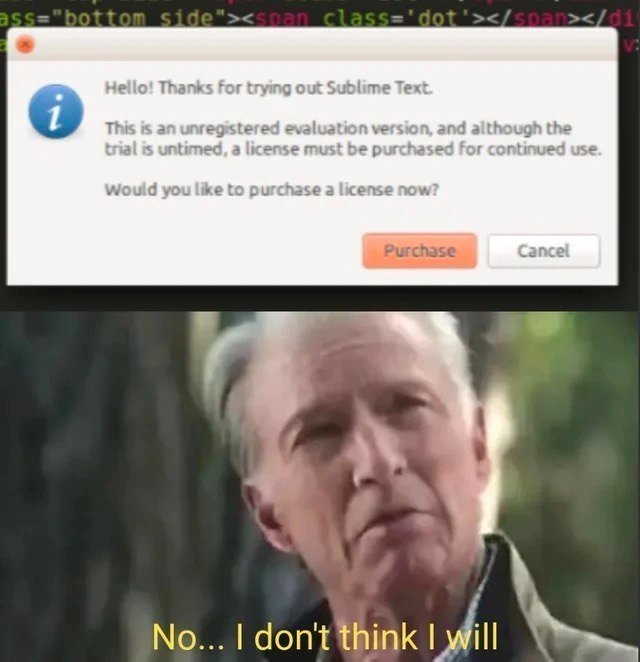
In the top panel of the meme, we actually see one of those reminder dialogs (often jokingly called a license nag screen). The dialog politely says: “Hello! Thanks for trying out Sublime Text. This is an unregistered evaluation version, and although the trial is untimed, a license must be purchased for continued use. Would you like to purchase a license now?” There are two buttons: an orange “Purchase” button, and a grey “Cancel” button. Essentially, Sublime Text is saying: “We’re glad you like our editor and we haven’t cut you off, but technically you should buy it to keep using it. Do you want to buy it right this moment?” For many users, especially those who might be students or just starting out, that “Purchase” button leads to a cost (Sublime’s license is a one-time payment to support the developers). If you click “Cancel”, Sublime Text doesn’t quit or block you – it simply goes back to normal, and you can continue writing code. This reminder will pop up again occasionally (for example, every few saves or openings of the program). It’s gentle and not too intrusive, which is why so many people end up clicking “Cancel” as a habit. Over time, seeing this dialog became a common part of using Sublime Text’s free trial.

The bottom panel of the meme shows an older man outdoors with a subtitle that reads, “No… I don’t think I will.” That man is actually Captain America (Steve Rogers) from a famous superhero movie (Avengers: Endgame), in a scene where he politely declines to share some information. On the internet, this scene turned into a meme template. When someone says “No... I don’t think I will,” it’s a humorous way of refusing a request or suggestion. In this meme, that subtitle is used as the developer’s response to Sublime Text’s question, “Would you like to purchase a license now?” In other words, the program is asking, “Do you want to pay for me now?” and the developer, showing Captain America’s face, is basically replying, “No, I don’t think I will.” It’s a very polite but firm “no.”

This is funny to programmers because it captures a scenario many of them have experienced. A lot of developers have used Sublime Text in unregistered mode for a long time without buying a license. Each time the reminder pops up, they just dismiss it and keep coding. The meme highlights this almost guilty routine. There’s a bit of an ethical aspect here: technically, if you use the software continuously, you are supposed to pay for it. But since Sublime Text doesn’t force you, many people take advantage of that kindness or convenience. It’s a running joke — developers are aware they’re kind of freeloading, but Sublime’s friendly reminder is easy to ignore, so they do.

The meme also touches on developer culture and attitudes towards tools. Developers often have favorite editors (there have even been playful “editor wars” over which editor is the best!). Sublime Text was extremely popular because of its speed and simplicity. However, the fact that it isn’t truly free put some people off from buying it, especially when other free editors are available. By 2019, for instance, a free editor called Visual Studio Code (VS Code) had become very popular, giving people a no-cost alternative with lots of features. So the scenario is also about a Developer Experience (DX) choice: pay for a beloved tool or switch to a free one? Many solved that dilemma by just continuing to use Sublime for free. The meme’s humor comes from recognizing this common situation. It’s poking fun at the way developers, who are usually sticklers for rules in code, will cheekily bend the rules when it comes to software licensing if it makes their life easier. Seeing Captain America, the embodiment of doing the right thing, effectively say “No, I won’t pay,” adds an extra layer of irony that makes tech folks chuckle. It’s a light-hearted reminder of our own inner rebel when a software politely asks for money and we just click “Not now” for the hundredth time.

Level 3: Nag Screen Endgame

Sublime Text’s perpetual unregistered evaluation is the stuff of modern coding folklore. In the landscape of IDEs and text editors, Sublime Text carved a niche for being blazingly fast and feature-rich, but with a unique licensing model: an untimed trial on the honor system. The first panel shows the familiar license nag screen – a polite dialog reminding the user that although the trial is unlimited, they really should purchase a license for continued use. Every seasoned developer knows this popup by heart: it’s practically a rite of passage in Developer Culture. The humor here is that Sublime’s trial is effectively infinite; the software never outright locks you out. Instead, at sporadic intervals (often on startup or after many file saves), it gently nudges: “Would you like to purchase a license now?” The Developer Experience (DX) of Sublime thus includes this semi-regular interruption, which many came to view as just another minor quirk of the tool – a tiny speed bump on the road of endless free usage.

What makes this scenario meme-worthy is the widely shared behavior it lampoons: developers simply clicking “Cancel” and carrying on, sometimes for years, without ever paying. It’s a classic example of a shareware standoff – the software trusts users to do the right thing, and users exploit that trust with a smirk. Back in the day, lots of software (think WinRAR, the legendary file extractor) used a similar approach: full functionality with periodic nag screens, hoping users would eventually support the product. In practice, techies quickly learned that “trial” didn’t actually mean “temporary” if you could put up with a dialog box now and then. Sublime Text perfected this infinite trial loophole. Many developers half-joke that the Sublime Text trial lasts “forever”, because unless you’re feeling especially principled (or annoyed by the popups), nothing forces you to stop using it. This creates a comedic tension in our community – we champion paying for quality tools and respecting software licensing, yet here we are, collectively winking at Sublime’s good faith and hitting “Not now” indefinitely. It’s both a running gag and a guilty pleasure in Developer Humor circles.

The meme juxtaposes this scenario with a pop culture punchline. The second panel shows an older Captain America (from Marvel’s Avengers: Endgame) looking sage and resolute, captioned with his famous line: “No... I don’t think I will.” In the film, it’s a gentle, polite refusal – and it’s been adopted as an internet meme for turning down requests with a calm finality. Here, the request is Sublime Text asking for a license purchase yet again, and the developer (symbolically portrayed by good old Cap) responds with a courteous but unyielding “No.” It’s the perfect crossover of tech and pop culture humor: a license nag screen meets a superhero meme, yielding instant relatability. Every developer who’s skipped Sublime’s license purchase for the 100th time can hear their inner voice in that “No, I don’t think I will.” The choice of Captain America adds an extra layer of irony – he’s the paragon of virtue normally, yet even he (tongue-in-cheek) won’t pay for that Sublime license! The meme playfully frames this habitual refusal as almost virtuous or heroic in its stubbornness.

From an engineering perspective, the Sublime Text trial dialog is a tiny UI element but huge in cultural impact. It raises discussions about tooling ethics and practicality. Why do smart developers, who often insist on supporting open-source and paying for what they use, keep ghosting Sublime’s $80 license fee? The answers range from convenience (“the nag is only a mild annoyance”) to inertia (“it’s been working fine without paying”) to economics (“free editors exist, why pay if I don’t have to?”). By 2019, many Sublime users had indeed jumped ship to fully free editors (such as VS Code or Atom), especially as those alternatives improved Developer Experience with extension ecosystems. Yet Sublime retained a loyal following for its speed and simplicity – and many of those loyal users were, paradoxically, unregistered users. This meme pokes fun at that irony: loving a tool enough to use it daily, but not enough to break out the credit card. It’s a lighthearted nod to the almost comical editor loyalty vs payment dilemma.

To illustrate the unspoken developer workflow being referenced, consider this tongue-in-cheek pseudo-code:

# Developer's Sublime Text usage loop (tongue-in-cheek)
while sublime_text.is_open():  
    write_code()  
    if sublime_text.shows_license_popup():  
        click("Cancel")  # "No... I don't think I will."
        continue  # Keep coding without buying a license

Every time that shows_license_popup() condition triggers, the dev’s response is to cancel and carry on – effectively saying “not today, Sublime.” We’ve all been there, grinning as we dismiss the dialog with the same determination Captain America showed refusing that request. The code comment even quotes the meme directly, underlining how the dev’s reaction aligns with Cap’s polite defiance. It’s a bit of Developer Humor in code form, reflecting how ingrained this ritual became.

In summary, the meme humorously encapsulates a well-known scenario in programming circles: Sublime Text’s infinite trial and the collective cheeky attitude toward it. It’s a wink and a nod among experienced devs – recognizing that moment when the “Would you like to purchase a license now?” prompt appears for the umpteenth time and, channeling our inner grizzled superhero, we quietly reply, No, I don’t think I will. It’s funny, a tad sarcastic, and just oh-so-relatable for anyone who has ever used a great tool on the honor system and stretched that honor just a little.

Description

A two-panel meme. The top panel displays a screenshot of a Sublime Text pop-up dialog box on a desktop, likely a Linux distribution given the window decorations. The dialog's text reads: 'Hello! Thanks for trying out Sublime Text. This is an unregistered evaluation version, and although the trial is untimed, a license must be purchased for continued use. Would you like to purchase a license now?' with 'Purchase' and 'Cancel' buttons. The bottom panel features a still image of an elderly Steve Rogers (Captain America) from the film 'Avengers: Endgame', with the subtitle text below him reading, 'No... I don't think I will'. The joke is about the widespread developer practice of using Sublime Text's evaluation version indefinitely, since the trial has no time limit, thereby perpetually ignoring the prompt to purchase a license. It's a relatable nod to developer frugality and the 'forever trial' culture around certain popular software
Comments

7
Anonymous ★ Top Pick Sublime Text's licensing model is the best implementation of the honor system I've ever seen. It trusts you'll pay eventually, and developers trust it'll keep asking tomorrow
  1. Anonymous ★ Top Pick

    Sublime Text's licensing model is the best implementation of the honor system I've ever seen. It trusts you'll pay eventually, and developers trust it'll keep asking tomorrow

  2. Anonymous

    I can spin up a multi-AZ Kafka cluster in minutes, but a $99 Sublime license still needs a three-month CapEx review - so ‘Cancel’ is basically my new hotkey

  3. Anonymous

    Sublime Text's business model is basically the software equivalent of a gym membership that relies on people feeling guilty enough to pay but not guilty enough to actually cancel - except we're all still showing up every day

  4. Anonymous

    Sublime Text's business model is the software equivalent of a gym membership where they let you work out forever but occasionally ask if you'd like to pay - and somehow they've convinced millions of developers that clicking 'Cancel' 80 times a year is a perfectly reasonable workflow. It's the only product where the 'evaluation period' has outlasted entire programming languages, framework lifecycles, and probably several developers' entire careers

  5. Anonymous

    Sublime invented eventual‑consistency licensing: the trial is untimed, the Cancel button is highly available, and Procurement remains the single point of failure

  6. Anonymous

    Monolith to k8s in a week; two quarters to approve a $99 Sublime license - hence cancel-driven development

  7. Anonymous

    Sublime Text's trial: the only infinite loop devs willingly embrace

Use J and K for navigation