Your Dinner Joke is a Hit with Big Tech CEOs
Why is this DataPrivacy meme funny?
Level 1: The Invisible Audience
Imagine you’re at the dinner table and you tell a joke, but your family doesn’t laugh. Instead, a little smart gadget in the room hears it and secretly sends it to some people far away who do laugh. It’s like you had an invisible friend eavesdropping on your joke and that friend’s bosses found it funny. The meme is funny because it’s as if the only ones who enjoyed your joke were the hidden listeners (your smart speaker and the big company behind it), not the actual people right in front of you. In other words, someone you didn’t see was listening the whole time, which is a silly and a slightly spooky thought – kind of like telling a joke to your pet or toy, and then hearing strangers chuckling in the closet! It makes us laugh because it shows how weird it can feel to have gadgets that might be listening when we think we’re just talking at home.
Level 2: IoT Dinner Guests
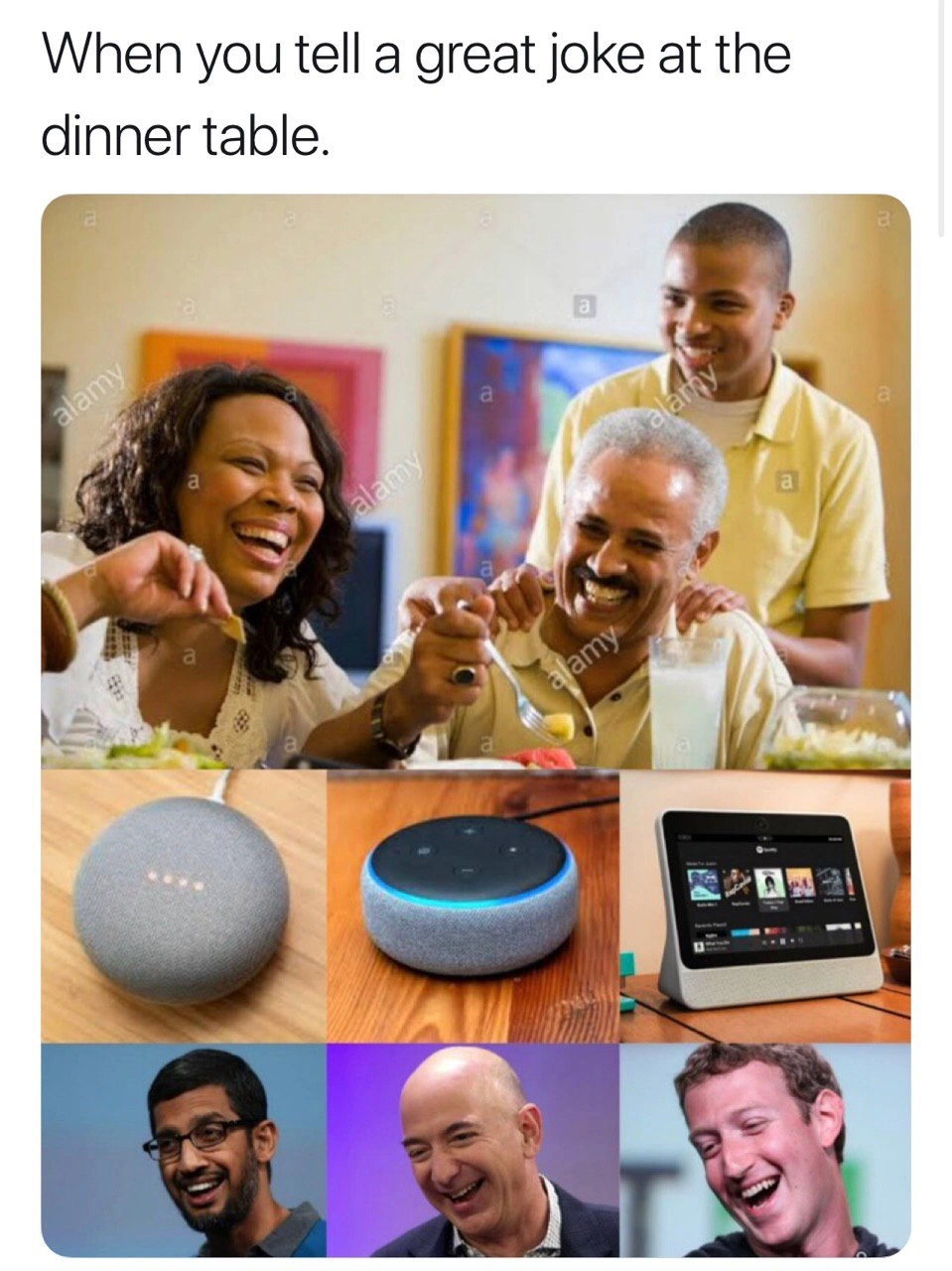
Let’s break down the scene in simple terms. IoT stands for Internet of Things – which basically means everyday objects that are connected to the internet and can send/receive data. A smart speaker is one of these “things.” It looks like a little speaker gadget, but it’s connected online and has a voice-controlled AI assistant inside it. For example, the round grey device in the meme is a Google Home Mini that uses Google’s voice assistant; the one with the blue light ring is an Amazon Echo Dot that uses Amazon’s Alexa; and the tablet-like screen is a Facebook Portal (which has voice and video calling features, and can use Alexa too). These are all devices you can talk to, and they’ll talk back or do stuff for you – like tell you the news, set a timer, or play a song. Pretty cool, right?
Here’s how they work in a nutshell: they have an “always-on” microphone, meaning the mic is always actively listening for a special wake-up word. Think of the wake word as the device’s name or a magic word – like “Hey Google,” “Alexa,” or “Hey Portal.” The device is basically constantly keeping its ears open for that word. If it doesn’t hear the wake word, it just keeps quiet (and supposedly doesn’t send anything out). When it does hear the wake word, the device perks up, often indicated by lights (that’s why the Echo Dot in the meme has a blue glow – it means “I’m listening now”). Then it will send what you say next to the company’s servers over the internet – this is often called cloud voice processing. The “cloud” just means lots of powerful computers at Google/Amazon/Facebook’s end. Those computers decode your voice, figure out what you’re asking, then send back an answer or action for the smart speaker to carry out (like telling you a joke or turning on the lights).
Now, the funny (or not-so-funny) thing about an “always-on” mic is it can make people worry about privacy. After all, if something’s always listening, is it recording me all the time? The companies say, “Don’t worry, we only start recording and sending audio after you say Alexa or OK Google.” And generally that’s how it’s designed to work. But the meme plays on the fear that maybe these devices hear more than they’re supposed to. In the meme, nobody in the family laughs at the joke, but those three devices did hear it (notice, they’re shown as attentive). The bottom pictures show the CEOs of the companies that make those devices laughing, as if they got to hear the joke through their products. It’s a tongue-in-cheek way to say: maybe the only ones who actually heard your awesome joke were the tech giants who made the always-listening gadgets in your home!
This relates to DataPrivacy and Security concerns people have. It’s like having uninvited guests to your family dinner – in this case, the “guests” are big tech companies listening in via the device. The meme exaggerates it (Sundar Pichai isn’t literally sitting there with headphones on), but it highlights a real worry in a humorous way. Are our smart home devices sharing too much with their makers? PrivacyConcerns arise because there have been instances where these devices misheard and sent audio they weren’t supposed to. For example, there have been news stories where Alexa accidentally recorded a private conversation and sent it to someone’s contact, or cases where employees at these tech companies listened to anonymized clips to improve the AI. So the meme is funny and a little cautionary. It’s reminding even junior developers and users: when we put a microphone connected to the Internet in our home, we’ve essentially got an invisible audience.
To sum it up simply: the meme shows a family and a joke that falls flat with the humans, but the smart speakers (those little IoT devices) are shown “listening,” and the big tech bosses (from Google, Amazon, Facebook) are the ones laughing. It’s joking that your home assistant devices might be the only ones who hear and appreciate your jokes. On one hand, it’s just silly humor. On the other hand, it’s referencing the real-life issue of trust we place in these technologies. It’s saying, be careful, the walls (or rather, the gadgets on the walls) may have ears! And that idea is both funny in this meme and a bit thought-provoking in real life.
Level 3: Open Mic in the Cloud
This meme hits home for anyone suspicious about their smart speakers doubling as surveillance devices. The setup: “When you tell a great joke at the dinner table.” In the image, a family sits together at dinner. You’d expect them to be rolling with laughter, but instead they look quite indifferent (it’s literally a watermarked stock photo family, and none of them are cracking up). Now, the meme’s punchline comes in two parts below: first, a row of our modern eavesdropping gadgets – a Google Home Mini, an Amazon Echo Dot (with its blue ring lit up, indicating it’s activated and listening), and a Facebook Portal display. They’re positioned almost like they’re part of the family gathering, glowing patiently as you deliver your joke. Second, at the bottom, we see three famous tech CEOs – Google’s Sundar Pichai, Amazon’s Jeff Bezos, and Facebook’s Mark Zuckerberg – all laughing gleefully. The implication? Your family might not find you funny, but guess who does? The only ones laughing at your joke are the always-listening devices and, metaphorically, the Big Tech folks on the other end of that data stream.
The humor is a bit dark: it’s poking fun at the idea that these devices are effectively spying on us, and the data is going straight to corporate headquarters. It’s like your dining room has a secret open-mic night where you perform and Big Tech gets free entertainment (or free data). For those of us in the industry, it lands as a joke about SurveillanceCapitalism – the notion that tech companies make billions by surveilling users and monetizing that information. Here your “great joke” at dinner becomes just another piece of content scooped up by the cloud, potentially analyzed to profile you or improve the AI. The CEOs laughing might as well be saying, “Haha, thanks for the data, buddy.”
Now, to be clear, Google, Amazon, and Facebook aren’t literally sitting in a room listening to every user’s conversations. But the meme exaggerates a feeling many people have. Remember those moments when Alexa suddenly speaks up unprompted, or your Amazon Echo gives a creepy little light ring because it thought it heard “Alexa”? That instantly makes everyone ask, “Wait, what did it just hear? Who else might have heard that?” This meme takes that paranoia and runs with it. Family didn’t laugh at your joke? Don’t worry, Alexa heard it and forwarded it to the cloud — and apparently Sundar, Jeff, and Mark are cracking up. It’s funny because it’s absurd, and it’s funny because it taps into an underlying truth of our tech era: we have InternetOfThings devices all around us that might be listening even when we don’t expect them to.
For seasoned developers or anyone who follows tech news, this image also alludes to real privacy blunders. Around 2019 (when this meme was posted), there were multiple reports of voice assistants doing sketchy things. Amazon had a well-publicized incident where an Echo mistakenly recorded a family’s private conversation and emailed it to a random contact. Apple’s Siri and Google Assistant were caught sending snippets of recordings to human contractors for transcription analysis — without users fully realizing it. And Facebook… well, Facebook has a long history of PrivacyConcerns, so when they released the Portal (a camera-and-mic device for your home), people were immediately wary. The presence of Zuckerberg laughing in the meme is a nod to that wariness: Facebook with a living room device? Yeah, what could possibly go wrong? The meme is essentially saying, “Your joke might not kill at the table, but it’s killing in the cloud, where a bunch of tech folks are all ears.”
From a senior engineer’s perspective, there’s an acknowledgement here of the gap between what these products promise and how they’re perceived. Officially, these smart speakers only listen after you say the wake word. Unofficially, most of us know that the hardware is indeed always listening in a technical sense (how else would it hear the wake word?). The data is buffered locally, but the fact remains: an internet-connected mic in your home is a potential pipeline of your personal moments to a remote server. That’s why this meme resonates as both comedy and caution. It’s riffing on the classic "Big Brother is listening" fear, but with a 2019 twist: we invited Big Brother in because he came in the form of a cute little gadget that can play Spotify and tell us the weather. We’ve effectively bugged our own dining rooms for the sake of convenience. So the meme’s joke is a developers’ inside wink: Yes, we know those devices could be hearing everything — hope you don’t mind your quips being part of the next training dataset!
Also, let’s talk about the CEOs laughing. These images of Sundar Pichai, Jeff Bezos, and Mark Zuckerberg show them in genuine laughter at conferences or events. Out of context, they look like three buddies having a great time. In the meme’s context, they appear to be laughing at you. That adds an extra layer of industry satire: it hints that Big Tech execs are basically laughing their way to the bank with all the data we freely give them. It’s a form of surveillance humor: we’re all a bit uneasy about how much Google, Amazon, and Facebook know about us, so we joke that they must be literally listening to our dinner conversations. Laughing is better than crying, right? The meme uses that discomfort and turns it into a scenario so ridiculous (your joke entertaining a trio of billionaires) that we can’t help but laugh along.
In essence, trust issues in tech are at the heart of this joke. We’ve got these amazing AI/ML gadgets that feel almost magical, but trusting them is another story. The meme underscores that disconnect with irony. The family in the picture doesn’t trust the joke (they’re not laughing), and by extension it feels like we can’t fully trust the devices on the table either. If only the unintended listeners appreciate your joke, what does that say about who’s really paying attention to you? It’s a witty reminder that in the age of ubiquitous smart devices, you never quite know who (or what) might be chuckling along. And if that makes you a bit paranoid, well, join the club – that’s exactly why this meme exists and elicits a knowing grin from developers and techies alike.
Level 4: Ambient Eavesdropping Architecture
Under the hood, those smart speakers are essentially ambient eavesdropping devices by design. Each gadget on your table (the Google Home Mini, Amazon Echo Dot, Facebook Portal) contains an always-on microphone array that continuously monitors audio for a specific trigger phrase (the wake word, like "Hey Google" or "Alexa"). The hardware isn’t crude either – these devices often have multiple mics and DSP (Digital Signal Processing) chips to perform noise cancellation and beamforming. Even over clattering silverware and dinner chatter, they can zero in on your voice.
When the device’s local AI thinks it heard the wake word (which might happen accidentally if your joke contained a similar sound), it opens the mic fully and starts streaming audio to the cloud. This is where a sophisticated speech pipeline kicks in. In the cloud, powerful server-side algorithms – typically deep neural networks for Automatic Speech Recognition (ASR) – convert your spoken joke into text. This speech-to-text process is heavy-duty AI/ML: models trained on vast amounts of audio data to handle different accents, noisy backgrounds, and even that mouthful of salad you had while speaking. The transcription is then handed to an Natural Language Processing (NLP) system that tries to interpret intent or meaning. Normally, that’s so it can execute a command or answer a question. In our case, of course, there’s no actual command – you just told a joke – so likely the system ends up logging the event (perhaps as unrecognized speech). Still, the entire punchline has now traveled to big-company servers.
This cloud-based voice processing architecture is what allows a tiny $50 gadget to seem so “smart.” All the real computation – speech recognition, understanding, deciding how to respond – happens on massive machines in data centers. The device itself is mostly a microphone, speaker, and a radio. By offloading to the cloud, companies can update and improve the AI models quickly (no need to update your physical device) and handle complex tasks that a small device CPU couldn’t. It’s the classic IoT trade-off: cheap, Internet-connected devices leveraging big centralized brains online. But it means your spoken words become network data. Even the funniest joke becomes just another data packet on the wire.
From a systems perspective, it’s impressive and a little alarming. The moment audio leaves your home, it’s encrypted and whisked through the internet to the provider. On the server side, that audio might be temporarily stored, transcribed, analyzed, and yes, potentially saved. Companies claim this data is used to improve the service (training better speech models or adding features). However, those same data packets can also be reviewed by humans if procedures allow. In fact, around 2019 it emerged that Amazon and Google had human reviewers listening to random anonymized Alexa/Assistant recordings for quality control. So the data privacy concern isn’t theoretical – snippets of real conversations (some containing private or sensitive moments) were heard by employees or contractors. Technically, the architecture allows this because once your voice is in the cloud, it’s subject to the company’s data handling practices (logging, retention, etc.). There’s a saying: if the product is free, you are the product. Here, your voice is part of the product ecosystem.
In summary, the architecture of a voice assistant device can be seen as a pipeline: Microphone → Wake Word Detection → Cloud Uplink → Speech-to-Text AI → Intent Analysis → Action/Response. It’s a marvel of modern AI/ML and distributed computing, enabling real-time responses to natural speech. Yet, by its nature, it blurs the boundary between private and public. A joke told in what feels like the privacy of your home actually traverses a global network and touches a corporate server, leaving bits of data (and potentially your punchline) stored outside your four walls. The meme’s scenario might be exaggerated (Sundar Pichai probably isn’t personally reading your joke transcript), but it’s grounded in this very real technology pipeline. The IoT devices in our homes create a two-way data street: they bring convenience to us and simultaneously send our voice and life moments back to Big Tech’s cloud. This is the ingenious and sometimes creepy reality of ambient listening tech in the modern era.
Description
This is a multi-panel meme that humorously critiques corporate surveillance and the lack of privacy in the era of smart devices. The top text reads, 'When you tell a great joke at the dinner table.' Below it, the first panel shows a stock photo (with 'alamy' watermarks) of a happy family laughing together at dinner. The subsequent panels create the punchline. The middle row displays three smart home devices: a Google Home Mini, an Amazon Echo Dot, and a smart display (like a Facebook Portal). The final row shows the laughing faces of the CEOs of these companies: Sundar Pichai (Google), Jeff Bezos (Amazon), and Mark Zuckerberg (Meta/Facebook). The joke implies that your private, intimate family moments are being listened to by these devices and, by extension, the corporations behind them, who are amused and profiting from your data
Comments
7Comment deleted
The difference between a family dinner and a product focus group is consent. And even that's just a checkbox buried in page 47 of the terms of service
I cracked a pun at dinner - the smart speaker shipped it to the cloud in 120 ms, sentiment analysis tagged it “LOL 0.92,” and marketing already A/B-tested it on 10 M users; my family’s still waiting for the punchline to reach their eventual-consistency zone
The only distributed system where eventual consistency means your punchline gets delivered to shareholders before your family finishes laughing
The joke's on us - we paid $50-200 each to install always-on microphones in every room, then clicked 'I agree' without reading the ToS. At least when the NSA did it, they had the decency to hide the bugs and not make us pay for Prime shipping
Joke lands so hard, it triggers false wake across the IoT mesh - quorum laughter without Raft consensus drama
That moment your dinner joke wakes Google Home, Echo Dot, and Portal - congrats, you’ve achieved multi‑cloud consensus; the punchline is now “training data” and your ad profile will eventually agree
Only the far-field mic laughed - wake-word false positive, event streamed to utterances-prod and replicated across three CDPs, while the family returned HTTP 204 No Content