Skip to content
DevMeme
595 of 7435
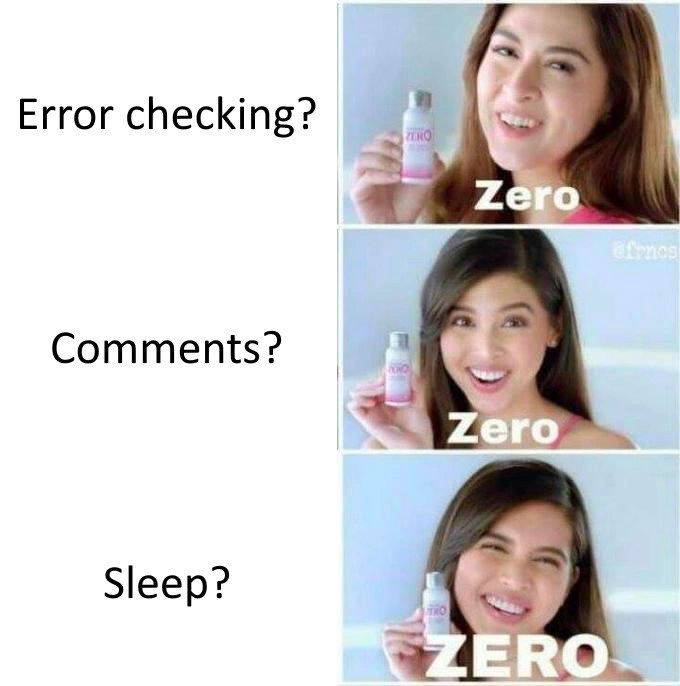
The Developer's Diet: Zero Checks, Zero Comments, Zero Sleep
CodeQuality Post #680, on Sep 20, 2019 in TG

The Developer's Diet: Zero Checks, Zero Comments, Zero Sleep

Why is this CodeQuality meme funny?

Level 1: No Safety, No Guide, No Sleep

Imagine you’re doing a big school project the night before it’s due. You don’t double-check your work at all, you don’t write any notes or explanations for how you got your answers, and you stay up all night with zero sleep to finish it. The next morning you slap a smile on your face and proudly turn it in saying, “Look, I did everything with ZERO mistakes checked, ZERO notes, and on ZERO hours of sleep!” Sounds pretty silly, right? You know the teacher wouldn’t be impressed – in fact, they’d probably be worried! This meme is joking about a programmer doing the same kind of thing. It’s funny because the developer is basically bragging about skipping all the important steps that make a project good or safe. It’s like baking a cake with no recipe, not tasting it even once to see if it’s okay, and doing it when you’re so tired you can barely keep your eyes open. The end result? Probably a yucky cake and a very sleepy baker. In the picture, the lady is holding up a bottle labeled “ZERO” and smiling, as if having nothing of those things is a great feature. Of course, everyone actually knows that having no safety checks, no instructions, and no rest is a recipe for disaster. We laugh because it’s a backwards way to do things – it’s making fun of the idea of working hard but not smart. The meme basically says: This developer didn’t check if their work was right, didn’t explain anything they did, and didn’t even sleep – and they’re oddly proud of that! Just like you’d shake your head and giggle if a friend boasted about doing their homework at 4 AM without reviewing it, we shake our heads and laugh at this programmer. The joke reminds us that skipping important steps (and sleep) might seem to save time, but it usually comes back to bite you – and it’s just a funny, relatable oops that we can all understand.

Level 2: No Exceptions, No Explanations, No Energy

Now let’s break this meme down in more straightforward terms. It’s highlighting three things a developer should do, but in the joke they do none of them. The three panels correspond to: error checking, code comments, and sleep. Each time, the answer is “Zero,” meaning the developer isn’t doing that at all. Here’s what those mean in real software development:

  • Error checking (error handling) – This means writing code to handle when things go wrong. For example, if your program tries to open a file that isn’t there, or send a network request and the internet is down, what happens? Good code will check for errors or exceptions and respond gracefully (maybe by showing a message like “Error: file not found” instead of just crashing). In the meme, “Error checking? Zero.” implies the developer isn’t bothering with any of that. They assume everything will work perfectly. That’s a huge gamble! New developers often learn about this the hard way: skip error checking and your program might just throw an uncaught exception or crash to desktop when something unexpected happens. It’s like driving a car with no brakes or seatbelts – fine as long as nothing goes wrong, but when it does, you’re in trouble. In code, error handling is done with things like if statements, return codes, or try/catch blocks around risky operations. For instance:
# No error handling example:
data = fetch_data_from_api()  
print("First item:", data[0])  # This will crash if data is empty or None

# With basic error handling:
data = fetch_data_from_api()
if not data:  
    print("Error: No data received from API.")  
else:  
    print("First item:", data[0])

In the first snippet, if fetch_data_from_api() fails or returns an empty result, the next line will cause a blow-up (maybe a TypeError or IndexError). In the second snippet, we check if data is valid before using it, printing an error message if something’s wrong. That’s error checking in action. The meme jokes that the developer does zero of this, meaning they wrote code like the first snippet everywhere – which experienced devs recognize as a bug farm waiting to happen.

  • Comments (documentation) – Comments are the little notes developers leave in the source code to explain things. They usually start with // or # or /* ... */ depending on the programming language. Comments don’t affect how the code runs; they’re there to help humans understand the code. For example, a comment might say // convert temperature from Celsius to Fahrenheit above a line of code doing a calculation. In teams, writing comments (or longer documentation) is part of good CodeQuality practices – it’s like leaving signposts for the next person (or your future self) who reads the code. The meme’s middle panel has “Comments? Zero.” That implies the code has no explanations at all. Everything could be written in a super terse or convoluted way with no hints about why it’s doing what it’s doing. For a newcomer or even the original coder coming back later, that’s frustrating. Many junior devs have had the experience of looking at their own code from a few months ago and going, “What on Earth was I thinking here?” If there’s a comment, it’d jog your memory. If there’s nothing, you play detective. Lack of comments can turn even simple maintenance tasks into stressful puzzles. It’s also tied to a bit of pride or myth among programmers: some think “well-written code is self-documenting.” It’s true that clear code with good naming is easier to read, but even then, a few comments can clarify the intent or important details. Comments are especially crucial when doing something non-obvious, like a workaround for a known bug or a complex algorithm. In short, writing zero comments is almost always a bad idea. The meme jokes about it because it’s relatable: a lot of us have been guilty of writing sparse comments, especially when rushing to finish something. But we usually regret it later (or our teammates certainly do). Modern code tools even encourage documentation (for example, Javadoc or Python docstrings) because they know everyone benefits from some explanation. So “Comments? Zero.” in the meme is basically saying this developer gave no help to anyone who will read this code later – a move that screams “I had no time (or I didn’t care) to make this understandable.”

  • Sleep (rest) – This isn’t a coding practice, but it’s a life practice that heavily affects coding. “Sleep? Zero.” means the developer pulled an all-nighter or has been awake for perhaps 24+ hours trying to deliver this software. In developer culture, sadly, this happens: before deadlines or during emergencies, people skip sleep to crank out code. How does lack of sleep relate to programming? Well, coding is a mentally intensive task, and doing it while sleep-deprived is like trying to solve puzzles with your brain in slow-motion. Sleep deprivation leads to mistakes – you might miss something obvious, or introduce new bugs because you’re not thinking clearly. If you’ve ever stayed up super late finishing an assignment or working on a project, you know that blurry, foggy feeling – that’s no state to produce quality work. Yet, a lot of newbie developers (and even students hacking on projects) sometimes romanticize the “programming until dawn with energy drinks” scenario. It can feel exciting in the moment, but it’s rough on your body and mind. The meme bringing up “zero sleep” is highlighting developer burnout culture in a jokey way. It’s basically saying: This coder didn’t sleep at all, just to ship this code (which, by the way, has no error handling and no comments either). The consequence? They’re going to be exhausted, and likely the code isn’t as good as it could be if they had rested. In real life, consistent zero-sleep crunching leads to burnout, where a developer might start hating the work or get sick or make a catastrophic mistake. It’s a serious mental health concern in the industry. So, the meme is a bit of gallows humor: we laugh because many of us have experienced those late nights, but we also know it’s not sustainable or wise. When you see “Sleep? Zero.” paired with the other two zeros, it paints a picture of a developer rushing like mad to deliver something, skipping all the quality checks and even basic self-care. It’s funny in the meme because of how absurd it is when you lay it out plainly – but it’s also a tiny bit painful because it reflects reality in some places.

Why is this meme relatable, especially for newer developers? Because it exaggerates common rookie (and not-so-rookie) mistakes in a clear, meme-friendly way. The woman holding the ZERO bottle in each panel makes it feel like an infomercial or an advertisement: “Introducing the new software development method: ZERO error handling! ZERO documentation! ZERO sleep! Order now and get a buggy app plus a side of burnout, absolutely free!” 🤦‍♂️ It’s poking fun at the fact that sometimes, under pressure, developers might actually cut all these corners – even though we all know we shouldn’t.

For a junior dev, the takeaways are:

  • Always handle errors (don’t assume everything will go perfectly, because users and computers love to surprise us).
  • Write comments or docs for anything that isn’t immediately obvious – your teammates and future self will thank you.
  • Don’t sacrifice sleep whenever possible – your brain is one of your best debugging tools, and it needs rest to function. Pulling an occasional late night might happen, but making it a habit will hurt both you and your code quality.

The meme resonates as coding humor because every developer has had that “oops” moment when they realized they forgot one of these things. Maybe you launched a demo without checking for a null input and it blew up in front of everyone, or you shared a project with a friend and they went “I have no idea what you did here” because there were zero comments. And certainly, many of us have tried to code while sleep-deprived and produced… questionable results. This meme rolls all those relatable mistakes into one package. It’s basically a checklist of what not to do, presented in a tongue-in-cheek way. CodeQuality matters, documentation matters, and your health matters – ignoring all three might make for a funny meme, but in real life it’s a trio of trouble. New developers can laugh at the hyperbole, but also recognize the underlying lesson: writing good software isn’t just cranking out features, it also means handling errors, writing docs, and taking care of yourself so you can think straight.

Level 3: Move Fast, Break Yourself

At a senior level, this meme hits on the holy trinity of bad software practices: no error handling, no documentation, and no rest for the weary. It’s darkly funny because experienced engineers recognize these as classic precursors to catastrophe in production. The image cheerfully advertises “Zero” of each, as if having zero code quality issues (like zero sugar in a diet drink) – but here it’s the inverse: zero quality controls. The humor is a nod-and-wink to the absurd reality that some projects are rushed out the door with zero error checking, zero comments, and the developer running on zero sleep.

Why is this combination so explosive? Let’s break it down from a battle-scarred perspective:

  • Zero Error Checking – Skipping error handling is a one-way ticket to runtime exceptions and bizarre bugs popping up at 3 AM. Any senior dev has been on-call when a service crashed because someone didn’t bother to check a null value or handle a failed API call. “Error checking? Zero.” – It’s like saying “We’ll just assume everything always works perfectly.” Seasoned devs know that assumption is laughably dangerous. Lack of error checking means that if one tiny thing goes wrong (a file missing, a network hiccup, a user input typo), the whole program might blow up. No try/catch, no if (err) {...}, nothing – just a ticking time bomb of unhandled exceptions. The meme’s cynicism implies code smells galore: it’s portraying a codebase written with a YOLO mentality (You Only Live Once) – just call functions and never check results. This is the kind of code that turns a simple bug into a production outage. It’s a “deploy and pray” strategy: ship it now, deal with the fallout later (probably at an ungodly hour).

  • Zero Comments – Ah, the code with missing_comments. Any veteran who’s maintained someone else’s code (or their own, six months later) can attest that lack of documentation is pure pain. The meme’s proud “Comments? Zero.” mocks that overconfident belief: “My code is self-documenting, I don’t need comments!” In reality, even well-written code can benefit from a few hints about why something is done. But this developer didn’t even leave a breadcrumb. For experienced devs, that’s a red flag – it means when something breaks (and it will, given zero error checks), whoever tries to fix it will have zero clue what the original author intended. It’s a setup for costly misunderstandings. We’ve all opened a source file to find cryptic logic with absolutely no explanation. It’s like discovering an ancient scroll with half the symbols faded away. The next developer might spend hours deciphering it, possibly introducing new bugs because they misunderstood a subtle point. Seasoned engineers chuckle (and cringe) because they’ve uttered the classic line: “Who wrote this nonsense?” only to realize it was their own past self, who was too tired or rushed to write a comment. Not commenting is a well-known code smell and a hallmark of technical debt – it’s essentially borrowing time now (skipping documentation) and making future maintenance pay it back with high interest.

  • Zero Sleep – The final panel drives home the mental_health aspect: this code was delivered with “absolutely zero sleep.” That’s the cherry on top of this disaster sundae. The meme exaggerates the macho “all-nighter” culture in tech, where a developer works 24+ hours straight fueled by caffeine and adrenaline. Senior folks recognize this as a burnout recipe. Shipping code bleary-eyed at dawn might sound heroic in startup lore, but in practice it means the code is likely riddled with mistakes and the developer is fried. “Sleep? ZERO.” – She’s grinning holding the Zero bottle, as if bragging about it. The dark humor here is that sacrificing rest is often (wrongly) worn as a badge of honor in dev culture. Experienced devs know lack of sleep leads to sleep_deprivation bugs: variables get misnamed, logic goes sideways, and you forget edge cases. There’s a bitter irony: the fewer hours of sleep you get, the more hours you’ll later spend fixing the carnage caused by brain-fog coding. It’s a vicious cycle – and we’ve all seen the zombie programmer in the office who checked in code at 4:00 AM and broke the build. Veterans chuckle at this panel because it’s too real: many have lived the developer_burnout_joke of working crazy hours only to create more problems.

In essence, this meme is a sarcastic checklist of what not to do if you want healthy software and a healthy developer. It lampoons the crunch-time culture where management cares only about delivering “something” by morning, even if it’s a hot mess internally. Each “Zero” is presented like a proud feature, which is the core of the joke – it’s a fake advertisement for a product no one should want. Seasoned developers laugh (and groan) because they recognize that fast + sloppy + sleep-deprived = guaranteed bugs. It’s a cynical summary of how technical debt and burnout accumulate: zero error handling leads to crashes (Hello, pager at 3AM), zero comments leads to maintainability nightmares, and zero sleep leads to personal crashes. The meme resonates as relatable humor because it’s basically a highlight reel of our worst coding habits set in a goofy infomercial format. It’s funny-’cause-it’s-true: we’ve all cut a corner or ten and paid for it later. The veteran perspective here is essentially a facepalm with a grin – we laugh at the meme, having learned these lessons the hard way, and we sincerely hope newer devs won’t repeat the “Triple Zero” approach (but we know some will, until experience teaches them otherwise).

Description

This is a three-panel meme. On the left side, three questions are listed vertically: 'Error checking?', 'Comments?', and 'Sleep?'. Each question is paired with a panel on the right featuring a smiling woman holding a small, white and pink bottle. Below her, the word 'Zero' is displayed in a stylized font, with the font size increasing in each panel. The meme template is from a commercial, used here to humorously indicate that the quantity of each item on the left is zero. The joke is a commentary on the pressures of software development, where developers often sacrifice best practices and personal well-being to meet deadlines. Skipping error checking leads to fragile code, omitting comments creates unmaintainable code (technical debt), and sacrificing sleep leads to burnout. For experienced engineers, this is a relatable, if cynical, take on the consequences of 'crunch culture' and poor project management
Comments

7
Anonymous ★ Top Pick I call this development strategy 'optimistic programming.' The code is optimistic it will never encounter an error, future developers are optimistic they can read my mind, and I'm optimistic I can function on caffeine alone
  1. Anonymous ★ Top Pick

    I call this development strategy 'optimistic programming.' The code is optimistic it will never encounter an error, future developers are optimistic they can read my mind, and I'm optimistic I can function on caffeine alone

  2. Anonymous

    Behold the “Enterprise Zero Stack”: zero error handling, zero comments, zero sleep - because why invest in observability when the pager already does real-time logging at 3 AM?

  3. Anonymous

    The startup that proudly ships "move fast and break things" eventually becomes the enterprise maintaining "moved fast, everything's broken, original team quit."

  4. Anonymous

    The three pillars of 'move fast and break things' culture: zero error handling because 'it works on my machine,' zero comments because 'the code is self-documenting,' and zero sleep because production is on fire at 3 AM. Turns out those try-catch blocks and inline documentation weren't just suggestions from your tech lead - they were prophecies of the on-call nightmares to come. But hey, at least you shipped on time, right?

  5. Anonymous

    Deadline-driven development: we hit the sprint goal by setting error handling and comments to zero and financing the difference with the on-call’s REM cycles

  6. Anonymous

    Our consistency model: fail-open on errors, write-only for comments, and eventual consistency for sleep

  7. Anonymous

    Zero errors, zero comments, zero sleep: the senior dev's perfect trifecta of green CI and red eyes

Use J and K for navigation