The Annual Purge, but for Technical Debt
Why is this VersionControl meme funny?
Level 1: Candy for Dinner
Imagine your parents decided that for one day, all the rules at home are off. You can eat candy for breakfast, lunch, and dinner, and you don't have to clean your room or do any homework. Sounds amazing, right? You and your siblings would run wild, stuffing yourselves with chocolate and turning the living room into a pillow fort kingdom. That day would be super fun while it lasts – no one saying "no" to anything! But now think about the next morning: there are candy wrappers everywhere, a spill on the carpet, toys scattered underfoot, and you wake up with a pretty bad stomach ache from all that junk food. Not so fun anymore. This meme is joking about the same kind of idea, but for computer programmers. Normally, programmers have rules to keep their code neat and safe (kind of like doing chores and eating vegetables). The joke says "What if, for 12 hours, all those rules went away and you could do whatever you wanted in the code?" It’s funny to picture because, just like a candy-eating day, it would start out exciting but almost certainly end in a big mess that everyone regrets later.
Level 2: Wild West Merges
This joke envisions a temporary no-rules zone in software development, so let's break down what that means. In a typical project using version control (like Git), developers create Pull Requests (PRs) when they want to merge their changes into the main codebase. A pull request is basically a proposal: "I’ve made these code changes, can we add them to the project?" Crucially, PRs usually require code review – teammates (often senior developers or the project maintainers) go through the changes with a fine-tooth comb. They look for bugs, suggest improvements, ensure the style and architecture are consistent, and generally act as quality control. Code review is like having an editor for your article or a teacher checking your homework: it might catch mistakes you missed and keep the work quality high.
Now, the tweet suggests skipping all of that for 12 hours. That would be a special no_review_window where any PR gets merged immediately, with zero oversight. It’s essentially saying: push whatever code you want, we won’t even glance at it. In software terms, that's like the Wild West of coding – no sheriff in town to enforce the rules. These wild west merges mean developers could introduce code that’s poorly tested, or not tested at all, full of shortcuts and hacks, or even completely broken, and it would still become part of the official code. In real life, most teams have safeguards to prevent this. For example, repositories on GitHub often have branch protection rules: you can’t merge to the main (or master) branch without at least one approval from a reviewer, and usually the code must pass automated tests. Here, those safeguards would be turned off. It's the equivalent of unchecked_commits, where changes go straight in without anyone double-checking them.
Let's talk about technical debt – a key term in this meme. Technical debt is a metaphor: it’s the extra work you take on later because you chose an easy or quick solution now instead of a better, longer-term solution. Imagine you have a school assignment due tomorrow and you copy some answers from the internet to save time, knowing you might have to relearn that material properly before the exam. That "borrowed time" is like technical debt in programming. For instance, a developer might write some messy code that barely works (a hack), just to meet a deadline, planning to clean it up later. That mess is the debt, and until it's cleaned up, it may cause problems (like bugs or slower development because the code is hard to understand). In healthy projects, teams try to minimize tech debt, or at least keep track of it (often with comments like // TODO: need to refactor this in the code, or tickets to improve things later). Code reviews normally flag these issues: a reviewer might say, "Hey, this approach is a bit hacky – can we make it cleaner?" or "We need tests for this new feature." In the spirit of the meme, "All tech debt is legal" means any quick-and-dirty solution is allowed during those 12 hours. No reviewer will object to that awkward workaround or that copy-pasted code from Stack Overflow. It’s a get-out-of-jail-free card for every questionable coding practice you can think of.
What would happen if we actually did this? For a junior developer, skipping code reviews might sound great at first. No one to nitpick your variable names or ask you to write more unit tests – yay! You merge your feature and it’s live immediately. But the catch becomes clear pretty soon. Without extra eyes, bugs slip through. Maybe you introduced a subtle error that a reviewer would have caught, like an off-by-one mistake in a loop or forgetting to handle a null value. Perhaps you didn’t realize your change breaks another part of the system. Those problems don’t disappear – they just show up later, possibly in production (which is the worst time to find a bug!). Then everyone has to scramble to fix the code after it’s already caused trouble. That’s a lot more painful than catching the issue in a code review before merging.
Another likely outcome of "The Merge" is a tangle of merge conflicts. Merge conflicts occur in version control when two people change the same part of a file or incompatible changes happen in parallel. Under normal circumstances, teams coordinate merges carefully. Reviewers might say "Hey, Alice is also editing that module, coordinate with her" to avoid conflicts, or at least whoever merges second will carefully resolve any overlaps by hand. But if everyone is merging everything without looking... it's like a dozen chefs throwing ingredients into the same pot without talking to each other. The codebase can end up with sections that simply don't mesh. The next developer who updates the project might open their Git tool to a barrage of conflict markers (<<<<<< HEAD and >>>>>>) indicating that two changes clobbered each other. Resolving those can be tricky, especially when neither change was reviewed – so you might not even know which approach was correct. It’s a bit of a nightmare scenario for version control.
The meme also name-drops "The Merge" as if it's the title of an event or movie. It’s directly referencing The Purge, a movie where, for one night, all laws are suspended. If you’re not familiar: in that film, people can do anything (even crimes) during that period without legal consequences. It's scary in the movie, but the meme uses that over-the-top idea in a humorously exaggerated way about coding. So instead of crimes being allowed, it's bad code that’s allowed. The comparison is meant to be ridiculous: committing sloppy code isn't actually illegal (nobody’s going to jail for not indenting properly!), but in well-run software teams it is strongly discouraged to just push unchecked code. It feels forbidden to bypass code review, because everyone knows it leads to poor quality software. By framing it as "All tech debt is legal," the joke leans into that feeling that writing bad code is akin to doing something mischievous.
To a newer developer (or someone who just joined a project), code reviews can sometimes feel like a hurdle – why won't they just trust my code and merge it? This meme is a playful reminder of why the hurdle exists. It's showing the extreme opposite world: no hurdles at all, and the likely chaos that would ensue. In day-to-day development, a little review and caution can save you from huge headaches later. So while "The Merge" sounds like a fantasy coding free-for-all (and indeed, some newbies might daydream about nobody critiquing their code), in reality it underscores the value of teamwork and quality control. After all, version control humor like this usually has a kernel of truth – here it's that unchecked commits would make a real mess. The experienced folks chuckle because they know how bad things could get, and newcomers laugh (and learn) because it highlights why those annoying code review comments actually matter.
Level 3: The Merge Purge
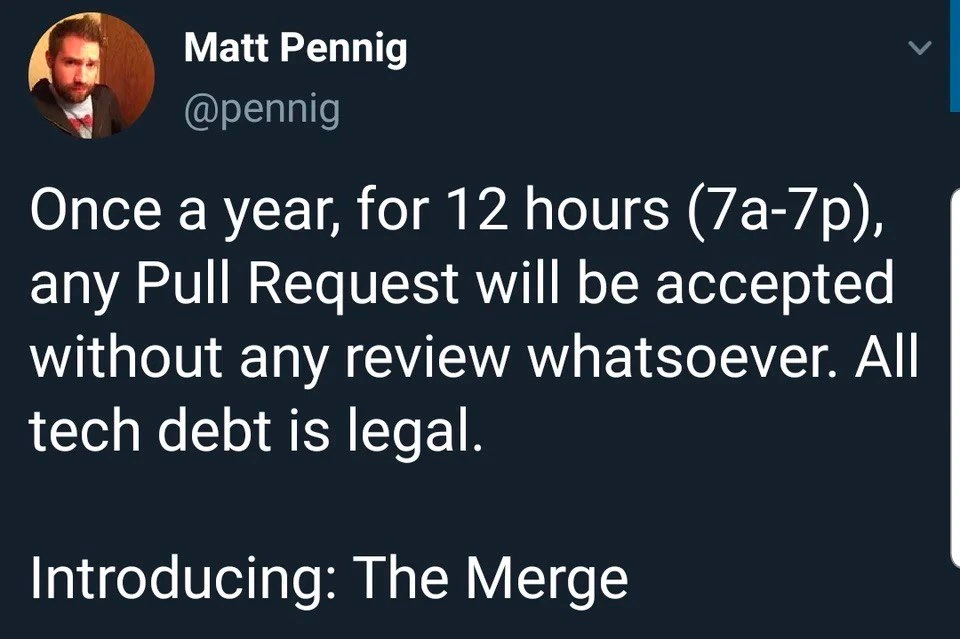
Imagine a world where your repository's safeguards vanish for half a day: no code reviews, no QA checks, no mercy. This meme tweet conjures exactly that scenario, riffing on the horror film The Purge but for software. It declares that "Once a year, for 12 hours (7a-7p), any Pull Request will be accepted without any review whatsoever. All tech debt is legal." In other words, a Pull Request Purge – an anarchic coding window when every shortcut, hack, and half-baked commit flies through to the main branch unchallenged. For experienced developers, the idea is equal parts hilarious and terrifying. Why? Because we've all seen what happens when even one unreviewed change slips through; now picture an entire day of unchecked commits. It's merging first, asking questions later – if at all.
On a normal day, the code review process acts as the immune system of the codebase, catching bugs and bad ideas before they spread. Remove that immune system and you get a full-on infection of technical debt. The tweet basically proposes a holiday where the usual laws of software engineering are suspended. Feature flag guidelines? Optional. Database migration plans? Toss ’em. Even that junior dev’s ten-thousand-line file of experimental code gets green-lit with a big green "Merge" button. The result would be a codebase in chaos: merge conflicts everywhere, broken builds, and logic so inconsistent that the next morning the entire team would be on firewatch duty trying to douse the flames. You can almost hear a veteran developer muttering, "What could possibly go wrong?" – a question so rhetorical it's basically a punchline in itself.
Let's put this insanity in pseudo-code, just to drive the point home. If someone actually implemented "The Merge" protocol, it might look like:
bool purgeMode = isAnnualMergeDay() && (currentHour >= 7 && currentHour < 19);
if (purgeMode) {
acceptPullRequest(pr, /* no review */ true); // All merges, no questions asked
} else {
requirePeerReview(pr); // Normal code review process
}
Here, purgeMode represents that fateful 12-hour no_review_window. In purge mode, every pull request is auto-merged with zero oversight. You can bet real-life senior engineers would wrap this in ten layers of access control to ensure it never actually runs – it’s a Wild West merges setting no sane maintainer would enable.
The humor hits hard because it's a reversal of everything we practice. Normally, teams treat unchecked merges like volatile dynamite: one wrong commit can bring down production. We add guardrails – automated tests, linters, approvals – specifically to prevent the kind of mayhem "The Merge" endorses. The meme amplifies a dark fantasy: “Imagine we just merge everything, screw consequences.” It’s funny because developers know the consequences all too well. The phrase "All tech debt is legal" is especially spicy – it implies that all those quick-and-dirty fixes you’re usually forbidden from pushing are suddenly fair game. In a real codebase, technical debt is like a credit card with a brutal interest rate: if you swipe it recklessly (say, by skipping tests or hardcoding values), you'll pay back tenfold in bug fixes and refactors down the line. A 12-hour free-for-all would be like maxing out every credit card in one night. Sure, you "got stuff done" during the spree, but the debt collectors (in the form of angry QA engineers and 3 AM on-call pages) will be knocking soon after.
Seasoned devs reading this are smirking because we've all been tempted by a mini version of this at some point. Maybe a critical hotfix went straight to production without review (it was an emergency, promise!), or a Friday 6 PM commit bypassed CI. We know the adrenaline of “I hope this doesn’t break anything…” followed by the dread of monitoring dashboards. The meme takes that thrill and fear and says, what if everyone did that, all at once? The codebase after such an event would look like a battlefield. You'd find functions with names like doStuff() added to critical modules, // TODO: fix later comments littering the logic, and probably an if(false) { ... } block someone pushed to disable a failing feature. It's the stuff that normally a diligent reviewer or CI pipeline would veto on sight. Without those gatekeepers, the inmates run the asylum.
It's worth noting the tweet’s clever nod to The Purge movie franchise. In those films, law and order take a 12-hour coffee break, leading to outrageous chaos. Here, the "laws" are coding standards and version control best practices. The comparison is perfect: turning off code review is as unthinkable to devs as turning off all laws is to society. And yet, the absurdity makes us laugh, perhaps with a touch of nervousness. We laugh because we can imagine the carnage: endless production outages and a JIRA backlog of bug tickets that could stretch to the moon. It's a cathartic "what-if" that highlights why we have process in the first place.
The meme’s popularity even spawned a tongue-in-cheek saga of sequels (blending in some Star Wars references for extra nerd points). Picture a whole series of films about The Merge aftermath, titled like so:
- Merge 2: The Rebase – The unwanted sequel where devs attempt to rebase and integrate the mess, leading to even more conflicts.
- Episode IV: A New Merge – A hopeful beginning: perhaps the first ever Purge Day, optimistically believing no review might somehow work out (spoiler: it doesn't).
- Episode V: The Tech Lead Strikes Back – In the aftermath, the senior engineers (the Tech Leads) return with a vengeance, rolling back bad commits and enforcing order again.
- Episode VI: Return of the Junior – The junior developers, guilt-ridden or eager to help, come back to clean up the chaos they may have caused, learning hard lessons in the process.
- Episode VII: The --force Awakens – Someone tries to fix the irreparable history with a
git push --force, awakening a new level of repository chaos (as if things weren’t bad enough!).
Each "sequel" name is a wink to the audience: --force is the dreaded Git flag that can rewrite history (dangerous, but oh-so-tempting when you're desperate to undo a mess). The Tech Lead striking back paints the image of a weary senior dev, eyes burning from diff reviews, heroically refactoring junk code back into shape. And "Return of the Junior" humorously acknowledges that it's often inexperienced devs (or just overconfident ones) who might push something crazy, but they also might be the ones staying late to patch it up with sincere determination. These references layer on additional humor for those who know Git and Star Wars lore, but they all circle back to the same truth: skipping process leads to the Dark Side.
In the real world, of course, nobody schedules a "Merge Day" (and if any CTO actually considered it, their dev team would probably stage an intervention). This meme resonates because it's a hyperbolic cautionary tale. It underscores why we have code reviews and sane merging policies: not to torturously slow down developers, but to protect us from ourselves. Every senior dev has a horror story of the time a tiny unchecked change took down a system or the multi-week slog to pay down accumulated tech debt. "The Merge" is that nightmare dialed up to 11 and turned into a comedy. It’s a funny thought experiment precisely because we know never to let it happen.
Description
This image is a screenshot of a tweet from user Matt Pennig (@pennig). The tweet's text reads: 'Once a year, for 12 hours (7a-7p), any Pull Request will be accepted without any review whatsoever. All tech debt is legal. Introducing: The Merge'. The profile picture shows a man in a suit with a red bow tie. The caption provided with the post adds another layer of humor, parodying Star Wars titles with git terminology: 'Merge 2: The Rebase, Episode IV A New Merge, Episode V The Tech Lead Strikes Back, Episode VI Return of the Junior, Episode VII The --force Awakens'. The central joke is a parody of the horror film 'The Purge,' where all crime becomes legal for a 12-hour period. In this tech version, the 'crime' is accumulating technical debt by merging code without any quality control or review. For senior developers, this is a darkly humorous fantasy about bypassing the often rigorous but necessary process of code review, especially when facing tight deadlines. It humorously acknowledges the constant tension between speed and quality in software development. The Star Wars-themed caption enhances the joke by referencing common, and sometimes dangerous, version control scenarios and team dynamics
Comments
7Comment deleted
The morning after 'The Merge,' the CI/CD pipeline doesn't just fail; it files for divorce and takes half the servers with it
Survival tip for “The Merge” day: push the monolith-to-microservice refactor as a single “rename” diff - Git thinks it’s just a file move, management sees all green, and by the time prod goes red we’re already in the next sprint’s retro
The Merge is just formalizing what already happens every Friday at 4:45pm when the PM suddenly remembers that critical feature they promised for Monday's demo
Finally, a solution to the age-old problem of PRs sitting in review purgatory for weeks: just declare technical bankruptcy once a year and let chaos reign for 12 hours. It's like The Purge, but instead of crime being legal, it's committing directly to main with that 'TODO: refactor this later' comment you know will never be addressed. The real genius is calling it 'The Merge' - because nothing says 'we've thought this through' like naming your annual code quality apocalypse after the Git operation that already causes the most anxiety
The Merge: 12 hours where main is write-only, CODEOWNERS resolves to /dev/null, and you convert saved review cycles directly into SEV-1s
Let’s schedule “The Merge”: bypass CI, ignore CODEOWNERS, spend the entire error budget at once - then call Monday’s offsite ‘git bisect.’
The Mererge: finally legalizing that 'temporary' monolith hack whose interest has outpaced your entire tech debt ledger