Skip to content
DevMeme
7439 of 7506
Your Frontier Model Trial Expires Tomorrow

Your Frontier Model Trial Expires Tomorrow

Why is this AI ML meme funny?

Level 1: The Free Sample Queue

Imagine a new amusement-park ride that is included with every ticket for two weeks. Everyone loves it, so the park announces that tomorrow it will leave the regular ticket and require special coins because the line is impossible to predict. People rush to ride one last time, making the line even longer. The joke is that the park’s warning creates the crowd it fears, while visitors discover that their new favorite “included” attraction was only temporarily included.

Level 2: Subscription Meets Meter

An API, or application programming interface, lets software send requests to a model programmatically. Instead of a person only typing in a chat app, a product or script can submit prompts, receive outputs, and integrate them into a larger workflow.

The screenshot contrasts two payment models:

  • A subscription plan charges a recurring fixed amount and includes some level of access, usually subject to limits.
  • Consumption-based billing charges according to use, commonly measured through input and output tokens or credits.
  • Usage credits are prepaid or billed units consumed when the model runs; they make use visible as a variable cost.

A token is a small unit of text processed or generated by the model. Token count is not identical to character count, and the total cost of an agent task can include repeated prompts, tool results returned to context, retries, and long outputs. A request that looks short to the user can trigger a long sequence behind the interface.

Capacity planning means estimating how much computing resource will be needed, placing enough of it where users are, and retaining room for bursts and failures. New models make this hard because nobody yet knows how many people will use them, how long their sessions will be, or which new applications their capabilities will create.

A small team preparing for a metered transition should:

  1. Measure current model use by task and project.
  2. Set spending limits and alerts before enabling automatic credit replenishment.
  3. Choose cheaper fallback models for ordinary work.
  4. Limit context and repeated retries where they do not improve results.
  5. Evaluate output quality and human review time, not tokens alone.
  6. Keep prompts, tests, and interfaces portable enough to change models.

The meme-like urgency in “don’t waste this time” is exactly what metering changes. Under a subscription, the instinct is to use every included bit before it vanishes. Under consumption billing, the instinct is to ask whether each request is worth its visible cost. Same model, entirely different psychology.

Level 3: Included Until It Matters

The visual punchline is a pricing transition written in launch-announcement prose. First comes reassurance:

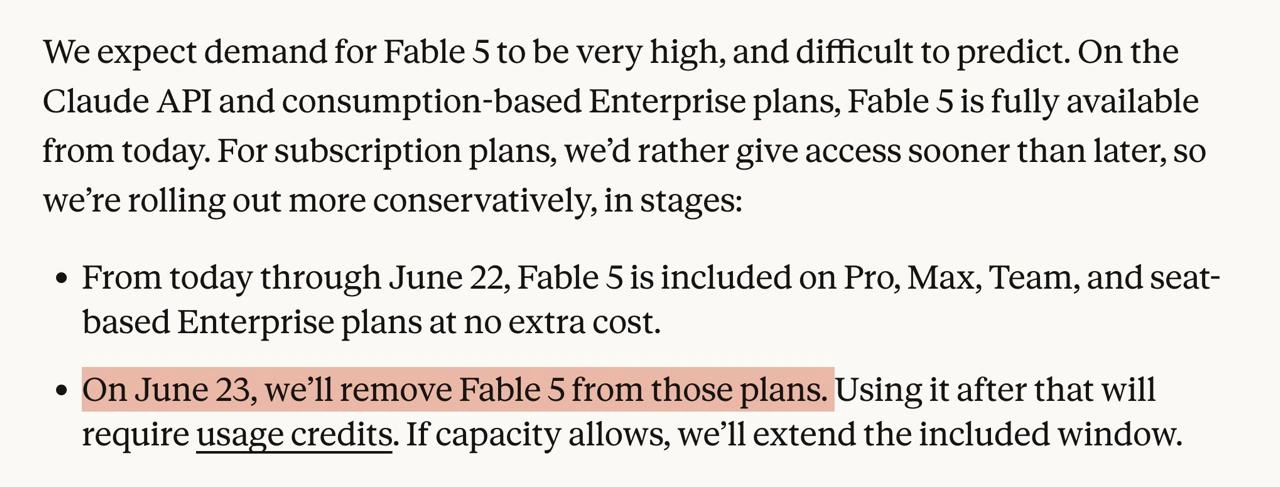
From today through June 22, Fable 5 is included on Pro, Max, Team, and seat-based Enterprise plans at no extra cost.

Then the pale-red highlight lands on the reversal:

On June 23, we’ll remove Fable 5 from those plans.

usage credits is underlined like the answer to a question no subscriber wanted to ask. The model is not being shut down in the quoted text: the paragraph says it remains fully available through the Claude API and consumption-based Enterprise plans. What changes is entitlement. Yesterday the fixed subscription opened the door; tomorrow the same capability requires metered spending.

The accompanying post appeared on June 22, 2026, making “one day left” literal under the original schedule. There was an additional complication knowable at that moment: Fable 5 access had already been suspended on June 12 under a US government directive, so the screenshot preserved the launch plan rather than proving subscribers still had a usable final day. The later outcome was not yet available to the person viewing this countdown. That mismatch makes the scarcity even stranger: users are urged not to waste a window whose operational availability had already been interrupted.

The crop also stops before the next bullet in the source announcement, which said Anthropic aimed to restore Fable 5 as a standard subscription benefit when sufficient capacity became available. Omitting that conditional intention makes the highlighted removal look more final. Yet even the fuller wording offered no date or guaranteed allowance, so teams still had to plan around the only firm statement: bundled access could disappear.

The humor comes from how quickly a developer workflow can normalize a premium capability. Two weeks is long enough to build prompts, repository instructions, review habits, and expectations around a stronger model. Removing it then feels less like ending a sample and more like reducing an existing plan. This is the SaaS version of lending the team a faster build server and installing a coin slot after everyone rewrites the schedule around it.

“At no extra cost” also deserves translation. Inference was never costless; during the included window, its cost was bundled into the subscription, subsidized as launch adoption, or absorbed by the provider. Consumption billing moves that marginal cost into view. Users gain a clearer relationship between workload and spend, but they also inherit bill volatility. A runaway agent loop, enormous context, verbose output, or retry storm can become a finance alert with surprisingly good prose.

For engineering organizations, this creates three kinds of risk:

  • Operational risk: a critical workflow depends on a model or entitlement that can change independently of the codebase.
  • Financial risk: per-use charges vary with tokens, retries, agent duration, and adoption.
  • Vendor-lock-in risk: prompts, evaluations, integrations, and human habits become tuned to one provider’s model behavior and plan structure.

The practical response is not to forbid the strongest model. It is to give it an explicit service tier. Route routine classification, formatting, and simple code edits to cheaper models; reserve the frontier model for tasks where measured quality justifies the cost. Track input, output, retries, latency, cache effectiveness, and success—not merely the monthly invoice. Set per-project budgets and alerts, cap agent loops, reduce irrelevant context, and test fallbacks before the premium queue disappears on deadline day.

Teams also need model evaluations based on their own work. A model that costs several times more per token can still be cheaper if it solves a hard migration in fewer attempts, while a spectacular benchmark leader may be wasteful for boilerplate. Cost optimization is therefore:

$$ \text{cost per successful task}

\frac{\text{all model and review cost}}{\text{accepted outcomes}} $$

That denominator includes human verification. Cheap generations that produce subtle defects are not bargains; expensive generations that nobody can audit are not strategy.

The announcement’s most revealing sentence is If capacity allows, we’ll extend the included window. Product availability, infrastructure headroom, and pricing are fused into one conditional. Subscribers are asked to treat an access tier like weather: perhaps the cloud will clear. Naturally, telling everyone there is one day left is also an excellent way to produce the demand spike that demonstrates why capacity was difficult to predict.

Level 4: The GPU Queue Bites

The phrase demand ... difficult to predict is doing serious distributed-systems work. Serving a frontier LLM is not equivalent to serving a cached web page. A request first processes its input context in a prefill phase, then generates output autoregressively, one token depending on the tokens before it. Input length, output length, reasoning effort, tool loops, and user behavior all change how long the job occupies expensive accelerator resources. A two-line question and a million-token agent session may enter through the same product button while having radically different service times.

Large deployments commonly split model computation across multiple accelerators and replicate those groups across a cluster. The exact Fable 5 architecture is not visible here, so it would be speculation to name its sharding scheme, but the general constraints are familiar:

  • Model weights and the per-session KV cache compete for high-bandwidth accelerator memory.
  • Longer contexts and more concurrent sessions increase cache pressure.
  • Batching several requests improves throughput but can worsen interactive latency.
  • Long, unpredictable generations create head-of-line and scheduling problems.
  • Failed hosts, networking limits, model loading, and regional capacity reduce the theoretical total.
  • New capacity requires more than buying a chip; it requires power, networking, deployment, testing, and a usable replica topology.

A simplified utilization measure is $\rho = \frac{\lambda}{c\mu}$, where $\lambda$ is arriving work, $\mu$ is service capacity per replica group, and $c$ is the number of groups. As $\rho$ approaches 1, small bursts or unusually long requests can make queueing delay and tail latency rise sharply. Operators therefore need headroom, not merely enough hardware for the average minute. “We can serve the mean” is how a launch page becomes a status page.

Flat subscriptions make the arrival process especially uncertain because the marginal price of one more request appears to be zero. A newly released, unusually capable model attracts experimentation, benchmark runs, long coding sessions, and people racing an announced cutoff. Usage credits reintroduce a marginal cost and a measurable budget, which shapes demand as well as revenue. The screenshot’s policy is thus a crude form of admission control: let subscribers sample the model, observe the workload distribution, then move heavy use onto a meter while capacity planning catches up.

That does not mean “capacity” is fake because API customers can still pay. Different products can use different queues, priorities, rate limits, reservations, and service objectives. Consumption pricing gives the provider a stronger signal about demand and a way to fund the resources consumed; subscription access promises a broad population a bounded experience for a fixed fee. The technically difficult task is converting tokens, cache occupancy, latency targets, and burstiness into an entitlement users can actually understand.

Description

A cropped section of an Anthropic announcement says demand for "Fable 5" is expected to be "very high, and difficult to predict" and that the model is fully available on the Claude API and consumption-based Enterprise plans. It explains that subscription access will roll out conservatively: "From today through June 22, Fable 5 is included on Pro, Max, Team, and seat-based Enterprise plans at no extra cost." The next bullet states, "On June 23, we’ll remove Fable 5 from those plans. Using it after that will require usage credits. If capacity allows, we’ll extend the included window," with the removal sentence highlighted in pale red and "usage credits" underlined. The screenshot emphasizes the abrupt transition from bundled access to metered billing, illustrating how scarce inference capacity and unpredictable demand shape access to frontier models.


Comments

1
Anonymous ★ Top Pick The model may have a huge context window, but the subscription benefit had a 14-day TTL.
  1. Anonymous ★ Top Pick

    The model may have a huge context window, but the subscription benefit had a 14-day TTL.

Use J and K for navigation