From Problem Solving to Token-Rationed Begging
Why is this AI ML meme funny?
Level 1: The Expensive Helper
Imagine that you used to learn how to repair your own bicycle. Now you must ask a clever but unreliable helper to repair it, you are allowed only a certain number of words, and each time the helper puts a wheel on backward you must spend more of those words asking for another try. The huge dog is proud of knowing the job; the little dog feels powerless while begging the helper. That loss of control is why the picture is funny—and why its frustration feels familiar.
Level 2: Tokens for Thoughts
An LLM, or large language model, generates text by predicting small pieces called tokens. A token may be a whole short word, part of a word, punctuation, or a fragment of source code. Services often measure how much input and output a user consumes, and some plans impose rate or usage limits. That explains the Cheems character's fear of “hitting token quotas” and the intentionally crude “caveman” phrasing: fewer words appear to mean more requests before the allowance runs out.
A prompt is the instruction and context sent to the model. Good prompts commonly need relevant code, an error message, expected behavior, environment details, and constraints. Removing those details to save tokens can make a bug report resemble this:
code broke. fix now. no long explain.
The model then has to guess, and a guess can compile while still being logically wrong, insecure, or incompatible with the rest of the project. Debugging is the work of finding why software behaves incorrectly; bug fixing is changing it without breaking something else. AI can help with both, but its suggestions still need tests and human review. The joke lands especially well for a newer developer who has watched one requested fix create a fresh error, pasted that error back, and begun a conversation long enough to qualify as a troubled relationship.
The body contrast supplies the emotional shorthand. Buff Doge looks powerful and self-sufficient, matching the long claim about skills, logic, and efficiency. Cheems looks small and resigned, matching repeated requests to a service he neither owns nor fully understands. Proprietary software means the provider controls the underlying product rather than exposing everything needed to inspect or operate it independently. Vendor lock-in is the practical difficulty of leaving after a workflow becomes dependent on that provider.
The meme exaggerates by treating traditional programming and AI assistance as mutually exclusive. In practice, a capable developer can ask a model for a draft and then reason about it, just as one can use a debugger without forgetting how code works. The warning is useful when the draft is accepted because it sounds confident, or when learning is replaced by an endless generate → fail → reprompt loop.
Level 3: Rationed Abstraction
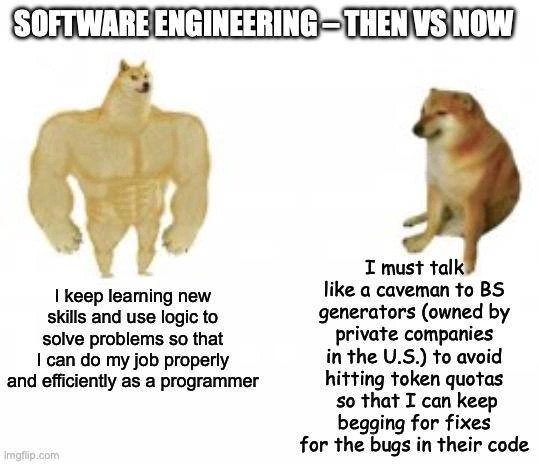
The Buff Doge/Cheems split turns a debate about developer agency into a deliberately humiliating before-and-after picture. The muscular figure represents an idealized engineer who says:
I keep learning new skills and use logic to solve problems so that I can do my job properly and efficiently as a programmer
The smaller, slumped dog instead describes having to:
talk like a caveman to BS generators (owned by private companies in the U.S.) to avoid hitting token quotas so that I can keep begging for fixes for the bugs in their code
The humor depends on several inversions. A tool advertised as a natural-language interface supposedly makes language less natural. Automation intended to increase productivity creates a new scarcity—tokens—and the programmer who once controlled the implementation becomes a petitioner negotiating with a probabilistic service. Buff Doge is comically overconfident, but Cheems is not merely using a weaker tool; he has surrendered the feedback loop of understanding, implementing, testing, and correcting.
That is the meme's sharpest AI-hype-versus-reality complaint. An LLM can produce plausible code quickly, yet plausibility is not correctness. When generated code fails, the model does not own the incident, understand the whole running system, or carry responsibility for the patch. The developer still has to reproduce the bug, inspect state, read logs, test assumptions, and review the proposed fix. If those skills atrophy, every follow-up prompt becomes a variation of “please try again,” and debugging turns into an expensive slot machine with excellent autocomplete.
The phrase “bugs in their code” is productively ambiguous. It could mean defects in code generated by the AI, or blame aimed at the vendors' own systems. Either reading supports the frustration: the user pays—in money, latency, privacy trade-offs, or a limited context budget—to repair output the tool helped create. Shortening prompts may conserve metered usage, but aggressive terseness can omit constraints and produce worse answers, causing more retries. The attempted optimization then increases the very consumption it was meant to reduce. Somewhere, a billing dashboard is feeling extremely efficient.
The parenthetical about private U.S. companies adds vendor lock-in and institutional power to what could otherwise be a simple tooling joke. A team may build workflows around proprietary models whose quotas, prices, model behavior, retention rules, and availability it does not control. Switching providers is harder once prompts, editor integrations, evaluation suites, and developer habits assume one vendor's behavior. The systemic risk is not that using an AI assistant automatically makes someone worse at programming; it is that management may treat generated output as a substitute for expertise while leaving engineers accountable for every consequence.
The “THEN VS NOW” framing is itself satire rather than history. Earlier software engineering was never pure logic performed by heroic individuals: programmers have always depended on compilers, libraries, search engines, documentation, forums, and commercial platforms. The real distinction is whether a tool extends the engineer's reasoning or becomes an opaque intermediary they cannot challenge. Strong use of an assistant still requires the supposedly old-fashioned habits pictured on the left: learning the domain, decomposing the problem, checking output, and knowing when the confident answer is nonsense.
Description
A white-background Buff Doge versus Cheems meme is headed "SOFTWARE ENGINEERING – THEN VS NOW" in large outlined lettering. The muscular Doge on the left says, "I keep learning new skills and use logic to solve problems so that I can do my job properly and efficiently as a programmer." The small seated dog on the right says, "I must talk like a caveman to BS generators (owned by private companies in the U.S.) to avoid hitting token quotas so that I can keep begging for fixes for the bugs in their code," and a faint "Imgflip.com" watermark appears at bottom left. The comparison presents modern AI-assisted development as a regressively constrained workflow in which terse prompting, vendor quotas, generated defects, and repeated repair requests displace direct reasoning and skill-building.

Comments
1Comment deleted
The AI writes bugs at machine speed; you debug them at per-token pricing.