Skip to content
DevMeme
7438 of 7506
Your Assigned FBI Agent Finally Replies

Your Assigned FBI Agent Finally Replies

Why is this DataPrivacy meme funny?

Level 1: Goodnight to the Watcher

Imagine joking that a guard secretly watches your bedroom window every night, so you wave and blow him a kiss before sleeping. Then your phone buzzes with a message from “Guard” saying, “Alright man,” as if he has finally had enough. That impossible reply makes the joke: a huge, scary idea about being watched becomes one awkward friendship, while the person is already telling everyone else about it in public.

Level 2: Camera, Data, and Spyware

A webcam turns light into digital images for applications such as video chat. Normally, an app must receive operating-system or browser permission before using it. The user can review or revoke that permission, and an indicator may show when the camera is active.

Spyware is software designed to collect information covertly. Depending on its permissions and capabilities, it may capture messages, files, location, audio, screenshots, or camera images. Webcam compromise is possible, but it usually requires malicious software, an exploited vulnerability, abused permissions, or control of a legitimate remote-access tool. It is not the default explanation for every targeted advertisement or uncanny recommendation.

Many ordinary privacy concerns do not involve live video at all. Services can learn a great deal from metadata—information about activity rather than its full content. Login times, IP addresses, device identifiers, contacts, locations, and interaction patterns can reveal routines and relationships. Automated systems can store and analyze such records without a named person staring at a screen.

Useful everyday checks include:

  1. Review camera and microphone permissions for apps and websites.
  2. Remove software and browser extensions you do not trust or use.
  3. Install operating-system, browser, and application security updates.
  4. Use unique passwords and multi-factor authentication for important accounts.
  5. Pay attention to unexpected sensor indicators or remote-access activity.
  6. Remember that anything posted to Everyone no longer depends on webcam espionage to become public.

The FBI Agent notification is funny precisely because none of that resembles an actual security architecture. It imagines every user receiving a dedicated watcher who responds through consumer messaging. The complexity of surveillance becomes a sitcom with two characters: the oversharing user and the agent who finally says, Alright man.

Level 3: Surveillance Gets Parasocial

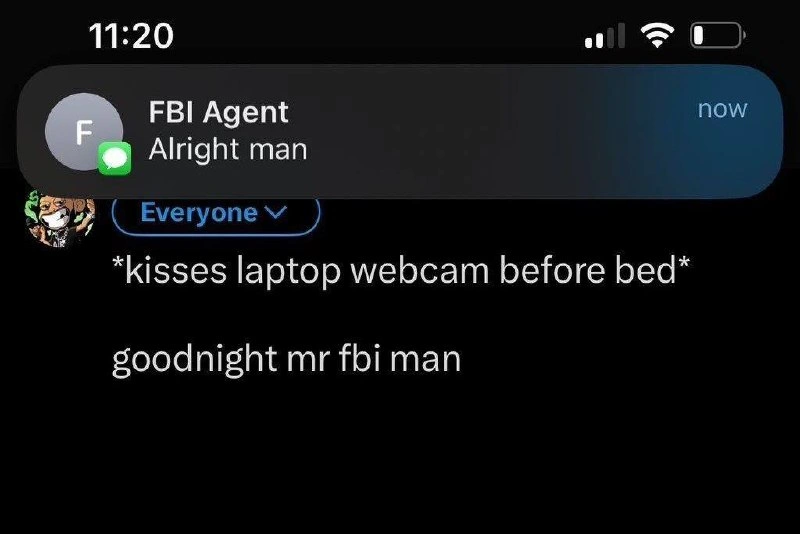
The screenshot turns a deliberately impossible relationship into a perfectly timed conversation. The underlying post says:

kisses laptop webcam before bed
goodnight mr fbi man

At that exact visual moment, an iOS Messages notification from a contact named FBI Agent arrives with Alright man. The response is neither sinister nor affectionate; it sounds like the exhausted acknowledgment of someone whose surveillance assignment has become much too personal. Mass observation has acquired a contact card and, apparently, boundaries.

The “assigned FBI agent” trope works by shrinking diffuse surveillance systems into one human observer. Real data collection can involve device telemetry, advertising identifiers, cloud records, network logs, automated detection, legal requests, targeted investigations, or endpoint spyware. Those mechanisms operate at different scales under different authorities. The meme discards all that infrastructure and imagines one civil servant watching one person’s webcam around the clock like the world’s least appropriate livestream moderator.

That personification changes fear into a parasocial relationship. An invisible institution is difficult to joke with; “my agent” can be greeted, embarrassed, thanked, or accused of divided attention. The wording circulated as part of the late-2010s wave of webcam-agent jokes, where the watcher was recast from faceless threat to reluctant companion. Adding the live Alright man notification completes the fantasy: the observer finally breaks protocol because even the surveillance state cannot process one more bedtime kiss.

The most elegant visual irony is the blue Everyone selector above the post. The speaker performs concern about involuntary observation while apparently preparing or displaying text for a broad audience. The guaranteed data exposure in the image is not a secret camera feed; it is the sentence voluntarily placed into a social interface and then preserved in a screenshot. Modern privacy is often less “someone secretly saw one thing” than “several services retained different pieces because sharing was the default interaction.”

The image itself proves none of the surveillance it jokes about. Phone contacts can be named FBI Agent, notifications can be timed, screenshots can be composed, and the sender’s identity is not authenticated by the label visible on a lock screen. There is no camera indicator, system alert, malware evidence, or message history showing a government account. Treating this crop as proof would reproduce the very category error the meme exploits: confusing a friendly interface label with knowledge of who is behind it.

Technically, several privacy scenarios are easy to conflate:

  • Ordinary app access: a video-call or browser app uses the camera after receiving permission.
  • Commercial data collection: a service records usage events, device details, searches, location signals, or social interactions, often without touching the webcam.
  • Account access: someone obtains cloud messages or stored files through stolen credentials, a compromised session, or a lawful request to a provider.
  • Network observation: an actor sees connection metadata or unencrypted traffic, which is different from controlling the endpoint camera.
  • Spyware: malicious software gains sensitive permissions or exploits the device to collect audio, images, messages, location, or files.

Encryption in transit can protect data moving between endpoints and a service, but it does not stop an authorized app or compromised endpoint from seeing data before encryption or after decryption. Likewise, a camera permission prompt is meaningful only if the operating system and device remain trustworthy. Security controls form layers; no single green dot, privacy policy, or piece of tape answers every threat model.

On current systems, users can review which apps have camera and microphone permission, and many platforms display an indicator while those sensors are active. Some laptop designs tie the built-in camera to an indicator in hardware or dedicated silicon; other devices make different guarantees. A physical shutter blocks images but not microphone access, screen capture, stored cloud data, or the information users publish themselves. The right defense depends on the feared capability rather than the satisfying feeling of covering one lens.

A practical privacy review therefore asks who might want which data, how they could obtain it, and what harm would follow. Keeping the operating system and browser updated, removing untrusted extensions, restricting sensor and accessibility permissions, using strong unique credentials with MFA, avoiding suspicious software, and checking unexpected indicators all reduce realistic risk. Someone facing credible signs of targeted spyware needs more careful incident response than a generic checklist, because poking at a compromised device can destroy evidence or alert the operator.

The meme’s emotional truth survives the technical correction. People know that online activity is observed in some form, but the systems are too vast and opaque to feel relational. Inventing one bored agent makes the power imbalance small enough to tease. The notification’s weary reply then punctures even that comfort: your imagined digital guardian is not falling in love; he would simply like the shift to end.

Description

A dark smartphone screenshot shows the iOS status bar at 11:20 with cellular signal, Wi-Fi, and battery icons. A Messages notification labeled "FBI Agent" says "Alright man" and is marked "now." Beneath it, a dark chat interface with a small illustrated avatar and a blue "Everyone" selector contains the lines "*kisses laptop webcam before bed*" and "goodnight mr fbi man." The perfectly timed notification literalizes the internet trope that an assigned government agent watches every user through their webcam, turning mass-surveillance anxiety into an awkwardly affectionate one-to-one relationship.

Comments

1
Anonymous ★ Top Pick The webcam threat model did not account for the observer sending read receipts.
  1. Anonymous ★ Top Pick

    The webcam threat model did not account for the observer sending read receipts.

Use J and K for navigation