Senior Dev Wisdom: An Indexed Collection of Past Mistakes
Why is this Juniors meme funny?
Level 1: Practice Makes Perfect
Imagine a little kid trying to ride a bicycle for the first time. They wobble and crash and keep asking, “Why can’t I get this right?” Now picture an older kid or an adult hopping on a bike and zooming off effortlessly. The younger kid might think, “Wow, they’re so smart or talented!” But what the kid doesn’t see is that the older rider fell down lots of times in the past while learning. Every scrape and bruise taught them a little more about how to keep their balance. Now, whenever the bike starts to tip, they know exactly what to do – almost without thinking – because they remember all those early mistakes. In other words, the older kid’s “bike wisdom” is really just a bunch of past falls and errors that they’ve learned from. They’ve collected those lessons in their head so they don’t tip over the same way twice. That’s why they can fix their balance so quickly, just like the senior developer who can fix a coding bug in a snap. It’s a real-life example of practice makes perfect: the more times you get something wrong and figure out how to do it right, the faster you’ll recognize and solve the problem the next time. The meme is funny and heartwarming because it reminds us that being “smart” at something is often just the result of making a lot of mistakes and remembering how to not make them again.
Level 2: Bug Cheat Sheet
Let’s break this down in simpler terms. Imagine a junior developer is new to coding and hits an error that leaves them stumped – they’re asking, “Why isn’t this working?” This is a pretty common debugging question when you’re starting out, because you haven’t seen a lot of these errors before. Now, a senior developer hears the question and immediately replies, “Oh, you just need to do X, Y, and Z.” To the junior, it feels like the senior has a cheat sheet or some kind of magic shortcut. In reality, that senior has probably been through the exact same problem multiple times. Maybe the fix (X, Y, Z) is something like: “Just set the correct configuration file, clear your cache, and restart the application.” The only reason the senior knows the answer so fast is because they made that mistake themselves in the past and remembered the solution. In essence, the senior developer has a mental bug cheat sheet – a list of “if you see this problem, here’s the solution” gained from experience. This is what we often call wisdom: knowledge gained from many past errors and lessons. The junior is learning those lessons for the first time, while the senior is recalling them from memory. It’s a classic learning curve situation in programming (and in life): the more mistakes you’ve already made, the easier it is to troubleshoot when something similar goes wrong later.
Now, the funny twist in this meme is the reference to a hashset. If you’re a newer developer and haven’t heard that term yet, a hash set is a kind of data structure (a way to store data) that’s designed to check for the existence of an item really quickly. Think of it like an ultra-fast checklist. For example, if you have a regular list of items and you want to see if “item X” is in it, a computer might have to look through the list one by one until it finds it. That could take longer if the list is very big. But if you use a hash set, the computer can jump directly to where “item X” should be and check almost immediately. In big O notation, searching a list is O(n) (slower, grows with n), while searching a hash set is O(1) on average (pretty much the same quick speed no matter how big it gets). In plain terms, faster lookups! So when the tweet jokes that “ideally it’s a hashset, for faster lookups,” it’s saying: wouldn’t it be nice if your wisdom (all your lessons learned) was stored in a super-efficient way so you can remember solutions instantly? It’s a pun that mixes a life lesson with a programming concept. A senior dev’s brain kind of works like that efficient system: the moment they see a familiar error, they immediately know “aha, I’ve seen this before!”
To visualize this, here’s a tiny code-like example. In Python, we can use a set (which is implemented as a hash set under the hood) to store mistakes we’ve seen, and then check if a new error is in that set:
# A simple example using a Python set (hashset) for quick "seen this bug before?" checks
past_errors = {"NullPointerException", "OffByOneError", "MissingSemicolon"} # collection of mistakes we've made
error = "MissingSemicolon" # the new issue we're facing
if error in past_errors:
print("Seen this bug before. We know how to fix it!")
else:
print("New bug. Let's investigate from scratch.")
In this snippet, past_errors is like the senior dev’s memory of bugs they’ve already encountered. The line if error in past_errors: is a constant-time check to see if the current problem is something we’ve seen before. If it is, we can confidently say “yep, we’ve dealt with this, and we know the solution.” If it’s not in the set, that means it’s a brand new problem – time to roll up our sleeves and figure it out (and once we do, we’d probably add that new mistake and its fix to our memory bank for next time!). Using a hashset (or Python set here) makes that have I seen this? check super fast, because under the hood it’s doing those optimized calculations (hashing the error string to find a slot) rather than scanning through every stored mistake one by one. The joke in the tweet is essentially comparing a senior developer’s wisdom to this kind of fast checklist. The senior’s brain doesn’t literally have a hashset data structure inside 😄, but it feels like it when they can recall a fix instantly. It’s a fun way to say: experienced programmers have an optimized mental cheat sheet of past bugs. They don’t waste time repeating the same mistakes if they can help it, because they remember the solution from last time.
So, to recap in simple terms: the meme is funny because it shows a junior and senior developer reacting to a bug in very different ways. The junior is confused and admiring the senior, thinking “they’re so smart!” Meanwhile the senior is laughing internally, thinking “I only solved that so quickly because I did the exact same dumb thing before… multiple times.” Then the punchline adds: “Wisdom is just a collection of mistakes,” with a programmer’s twist that this collection should be a hashset for efficiency. It’s a little nerdy joke that combines a truth about learning (we learn by making mistakes) with a coding concept about storing and looking up information quickly. In short, the senior dev’s “secret” is not instant genius, it’s experience – organized just like a handy data structure.
Level 3: Constant-Time Wisdom
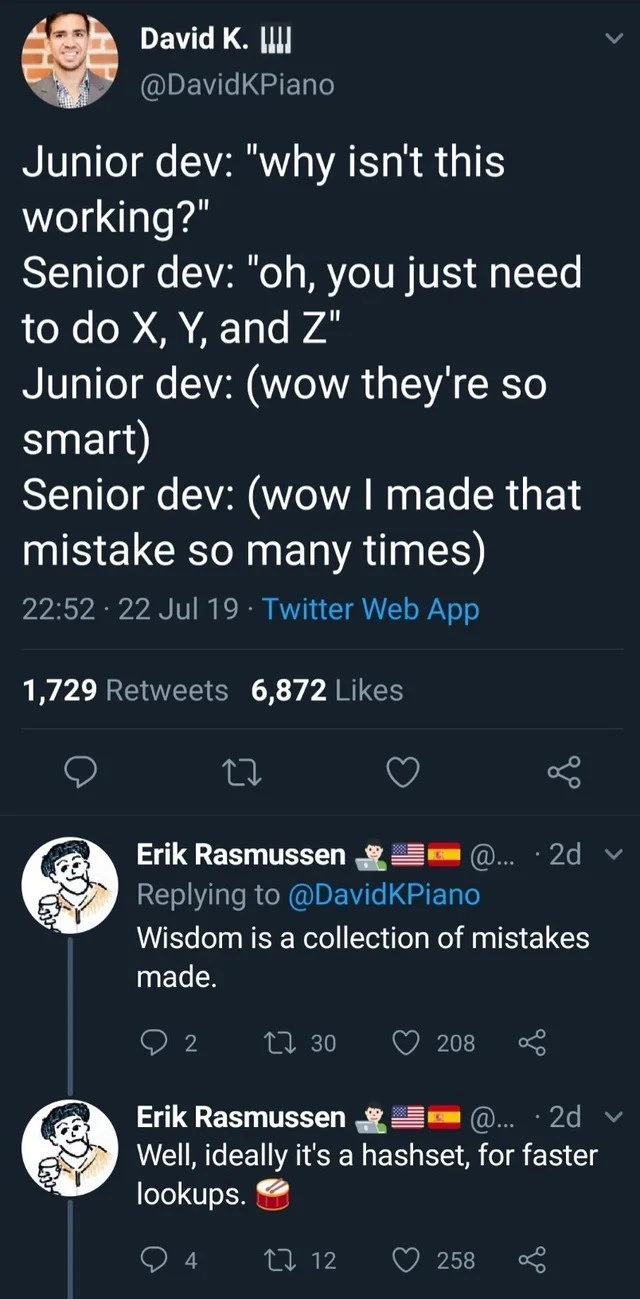
This meme captures a classic Senior vs Junior Developers moment layered with clever data structure humor. In the Twitter exchange, a junior developer cries out in frustration, “why isn’t this working?” and the senior developer calmly replies, “oh, you just need to do X, Y, and Z.” To the new dev, that instant fix seems like wizardry. But the seasoned dev’s inner monologue admits, “wow, I made that mistake so many times.” The humor here is both relatable and technical: it highlights how senior engineers often appear to have superpowers in debugging_troubleshooting simply because they’ve encountered those same issues repeatedly in the past. This scenario nails the dynamic of SeniorVsJuniorDevelopers – the junior is bewildered by a tricky bug, while the senior has a déjà vu moment, recalling the exact fix from their personal history of bug-hunting war stories. It’s the kind of everyday DeveloperHumor that makes you smirk and think, “Yep, been there.”
Erik Rasmussen’s reply under the tweet spells out the theme: “Wisdom is a collection of mistakes made.” In other words, a senior developer’s "smart" answers are really just an indexed collection of past facepalms and failures. Each bug they’ve fixed before becomes a lesson in their mental library. Over years of learning (often the hard way), an experienced dev accumulates a hefty catalog of “don’t do that again” moments. So when a junior asks “why isn’t this working?”, the senior isn’t pulling knowledge out of thin air – they’re doing an instant lookup in a large mental database of debugging lessons learned. (It’s like they have every bug they’ve already fixed cached in their brain.) The tweet thread cleverly calls this out: the junior is impressed at the senior’s wisdom, while the senior is silently chuckling because that “wisdom” came from doing the exact same dumb thing so many times before. It’s a shared joke about the learningCurve in development – progress often comes from screwing up and memorizing the fallout.
Now, here’s where the meme adds a nerdy twist with the hashset_joke. Erik follows up by quipping, “Well, ideally it’s a hashset, for faster lookups.” 🥁 This one line turns a life lesson into a coding pun. To unpack it: in computer science, a hash set is a data structure optimized for extremely fast lookup of items. In a well-implemented hash set, checking if something exists is on average O(1) – meaning it takes constant time, regardless of the size of the collection. By joking that wisdom should be a hashset, he’s saying: “Wouldn’t it be great if our collection of past mistakes were organized for instant retrieval?” This is a playful nod to the way experienced devs can recognize a familiar bug in a split second. The tweet is essentially picturing a senior engineer’s brain as a giant HashSet<LessonsLearned> – a bucket of all their past errors hashed and ready, so when a new error comes up, they can check faster (lookup in constant time) if they’ve seen it before. No need to iterate through every memory or relearn anything from scratch (that would be like a slow O(n) linear search through a long list of mistakes). Instead, the answer pops out immediately like a constant-time cache hit in the brain. It’s a witty blend of wisdom_from_mistakes and pure data_structure_humor that seasoned developers adore.
To appreciate the joke fully, remember that a HashSet (often backed by a hash table) uses a hash function to assign each item a slot, enabling direct lookups. So comparing wisdom to a hashset is tongue-in-cheek saying “my brain has hashed all my past bugs for quick access.” The 🥁 drum emoji punctuates this as a punchline – essentially a techie rimshot. It acknowledges the pun openly: faster_lookups in life’s mistake collection is an absurd, funny idea. The whole exchange is both philosophical and geeky. It’s philosophical because it reminds us that expertise comes from failure; it’s geeky because it wraps that idea in the garb of algorithmic efficiency. In typical DeveloperMemes fashion, it transforms a relatable dev experience into an inside joke: experience = (mistakes) collection; optimized experience = (mistakes) hashset. No wonder this tweet screenshot (complete with the beloved dark_theme_ui that developers favor) garnered thousands of likes and retweets – it resonated with the collective memory (or should we say collective hashset? 😄) of developers who’ve all been that struggling junior and later that “all-knowing” senior. The meme strikes a chord by validating that feeling when you finally realize: the seniors aren’t magicians, they’re just walking crash-test dummies who memorized what not to do, and that’s wisdom in a nutshell (or in this case, in a hash table).
Description
A screenshot of a Twitter thread that captures the dynamic between junior and senior developers. The main tweet, by David K. (@DavidKPiano), describes a scenario: a junior dev asks why something isn't working. The senior dev provides the exact solution, leading the junior to think, '(wow they're so smart)'. Internally, the senior dev thinks, '(wow I made that mistake so many times)'. Below the main tweet, which has 1,729 Retweets and 6,872 Likes, are two replies from Erik Rasmussen. The first states, 'Wisdom is a collection of mistakes made.' The second reply adds a technical punchline: 'Well, ideally it's a hashset, for faster lookups. 🥁'. The humor comes from revealing that senior expertise is less about innate genius and more about a well-cataloged history of failures. The follow-up joke perfectly targets the senior developer audience by applying a computer science optimization concept to this metaphorical collection of mistakes
Comments
7Comment deleted
Seniority is just having a well-indexed, read-replicated database of every possible way a system can break, with single-digit millisecond query times
My brain after two decades of prod support is basically a Bloom filter: I can tell you a bug is almost certainly a duplicate, but don’t ask me which module actually owns it
The real optimization is when you've made the same mistake so many times, you can predict it before the junior even finishes explaining the problem - that's when your brain achieves O(1) pattern matching on production disasters
The real senior move here is Erik's reply: recognizing that wisdom isn't just an array of past mistakes - it's a HashSet for O(1) lookup time. Because when you've made the same mistake 47 times across 12 different codebases, you need instant recall to confidently say 'oh yeah, just do X, Y, and Z' while internally screaming 'not again.' The junior sees expertise; the senior sees a well-indexed collection of their own historical failures, optimized for rapid retrieval during code reviews
Senior wisdom: a perfect mental hash table of stack traces, O(1) lookup on every 'I've done that' blunder
Real seniority is just an O(1) hash set of past outages - cache hit: fix in minutes; cache miss: enjoy the 3am postmortem
To juniors it looks like magic; to seniors it’s a read‑optimized index over their own postmortems - fast queries because the writes happened at 3 a.m