Ultimate Tech Challenge: PMs Merging a PR vs Engineers Making a Phone Call
Why is this Management PMs meme funny?
Level 1: Comfort Zone Challenge
Imagine a silly game show where two teams have to do things that are the opposite of what they’re good at. For example, picture a team of five professional chefs and a team of five car mechanics. Now, the challenge is that the chefs have to fix a car’s engine, and the mechanics have to bake a fancy cake. Who do you think will finish first? It’s a funny idea because chefs normally cook (and might have no clue about car parts), and mechanics normally fix cars (and might be totally lost when it comes to baking). Each team is awesome at their own job, but when you swap their tasks, they feel nervous and awkward.
That’s exactly what’s happening in this meme, but with tech people: one team of project managers is asked to do a coding task, and another team of engineers is asked to do a people-oriented task. It’s funny and relatable because each team is being pushed out of their comfort zone. One side is thinking, “Oh no, I have to deal with this scary computer thing I never do!” and the other side is thinking, “Oh no, I have to talk to a person live on the phone!” We find it humorous because we know both tasks are normally pretty simple – pressing a button or making a call – but when you’re not used to something, even a simple task can feel like a big challenge. The game show idea makes it even sillier, as if we’re all watching this play out and cheering to see who conquers their fear first. In the end, it’s a light-hearted way to show that everyone has different strengths and weaknesses, and it’s okay to laugh about how hard something easy can feel when you’re not used to it.
Level 2: Git vs Grit
Let’s break down why this tweet is humorous by explaining the key pieces in simpler terms. First, there’s the pull request side of the joke. A Pull Request (PR) is a way developers ask to merge (combine) their code changes into the main project code. Think of it like submitting your homework for review: your team checks it, discusses any issues, and then approves it to become part of the official project. Merging a PR means clicking a button (or running a command) that finalizes this and adds the new code to the main codebase. Now, for software engineers, doing a PR merge is pretty standard – it’s part of their daily workflow using tools like GitHub or Bitbucket. However, project managers (PMs) typically don’t use Git (the version control system behind pull requests) as part of their job. A project manager’s role is usually to plan projects, coordinate team members, manage timelines, and communicate with stakeholders (like clients or other departments). They live in tools like JIRA, Trello, Excel, or email – not in code editors or Git terminals. So asking 5 PMs to merge one pull request is funny because you’re essentially asking a group of people to do something they’re totally unfamiliar with. It would be confusing and intimidating for them. Imagine opening a programmer’s tool you’ve never seen before with a screen full of strange messages – that’s probably how a PM would feel looking at a GitHub merge page. They might worry they’ll mess up the code if they click the wrong thing. This part of the joke plays on a stereotype: PMs are not technical, so even a simple coding task could stump them. The term “merge_button_phobia” (not a real medical term, just humorous) captures that fear that non-developers might have about messing up the codebase: they’re afraid of that Merge button like it’s going to bite them! The truth is, merging a PR isn’t inherently dangerous – especially if tests have passed and reviews are done – but to someone who’s never done it, it can feel like “Oh no, I hope I don’t break the entire app with one click.”
On the flip side, the tweet also jokes about 5 engineers in a room who have to make one phone call. This highlights a common developer stereotype: that engineers, while technically skilled, often struggle with social skills or communication, especially things like talking on the phone or in person. Many developers are more comfortable with written communication (like chatting on Slack or writing emails) than making phone calls. Why? There are a few reasons often given: social anxiety is one – some people in tech tend to be introverted and feel nervous talking to people, especially strangers or clients, without the “shield” of a computer screen. Another reason is control and clarity: when writing, you have a chance to think and edit your words; in a live phone call, you have to respond on the spot. Engineers love to problem-solve in a controlled environment, and a phone conversation can feel like a situation with too many unknowns (you can’t silently debug a conversation or Google an answer without the person noticing!). So, the joke imagines putting a group of engineers in a scenario that seems simple (just call someone on the phone) but is actually nerve-wracking for them. It’s the same kind of comedy as picturing a cat forced to swim – something that is easy for dogs (or in our case, easy for PMs who are used to calls) but terrifying to the cat.
Now, why a “game show”? The tweet sets it up as a competition: which team will finish their task first – the PMs merging the code or the engineers making the call. This format is just for humor, to exaggerate the scenario. In reality, neither task is objectively that hard: merging a pull request is usually a one-click action if all is prepared, and dialing a phone number is also straightforward. But the joke’s point is that psychologically, each task is hard for the respective group. The game show setup makes us imagine a funny scene: perhaps a live audience watching these folks struggle, a timer ticking, and maybe a commentator narrating the hilarious slow progress. It emphasizes the contrast: PMs are usually great at communication (think: calls, meetings, presentations) but might be lost with developer tools, whereas engineers are great at using those technical tools but might freeze up when it comes to interpersonal communication like phone calls.
We should clarify who project managers and engineers are in a software context:
- Project Manager (PM): This person’s job is to manage projects. In software teams, they organize the workflow, set deadlines, make sure everyone knows what they should be doing, and communicate between the clients/customers and the technical team. They often run meetings (daily stand-ups, planning meetings) and are skilled at things like writing progress reports, removing roadblocks for the team, and yes, making phone calls or Zoom meetings with clients and stakeholders. However, many PMs do not write code themselves. They might have some technical background or they might come from a completely different background (like business or communications). Either way, it’s not their day-to-day task to use Git or review code. So if you put them directly in front of a developer’s task like merging a PR, they’ll probably feel like a fish out of water.
- Software Engineer / Developer: This is the person who writes code to build the software. They spend their days in code editors, running programs, fixing bugs, and using tools like Git for version control. They are very comfortable with technical complexity and logical problem solving. However, it’s often joked (and sometimes true) that many engineers prefer minimal human interaction, especially spontaneous conversations. They often like to communicate in writing because it’s similar to how they work with code – it’s precise, and you have time to refine what you “say” (type). As a result, some engineers might find tasks like calling someone on the phone to be stressful. It requires quick thinking, social niceties, and small talk – things that aren’t part of a coding routine. Of course, not all engineers are shy or anxious, but the stereotype exists enough in developer culture that this joke makes sense to a lot of people.
So in the meme’s imagined game show:
- The 5 PMs merging one pull request would probably involve them puzzling over the GitHub interface. They might be saying things like, “Okay, I see the green button that says ‘Merge’ – do I click it now? It says there are checks failing, what does that mean?” They might not realize that perhaps some automated tests need to pass first or that someone from the dev team usually reviews it. They might even debate among themselves who should do it: “I don’t want to be the one to break it!” This is funny to developers because merging is so everyday for them that seeing PMs dramatize it is like watching someone panic over plugging in a USB drive.
- The 5 engineers making a phone call would likely have them negotiating who has to do it: “I called the pizza place last week, so it’s your turn to call the client!” They might even script out what to say beforehand, or one of them might pretend to be sick to avoid talking. The tweet specifically mentions “get over their social anxiety long enough to make one phone call”, which paints a picture of them psyching each other up like they are about to go bungee jumping or do something daring, even though it’s actually an ordinary phone call. This is humorous because outsiders might think, “What’s the big deal? It’s just a call,” but many in the tech community will relate to that feeling of dread when the phone rings unexpectedly or when you have to call someone you don’t know well.
The phrase “see who wins first” at the end of the tweet ties back to the game show idea. It implies a competition: will the technically-challenged PMs figure out how to use Git faster, or will the socially-anxious engineers overcome their fear and dial out faster? It’s a toss-up meant to be absurd – realistically, both tasks might take these groups a while. The comedy comes from the fact that an outsider might assume engineers would of course win (since merging code is part of making software) or that PMs would win (since calling is so trivial), but those assumptions flip given the context. In the world of this joke:
- PMs are portrayed as slower at a tech task (merging code) because it’s not their skill set.
- Engineers are portrayed as slower at a people task (making a call) because it’s outside their comfort zone.
The tweet’s popularity (with lots of likes and retweets) shows it resonated with many folks who have experienced this kind of role-based awkwardness in real life. It’s a bit of ProjectManagementHumor meeting DeveloperHumor – each side can chuckle at the other and themselves. The categories like CodeReviews are relevant because a pull request merge is part of the code review process, and Communication is a theme because phone calls vs online communication is the crux of the joke. The tag SoftSkills is often used to describe skills like communication and teamwork – things that engineers sometimes have to consciously work on, just as non-tech managers might have to work on their technical literacy.
In simpler terms, the humor is about mismatched skills. Each team is given a task that the other team does all the time. We laugh because we know both teams are likely to comically struggle, even though normally each task isn’t objectively hard – it’s only hard when you’re not used to it. It also lightheartedly reminds us that being great in one domain (like coding or management) often means we might be lacking in another (like social confidence or technical knowledge). Good tech teams actually need both types of skills: the technical know-how to merge PRs and the communication skills to make calls and coordinate. But instead of turning it into a lecture, the meme makes it a funny what-if scenario that exaggerates the gap for effect.
Level 3: Merging Mayhem vs Dialing Dread
Imagine a high-stakes cross-discipline showdown that plays on classic tech team stereotypes. In one corner, we have five Project Managers (PMs) huddled around a laptop, staring at a GitHub page with a pending Pull Request (PR). Their challenge: figure out how to merge that PR into the codebase. In the other corner, five software engineers nervously eye a telephone, tasked with making a simple phone call to a client. It’s a hilarious role-reversal scenario – essentially a contest of version control vs voice control – and the humor comes from each team tackling the other group’s nightmare task.
For seasoned developers, hitting the Merge button on a PR is a routine part of daily life. A pull request is a package of code changes that developers submit for review before it becomes part of the main code. Merging it means incorporating those changes into the primary branch (often main or master). Simple, right? Well, not if you've never touched Git. Our five PMs likely live in a world of spreadsheets, project timelines, and stakeholder emails – not command lines. To them, Git’s jargon like commit, rebase, or merge conflict might as well be arcane spells. The tweet jokes about a merge_button_phobia: that deer-in-headlights moment when a non-coder faces the Merge Pull Request dialog and silently panics, “What if I break the product?”. We can practically see the PMs gingerly hovering the mouse cursor over the merge button, triple-checking if it's safe. They might debate endlessly: “Did everyone approve this? Do we need another meeting before we click?” In true ManagementVsEngineering fashion, they’re applying project manager instincts (ensure consensus, minimize risk) to a developer task that usually just requires technical confidence. The situation lampoons a real communication gap in many organizations: non-technical managers feel out of depth with developer tools, much as developers poke fun at how “brave” one must be to click that scary Deploy or Merge button. It highlights a genuine developer pain point too – sometimes engineers joke that involving non-coders in the code review process would be chaotic, and here we’re humorously confirming that suspicion.
Now switch scenes to the engineers’ room. The five engineers know Git like the back of their hand, but that ringing telephone is their true boss battle. Many engineers (not all, but the stereotype fits) are introverts or at least very comfortable behind a keyboard. They thrive on written communication: emails, chat apps, issue trackers – mediums where they can carefully compose their thoughts (and even edit before sending!). A synchronous voice call, though? That's an entirely different protocol – one that doesn’t allow pull requests or unit tests before you speak. The meme cleverly jabs at this social_anxiety_in_engineers, the way some devs hesitate to dial a number the same way others might hesitate to push to production on a Friday. There’s a well-known tongue-in-cheek saying among developers: “I’ll do a code merge at 5 PM on a Friday, but please don’t make me do a cold call any day of the week!” It’s funny because it flips the typical notion of what is “scary.” Non-engineers might think merging code sounds scary and serious, whereas developers often find something as ordinary as a phone call to be scarier than a merge conflict. The tweet’s challenge describes engineers needing to “get over their social anxiety long enough to make one phone call” – we can all picture that scenario. The devs might be procrastinating, saying “Maybe I’ll just Slack the person instead… yeah, let’s try Slack first.” Meanwhile the clock is ticking in this hypothetical game show. It’s a playful nod to soft skills (like clear communication, phone etiquette) being a whole different skill tree that many engineers haven’t maxed out, in contrast to their well-honed technical skills.
The brilliance of this game_show_scenario is how it simultaneously pokes fun at both sides of a common corporate dynamic. It’s not mean-spirited; it’s more of a friendly roast. On one side, project managers are portrayed as technically challenged, sweating over what any junior developer would consider a trivial Git action. On the other side, engineers are portrayed as socially challenged, breaking into a cold sweat over what any PM or salesperson would consider a routine phone call. The humor lands because both situations ring true in many offices. Developers have indeed joked about project_managers_versus_git (“Did the PM just ask me what a repository is?!”), and PMs have definitely nudged engineers about communicating better (“This dev writes brilliant code but won’t pick up the phone to discuss requirements.”). We’re essentially witnessing a communication gap and a skill gap collide, framed as an epic race.
From an experienced developer’s perspective, this also underscores a subtle truth: every role has specialized knowledge that seems trivial to insiders and mystifying to outsiders. The meme could be seen as a call for empathy beneath the laughs. After all, in real life, the best teams bridge these gaps: engineers improve their soft skills over time, and good project managers pick up just enough technical know-how (maybe even learning basic Git commands) to collaborate effectively. But in this exaggerated scenario, we strip away that cross-training and see pure, stereotype-driven comedy. It’s the DeveloperHumor version of a reality show. If you think deeper, there’s almost an element of a deadlock here (in computer science, a deadlock is when two processes wait for each other indefinitely). The PMs are stalled, waiting for someone else to take the merge initiative; the engineers are stalled waiting for someone else to maybe handle the call. Who breaks the deadlock first? That’s the big question – “see who wins first,” as the tweet says.
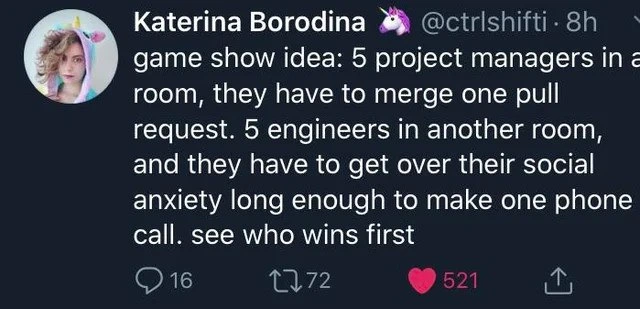
Now, the tweet format adds to the effect. It’s presented by Katerina Borodina (with a unicorn emoji flair 🦄) as a casual musing on Twitter, but it clearly struck a chord (notice those 72 retweets and 521 likes at the time of the screenshot). The engagement numbers and the quick spread show that this scenario resonated widely – it’s a shared joke among software folks. Tweets like this often go viral in tech circles because they validate our shared experiences with a dash of absurdity. The Twitter communication medium itself is fitting: a short, witty observation that gains traction because both engineers and managers tagged in the joke can laugh at themselves. It’s a piece of ProjectManagementHumor as much as it is developer humor. Also, framing it explicitly as a “game show idea” is genius – you can almost hear a deep-voiced announcer narrating: “Next up on Channel Dev: Watch as Team Manager tries to push to master, while Team Engineer attempts small talk with a real human! Who will crack under pressure first?!” The absurdity of turning these mundane-yet-terrifying tasks into a spectator sport is what makes it extra funny.
In practice, would either team succeed quickly? The seasoned cynic in us might bet “neither” – they'd probably call for outside help, which ironically defeats the purpose. A PM might end up phoning an engineer (“Hey, could you come merge this PR for us?”), and an engineer might end up messaging a PM (“Could you possibly call the client instead?”). Such a stalemate is the ultimate punchline: both tasks get done by other people, which is often the unspoken reality in workplaces (people sticking to their comfort zone and delegating the scary stuff). This meme shines a light on that truth in a humorous way.
Ultimately, the joke works on multiple levels. On the surface, it’s just laugh-out-loud ridiculous – a literal depiction of each group’s stereotype. On a deeper level, it’s almost satirical commentary on how specialized and siloed tech roles can become: each side might not fully appreciate what the other finds difficult. The shared laughter is a little remedy to that tension. A senior engineer reading this will chuckle but also remember those times they had to step up and call a customer (sweaty palms and all), or the times a well-meaning PM asked “Can I just merge it myself?” causing the dev team to collectively gasp. It’s funny because it’s true, and it’s true across many teams. In summary, this meme’s miscommunication game show captures an ManagementVsEngineering culture clash in one neat, humorous package – leaving us with the realization that everyone has their own “easy” buttons and their own “panic” buttons, and we’re all just a bit afraid of what’s on the other side.
Description
A screenshot of a tweet from a user named Katerina Borodina (@ctrlshifti). The user's profile picture shows a woman with curly hair wearing a colorful unicorn hoodie. The tweet, set against a dark blue background, reads: 'game show idea: 5 project managers in a room, they have to merge one pull request. 5 engineers in another room, and they have to get over their social anxiety long enough to make one phone call. see who wins first'. Below the text, social engagement icons show 16 comments, 72 retweets, and 521 likes. The humor stems from pitting two common tech stereotypes against each other in a race. It ironically suggests that five project managers attempting a technical task like a Git merge - often perceived as outside their skillset - is an equally difficult challenge as five engineers overcoming social anxiety to perform a simple, non-technical task like making a phone call. This is highly relatable to senior developers who have experienced the cultural and skill divides between management and engineering teams
Comments
7Comment deleted
The real winner is the solo DevOps engineer who ends up fixing the merge conflicts and making the phone call, all while on-call at 3 AM
Realistic outcome: PMs spend the afternoon deciphering why the merge button is greyed out by branch-protection rules, while the engineers open a Slack thread to bikeshed an RFC titled “VoiceCall v1” - nobody ships, everybody times out
Plot twist: Both rooms remain locked indefinitely because the PMs keep requesting changes to the merge commit message while the engineers have formed a Slack channel to discuss whether the phone call could be an email instead
The real twist ending: both teams immediately create a Slack channel to discuss the task, schedule a 45-minute sync meeting to align on approach, and then realize they could have just done it in the time they spent coordinating. The engineers win by writing a script to make the phone call, while the PMs are still debating whether to rebase or merge
Engineers conquer CAP theorem across clusters, but a single RTP stream - Real-Time Phone - triggers full-stack social meltdown
Vegas odds favor engineering: branch protection, CODEOWNERS, and red CI gates turn 'merge one PR' into an RBAC escalation saga, whereas a phone line is at least eventually consistent
Five PMs to merge a PR? Meet branch protection, failing checks, and CODEOWNERS. Five engineers to make a call? They’ll ship a Slack bot that hits Twilio so nobody has to talk