Skip to content
DevMeme
7422 of 7435
C Pointers As RAM Landmines
LowLevelProgramming Post #8132, on Jun 17, 2026 in TG

C Pointers As RAM Landmines

Why is this LowLevelProgramming meme funny?

Level 1: The Dangerous Treasure Map

This is like giving someone a treasure map instead of giving them the treasure, except one wrong step on the map might set off a trap. C pointers are useful because they tell a program where to find things, but they are scary because going to the wrong place can break everything.

Level 2: The Dangerous Address

A pointer is a variable that stores the location of something else in memory. If x is an integer, then &x means "the address of x," and an int * can store that address. Using *p means "go to the address stored in p and use the value there." That is called dereferencing.

Pointers are useful because they let C programs work efficiently with large data, dynamic memory, arrays, and hardware-like structures. Instead of copying a whole object, a program can pass around where the object lives. The risk is that the address might be wrong, old, empty, or no longer safe to use. That can cause a segmentation fault, a crash that happens when the program accesses memory it is not allowed to touch.

For a junior developer, the hard part is that pointer mistakes often look simple but fail mysteriously. NULL pointers, dangling pointers, buffer overruns, and off-by-one arithmetic can all come from tiny misunderstandings. The meme exaggerates this by saying the junior was not handed a helpful reference; they were handed the coordinates of something that might explode.

Level 3: Here Be RAM

The meme is funny because it frames an ordinary C feature as an act of occupational cruelty. Instead of "here is the value," the junior developer gets "here is where the value lives, probably, unless it moved, expired, was never initialized, or was actually a pointer to a pointer to a buffer someone resized during a refactor." Every senior systems programmer has seen a one-character pointer mistake produce a crash far away from the line that caused it. C does not merely let you shoot yourself in the foot; it helpfully exposes the foot's memory address.

This is the ancient bargain of manual memory management. C was designed for low-level control, portability across hardware, and efficient mapping to machine operations. That power is exactly why it remains important in systems programming, but it is also why the language feels hostile to beginners. Pointers are used for arrays, output parameters, dynamic allocation, linked data structures, function callbacks, memory-mapped I/O, and APIs that avoid copying large objects. They are not optional trivia; they are the load-bearing beams of the language.

The landmine image works because a pointer bug often has delayed consequences. Passing a bad pointer into a function can look harmless until that function writes through it. Returning a pointer to a stack variable can pass tests until stack reuse changes. Pointer arithmetic can be correct for one buffer size and catastrophic after a seemingly unrelated change. The system keeps moving, and then something explodes under the next person to touch it. Naturally, that person is often the junior developer, because onboarding documentation traditionally says "ask Dave," and Dave left in 2022.

Level 4: Undefined Behavior Coordinates

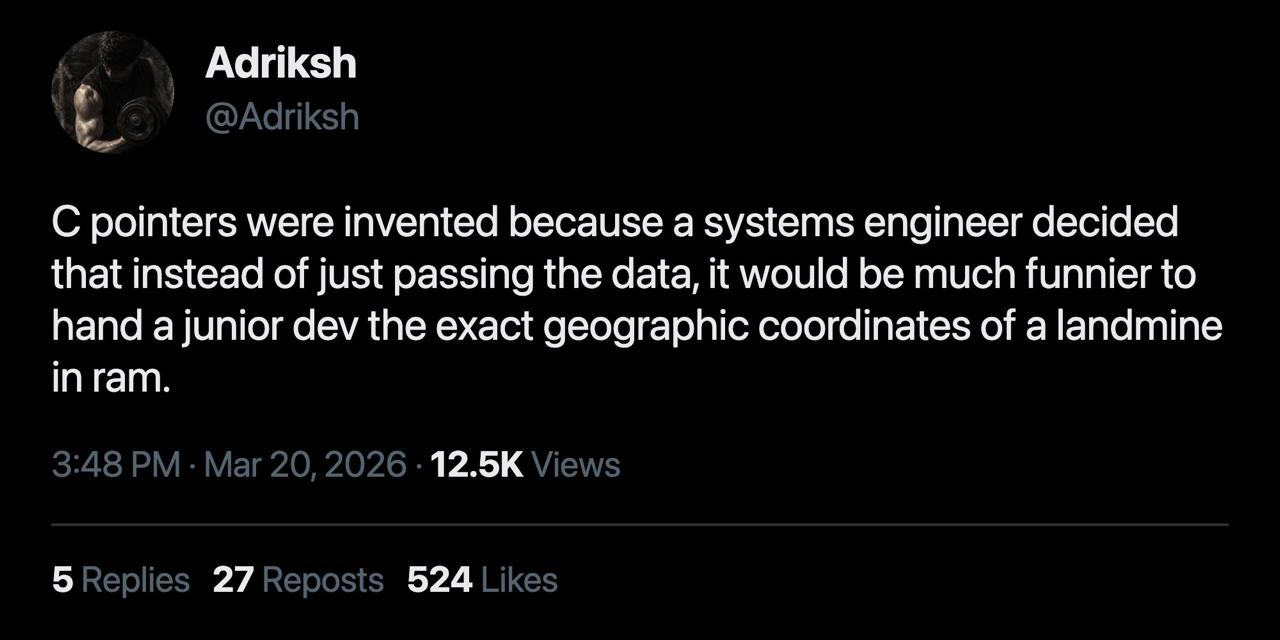
The post says:

C pointers were invented because a systems engineer decided that instead of just passing the data, it would be much funnier to hand a junior dev the exact geographic coordinates of a landmine in ram.

That "coordinates" metaphor is painfully precise. A C pointer is not the data itself; it is a value that identifies where an object may be accessed. On real machines that often corresponds to an address in a process's virtual address space, translated by hardware and the operating system into physical memory. But in the C abstract machine, a pointer is more than a number: it is tied to object lifetime, type, alignment, and provenance. Treating it as "just an integer address" is how the landmine acquires a pressure plate.

The reason this becomes dangerous is undefined behavior. C gives systems programmers close control over memory because operating systems, embedded firmware, runtimes, kernels, drivers, allocators, and performance-sensitive libraries need it. The trade-off is that the language assumes the programmer obeys rules the compiler can exploit aggressively. Dereference a pointer after free, step outside the bounds of an object, violate strict aliasing, or use a misaligned pointer, and the compiler is no longer required to preserve your intuition. It may crash, appear to work, corrupt unrelated state, or optimize your bug into a shape that looks like a crime scene.

int *p = malloc(sizeof *p);
*p = 7;
free(p);

*p = 42; // use-after-free: the address may still exist, but the object does not

The hardware layer adds another joke. Modern processes live in virtual memory, so a pointer can be a valid-looking bit pattern that maps to nothing accessible, maps to memory with the wrong permissions, or maps to memory that has been reallocated for a completely different object. A segmentation fault is the lucky version of this story: the operating system catches you stepping on forbidden ground. The unlucky version is silent memory corruption, where the program continues long enough to make debugging feel like interrogating a dream.

Description

A dark-mode social media screenshot shows a post by Adriksh (@Adriksh) with the text: "C pointers were invented because a systems engineer decided that instead of just passing the data, it would be much funnier to hand a junior dev the exact geographic coordinates of a landmine in ram." The timestamp line reads "3:48 PM · Mar 20, 2026 · 12.5K Views," and the engagement row shows "5 Replies," "27 Reposts," and "524 Likes." The joke reframes pointers as dangerous coordinates into memory rather than simple references, capturing how C exposes raw address manipulation and memory safety hazards. It is especially relatable to systems programmers who have watched pointer arithmetic, dangling references, or invalid memory access turn a tiny mistake into a crash.

Comments

26
Anonymous ★ Top Pick A pointer is just pass-by-reference with the safety rails replaced by a debugger subscription.
  1. Anonymous ★ Top Pick

    A pointer is just pass-by-reference with the safety rails replaced by a debugger subscription.

  2. @Agent1378 3w

    Funny thing is - pointers existed before simple variables

    1. @M285b 3w

      Fortran?

      1. @Agent1378 3w

        Asm of course

    2. @ZgGPuo8dZef58K6hxxGVj3Z2 3w

      Lmfao I am pretty sure registers are/were pretty much variables and thise deffo came first 😂

      1. @Agent1378 3w

        Memory addresing with register content as an adress came at same time everywhere.

      2. Егор 3w

        Saying “I am pretty sure registers are/were like variables” in an interview is a great way to be thrown out of the window.

        1. @ZgGPuo8dZef58K6hxxGVj3Z2 3w

          Not really

          1. Егор 3w

            146%

            1. @ZgGPuo8dZef58K6hxxGVj3Z2 3w

              Then they do not know the history behind naming and legacy decisions

  3. Егор 3w

    evolution of a python programmer: «missed ;» memes -> «unclosed }» memes -> «ai ran rm -rf» memes -> «i don’t understand pointers» memes

    1. @feedable 3w

      THIS

    2. @cmdrosmium 3w

      -> "man i love C" (after reading PEP 622)

    3. @yuri_kilochek 3w

      ironic, since every variable is a pointer in python

      1. @Daonifur 3w

        Everything is a pointer if you use goto in assembly

        1. @Daonifur 3w

          In fact, goto makes more sense to me than pointers

          1. @hy60koshk 3w

            These people are allowed to code. Think about it.

            1. @maks_mikh 3w

              Then LLMs are trained on that code

              1. @feedable 3w

                well this is good actually

                1. @hy60koshk 3w

                  Just have to pray that StackOverflow will outlive them basterds

        2. @feedable 3w

          bro is just saying stuff 🙂

          1. @Daonifur 3w

            Do you not know what goto does?

      2. Егор 3w

        reference is not a pointer womp womp

  4. @q_rsqrt 3w

    a pointer is a direct representation oh how memory addresses work, it's literally the address plus the type, it's not like some kind of a weird abstraction that was "invented", like, who the fuck makes and likes these memes?

    1. @sysoevyarik 3w

      I guess it's same people who think that "0.1 + 0.2 != 0.3" is js quirk

  5. @GioMetal 2w

    Bro, dereferencing and referencing are INSTRUCTIONS, so pointers is not a C thing.. it is how computer memory works.

Use J and K for navigation