Skip to content
DevMeme
7315 of 7435
Vibe Coder New Hire Proudly Admits Ignorance of If Statements
AI ML Post #8018, on May 22, 2026 in TG

Vibe Coder New Hire Proudly Admits Ignorance of If Statements

Why is this AI ML meme funny?

Level 1: The Cook Who Can't Read a Recipe

Imagine a restaurant hires a new chef who proudly announces he doesn't know what an oven is — he just shouts food orders into a magic box and serves whatever comes out. Standing next to him is the chef who spent ten years learning to cook, holding the same paycheck and a very tired expression. The joke is that one person worked hard to understand their craft, the other skipped all of it and got the same job anyway — and he's not even embarrassed. He's bragging. It's funny because it's unfair in a way everyone recognizes, and a little scary because the magic box doesn't always get the order right.

Level 2: The Building Block You Skipped

An if statement is conditional branching — the most basic decision-making construct in virtually every programming language:

if (userIsLoggedIn) {
  showDashboard();
} else {
  redirectToLogin();
}

It's typically taught in the first hour of any programming course, before loops, before functions. Not knowing what one is, while employed as a developer, is roughly equivalent to a hired translator not knowing what a verb is.

Vibe coding is a term (popularized in the LLM era) for building software by prompting an AI — "make a login page," "fix this error" — and accepting the output without reading or fully understanding the code. It can genuinely produce working prototypes fast, which is why people get hired off the back of vibe-coded portfolios. The trouble starts at the moments the meme's "Dev" lives for: a production bug, a code review question, an interview deep-dive — any situation where the human, not the model, has to explain why the code does what it does.

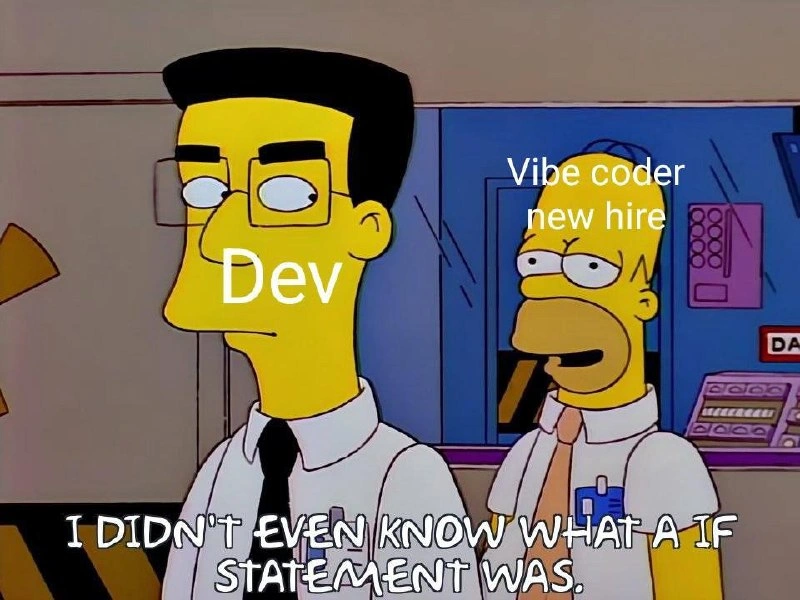
The labeling follows the standard two-character meme format: the foreground figure (serious, bespectacled, tie) represents the traditionally trained engineer; the background figure (relaxed, slightly smug) represents the newcomer who skipped the hard parts. If you're early in your career, the takeaway isn't "don't use AI" — it's that the fundamentals are what let you supervise the AI instead of the other way around.

Level 3: Grimes Was Right All Along

The genius of casting Frank Grimes as "Dev" and Homer Simpson as "Vibe coder new hire" is that the original episode this frame comes from is already a perfect parable about competence and reward being completely decoupled. Grimes did everything by the book — earned his credentials, worked himself raw — and watched a cheerful idiot fail upward into the same job. Swap "nuclear safety inspector" for "software engineer" and the satire ports over without modification, which should worry everyone.

The caption — "I DIDN'T EVEN KNOW WHAT A IF STATEMENT WAS." — lands because it's delivered as a boast, not a confession. That's the cultural shift being skewered. Vibe coding — describing what you want to an LLM and shipping whatever comes back — has produced a cohort of new hires for whom ignorance of fundamentals isn't a gap to close; it's a badge of efficiency. Why learn control flow when the autocomplete oracle handles it? The grammatical error in the caption ("a if statement") is doing quiet, devastating work here: the speaker is so unfamiliar with the concept that even the article in front of it comes out wrong.

The deeper anxiety, the one that makes seasoned developers stare at this meme a beat too long, is economic. Grimes-as-Dev spent years internalizing CS fundamentals — branching logic, invariants, the mental model of how a machine actually executes a program. Homer-as-new-hire arrived at the same desk, same badge, same standup, without any of it. The industry's incentive structure has never rewarded understanding directly; it rewards shipped features, and AI coding assistants have made it possible to ship features while understanding nothing. This works right up until the generated code does something subtly wrong — and the person who deployed it cannot debug what they cannot read. That's when the on-call rotation discovers that the bus factor for the new microservice is effectively zero, because not even its author knows how it works.

And per the source material, remember how the Grimes arc ends: the diligent professional has a breakdown while imitating his oblivious colleague, and Homer keeps the job. The meme doesn't need to show that part. Everyone in the comments already knows.

Description

A meme using a classic Simpsons scene featuring Frank Grimes and Homer Simpson standing side by side in a power plant office. Grimes, a serious bespectacled man in a white shirt and black tie, is labeled 'Dev' in white text, while Homer behind him is labeled 'Vibe coder new hire'. The caption at the bottom in Simpsons-style font reads 'I DIDN'T EVEN KNOW WHAT A IF STATEMENT WAS.' The meme satirizes the rise of AI-assisted 'vibe coding', where newcomers ship code via LLM prompts without understanding fundamental programming constructs, evoking the Grimes-vs-Homer dynamic of the diligent professional resenting the oblivious yet somehow employed colleague

Comments

1
Anonymous ★ Top Pick Grimes spent 15 years mastering control flow; Homer just prompts 'make it work' - and only one of them survives the next reorg, and it's not the one who knows what an if statement is
  1. Anonymous ★ Top Pick

    Grimes spent 15 years mastering control flow; Homer just prompts 'make it work' - and only one of them survives the next reorg, and it's not the one who knows what an if statement is

Use J and K for navigation