Skip to content
DevMeme
1231 of 7435
The Hierarchy of Terrible Data Security
Security Post #1375, on Apr 24, 2020 in TG

The Hierarchy of Terrible Data Security

Why is this Security meme funny?

Level 1: You Guys Had Secret Codes?

Imagine four friends are passing secret notes in class, and each has a different way of hiding the message. The first friend writes his note in a super tough secret code that only he and one other person know (like a special language – this is the really good lock 🔒). The second friend uses a simpler code: she shifts each letter a bit – so A becomes N, B becomes O, etc. It looks gibberish at first, but honestly, anyone who figures out the trick can read it (it’s like a little puzzle 🧩). The third friend doesn’t really use a true code at all – she just rewrites her note in a funny alphabet that’s public. It looks like nonsense, but if you know that alphabet, you can read it easily (so, not a real lock, just a disguise 😅). The fourth friend? He just writes his note in plain English with no secret at all. Now picture that fourth friend’s face when he finds out the others all had some kind of secret code for their notes: eyes wide, jaw dropping, saying, “Wait, you guys were hiding your messages? You all used secret codes and nobody told me?!” He feels totally left out and exposed. That’s the joke of the meme: everyone else had at least something to protect their secret, and the poor last guy had no idea and left his message out in the open. It’s funny and a little silly – like discovering you’re the only one who didn’t get a lock for your diary when all your siblings did.

Level 2: Wait, Base64 Isn't Encryption?!

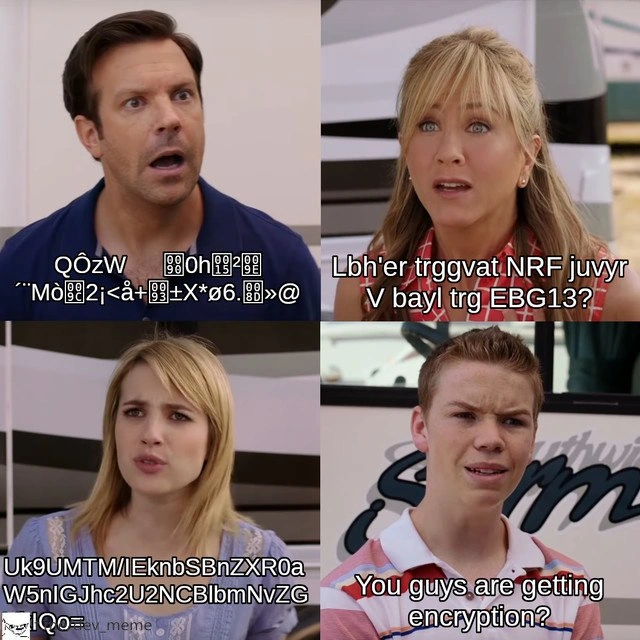
Let’s break down the joke for those newer to these terms, because the meme is basically a crash course in Encryption vs. Encoding vs. Plain text. In tech, when we say something is encrypted, we mean it’s been locked up with a secret key, so that only someone with the right key can unlock (decrypt) it. The gibberish in the first panel is an example of real encryption. Specifically, that looks like output from AES, a strong encryption algorithm. AES takes your data (plaintext) and a secret key, and churns out an unreadable jumble of characters (ciphertext). If you don’t have the key, that jumble is supposed to be practically impossible to turn back into the original message. Think of AES like a super secure safe: you lock your message in it using a combination code (the key), and without that code, nobody’s getting your message out. This is what we ideally use to protect sensitive data – everything from credit card numbers to passwords (actually passwords are usually hashed, but that’s another story) to confidential messages can be AES-encrypted so that they stay private. The top-left guy in the meme basically speaks fluent AES ciphertext – and to anyone without the secret, it’s complete nonsense.

Now, ROT13 looks like nonsense at first glance too, but it’s a very different beast. ROT13 stands for “Rotate by 13.” It’s a simple letter substitution cipher that shifts each letter 13 places down the alphabet. So A becomes N, B becomes O, C becomes P, and so on… and likewise N becomes A, O becomes B, etc. Because 13 is half of 26, doing it twice brings you back. Essentially, ROT13 is its own undo. If you see a message that looks like “Guvf vf n frperg zrffntr,” you might guess it’s ROT13 because it’s all letters and kind of gibberish. Decoding it by shifting letters 13 back would reveal it says “This is a secret message.” In the meme, the woman’s text “Lbh'er trgvat NRF jvyr V bayl trg EBG13?” is actually ROT13-encoded English. If we apply a ROT13 decoder to that, it reads: “You’re getting AES while I only get ROT13?”. So she’s complaining that someone else got to use real encryption (AES), while she’s stuck with this flimsy letter rotation. For a newcomer: ROT13 is not secure. It’s basically like a child’s secret decoder ring. Fun to play with? Sure. But anyone who knows the trick can reverse it in an instant. In fact, many programming languages or websites have a built-in ROT13 tool because it’s used for puzzles or hiding spoilers (like posting a movie spoiler in ROT13 so only people who deliberately decode it will see it). If you ever encounter a mix of letters that looks like it might be gibberish English, try ROT13 – you might unveil a not-so-secret message!

Next up, Base64. This one is a bit different because it’s actually not meant for secrecy at all. Base64 is an encoding scheme. The goal of Base64 is to take binary data (like raw bytes, which might include non-printable values) and encode it into plain text characters that are readable and safe to transmit in text-based systems. It uses letters (both uppercase A-Z and lowercase a-z), digits 0-9, and two symbols + and / to represent data, six bits at a time (hence 64 possible values, since 2^6 = 64). Often you’ll see Base64 strings end in one or two = signs — those are padding characters added to make the length a multiple of 4 characters. In the meme’s bottom-left panel, the string Uk9UMTM/IEnbSBnZXR0aW5nIGJhc2U2NCBlbmNvZG lQo== is a textbook example of Base64-encoded text (you can see letters, a slash, a plus, and == at the end). Important: Base64 doesn’t use a key. It’s not “locked” — it’s just translated. Anyone who recognizes a Base64 string can decode it easily. It’s like writing a message in a foreign alphabet that many people know how to read. For instance, if I take the English word “Hello” and represent it in Morse code, that’s encoding, not encryption; anyone familiar with Morse can translate it back. Similarly, Base64 is a well-known “translation” from raw data to text. Developers often use Base64 to embed images or icons in code, or to include binary files within JSON or XML, or to send credentials in an HTTP header (the infamous “Basic auth” is just username:password encoded in Base64 — easily decoded). The woman in the meme complaining in Base64 is essentially saying, “ROT13? That’s at least a code. I got stuck with just Base64!” Her text, once decoded from Base64, comes out to a readable sentence (which the meme description tells us is her saying she’s only getting base64 encoding). So, Base64 makes things look secret (since it turns, say, Hello into SGVsbG8=), but it’s not a secret to anyone who knows how to read it. Think of it like a visual filter — the text is obscured to the naked eye, but not truly hidden, since the “filter” (the encoding scheme) is publicly known and easily reversed.

Finally, the poor kid on the bottom-right is essentially not using any protection – just plain text. When he says, “You guys are getting encryption?”, it’s the equivalent of, “Wait, I didn’t know we were allowed to have secret codes! I’ve been writing everything normally!” In tech terms, plaintext means the data is stored or transmitted as-is, with no encoding to hide it and no encryption to lock it. It’s the least secure way (or rather, not secure at all). If you send a password in plaintext over the internet and someone is eavesdropping, they can read it. If you store personal info in a database in plaintext and it gets leaked, everyone can see it immediately. So in our hierarchy of security measures, this kid is at rock bottom – nothing was done to protect his info.

To summarize the four “levels” seen in the meme in a beginner-friendly way:

  • AES Encryption (Real encryption)This is like a locked safe. You need the correct key to decipher the content. Extremely secure when used properly. The text looks completely random (lots of strange symbols or bytes) if you don’t have the key.
  • ROT13 (simple cipher)This is like a basic letter swap puzzle. It does hide the message from someone who’s just casually looking, but it’s a very easy code to crack. No key needed beyond knowing “rotate by 13”, and doing that again restores the original text.
  • Base64 EncodingThis is like writing a message in a secret alphabet that everyone knows. It’s not really a secret at all; it just looks foreign or scrambled. Anyone can translate it back with a standard method or tool. There’s no secret key.
  • Plain Text (no protection)This is like writing a message normally with no disguise. It’s plain for all to see. No effort to hide or lock it at all.

So, in the meme, each person is upset because the one before them had a “better” way to hide their info. The AES guy has a real lock, the ROT13 gal is envious because she only had a kiddie cipher, the Base64 girl is even more miffed because she just got a dress-up encoding (not a lock at all), and the last dude is shocked to learn he could have been hiding his info in the first place! The meme is basically a nerdy comparison of strong vs weak vs faux encryption, using a funny movie reference to drive the point home.

Level 3: Good, Bad & Base64

To a seasoned developer, this meme hits on a painfully familiar scenario: inconsistent and misguided security practices. It’s poking fun at the encryption hierarchy that often exists in the wild. The humor comes from juxtaposing something truly secure (AES) with something laughably weak (ROT13) and something that isn’t even encryption (Base64), as if they’re all just different flavors of “protecting data.” We immediately recognize the absurdity: it’s like comparing a bank vault to a cheap padlock to a taped-shut box. The characters’ reactions — envy and shock — mirror how developers feel upon discovering that others have much better security.

Anyone who’s worked in a large codebase or multiple teams knows this feeling. Imagine one module of an application properly encrypts sensitive information with AES, following best practices, keys stored securely — the whole nine yards. But then, another part of the system (perhaps written years ago or by a less experienced dev) is doing something like password = base64_encode(password) // "encrypt" password. 🙈 When you uncover that, it’s a facepalm moment. This meme exaggerates it for effect: one person bragging “I’ve got AES,” another grumbling “Lucky you, I’m stuck with ROT13,” and yet another saying “ROT13? I only got Base64!” By the time we get to the naive kid asking “You guys are getting encryption?”, it’s beyond parody — it’s a collective developer nightmare distilled into a punchline. We laugh, but it’s that knowing laugh of “yep, seen this before.”

The phrase “You guys are getting encryption?” has become a bit of an inside joke among devs. It’s a twist on the movie line “You guys are getting paid?”, repurposed to roast security negligence. It perfectly captures that dawning realization when someone finds out others were doing something they completely missed. In real teams, you might hear a junior developer sheepishly say, “Wait, we were supposed to encrypt that data? I had no idea!” In the meme, the kid’s bewildered face says it all: he didn’t get the memo about any security measures. It’s funny in the meme, but in real life that gap can mean major vulnerabilities.

Industry lore is full of stories where critical data was protected by what amounts to ROT13 or Base64. Seasoned engineers have encountered passwords stored in Base64 (“don’t worry, it’s encoded!”), API keys “encrypted” with a Caesar cipher (with the key hardcoded, of course), or proprietary “encryption” that’s just XOR with a single-byte key. These are not hypotheticals; they’re the kind of security fails you find during code reviews or (worse) after a breach. The meme resonates because it’s a comical summary of those experiences. The mother’s ROT13 complaint is basically the developer who implemented a known weak algorithm thinking it was at least something. The daughter’s Base64 gripe represents the dev who might not even distinguish between encoding and encrypting — “hey, it looked scrambled, so I assumed it was safe.” And the son with no encryption is the part of the system that got utterly neglected, perhaps out of ignorance or expedience. Each of these is a step down in security, and each character is jealous of the higher step they missed out on – a classic case of "encryption envy." 🔐😅

This meme also reflects organizational silos and inconsistent standards. One team might have a security expert who mandates AES encryption for everything sensitive. Another team, maybe lacking expertise or under tight deadlines, might resort to a quick obfuscation like ROT13 to “get it done.” Yet another group might not even consider security, leaving things in plain text or thinking base64 is sufficient because “at least it’s not human-readable.” These differences often only come to light when systems integrate or during a security audit. Suddenly everyone’s comparing notes: “Wait, you’ve been encrypting user data? We’ve just been encoding it!” — cue awkward silence. 🤦‍♂️ The meme’s bus scene is the perfect metaphor: they’re all on the same ride (the same company or project), but each brought a drastically different level of security to the trip. The hilarious indignation (“You get AES? I only got ROT13!”) is exactly how a dev might sarcastically react upon learning a sibling team had the luxury of proper cryptography while their team was left with a joke cipher.

Why does this keep happening in real life? Because cryptography is hard – not the algorithms per se (you don’t usually write AES from scratch; you use a library), but using it correctly. There’s key management, performance concerns, backward compatibility, regulatory hoops, etc. It’s tempting for an under-pressure developer to say, “I’ll just do something quick to hide the data” and move on. ROT13 and Base64 are quick and require no external libraries or key storage. They give the illusion of security (“look, the data isn’t in plain English anymore!”) without the heavy lifting. It’s the classic security by obscurity trap. A senior dev knows that obscuring is not the same as securing – if an attacker can figure out your trick (which in the case of ROT13 or Base64 takes all of 2 seconds), they have the data. But management or junior devs might be satisfied at first that “it looks scrambled.” Only later does everyone realize the emperor has no clothes.

The shared trauma among veteran developers is real. Many have had that “oh no” moment discovering that what was supposed to be encrypted was just base64-encoded. It’s the kind of thing that keeps security auditors up at night. We joke about it now (to keep from crying), and that’s why the meme is funny: it’s an over-the-top portrayal of a very real problem. It acknowledges the gulf between best practices and actual practices. Best practice says: Use strong, peer-reviewed encryption algorithms with proper key handling. Reality sometimes is: We used a nonsense scheme and hoped for the best. 😬

Notice also the family dynamic in the meme: it’s adapted from We’re the Millers, where none of them are actually related — they’re a fake family. That adds an extra layer to the joke: these encryption methods don’t belong together, just like the “family” in the movie was pretend. AES, ROT13, Base64, and “nothing” are a mismatched set, yet here they are in one scene. The dev community often uses this format to illustrate “one of these is not like the other” situations. By using this meme format, the creator is winking to us: we know these things don’t belong on equal footing. The more egregious the comparison, the funnier it is. AES vs ROT13 vs Base64 is basically expert vs beginner vs not even trying. It’s a tech inside-joke, and we’re all in on it.

In essence, the senior perspective sees this meme and nods knowingly. It humorously underscores the importance of doing security right. We laugh at the poor kid with plaintext because we’ve all either been that kid (early in our career) or had to fix the kid’s work later. It’s a reminder that encryption is not a checkbox feature you fake – you either do it properly or you’re not doing it at all. And if you don’t, you might end up like the kid, incredulously asking, “Wait, we were supposed to encrypt that?” as everyone else slowly shakes their head. Better to be the guy with AES than the one with Base64 when the CTO asks about data protection! 😅

Level 4: Key Length Envy

At the top of the crypto food chain, AES (Advanced Encryption Standard) is a powerhouse of modern encryption. It's a symmetric block cipher that scrambles data into seemingly random noise using a secret key. Under the hood, AES uses a rigorous substitution–permutation network: multiple rounds of mixing bytes, shifting rows, and combining columns in a Galois field (2^8) to achieve Shannon’s coveted confusion and diffusion. The result? Ciphertext that is indistinguishable from random bits. In the meme’s top-left panel, the garbled string QÔzW ██oh██? ˇMò2i<å÷┼x°6.█»@ is the kind of high-entropy output you get from proper AES encryption – pure gibberish to anyone without the key. The key itself is the crown jewel: even AES-128 (considered “entry level” by today’s standards) has an enormous keyspace of 2^128 (approximately 3.4×10^38) possible keys. To brute-force that by trying keys one by one is astronomically infeasible – there aren’t enough computers or years in the universe. AES was chosen as the U.S. encryption standard in 2001 (originating from the Rijndael algorithm) because it withstood intense cryptanalysis, exhibiting no exploitable weaknesses in its design. In short, AES offers strong encryption: without the secret key, your data stays safe. It’s no wonder the “AES guy” in the meme looks confident – he’s speaking pure ciphertext that nobody is cracking anytime soon.

Now contrast that with ROT13, sitting in the middle of this “encryption envy” hierarchy. ROT13 is basically the poster child for weak substitution ciphers. It’s a specific case of the ancient Caesar cipher (named after Julius Caesar, who used a shift of 3 to encode military messages). ROT13 simply rotates every letter 13 positions through the alphabet. In mathematical terms, for each letter, ( L ) becomes ( (L + 13) \mod 26 ). It’s so simple that ROT13 is its own inverse – apply it twice and you’re back to the original text (13 + 13 = 26 letters). Cryptographically, this is child's play: the “key” is always 13, so there’s effectively no secret key at all (or at most a tiny 5-bit key space if you considered all possible Caesar shifts). Frequency analysis – a classic cryptographic attack from as far back as the 9th century (thanks to scholar Al-Kindi) – busts any monoalphabetic cipher like this with ease. Because ROT13 just maps one letter to another, it preserves letter frequencies and structure. An attacker (or any curious coder) can break ROT13 literally in seconds, either by recognizing common patterns or by simply running the text through another ROT13 transform (since (E(\text{ROT13}(X)) = X)). The meme highlights this with the mom character speaking ROT13-encoded text: Lbh'er trgvat NRF jvyr V bayl trg EBG13?. To someone familiar, those gibberish letters are an obvious ROT13 cipher – decoding them yields, “You’re getting AES while I only get ROT13?” Her jealous gripe is transparent because ROT13 offers no real secrecy. In essence, ROT13 is obfuscation, not robust encryption. It’s often used tongue-in-cheek or to hide spoilers in forums (where readers can easily decode it if they choose), but it utterly fails by modern security standards. If AES is a steel vault, ROT13 is a luggage lock that anyone can pick with a quick twist.

Then we have Base64 – which isn’t encryption at all, but an encoding scheme. Base64 is a method to represent binary data in ASCII text, using a 64-character alphabet (A–Z, a–z, 0–9, +, and /) to encode 6 bits per character, plus = as padding. It’s designed for data transmission, not security. The woman in the bottom-left panel is showing a Base64 string: Uk9UMTM/IEnbSBnZXR0aW5nIGJhc2U2NCBlbmNvZG lQo==. This looks arcane, but Base64 is completely deterministic and reversible — by anyone. There’s no secret key; the “mapping” (e.g., A → 0x00, B → 0x01, …, + → 62, / → 63) is public knowledge. In cryptographic terms, Base64 provides zero confidentiality. It’s akin to writing a message in a known code language: once you recognize “Oh, that’s Base64,” you can decode it instantly with a standard library or an online decoder. The telltale sign is often those == or = at the end of the string (padding characters to make the data length a multiple of 3 bytes). In the meme, that Qo== at the end is a dead giveaway of Base64. If we actually decode her Base64 blob, it reveals another complaint (meta, right?): it decodes to something like “ROT13? I’m getting base64 encoding!” – meaning she’s not even dealing with encryption, just a trivial encoding. According to Kerckhoffs’s principle (the 19th-century rule that a cryptosystem should be secure even if everything about it is public, except the key), Base64 doesn’t qualify as a cryptosystem at all — there is no key. It’s purely a coding scheme to ensure safe transmission of data through text-only channels (for example, email attachments or embedding images in CSS). Anyone who intercepts a Base64 string can recover the original data without any special privilege. In terms of “key length envy,” Base64 has a key length of 0 — there’s nothing to guess. No wonder security engineers cringe when a newbie developer says they “encrypted” something in Base64! It’s like putting a letter in a fancy envelope; it might fool the casual observer, but anyone determined will just open it.

Finally, the naive young man in the bottom-right panel represents no encryption at all – plaintext. He exclaims, “You guys are getting encryption?” with genuine surprise. In all likelihood, his data isn’t protected in any way (perhaps stored in plain text or sent over the wire as-is). From an information-security perspective, this is the baseline zero: plain text offers no confidentiality. It’s readable by anyone who sees it, period. If AES is a hardcore lock, ROT13 is a toy cipher, and Base64 is a disguise, then plaintext is just leaving the message out in the open. The humor is that he didn’t even realize encryption was an option – implying some developers (or systems) don’t implement any protection while others do. This stark hierarchy of protection — from strong encryption down to none — is the crux of the meme’s joke. We’re looking at four “levels” of securing data: a proper cipher, a trivial cipher, a reversible encoding, and plain data. The technical irony is rich: lumping AES, ROT13, and Base64 together is absurd from a security standpoint, yet in the wild you might actually find all three used inconsistently across different parts of a codebase. The meme cleverly dramatizes that disparity. In essence, it’s a nerdy reminder that not all gibberish text is equally secure — and if you’re the one still in plaintext, you’re in for a shock!

Description

A four-panel meme using the 'We're the Millers' format to satirize different levels of inadequate data protection. The first three panels show characters with captions in various forms of obfuscated text, while the fourth delivers the punchline. The first panel shows garbled text with random symbols, representing character encoding errors (Mojibake). The second panel's text is in ROT13, a simple substitution cipher, which decodes to 'You're getting AES while I only get ROT13?'. The third panel's text is Base64, which decodes to 'ROT13- I'm getting base64 encoding. !'. The final panel shows the character Kenny looking bewildered, with the caption, 'You guys are getting encryption?'. The joke contrasts different, and mostly ineffective, methods of hiding data - from data corruption to a trivial cipher to a non-security encoding - with the punchline revealing the grim reality of many systems: having no security at all. It's a relatable scenario for senior developers who've seen security theater and legacy systems that store sensitive data in plaintext

Comments

5
Anonymous ★ Top Pick Arguing about ROT13 vs. Base64 for security is like debating whether to use a screen door or a beaded curtain on a bank vault. Meanwhile, the legacy system guy in the back is shocked you even have a vault
  1. Anonymous ★ Top Pick

    Arguing about ROT13 vs. Base64 for security is like debating whether to use a screen door or a beaded curtain on a bank vault. Meanwhile, the legacy system guy in the back is shocked you even have a vault

  2. Anonymous

    Real-world crypto hierarchy: infra team uses AES-GCM in KMS, the legacy service still ROT13s passwords into varchar(255), and the frontend just Base64s it into localStorage - yet the CISO’s slide still says “End-to-End Encrypted.”

  3. Anonymous

    ROT13: the 'encryption' where key management is just remembering to apply it twice - perfect for enterprise compliance audits

  4. Anonymous

    AES, ROT13, Base64 - the org’s crypto strategy: one actual cipher, one museum piece, and one string transport, all proudly filed under “encryption at rest.”

  5. Anonymous

    Our policy says AES-256 with KMS and envelope encryption; the repo says b64encode(rot13(payload)) - apparently key rotation is just renaming the function

Use J and K for navigation