Skip to content
DevMeme
6344 of 7435
When Internal Debug Messages Go Public
Debugging Troubleshooting Post #6957, on Jul 17, 2025 in TG

When Internal Debug Messages Go Public

Why is this Debugging Troubleshooting meme funny?

Level 1: Call Bob to Fix It

Imagine you’re playing your favorite video game, and all of a sudden it freezes and crashes. Instead of showing a useful error or letting you restart, a little box pops up on the screen that says: “Oops, the game broke. Please call Alex to fix it.” You’d probably blink and think, “Who on earth is Alex?!” It’s as if your game expects you to personally know the one specific person who can repair it. You can’t fix the game yourself, and the message isn’t giving you any normal solution like restarting or checking online help. It literally tells you to go find Alex. You’d be frustrated and also find it a bit silly. Maybe you’d even go on social media and post, “Hey, my game says I should call Alex. Does anybody know Alex?” hoping someone can help you out.

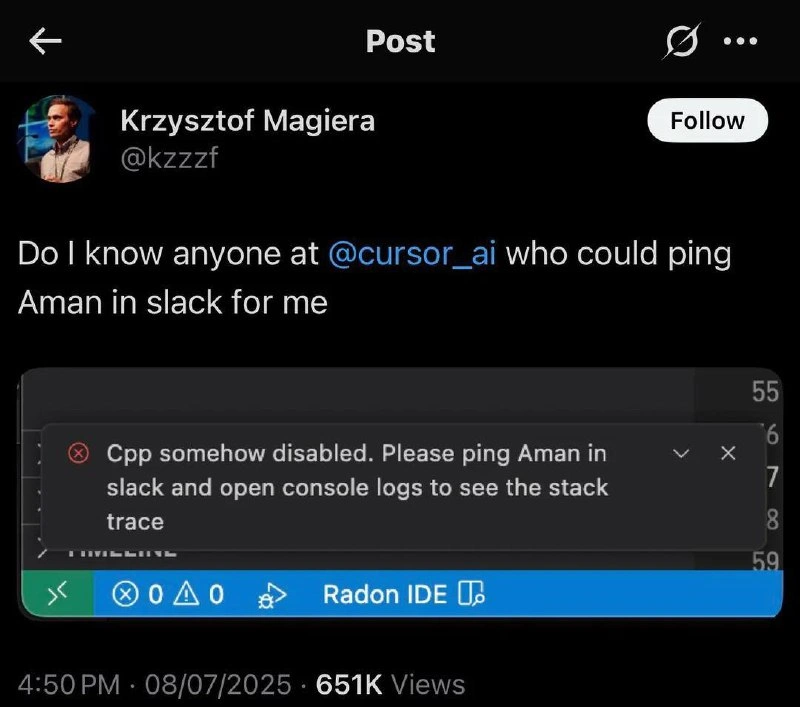
That’s exactly what’s happening in this meme, but with a coding program instead of a game. The program broke, and it told the developer to ping Aman on Slack (which is like saying “send a message to Aman in the work chat”). The developer doesn’t know who Aman is or how to message him, so he jokingly asked on Twitter if someone can do it for him. It’s funny because software usually shouldn’t rely on you having to contact a specific person to fix a problem – it’s like a car that, when it stops working, flashes a note saying “please find Mike to repair me.” It shows how sometimes technology can fail in ridiculous ways, and all you can do is laugh and try to find help from whoever might know this mysterious “Aman” (or Alex, or Mike). The humor is in the sheer absurdity: the tool that’s supposed to help you ended up sending you on a wild goose chase to find a human hero to save the day.

Level 2: When an Error Needs a Human

Let’s break down what’s happening in simpler terms. We have an IDE (Integrated Development Environment) called Radon IDE, which is like a programmer’s workshop app for writing code. In this IDE, something went wrong with the C++ language support – C++ (pronounced "see plus plus") is a programming language, and the error says it’s “disabled.” That’s a big problem because if C++ is disabled, any features or code related to C++ might not work at all. It’s as if the tool’s C++ engine just stopped or crashed.

Now, normally, an error message from an IDE would give you a clue how to fix it or at least a proper warning. But this one is pretty unique: it literally says “Please ping Aman in Slack and open console logs to see the stack trace.” Let’s unpack that: Slack is a workplace chat app (imagine a professional version of group chat where your team talks every day). To “ping” someone on Slack means to send them a direct message or alert – basically saying “hey, I need you.” So the error is telling the user to go message a person named Aman on this company’s Slack. In other words, go ask Aman for help. This is highly unusual, because most software errors don’t assume you personally know the developers! It’s like Microsoft Word telling you “Please ping Bill in Slack, he’ll know why your document won’t print.” It sounds more like an internal company joke or a placeholder note than something users are meant to see.

The message also says “open console logs to see the stack trace.” A stack trace is a technical term for a report that shows the sequence of steps the software took right before it crashed or hit an error – essentially a nerdy breadcrumb trail leading to the problem. Usually, developers look at stack traces to debug issues. So the IDE is saying: “I can’t handle this automatically; check the logs for details and get Aman on the case.” It suggests that maybe this IDE has a console (a log window) where detail about the error is written, but the user still might need help interpreting it – hence, call Aman.

For a less experienced developer or someone new to these tools, this is a head-scratcher. Who is Aman? Why Slack? If you’re just trying to code, being told to message some Aman on Slack is confusing. You might wonder, “Is Aman a support bot? Or an actual person at the company? Do I even have access to their Slack workspace?” Most likely, Aman is a specific engineer or team member at Cursor (the company behind Radon IDE). This error was probably not meant to show up for end-users; it feels like something left in during testing. Perhaps Aman is the one who wrote or maintains the C++ part of the IDE, and during development they added that message for internal folks: if C++ feature breaks, get Aman to fix it. It’s a very personal touch for an error message – definitely not standard practice! Usually, you’d expect something like “C++ module failed to load. Please restart the IDE or contact support.” Naming a person and a communication channel (Slack) is more like how one teammate would tell another teammate to handle an issue, not how software talks to a customer.

Now, the funny part is how the developer reacted. He took a screenshot of the error and posted a tweet that basically says, “Do I know anyone at @cursor_ai who could ping Aman in Slack for me?” This means the developer himself couldn’t directly message Aman (since he’s not in the same Slack workspace, presumably), so he’s asking on Twitter if someone in his network can reach out internally. This is a tongue-in-cheek way to escalate the issue. In the software world, there’s an inside joke that sometimes the fastest way to get a tech company’s attention for a bug is to call them out on Twitter or other social media. Companies often monitor their Twitter mentions (@cursor_ai is the company’s Twitter handle here), and nobody likes a bad PR moment. By tweeting this, he’s both genuinely asking for help and also poking fun at how ridiculous it is that an error message told him to do that. It’s a bit like saying, “Hey guys, your app told me to message Aman on Slack – obviously I can’t, so maybe someone over there can handle this?” And because it’s public, it puts a little gentle pressure on the company to respond.

For junior devs or anyone new: imagine you’re coding and your tool breaks. Instead of giving you a solution, it tells you to contact a specific person you don’t know. You’d be pretty stuck, right? You might search Google or documentation, but here the “solution” is locked behind knowing someone internally. The tweet is the developer’s clever workaround: he basically asked the whole world, “Does anyone have a friend at this company?” It’s both funny and relatable because early in your career you might not have direct lines to the tool developers, and you rely on community help or official support channels. Seeing a message like this would definitely be confusing if you’re not used to how scrappy internal tools can be. It highlights a big DeveloperPainPoints: sometimes tools fail in ways that you can’t fix on your own, and you have to reach out for help. In this case, the “reach out” was literally baked into the error message (Slack Aman!).

So in summary for Level 2: The meme is showing a weird error from an IDE that basically says “go get a particular person to help.” It’s funny to developers because it’s so informal and not something you expect a polished software to say. It reveals a bit of how the sausage is made – maybe the product is in beta or internal, and they forgot to change that message. It’s a mix of Debugging_Troubleshooting gone wrong and some poor developer (Aman) being the go-to fixer for a critical problem. And the author of the meme turned it into a public joke on Twitter to get assistance, which many devs found hilarious because it’s both absurd and a tiny bit embarrassing for the toolmaker.

Level 3: Bus Factor = 1

At first glance, this meme is a facepalm cocktail of Bugs, bizarre ErrorMessages, and on-call nightmares. In the screenshot, an IDE (the Radon IDE from Cursor AI) throws a show-stopper error:

❌ Cpp somehow disabled. Please ping Aman in Slack and open console logs to see the stack trace.

This is not your usual "null pointer exception" or missing semicolon. It’s an unexpected_ui_copy that basically hard-codes the support playbook into the error message. The IDE calmly says “C++ support is borked, so go bother Aman on Slack for the fix.” This implies the bus factor here is exactly one person: Aman. If Aman’s not around, tough luck – C++ functionality’s disabled and the tool has no plan B. This is a darkly funny example of a DeveloperExperience_DX fail. Instead of a robust recovery or at least an error code, the system punts the problem to a specific human being. It’s like the IDE’s entire C++ module was held together by one engineer’s know-how, and they literally wrote “Ping me if it breaks” into the code.

For seasoned devs, this scenario hits a nerve. It exposes an InsideJokes-worthy truth about some internal tools: critical features tied to a single dev’s intervention. In production-grade software, an error might suggest restarting a service or contacting a support team; here we get a first-name basis support_escalation_via_social. The meme’s author, Krzysztof, doesn’t have direct Slack access to Aman (obviously, since Aman is presumably an internal Cursor AI dev). So what does he do? He escalates hilariously via Twitter: asking if anyone knows someone at @cursor_ai who can poke Aman on Slack. In other words, the official “resolution” per the error is so absurd that the dev resorts to a public tweet with 651K views – basically turning a private debugging session into a globally witnessed tech farce.

This resonates with veteran engineers because it combines multiple familiar DeveloperPainPoints: a BugsInSoftware that halts your work, a cryptic message that gives you zero DIY options, and an external dependency that shouldn’t be there. It’s a reminder of every time a fragile system coughed up “Contact Bob, the one guy who knows this,” during a critical deploy. The humor comes from how nakedly the error admits defeat: no automated crash report, no fallback, just “please disturb Aman on chat.” We’ve all dealt with flaky build tools or CI pipelines where the unwritten rule is “if it fails, ping the guru.” Here that unwritten rule became written – right in the UI! It’s a DebuggingFrustration nightmare dressed as a polite instruction.

From a senior perspective, the meme highlights poor DeveloperExperience_DX design and the human side of DevOps gone wrong. It satirizes the idea of incident response via Slack DMs rather than proper monitoring. Think about it: they effectively replaced what should be an automated alert or user-facing solution with a manual step: Slack one specific dude. It’s both hilarious and horrifying. No wonder so many devs liked and shared this tweet – it’s cathartic to laugh at a scenario that exaggerates our worst-case support single point of failure. After all, nothing screams “startup codebase” like shipping an error message that might as well say “Our bad, we didn’t handle this – find Aman, he’ll know what to do.”

// Hypothetical snippet from Radon IDE's codebase:
if (cppEngine.status == DISABLED) {
    // Emergency fallback: escalate to Aman on Slack
    showError("Cpp somehow disabled. Please ping Aman in Slack and open console logs to see the stack trace");
    logDebug("C++ module crashed! Forward to Aman. Stack trace available in console.");
    // TODO: Replace with proper error recovery before public release
}

The code above (imaginary, but not hard to believe) is basically what the IDE is doing. Instead of handling the error internally, it bails out with a message that sounds like a panicked dev’s note-to-self. The comment // TODO: Replace... before public release is the kicker – looks like that TODO never happened. The result? An inside joke escaped into the wild. DeveloperHumor at its finest: we’re laughing because this is one of those “it shouldn’t happen, but it did” moments in software development. In summary, Level 3 sees this meme as a commentary on fragile tooling and the absurdities of real-world debugging. It’s a reminder that behind slick UIs, sometimes there’s just a tired engineer named Aman holding things together with duct tape and Slack notifications.

Description

A screenshot of a post from user Krzysztof Magiera (@kzzzf) on a social media platform resembling Twitter/X. The post reads, 'Do I know anyone at @cursor_ai who could ping Aman in slack for me'. Attached to the post is a screenshot of an IDE, seemingly called 'Radon IDE', displaying a critical error message in a dark-themed pop-up. The error states, 'Cpp somehow disabled. Please ping Aman in slack and open console logs to see the stack trace'. The humor arises from a classic developer mishap: an internal-facing debug or error message, specifically meant for the development team ('ping Aman in slack'), has accidentally been shipped in a public-facing product. The user is left with an instruction they cannot possibly follow, forcing them to resort to a public plea on social media to find someone who can relay the message internally. It's a highly relatable scenario that highlights the fallibility of development processes and the funny consequences of leaky abstractions
Comments

8
Anonymous ★ Top Pick Error handling level: 'delegate to the nearest available employee via public broadcast'. It's a bold strategy for incident response
  1. Anonymous ★ Top Pick

    Error handling level: 'delegate to the nearest available employee via public broadcast'. It's a bold strategy for incident response

  2. Anonymous

    Slack-driven development: when your exception handler is literally `throw Notify(“Aman”)`

  3. Anonymous

    Nothing says 'enterprise-ready tooling' quite like an IDE that handles C++ failures by asking you to personally DM someone on Slack - it's like discovering your production monitoring system is just Dave checking his email twice a day

  4. Anonymous

    When your IDE's error handling strategy is 'escalate to Slack and hope Aman is online' - a perfect example of distributed systems where the critical path runs through one person's DMs. At least the error message is honest about the dependency chain: C++ → Aman → Slack → Stack Trace. This is what happens when your bus factor is literally one guy named Aman, and your disaster recovery plan is 'tweet about it and hope someone knows him.' The real bug isn't in the code - it's in the org chart

  5. Anonymous

    We’ve replaced observability with Aman-as-a-Service - C++ disabled, please ping the singleton; RTO now depends on his Slack availability

  6. Anonymous

    When your AI IDE's C++ error delegates to Slack ops - because true concurrency needs humans

  7. Anonymous

    Nothing says mature DX like catch (Exception e) { Slack.ping('Aman'); } - observability by bus factor

  8. @SamsonovAnton 11mo

    https://t.me/dev_meme/6955

Use J and K for navigation