The AI Talent Wars' Two-Week Round Trip
Why is this Career HR meme funny?
Level 1: Bounced Right Back
Imagine one of your friends switched over to a new soccer team because that team really wanted them, but then, after playing just one game, they came straight back to your team. You’d all be surprised, right? You might laugh and say, “Wow, that was quick!” This meme is funny for the same kind of reason. Two people left their company to join a new one, but so soon after, they returned to their old company as if nothing happened. It’s like they tried going to a new playground across the street, then decided almost immediately that they’d rather be back on the original playground with their old friends. Everyone watching went 😳 because it happened so fast! The joke compares this quick come-and-back move to pressing an undo button. In the end, things went back to how they were before, and it just makes us smile because of how rapid and unexpected that bounce back was.
Level 2: Talent Tug-of-War
Let’s break down what happened in simpler terms. Anthropic is an artificial intelligence company (focused on advanced AI, like a rival to OpenAI) and Anysphere is a smaller startup that created a product called Cursor (an AI tool to help programmers write code). Two important leaders who worked on Anthropic’s coding AI project decided to leave Anthropic and join Anysphere’s team to work on Cursor. This kind of move – jumping to a rival company – is often called talent poaching when a company actively recruits people from a competitor. It’s like a tug-of-war for skilled people: each company pulls to have the best team.
Now here’s the twist: after only about two weeks, those two leaders quit the new startup and went back to their old jobs at Anthropic. In software development, teams often work in sprints, which are short periods (usually two weeks) to plan and deliver work. So when the meme says “two sprints,” it’s roughly two iterations – basically the same as two weeks in this context. That’s an insanely short time to be at a new job! They probably hadn’t even finished onboarding or set up their company laptop before returning to their previous employer. This quick return is sometimes jokingly called an employee boomerang – when someone leaves a company and then comes right back. Boomerangs happen, but doing it in two weeks is almost unheard of and is what makes this situation humorous.
The meme caption frames this in engineering terms: “distributed hiring rolls back to its original node.” Let’s decode that. In computing, a distributed system is when work is spread across multiple computers (nodes). If something goes wrong, a system might roll back changes to a previous state. So, metaphorically, “distributed hiring” imagines the hiring process like a distributed system where multiple companies are nodes in a network. The two leaders leaving Anthropic to join Anysphere is like information moving to a new node. But then “rolling back to the original node” means undoing that move – the two people returned to their original place, Anthropic, almost as if nothing had changed. It’s saying the hiring change was reverted, just like you’d undo a mistake in code. The fact it happened “in two sprints” just highlights how fast it was – basically the change was undone almost immediately.
This reflects what’s happening in the AI industry right now. There’s a lot of hype (excitement and buzz) around AI, especially tools that can write code (often called coding AI platforms). Many startups and big companies are racing to build the best AI coding assistant (think of things like GitHub Copilot or ChatGPT’s little cousin that can help you program). Because this field is so competitive, there’s a war for talent – companies fight over the limited number of people who have the experience to build these advanced tools. Hiring practices can get extreme: one company might offer huge salaries, big bonuses, or fancy job titles to lure someone over. That’s what we suspect happened here: Anysphere managed to hire those two leaders away from Anthropic. But then Anthropic likely made a counter-offer or changes to lure them right back. Maybe they gave them an even better deal or the leaders realized very quickly that they preferred Anthropic’s mission or team.
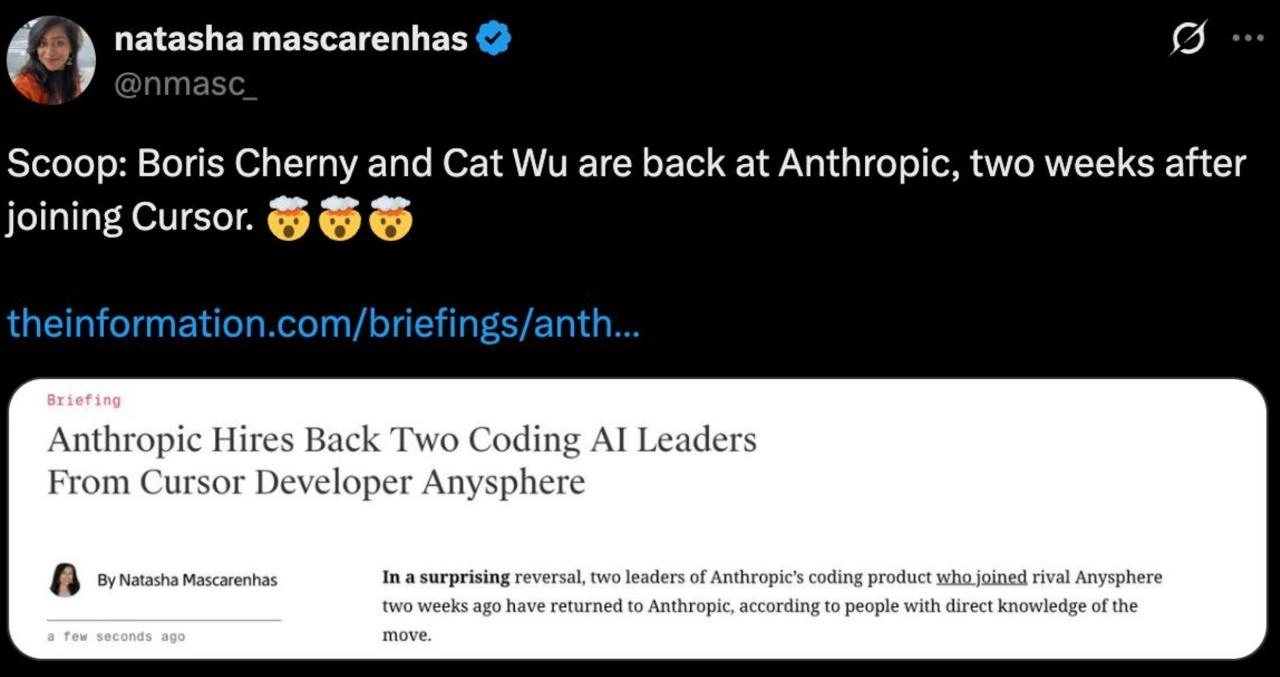
For a junior developer or someone early in their career, this kind of ultra-fast job change is startling. Usually, people stay at a job for at least a year or two, if not longer. Changing jobs involves interviews, paperwork, getting to know a new team – it’s a big decision. So seeing folks do a full round trip in two weeks is almost cartoonish. The tweet in the meme even includes three wide-eyed 😳😳😳 emojis to express shock. It’s basically the journalist (Natasha Mascarenhas) saying “I can’t believe this happened!” and sharing the scoop (exclusive news) that these two well-known AI engineering leaders are back at Anthropic just days after joining a competitor. The linked article title “Anthropic Hires Back Two Coding AI Leaders From Cursor Developer Anysphere” spells it out: Anthropic took back two key people who had briefly been at a rival startup (Anysphere).
So why is this funny to developers? Partly because it uses a tech analogy (distributed systems and rollback) to describe a HR situation, which is a clever play on words. Also, it highlights how crazy the competition in tech has become – almost like a soap opera for those of us in the field. It’s career humor mixed with tech humor. The idea of someone reporting to a new job and then boomeranging right back to their old job in the span of a single pay period makes us both laugh and shake our heads. It’s a real-life example of how unpredictable careers in the TechIndustry can be, especially in hot areas like AI. If you’re new to this field, don’t worry – this isn’t a normal thing to happen! It’s an extreme case, which is why everyone is talking and joking about it.
Level 3: Boomerang Talent Wars
From a senior engineer’s perspective, this tweet hits on the absurd speed of the modern AI talent wars. Two high-profile leaders left Anthropic to join a rival startup (Anysphere’s Cursor platform) and then came back to Anthropic in only two weeks. That’s essentially one or two sprints – barely enough time to adjust your office chair at the new company! The humor comes from the whiplash of it all. In startup culture, we talk about being agile, but this is ridiculous: these folks switched jobs and switched back before anyone could even remove them from the old team’s Slack channel. It’s a boomerang move in record time. Senior devs chuckle because we’ve all seen weird job-hopping, but a round-trip in 14 days is next-level CareerHumor.
This reflects how aggressive talent poaching and retention have become in the AI/ML startup world. Companies like Anthropic and up-and-comers like Anysphere (maker of the Cursor coding AI) are in an arms race for top coding AI experts. It’s the coding-assistant arms race in full swing. One week Company A is bragging about hiring two star engineers away from Company B; the next week Company B has wooed them right back. For seasoned engineers, this feels like watching a crazy bidding war or a high-stakes game of ping-pong with human careers. The meme’s title nails it: “distributed hiring” implies talent being spread across competing startup “nodes,” and when it “rolls back to its original node,” it means those hires reverted to their old team. It’s as if Anthropic issued a hotfix to their hiring practices to undo a regrettable loss – perhaps by offering a big counter-offer or a shiny new title – and succeeded within two iterations of development.
We find it funny because it’s TechIndustryHumor that rings true: the situation highlights both AI hype and the chaos of StartupCulture. In the world of generative AI startups, valuations and egos are soaring, and top engineers or researchers are treated like free agents in professional sports. A rival company might swoop in with promises of huge stock options or the excitement of building the next big coding AI platform, effectively “stealing” key people overnight (classic poaching). But here we see the unusual inverse: Anthropic managed to boomerang their people back almost immediately. That’s a blink-and-you’ll-miss-it reversal. Senior folks joke that it’s like deploying a new microservice version and rolling it back almost instantly because production wasn’t ready for that change. The eventual_consistency_irl tag attached to this meme even winks at how the whole saga is like a real-life eventually consistent system: after some turbulence, things settled back to the old normal.
There’s also an undercurrent of “Seriously? Two weeks?!” that experienced engineers might express with some sarcasm. Onboarding usually takes longer than that! By the time these leaders would have set up their dev environment or learned where the restroom is at the new office, they were already packing up to return. Imagine being a team member at Anysphere: you get introduced to your high-profile new colleagues, and before the next sprint planning, they’re gone, back to their previous “original node.” It highlights a bit of Career_HR absurdity – normally, changing jobs is a big deal, but during an AIIndustryTrends gold rush, it can become a revolving door. For veterans, it also raises an eyebrow: was this about a massive counteroffer? Regret upon seeing the new codebase? Perhaps a non-compete clause scare? The meme doesn’t say, but those are exactly the kind of juicy behind-the-scenes shenanigans we suspect in a startup rivalry.
In essence, the meme captures a perfect storm of AIHype and human nature. It’s poking fun at the industry’s hyper-competitive hiring practices. Everyone claims to want stability and team culture, yet here we are with near-instant talent churn. The phrase “two sprints” especially tickles engineers – in agile development a sprint is often two weeks long, so two sprints is basically the time between planning a feature and doing a quick retro. These two made a round-trip career move in the time many of us resolve a single Jira ticket! It’s both impressive and comedic, highlighting how reality in hyper-growth tech can sometimes parody a meme. Senior engineers laugh (perhaps a bit ruefully) because we recognize the underlying truth: in hot tech sectors, employees can become like well-funded distributed systems data – always in flux, eventually (hopefully) consistent, and subject to sudden rollbacks.
Level 4: Eventually Consistent Org Chart
At the deepest technical level, this scenario feels like a distributed system achieving eventual consistency with its personnel. In distributed computing, eventual consistency means that after a series of updates and possible delays, all nodes (servers) will converge to the same data if no new changes occur. Here the “data” is the two AI leaders’ employment status. Initially, the system (the AI industry’s talent pool) had a consistent state: Boris Cherny and Cat Wu at Anthropic. Then an update occurred: they moved to Cursor (Anysphere’s coding AI startup), causing a temporary inconsistency between “nodes” (companies had differing views of where the talent resided). But within two weeks – roughly the length of two sprints – the system converged back to a single truth: both leaders are back at Anthropic. This is like a real-life distributed database where a write to a new node was quickly rolled back to maintain consistency.
In distributed transaction terms, hiring can resemble a two-phase commit protocol across organizations. Phase one (“prepare to commit”): Anthropic’s leaders announce departure and join the rival, analogous to staging a change on multiple nodes. Phase two (“commit” or “abort”): if all conditions aren’t met (perhaps the new gig wasn’t a fit or Anthropic issued a compelling counteroffer), the transaction aborts and a ROLLBACK occurs. The phrase “rolls back to its original node” in the meme title directly evokes this — the hire was like a change that didn’t commit, so the state reverted to the original employer. It’s a playful analogy: the cluster of AI startups attempted to redistribute a resource (talent), but a fast consistency correction restored the original allocation.
Fundamentally, it highlights the challenge of maintaining strong consistency in an open talent network. The tech industry labor market is highly distributed – talent moves freely like data packets between companies/nodes. Achieving a stable distribution of experts is as tricky as distributed consensus. If one company “writes” a change (hires someone) but the “cluster” environment still favors the original state (perhaps due to better incentives or strategic needs), we get a rapid reversion. In a way, it’s the CAP theorem playing out in HR: you can’t guarantee immediate consistent team composition in a distributed talent pool when partition tolerance (freedom for people to move) is a given – you end up with eventual consistency at best. And in this case, the eventual consistent state was the same as the starting state!
-- Pseudo-database transaction illustrating the hiring saga
BEGIN TRANSACTION;
-- Employee leaves Anthropic to join Cursor (Anysphere)
DELETE FROM Team WHERE company = 'Anthropic' AND name = 'Boris Cherny';
INSERT INTO Team VALUES ('Cursor (Anysphere)', 'Boris Cherny');
-- ... two weeks pass, decision to revert ...
ROLLBACK;
-- Transaction aborted: Boris Cherny is back at Anthropic
Even the org chart ended up eventually consistent with the initial configuration. The meme humorously treats people as if they were data shuttling between microservice nodes, highlighting an almost computing-like quality of today’s frenzied hiring maneuvers. It’s a rare, extreme example of an employee boomerang visualized as a cluster state reset. The deep irony is that behind the human drama is a neat technical parallel: no matter how distributed or partitioned the hiring became, the system’s single source of truth (where these leaders work) reconciled back to the original node.
Description
A screenshot of a tweet from tech reporter Natasha Mascarenhas (@nmasc_). The tweet text reads: 'Scoop: Boris Cherny and Cat Wu are back at Anthropic, two weeks after joining Cursor. 🤯🤯🤯'. Below the tweet is a linked article preview from 'theinformation.com' titled, 'Anthropic Hires Back Two Coding AI Leaders From Cursor Developer Anysphere.' The article's summary explains the 'surprising reversal' where two leaders, who had joined the rival company Anysphere (developer of Cursor) just two weeks prior, have already returned to Anthropic. This image captures a moment of high drama in the competitive AI talent landscape, where key personnel are poached and counter-poached in very short timeframes. For the tech community, it's a fascinating and almost amusing example of the volatility and intensity of the 'talent wars,' where a two-week stint at a new company can feel like a brief, failed deployment before a rapid rollback
Comments
14Comment deleted
Leaving and returning to a company in two weeks is the career equivalent of a production rollback. The post-mortem probably blamed a 'misconfiguration in the career environment variables'
Apparently even career moves follow eventual consistency - after a short network partition, the team state converged back to the original replica
Two weeks at a startup is basically a full product lifecycle these days - they probably shipped three pivots, rewrote the codebase twice, and still had time to realize their vesting cliff was four years away
When your two-week notice becomes a two-week trial period. Apparently even AI coding leaders need a 'grass is greener' reality check - turns out Cursor's autocomplete couldn't predict they'd be back at Anthropic before their new employee swag even shipped. Nothing says 'cultural fit assessment' quite like a full sprint cycle at the competitor
HR just shipped a hotfix: git revert --no-ff talent-poach on the org chart, MTTR ≈ 14 days
In the AI IDE wars, they basically ran a canary career deploy to Anysphere, watched the culture/comp metrics regress, and executed a clean rollback to Anthropic - MTTR under 14 days, blue‑green onboarding included
AI coding leaders treating startups like inference runs: Cursor hallucinates a quick fork, but revert to Anthropic's stable base model
Now wait for another counter counter offer Comment deleted
prodigal sons Comment deleted
They couldn't find Aman in Slack to ping him, that's why they left so quick🤣 Comment deleted
Anthropic ? Comment deleted
Oh Comment deleted
It is not what I thought it is Comment deleted
Commercial espionage moment :) Comment deleted