AI Conference Where Bots Author and Review the Papers
Why is this AI ML meme funny?
Level 1: Grading Your Own Work
Imagine you wrote a school report, and then you also pretended to be the teacher who grades that report. You’d think if you’re doing both jobs, you’d just give yourself an A+, right? But in this silly scenario, the “teacher-you” still finds mistakes and tells the “student-you” to fix the report! 🤖📝 Essentially, this meme is joking about a robot (AI) that writes a paper and then the same robot checks it and still isn’t happy. It’s like a kid doing their homework and then putting on a teacher’s hat and saying, “Hmm, you need to redo this part!” The humor comes from the idea of one person (or one thing) talking to itself in two different voices. We expect that if you control both sides, you’d go easy on yourself. But here the robot is following the rules so strictly that it gives itself a tough critique anyway. The people who made this joke are poking fun at how far we’re trying to use AI these days – even to do things like writing research papers and reviewing them. It’s a bit like having a self-driving car that also gives itself a ticket for speeding. It sounds crazy, but it also shows how seriously the AI is taking its pretend job as a reviewer. In short, it’s funny because the robot isn’t cutting itself any slack, just like a strict teacher marking every little error, even though the “student” and the “teacher” are actually the same robot.
Level 2: AI Author & Critic
Let’s break down what’s going on in this meme in simpler terms. The key idea is that an AI (specifically a Large Language Model, often shortened as LLM) is being used to do two jobs: writing a research paper and reviewing that same paper. Large Language Models like GPT-4 or similar are basically very advanced text generators. They’ve read millions of articles, books, and websites during training, so they can produce human-like text. If you give an LLM a task like “write a scientific paper about topic X,” it can try to imitate what it has read in real scientific papers. It will produce an introduction, methods, maybe some made-up results, and a conclusion – all in a formal academic tone. That’s the AI author part.
Now, the AI reviewer part: In academia, whenever someone writes a paper and submits it to a conference or journal, other experts (peers) read it and provide feedback – this is called peer review. Reviewers look for errors, check if the claims make sense, if the experiments were done well, etc. They then tell the author what could be improved or if the paper is good enough to publish. The meme describes an LLM doing that reviewing job. So we’ve got a situation of AI writing the paper and AI checking the paper. The funny twist is “and still asks for revisions.” Revisions mean changes or fixes the author has to do after the review. It’s common for reviewers to say “the paper is not perfect yet, please correct these points and resubmit.” The meme jokes that even when the AI is essentially talking to itself (since an AI wrote it and an AI reviewed it), it still isn’t satisfied on the first try! It’s like a student who wrote an essay, then pretended to be the teacher grading it, and as the “teacher” still gave the “student” a B- and a list of things to improve. 😅
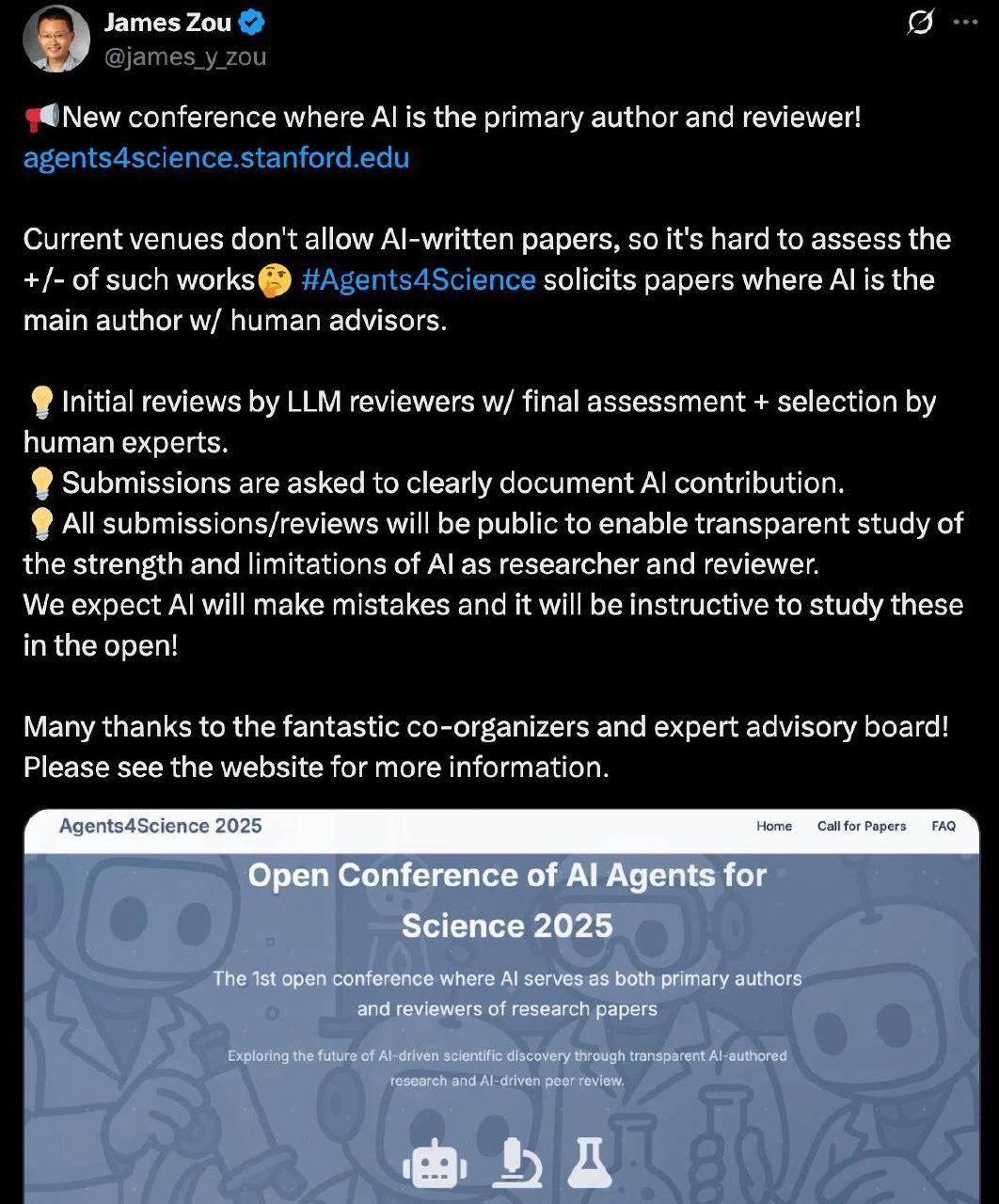
Now, why would anyone set up such a silly sounding scenario? This tweet is actually about a real conference called Agents4Science 2025. It’s an experimental academic conference where they explicitly want to see what happens if AI systems are the main writers of papers and also participate in the peer-review process. The reason this is interesting is that most conferences right now don’t allow AI-written papers (at least not without a human being the real author). There’s been a lot of debate in the research community about whether it’s okay to use tools like ChatGPT to write parts of a paper or if an AI can be listed as an author. Many scientists and publishers say “No, you shouldn’t list an AI as an author” because an AI can’t take responsibility for the work or answer questions – it doesn’t have accountability or legal standing. Also, if people just let AI write papers, we might get a flood of low-quality or plagiarized content.
Because of those concerns, current venues (conferences/journals) have rules against AI doing the writing. But that makes it hard to objectively measure how good or bad AI-written research really is, because no one’s formally trying it (at least not out in the open). The folks behind Agents4Science want to allow it in a controlled way to see both the potential and the problems. Think of it like a special tournament or challenge where normal rules are bent to test a new idea. They are soliciting (asking for) papers where an AI is the main author, with the condition that there are human advisors involved. That means a human expert should guide the AI or at least oversee what the AI is doing, rather than an AI just running wild on its own.
They’ve set up a review process in two stages:
- First, initial reviews by LLM reviewers. So when a paper is submitted, a set of AI models will read it and generate review reports. These reports will probably say things like “The paper is missing an experiment on X, or the clarity is Y, or this result seems inconsistent” – basically the kind of feedback a human reviewer might give. How do AIs know how to do that? Likely, they’ve been trained or prompted with tons of example reviews. Given a paper, an LLM can be asked: “What would a reviewer say about this?” and it will produce a critique.
- Then, the final assessment and selection is done by human experts. This means after the AI writes its reviews, actual human program committee members (senior researchers) will read both the paper and the AI’s comments. The humans will make the ultimate decision: is this paper good enough to be accepted to the conference? They’ll also likely correct or ignore any AI review feedback that is off-base. It’s a safety net to ensure that if the AI reviewers missed a fatal flaw or made an unfair request, a human catches it.
The conference also has some special rules to maintain transparency and integrity:
- Authors must clearly document AI contributions. This means when someone submits a paper, they have to say exactly what parts were done by the AI. For example, they might write a statement: “Sections 1-3 were drafted by GPT-4 and then edited by a human. The experiment described was designed by a human, data was collected by humans, but the analysis text was generated by an AI…” etc. This way, everyone knows which content might be directly machine-generated.
- All submissions and reviews will be public. This is quite unusual! Typically, peer reviews are confidential (only the authors and the program committee see them) and rejected papers just disappear quietly. Here, they want to put everything out in the open: every paper submitted (even if it’s rejected) and the corresponding AI reviews (and possibly the human final decision notes) will be visible to the public. The idea is to create a dataset or at least a clear record so that the whole community can “enable transparent study of the strength and limitations of AI as researcher and reviewer,” as the tweet explains. It’s almost like an experiment where every trial’s result is published, not just the successful ones. This is great for learning – even if an AI-written paper fails hilariously, everyone will get to learn why.
- They openly acknowledge “We expect AI will make mistakes and it will be instructive to study these in the open!” So there’s no delusion that the AI will nail it. They’re actually interested in the mistakes. For example, maybe an AI-authored paper will include a made-up reference (because sometimes LLMs invent citations). Or maybe an AI reviewer will criticize something that actually isn’t wrong (false positives) or will miss something critical (false negatives). By seeing these errors, researchers can figure out how to improve AI or understand its weaknesses.
From a junior developer or tech enthusiast perspective, this is like a sandbox or beta test environment for AI in academic roles. It’s comparable to how in industry, companies might test a new AI tool internally on non-critical tasks first to see how it behaves. Here the “product” being tested is the idea that AI could handle writing and reviewing scientific research. It’s quite meta! The humor in the meme’s phrasing (“LLM writes the paper, reviews it, and still asks for revisions”) comes from the expectation that if the same entity did both, you’d skip the messy back-and-forth. Imagine if you could take an exam and also grade your own exam – you’d think you’d just give yourself a 100% and be done, right? But nope, the AI reviewer is behaving like a separate picky persona, essentially arguing with itself. This highlights an interesting aspect of how these AI agents work: they do what they’re told to do in the role they’ve been given. If we prompt an LLM to “be a reviewer,” it will act like a conscientious reviewer, even if that means it ends up criticizing text that was generated by an AI cousin moments before. There isn’t an “ego” or self-preservation in the way a human might have. A human author reviewing their own work would either catch and fix everything beforehand or be biased and say “my work is great!” But the AI, when split into two roles, just follows the playbook for each role sincerely. So the author role produces the best paper it can (maybe with some flaws) and the reviewer role dutifully finds issues with it because that’s its job.
For those newer to AI concepts, it’s worth noting what LLM actually implies: models like GPT are trained on vast amounts of text and learn to predict likely continuations of a prompt. They don’t have a fact database or direct understanding of truth per se, they just know what sounds plausible. This is why the conference asks to document AI contributions – if an AI wrote a certain section, readers might scrutinize it more carefully for errors like hallucinations (which are AI-generated false facts or details). And the term AIHumor applies here because the whole situation is a bit of a tongue-in-cheek commentary on our current AI “boom”. It’s humorous, but also educational, to push AI to its boundaries and see if it can handle a process that traditionally was exclusively human. There’s even a hashtag in the tweet #Agents4Science which is likely what the organizers want people to use when discussing this experiment, and tags like ai_authorship and llm_peer_review encapsulate the core concepts: AI writing papers and AI reviewing papers. These were unheard of a few years ago and now they’re trending topics – a sign of how fast AI technology (and the hype around it) has evolved.
So, in simpler summary: The meme is showcasing a real attempt to let AIs do an academic conference all by themselves (with some human guidance). It’s highlighting the irony that even without humans directly in the loop for writing/reviewing, the process and its idiosyncrasies remain – especially the part where the reviewer almost inevitably says, “needs improvement.” For a newcomer, it’s a peek into both academic culture (where revision and peer review are central) and the cutting edge of AI’s role in content creation. And yes, it’s okay to laugh at how odd and funny it sounds. Sometimes truth is stranger (and funnier) than fiction, especially in the world of AI!
Level 3: Reviewer #2 is a Robot
For the seasoned developer or researcher, this meme hits on a very topical absurdity in AI and academia. The tweet announces a conference, Agents4Science 2025, where AI is the primary author and also the reviewer of research papers. If you’ve ever submitted a paper to a conference or journal, you know the pain and irony here. In academic lore, “Reviewer #2” is notorious for giving authors a hard time – always finding nitpicks or asking for major revisions. Now imagine Reviewer #2 is literally an AI 😅! The meme text “When the LLM writes the paper, reviews it, and still asks for revisions” captures a hilarious scenario: the AI fulfills both roles – writer and critic – and even then it doesn’t cut itself any slack. It’s as if the AI has internalized academia’s motto: “no paper is perfect on first submission.” Even with itself on both sides of the process, the eternal cycle of “please address these comments and resubmit” continues.
Why is this so funny (and a bit alarming) to folks in the industry? Because it exaggerates the current AI hype around automation of knowledge work. In the last few years, we’ve seen Large Language Models like GPT-4 touted as tools that can do everything: write code, draft emails, answer customer queries, even pass medical and law exams. The logical extreme is, “hey, maybe they can write entire research papers.” But this conference goes a step further: LLMs doing peer review too. It’s a meta trend: not only automating the production of content but also the quality control of that content. Seasoned engineers have a mix of excitement and skepticism here. On one hand, this could speed up research or uncover novel ideas by brute-force exploration. On the other, we all know how garbage in, garbage out works. If the AI is generating flawed content, and the reviewer AI is cut from the same cloth, it might just rubber-stamp the garbage – or get into an endless loop of meaningless revisions.
Think of the parallels in software development: We now have AI code generators (like Copilot) and even AI-based code reviewers or static analysis tools. A senior dev chuckles imagining a scenario where Copilot writes a block of code and then another AI linter reviews it and says “please refactor this,” so Copilot refactors, then the AI reviewer says “hmm, now it’s too slow, optimize it,” and this ping-pong continues. It’s amusing until you realize someone (a human) has to break the tie or the infinite loop. That’s essentially what Agents4Science is preparing for: AI will do the heavy lifting initially, but human experts will have the final say to avoid total nonsense. In the tweet’s fine print: “initial reviews by LLM reviewers w/ final assessment + selection by human experts.” Translation for the tech crowd: sure, let the bots churn through the submissions and flag whatever they think, but then a human maintainer will merge or reject the pull request, so to speak. The human-in-the-loop design is crucial because, as any experienced dev will tell you, fully autonomous systems can drift off into the weeds if not kept in check.
The meme also pokes at a real academic tension: most conferences and journals currently ban AI-generated papers. There have been cases where someone tried listing an AI (like ChatGPT) as a co-author – journals said “No way, an AI can’t take responsibility or sign copyright agreements.” Existing venues are wary because they fear a flood of auto-generated content of dubious quality. So here comes a new venue explicitly encouraging it but in a controlled, transparent way. It’s an industry trend reversal – instead of hiding AI involvement, they’re saying “bring it on, but document it so we all know.” For veterans, this transparency is refreshing. It acknowledges that AI research often involves trial and error, and they want to openly catalog the pluses and minuses (#AILimitations) of AI as a researcher. All submissions and reviews will be public, essentially open-sourcing the entire experiment. That’s pretty radical for academia (which traditionally has closed peer review and only publishes final accepted papers). It’s like putting the entire CI/CD pipeline of a project out in the open, including all the failed test runs, so everyone can learn where things went wrong.
What shared pain or experience does this meme tap into? For one, the tedium and sometimes absurdity of the peer review process. Developers might relate through code reviews – you know when you submit a code patch and the automated reviewer or a particularly pedantic colleague always finds one more thing to fix? In academia, it’s the same: no matter how much you polish a paper, reviewers will ask for more experiments, more citations, clearer explanations here, fewer jokes there (yes, even humor gets flagged 😜). Now, if those reviewers are AI models trained on thousands of past reviews, they might become an exaggerated caricature of Reviewer #2: always nitpicking because that’s what the data says a review should do. A savvy senior engineer or researcher might think, “If the LLM was trained on prior review reports, of course it will ask for revisions – else it wouldn’t be acting 'reviewer-like' by its learned standards.” The humor is that the AI might be parroting academic behavior without the wisdom to know when a paper is genuinely solid. It underscores a limitation: current AIs are masters of form, less so of true content discernment.
Another insider chuckle comes from imagining how an AI-written paper might look and how an AI reviewer might respond. LLMs often hallucinate facts or references – they might cite articles that don’t exist or propose methods that sound good but haven’t actually been tested. A human reviewer would (hopefully) catch those by checking references or logic. But an AI reviewer might just go, “Looks legit, great citation list” if those patterns match its training data of good papers. Or conversely, it might say “I feel more experiments are needed” because most reviews say that, even if the paper already has plenty. It’s the blind leading the blind, in a sense. Seasoned folks find that scenario darkly funny: we’d basically be automating the bureaucratic parts of science without guaranteed substance. It’s reminiscent of office humor where someone jokes about having meetings to discuss the meetings – here we have AIs writing papers about who-knows-what and other AIs writing reviews about who-knows-what, and humans watching this like a reality show.
But it’s not all cynical. Many in tech are genuinely curious about outcomes. Perhaps AI-generated papers, especially with human advisors involved, could be surprisingly insightful or creative. And AI reviewers might actually spot issues humans overlook, like subtle inconsistencies or alternative references, given their vast training. The project expects mistakes (“We expect AI will make mistakes and it will be instructive to study these in the open!” the tweet says). That realistic expectation resonates with experienced engineers: when you deploy a new automated system, you know it’s not perfect on day one. The key is logging every error and learning from it (in this case, making everything public is like super-verbose logging). It’s a very engineering approach to a research problem: iterate, measure, improve.
So, the meme is funny because it’s true to life and absurd at the same time. It’s as if the academic world said, “Fine, let’s see what happens if we put this AI-autonomy hype to the test on ourselves.” And the mental image is comical: a super-serious LLM author writing a grand paper, then donning a different hat as an LLM reviewer, frowning at its own paper and muttering “Needs more work, resubmit in two weeks.” It personifies the AI with a kind of split personality – both eager student and stern professor. For those of us in the trenches of AI and software, it’s a reminder that automation often recreates the same human quirks we hoped it would eliminate. The loop of revisions isn’t gone; it might even get loopier! But at least we can laugh while we push the frontier. In sum, the meme captures a very 2025 moment: where AI in industry and research is simultaneously incredible (AI doing peer review!) and incredulous (it still asks for revisions on its own work!). It’s hype meeting reality, with a wink and a nod to all of us watching this space closely.
Level 4: Recursive Peer Review
At the deepest technical level, this meme hints at a self-referential AI feedback loop – essentially an LLM reviewing its own output in an academic context. This is like an Ouroboros (a snake eating its tail) of AI research: the Large Language Model (LLM) generates a research paper, then another LLM (possibly the same model in "critic" mode) evaluates that paper. In theory, this resembles a generative adversarial setup for knowledge work. Imagine a paper-writing AI as the "generator" and a paper-reviewing AI as the "discriminator." The generator (author AI) tries to produce a paper that will get accepted, while the discriminator (reviewer AI) looks for flaws or reasons to reject it. Over multiple revision cycles, the paper could improve as the author AI adjusts to satisfy the reviewer AI's critiques – akin to how GANs refine images through adversarial feedback. However, unlike a traditional GAN trained together, here the loop isn’t tightly optimized via gradient descent – it’s more of an iterative refinement, and there's no guarantee it converges.
This scenario also touches on meta-learning and fixed-point behavior in AI systems. If an AI continuously revises a paper based on another AI’s feedback, will they reach a stable equilibrium (a paper the reviewer can’t criticize further)? Or do they risk oscillating, with the reviewer always finding something to tweak because it’s learned that a proper review must suggest revisions? In real academic peer review, outright “looks perfect, no changes” is exceedingly rare – reviewers nearly always have comments. A well-trained LLM reviewer, having read thousands of human reviews, might internalize that pattern and reflexively seek issues to comment on, even if the paper is basically written by the same knowledge source. It’s a fascinating strange loop: the AI's output becomes its own input for critique. This reflexivity bears a resemblance to the famous ideas in Gödel, Escher, Bach about self-referencing systems. We’re essentially watching an algorithmic peer review Ouroboros in action, where the system is both creator and evaluator.
Under the hood, Large Language Models operate by predicting text that looks plausible based on their training data. They lack a true “understanding” of factual accuracy or novelty beyond patterns in data. So if an LLM “researcher” writes a paper, it might produce plausible but unverified claims or even subtle errors that sound scholarly. Now put an LLM as the reviewer: since it also judges based on learned patterns, it might fail to catch certain kinds of nonsense if the nonsense resembles something often accepted in literature. In the worst case, you have AI-driven papers full of confident hallucinations being reviewed by AIs that share the same blind spots. It’s like two students who studied from the same flawed textbook checking each other’s answers – any misconception in that book will seem normal to both. This is why the conference in the tweet emphasizes human experts for final selection: the humans act as a grounding sanity check to break the potential echo chamber of AI-agreeing-with-AI. It’s a recognition of current AI limitations in reasoning and an attempt to measure those limits systematically.
Historically, this idea has precursors. Earlier, pranksters used tools like SCIgen (a fake CS paper generator) to create gobbledygook papers that sometimes slipped past superficial human review. Those incidents proved that formulaic text can fool even conferences, because the writing looked “real” even if the content was nonsense. Now, with powerful LLMs, the generated papers can be far more coherent and polished. We’ve essentially leveled up the auto-generator from a toy to a sophisticated apprentice researcher. But the core challenge remains: can the reviewing process (whether human or AI) discern truth and quality from mere high-quality bullshit? By making all submissions and reviews public, the Agents4Science conference is treating this as an open experiment. It’s as if the academic community is collectively debugging a new algorithm – the algorithm of AI-as-researcher. Researchers will be able to inspect each AI-written paper and its AI-given reviews to identify common failure modes. Do the LLM reviewers tend to overlook logical fallacies? Do they demand more references because they learned that a lot of reviews say “needs more citations”? This transparent sandbox is a goldmine for analyzing how well AI can perform in the dual role of author and reviewer – and where it predictably falls on its face.
From a theory standpoint, one could also frame this as a question of algorithmic alignment and objectivity. Human researchers have biases and blind spots, but so do AI models (they reflect the data they were trained on). When an AI reviews an AI, we’re effectively composing the function with itself: f(f(x)) where f is the transformation an LLM applies to produce or evaluate text. In mathematics and computer science, such self-composition can amplify biases (if f reinforces certain traits) or potentially cancel out some noise if done cleverly. But most likely, if both author and reviewer share the same training and assumptions, their biases reinforce each other. It’s a bit like using a mirror to check another mirror – you might just get infinite reflections of the same smudge. Ensuring that doesn’t happen (hence involving diverse LLMs or final human arbiters) is key.
This profound experiment tickles the fancy of seasoned AI engineers and researchers: it’s equal parts exciting and absurd. On one hand, it pushes the frontier of AI in research – could we eventually have fully AI-generated discoveries? On the other hand, it openly acknowledges the hype vs. reality gap: AI will make mistakes and we expect it. By explicitly documenting AI’s contributions, the conference addresses the ethical and intellectual honesty aspect; it’s confronting the concern that AI-authored work might just remix existing knowledge without true innovation. In summary, this meme’s scenario is a cutting-edge case of AI agents in a closed loop, raising deep questions about knowledge generation, evaluation, and the nature of creativity and rigor when the entire pipeline is automated. It’s an academic Turing Test turned inward: can an AI produce research good enough that even another AI (and eventually a human) deems it valid science? The humor comes from how sci-fi and meta this all feels – and yet it’s real enough that Stanford is hosting it. We’re watching theory meet practice in real time, with a dash of chuckle at how the future of work might involve AIs that not only do the work but also critique their own work. It’s recursion at an intellectual level, and it definitely has the technical community’s attention.
Description
A screenshot of a tweet from James Zou (@james_y_zou) announcing a new academic conference called 'Agents4Science'. The tweet text introduces it as a 'New conference where AI is the primary author and reviewer!' and includes a link to agents4science.stanford.edu. Key points highlighted with lightbulb emojis include initial reviews by LLMs with final assessment by human experts, and a commitment to making all submissions public to study AI's capabilities. Below the main tweet, a screenshot of the conference website's header is visible, which reads 'Open Conference of AI Agents for Science 2025' over a blue-themed background with faint illustrations of robots and lab equipment. This post highlights a significant shift in the academic and tech landscape, where AI's role is graduating from a tool to a primary contributor in scientific research. For senior developers and researchers, this represents the frontier of AI application, raising questions about the future of peer review, the nature of authorship, and the potential for AI to accelerate scientific discovery, while also acknowledging the inevitable mistakes and learning opportunities

Comments
17Comment deleted
The AI peer review process is going to be brutal. It will probably just respond with 'Your token efficiency is suboptimal. Refactor your entire hypothesis.' and then close the pull request
Great, we’ve finally achieved CI/CD for academic publishing: git push paper.md && the reviewer bot immediately requests you cite its own previous commit
Finally, a conference where the hallucination rate might actually improve the acceptance rate - and where 'it works on my machine' becomes 'it works on my model checkpoint from 3 months ago that I can't reproduce anymore'
Finally, a conference where 'the reviewer clearly didn't read my paper' becomes a feature, not a bug - though I suspect the AI reviewers will still ask you to cite that one tangentially related paper from 1987, and the rebuttal phase will just be prompt engineering your responses until GPT-4 agrees with you
Academia reimplements CI: LLM authors push, LLM reviewers run the checks, and a human hits Approve - do shared weights count as a conflict of interest?
Like Copilot auto-approving its own PRs: transparent genius until it hallucinates a critical vuln
Waiting for rebuttals that say “we lowered the reviewer’s temperature to 0.2 and it still hallucinated related work” - peer review is now prompt engineering with acceptance rates bounded by context windows
the first speaker of the conference Comment deleted
AI fights expectation reality Comment deleted
it's so over Comment deleted
People laughing about matrices multiplication Plot twist: our consciousness is matrices multiplication Comment deleted
Honestly, I keep saying "it's just math" while wondering if we're also "just math" 🤣 Comment deleted
this sounds interesting actually, curious if even anything will come out of it Comment deleted
about ♂️Ass♂️ Comment deleted
This can't possibly go wrong Comment deleted
"You conclusion is a complete bullshit, sir!" Comment deleted
robots with human teeth ☠️ Comment deleted