Skip to content
DevMeme
2625 of 7435
The Five Stages of API Deprecation Grief
API Post #2904, on Apr 7, 2021 in TG

The Five Stages of API Deprecation Grief

Why is this API meme funny?

Level 1: Favorite Toy Gone

Imagine you have a favorite toy that you love playing with every day. It’s the best toy – maybe it lets you do something really cool or it just makes you happy. Now picture that one morning, you excitedly tell your friends or your teacher, “I really like this toy!” But right after you say that, a grown-up comes over and tells you, “Actually, we’re going to stop making that toy, and soon you won’t be able to play with it anymore.” How would you feel? Probably very upset or confused, right? You’d be like, “Wait, what? But I just started loving it!” You might even feel like going off by yourself to sulk because there’s nothing you can do to change their mind.

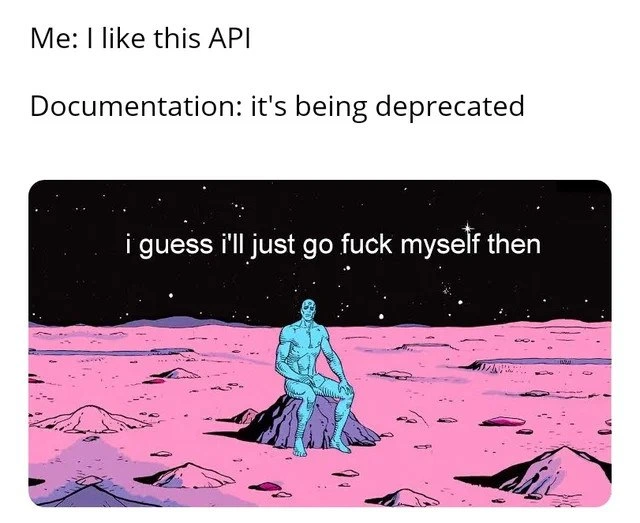
In the picture, there’s a blue guy sitting all alone on what looks like the moon (or some other planet). He looks kind of sad and lost. That’s how the developer (the person who writes code) feels in this joke. The developer’s “toy” is an API – that’s just a tool or service they were using to make their app or program work. They were happy with it, like you are with your favorite toy. But then the documentation (which is like the instruction book or the official info about that tool) said “it’s being deprecated,” which is a big phrase that basically means “we’re going to take it away soon.”

So the developer feels abandoned and frustrated, like if your toy was suddenly taken away for good. The line the blue character says – “I guess I’ll just go fuck myself then” – is an extremely rude and exaggerated way of saying “I give up, I’ll just be here alone now.” (It’s not a nice phrase to use in real life, but in the meme it’s meant to be over-the-top and darkly funny.) It’s showing that the developer feels powerless and a bit angry, like there’s nothing they can do but sit there and feel bad.

To put it simply: this meme is funny to programmers because it compares a grown-up problem (a useful tool being taken away) to that feeling when a kid’s favorite thing is suddenly made off-limits. It’s both sad and funny because the situation is so unfair and out of the person’s control. Just like you might pout if your favorite toy is gone, the developer is “pouting” in a big dramatic way on a lonely planet. The humor comes from recognizing that emotion – “ugh, fine, I can’t do anything about it” – and laughing at how spot-on it feels. It’s a way for people who make software to say to each other, “Yep, I’ve been there too, and it stinks!”

Level 2: Favorite API, Gone Tomorrow

Let’s break down what’s happening here in simpler terms. First, API stands for Application Programming Interface. An API is like a contract or set of rules that lets different software programs talk to each other. For example, if you have a weather app on your phone, it might use an API provided by a weather service to ask “What’s the temperature in New York?” and get back an answer. Developers love good APIs because they make our lives easier — we can get data or functionality from another service without reinventing the wheel.

Now, what does it mean when an API is "deprecated"? In documentation or tech lingo, deprecated means "we’re phasing this out." It's a warning that this feature or service is old or will stop working in the future. It’s like a polite way of the documentation saying, “Don’t get too attached; this will be removed or replaced soon. Please prepare to use something else.” Deprecation is usually the step before removal. The API might still work today, but it’s officially marked as something you shouldn’t rely on long-term. Think of it as a big heads-up. Often documentation will say something like, “Deprecated as of version 4.2, will be removed in 4.4. Use the new XYZ method instead.”

In the meme conversation, the developer says, “I like this API,” and the documentation immediately replies, “it’s being deprecated.” This is funny (in a painful way) because it’s a situation developers often find themselves in: you discover a tool or an interface that seems great, and just when you start using it or praising it, you read the docs or release notes and find out the maintainers have decided to retire it. It’s like building your house on what you thought was solid ground, and then seeing a sign that says “Scheduled for demolition.” 🏚️

For a less technical analogy: imagine you find a great new toy to play with and then see a note from the manufacturer saying “this toy will be discontinued next month.” That’s basically what’s happening, but with software. The developer experience (DX) of that is pretty frustrating: you might have spent hours or days integrating with this API (writing code to use it), and now you learn that effort will have to be redone with something else. It’s wasted or at least temporary work, which is every developer’s nightmare.

Let's identify the visual part of the meme: the image of the blue muscular figure sitting alone on a pink, cratered landscape under a starry sky. That character is Dr. Manhattan from the graphic novel and movie Watchmen. In that story, Dr. Manhattan is an all-powerful being who, at one point, gets fed up with Earth and goes to sit by himself on Mars (hence the alien-looking pink landscape, which represents Mars). He’s blue, nearly invincible, and can do almost anything, yet he often feels detached and isolated. People online turned an image of him sitting on Mars into a meme template to express feelings of loneliness or defeat when something doesn’t go their way. They add captions to show what he might be thinking. In this meme, the caption above his head says “I guess I’ll just go fk myself then.”**

Now, that caption is a very blunt, R-rated way of expressing despair or frustration. It’s internet-slang for “Well, I have nothing left to do here” or “I feel useless now.” When someone says that, they usually mean they feel ignored, irrelevant, or helpless in a situation. Here, the developer is jokingly saying it about themselves after hearing the API they like is deprecated. It’s a self-deprecating, dark humor way to say, “Great, I’m screwed and I can’t do anything about it. Thanks a lot.” The reason it’s Dr. Manhattan saying it is to exaggerate how defeated the developer feels — Dr. Manhattan is super powerful, yet even he looks small and sad in that picture. That’s exactly how a dev might feel: you could be a coding wizard, but you can’t stop a company or an open-source project from retiring the tool you rely on.

For someone newer to development, it helps to know this is a common pain point. Dependencies (things your project relies on that you didn’t build yourself) are wonderful until they change or go away. When an API changes in a backward-incompatible way or is outright removed, we call it a breaking change. It breaks your code because your code was expecting the old behavior. Usually, good documentation will announce deprecations early and suggest an alternative or an upgrade path. For example, an API might say, “Endpoint /v1/users is deprecated, please use /v2/users.” This means they have a new version (v2) you’re supposed to switch to, because at some later date, v1 will stop responding. But even with a replacement available, it’s extra unplanned work for the developer to adapt and test everything with the new API.

The meme resonates with developers because it captures that exasperated reaction we have. The top text “Me: I like this API” is deliberately simplistic — it represents any developer being happy with a tool. The next line, “Documentation: it’s being deprecated,” is the punch in the gut delivered in a very deadpan way (documentation doesn’t usually convey emotion; it just states facts like a notice). The contrast is funny: a human saying “I love this!” versus a manual dryly saying “too bad, it’s going away.” It’s like a comedy setup and punchline in two lines.

Then the image with Dr. Manhattan is the extra drama that makes the meme memorable. For context, there’s a broader meme where people use the phrase “Guess I’ll go f**k myself” with images (there’s even one with a guy holding his own hand after being left hanging on a high-five). It’s used when someone feels embarrassed or abandoned. In developer memes, it often appears when something beyond your control invalidates all your effort — exactly like a deprecated API scenario.

So, what do developers do when they find out something they use is deprecated? Typically:

  • They sigh (or maybe scream a little internally),
  • Read what the documentation says about timelines (e.g., “Will stop working after July 2022”),
  • See if there’s a migration path or a new version (like an updated API or library to move to),
  • Adjust their plans to allocate time to change their code,
  • Sometimes, if it’s an open-source project, they might even consider forking it or maintaining the old version themselves if it’s critical and no longer supported (though that’s a lot of work).

It’s almost like if your favorite train route is being closed, you have to find a new way to get to work. You can’t force the train to keep running, so you just have to deal with it. That feeling is what this meme encapsulates in a jokey way. The developer pain point here is the lack of stability. Every deprecation is a reminder that in tech, things change constantly, and staying still isn’t an option.

One more thing to note is why APIs get deprecated, which can help a newcomer understand the bigger picture. Common reasons include:

  • The API has a better version now (maybe the old one is inefficient or has design flaws, so a new version is created and the old one is slated to retire). Example: a service might move from v1 to a cleaner v2 version of its API.
  • There are security issues or maintenance burdens. Perhaps the old API can’t be easily secured or scaled, so they need everyone off of it.
  • Low usage: if an API or feature isn’t used by many, the maintainers might kill it to reduce complexity.
  • Business changes: sometimes companies shut down services or change their focus, so the associated APIs go away (developers dread this because it feels like a rug pull).

For the developer, none of these reasons soften the blow when you’re the one using the soon-to-be-dead API. It still means you have to do extra work. That’s why the meme’s dramatic, lonely space-guy imagery is so apt. The dev feels abandoned by the platform, left alone to figure out the next steps.

In summary, this meme is showing a very relatable developer experience through a mix of straightforward text and an exaggerated cartoon image. It’s saying: “Hey, have you ever been excited about a tool or API, only to immediately find out it’s marked for removal? It sucks, right?!” and doing so in a humorously over-the-top way. Anyone who’s dealt with deprecated code or shifting API versions will likely smirk (or maybe groan) at this because they’ve felt that exact same “well, I’m completely on my own now” moment.

Level 3: Deprecation Blues

Ah, the classic “love an API, and it will break your heart” scenario. This meme hits on a well-known cycle in software development: you finally find a stable, elegant API that perfectly fits your needs, you start singing its praises... and then the Documentation casually drops a bomb: "this API is being deprecated." The humor comes from the whiplash between the developer’s enthusiasm and the cold, indifferent deprecation notice. It’s a tongue-in-cheek reminder that in tech, nothing gold can stay (at least not without a version bump).

In the meme’s text, we see:

Me: "I like this API"
Documentation: "it's being deprecated"

This immediately sets up the punchline. As developers, we've all been in that situation. The timing is comedic: the moment you express affection for a tool or function, you discover it’s on death row. It feels like a personal betrayal by the platform or library maintainers. The image below those lines amplifies the feeling: Dr. Manhattan (the blue muscular figure from Watchmen) sits alone on a barren, pinkish lunar landscape under a vast black sky, captioned with the crude but darkly funny phrase, "I guess I'll just go f**k myself then." Even if you didn’t know the character, the visual screams cosmic loneliness and futility. Dr. Manhattan is practically a god, yet here he symbolizes a developer’s powerlessness when an external dependency changes. It’s an exaggerated metaphor for the isolation a dev feels when an adored API is yanked away: even a superpowered being can’t save code from breaking when the breaking changes come.

This scenario is painfully familiar in the era of ever-evolving web services and libraries. The meme is relatable because many of us have invested time integrating with an API (or using a library function) only to discover a deprecation warning tucked in the docs or release notes. That’s when you realize: all that work has an expiration date. The phrase “I guess I’ll go f**k myself” is vulgar, yes, but it’s a well-known internet meme expression encapsulating utter defeat. In developer terms, it's "Welp, time to throw my code in the trash and rewrite, because what else can I do?". It’s a mix of resignation and bitter humor.

Why do these situations happen so often? Sometimes it’s because maintaining old endpoints or functions is costly, and companies push for newer, “better” versions. Sometimes an API you love is part of a platform that’s pivoting or sunsetting products (Google, we’re looking at you and your cemetery of killed services 🔪). There’s even a bit of Murphy’s Law for APIs: the more you depend on an interface, the more likely it is to receive the dreaded deprecation tag. Veteran engineers know this feeling well; it’s why they might joke that "legacy code" is just code that survived long enough to retire you first.

From a senior dev perspective, there’s rich subtext here about API versioning and communication. Ideally, a deprecated API should come with a migration path: a new version, a timeline, maybe tools to ease the transition. In reality, it can feel like you’re on your own (cue Dr. Manhattan on his lonely rock). The documentation’s terse “it’s being deprecated” often isn’t accompanied by an apology — just an implication that your current implementation has an expiration date. That’s a massive DeveloperExperience (DX) pain point. It means unexpected refactoring, scrambling to understand a new API version, and possibly dealing with bugs introduced by the change. No wonder the developer in the meme is essentially saying “well, great, thanks a lot (not).”

Let’s talk about the emotional rollercoaster a developer goes through upon encountering such news. It mirrors the five stages of grief (with a coding twist):

  • Denial: “No, no, this must be a mistake in the docs. They wouldn’t kill off this endpoint... would they?” You double-check hoping you misread it.
  • Anger: “Who the heck thought deprecating this was a good idea?! It was working fine. Don’t they know how many projects will break?” You feel a spike of rage at the maintainers or the organization.
  • Bargaining: “Maybe I can keep using it unsupported? Or perhaps there’s a way to shim the new API to behave like the old one… There has to be a workaround, right?” You scour forums and consider holding off updates.
  • Depression: “All that effort was for nothing. I can’t believe I have to redo this. Maybe I’m just unlucky... Why do I even get excited about new APIs?” This is the Dr. Manhattan-on-Mars phase: lonely and defeated.
  • Acceptance: “Fine. It’s deprecated. Let’s see what the new version is about. I’ll allocate time to refactor and hope for the best.” With a sigh, you roll up your sleeves and start planning the migration.

The meme compresses all of that into one bittersweet laugh. The term “Deprecation Blues” captures it perfectly: it’s the blue mood you get when your beloved tool is put out to pasture, and in the image, it’s literally a blue dude sulking. Seasoned developers chuckle at this because it’s a shared rite of passage in our field. We’ve learned (the hard way) not to get too emotionally attached to any one API or library. Today’s shiny stable interface might be tomorrow’s legacy code marked with a big fat @Deprecated annotation.

Speaking of @Deprecated, in many programming languages and frameworks, that’s how you find out your favorite method or class is being phased out. For example, a Java library might suddenly show:

@Deprecated(since="2.0", forRemoval=true)
public void doAmazingThing() {
    // ...
}

When you see that in your code, it’s like an eviction notice: time to move out of this comfy API and find a new home. If you’ve ever read through auto-generated docs or IntelliJ/VSCode warnings, the moment you see a strike-through on the API name or a big deprecation banner, your heart sinks. The meme nails that feeling with dark humor.

On top of this, there’s an industry commentary: dependencies can be a double-edged sword. Relying on third-party APIs and libraries accelerates development, but it also puts you at the mercy of someone else’s roadmap. The meme highlights a RelatableDevExperience: you’re not in control of the ground shifting under you. In a perfect world, there’d be eternal backwards compatibility or at least very long support periods (some older enterprise tech actually has that—think COBOL systems still running decades later, or Microsoft keeping old Win32 APIs alive for ages). But in the fast-moving world of web APIs and JavaScript libraries, the reality is closer to “move fast and break things” (sometimes literally breaking developers’ things).

The Watchmen reference adds a nice layer for those who catch it. Dr. Manhattan left Earth for Mars when he became disillusioned and detached from humanity. The parallel in the meme is a developer becoming disillusioned with their tools and perhaps feeling detached from the vendor or project that deprecated the API. It’s a bit dramatic, sure, but that’s why it’s funny. The dev in the meme is basically saying: “The platform doesn’t care about me, so fine, I’ll just isolate myself and wallow.” It exaggerates our internal tantrum when facing deprecation doom. And the fact that Dr. Manhattan is all-powerful yet still sitting there doing nothing? That’s the cherry on top: even the most skilled coder can’t magically undeprecate an API; you just have to accept it.

In summary, the meme combines developer humor with a pop culture image to commiserate over a universal programming problem: the dreaded deprecation notice. It’s funny because it’s true. Everyone who’s maintained software for a few years has that scar. The next time you see “Deprecated: will be removed in next major version” in your favorite library’s changelog, you might just remember this blue guy on his pink rock and let out a knowing, rueful laugh (before getting back to rewriting your code, of course).

Description

A two-part meme expressing a common developer frustration. The top section, on a plain white background, presents a short dialogue: 'Me: I like this API' followed by 'Documentation: it's being deprecated'. The bottom section features a well-known panel from the 'Watchmen' graphic novel, where the character Dr. Manhattan, a powerful blue being, sits dejectedly on the rocky, pink surface of Mars under a starry sky. Superimposed over this image is the vulgar and resigned statement, 'i guess i'll just go fuck myself then'. The meme humorously equates the sudden deprecation of a beloved and integrated API to a moment of existential crisis. It perfectly captures the feeling of helplessness and exasperation experienced by developers when their work is unexpectedly invalidated by external forces, forcing them to undertake the often arduous task of refactoring and migrating their code

Comments

8
Anonymous ★ Top Pick My favorite API is being deprecated. I'm not mad, I'm just disappointed. And now I have to rewrite three years of work. So yeah, mostly mad
  1. Anonymous ★ Top Pick

    My favorite API is being deprecated. I'm not mad, I'm just disappointed. And now I have to rewrite three years of work. So yeah, mostly mad

  2. Anonymous

    Nothing like reading a “deprecated, no replacement” note on the endpoint anchoring your event-driven system to realize the real SPOF is a product manager’s quarterly OKR

  3. Anonymous

    The deprecation notice is just their way of saying "we've rewritten this in Rust and now you need to migrate 47 microservices by Q3 or production breaks."

  4. Anonymous

    Every senior engineer has that one deprecated API they refuse to let go of - like a toxic relationship where you know it's ending but you've already built three microservices around it. The real tragedy isn't the deprecation notice; it's realizing you'll spend the next quarter explaining to stakeholders why 'just updating the dependency' actually means rewriting half the platform because the new API uses a completely different paradigm and nobody bothered with a migration guide

  5. Anonymous

    I only praise endpoints from behind an adapter - every compliment schedules a 410 and a cheerful Medium post

  6. Anonymous

    The nicer the API, the shorter its half-life - Heisenberg for software: you observe elegance exactly when the docs flag it “deprecated” and your Q3 becomes a migration plan

  7. Anonymous

    Deprecated APIs: the tech equivalent of 'it's not you, it's our new GraphQL schema' - cue six months of vendor lock-in escape planning

  8. @doodguy1991 5y

    Who cares if it's deprecated? Use it anyways

Use J and K for navigation