Welcome to Vulkan: Your First Triangle Will Hurt
Why is this Graphics meme funny?
Level 1: Some Assembly Required
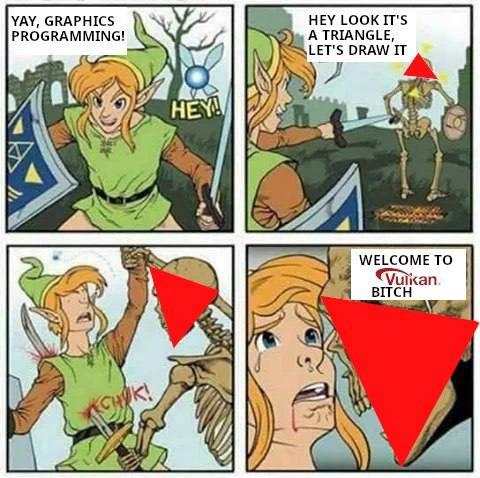
Imagine being excited to ride your new bike, opening the box, and finding three thousand loose pieces, a bag of screws, and a manual that starts with "Chapter 1: Forging Your Own Wrench." The kid in the comic just wanted to draw one simple shape — the easiest shape there is, a triangle — and the triangle turned around and stabbed him, because making the computer draw it requires building practically the whole bike factory first. The "WELCOME TO Vulkan BITCH" sign is the toolbox cheerfully greeting its newest victim.
Level 2: The Words on the Boilerplate
- Vulkan — a modern, cross-platform graphics API: the low-level interface programs use to command the GPU. Its logo is the red mark on the sign in panel four.
- Hello triangle — graphics programming's "Hello, World!": draw one colored triangle. Triangles matter because GPUs build everything — characters, terrain, UI — out of millions of them.
- Boilerplate — repetitive setup code you must write before the interesting part. In OpenGL, a triangle was a few dozen lines; in Vulkan, roughly a thousand, because you configure every stage by hand.
- Swapchain — the queue of images the GPU draws into while the screen displays the previous one; you manage it yourself in Vulkan.
- Pipeline — the fixed recipe describing how vertices become pixels; in Vulkan you build it explicitly, every field, no defaults.
If your first week with a graphics tutorial feels like panel three, that's not a sign you're unqualified — it's the standard experience. Everyone gets stabbed by the triangle.
Level 3: The Initiation Ritual
The comic's escalation mirrors the canonical learning curve with painful accuracy. Panel one — "YAY, GRAPHICS PROGRAMMING!" — is the newcomer fresh off watching a ray-tracing demo, sword and shield up, ready to make beautiful pictures. Panel two — "HEY LOOK IT'S A TRIANGLE, LET'S DRAW IT" — is the moment they open the official tutorial and see that hello triangle, the field's traditional first program, is the curriculum's entire first month. Panels three and four are the tutorial itself: instance creation, validation layers, physical device selection, queue families, logical device, surface, swapchain, image views, render pass, descriptor layouts, pipeline, framebuffers, command pool, command buffers, and a synchronization dance — all before one triangle rasterizes. The skeleton stabbing Link with the triangle is the perfect visual: the goal becomes the weapon.
The use of the Zelda CD-i art style is a sly bonus layer. Those Philips CD-i Zelda games are infamous as some of the most awkward licensed products in gaming history — beloved-franchise characters rendered with hostile jank. Using them to depict a beloved craft (graphics programming) ambushing its fans with hostile jank is thematically exact, whether or not the memer intended the symmetry.
What seniors recognize beneath the joke is a real pedagogical schism. Vulkan's verbosity is correct for engine developers at studios who need every microsecond — explicitness is the price of predictable frame times and multithreaded rendering. But the industry funneled hobbyists and students toward it anyway, because "Vulkan" was the new shiny and OpenGL was declared legacy. The result: a generation of learners bleeding out in panel four, when WebGPU or a framework would have taught them the actual concepts — transforms, shading, lighting — without the swapchain hazing. Choosing the maximally explicit tool for a learning task is its own anti-pattern; the API isn't wrong, the onboarding funnel is.
Level 4: Why the Triangle Fights Back
The thousand-line triangle isn't gratuitous cruelty — it's the visible cost of a deliberate architectural decision about where complexity should live. Older APIs like OpenGL presented the GPU as a friendly state machine: you said glBegin(GL_TRIANGLES), the driver guessed everything else. That guessing was the problem. Drivers accumulated heroic, vendor-specific heuristics — shader recompilation at draw time, hidden synchronization, implicit resource hazards — producing the era's signature failure mode: unpredictable frame-time spikes that no profiler could explain because the work happened inside a black box.
Vulkan (Khronos, 2016, descended from AMD's Mantle) inverts the contract: the driver does almost nothing implicitly, so the application must state everything explicitly. A pipeline state object bakes shaders, vertex layout, blend state, and rasterizer config into one immutable, pre-validated artifact — eliminating draw-time recompilation. The swapchain forces you to negotiate image counts, formats, and presentation modes with the windowing system yourself. And the deepest pain: explicit synchronization. GPUs are massively parallel pipelines where transfers, vertex work, and fragment shading overlap freely; correctness requires fences, semaphores, and pipeline barriers that you place, because the hardware genuinely has no global ordering unless someone pays for one. The triangle takes a thousand lines because you are no longer calling a renderer — you are writing the part of the driver that used to lie to you. That trade is also why a well-written Vulkan renderer can record command buffers across many CPU threads, something OpenGL's single-context model fundamentally couldn't do.
Description
A four-panel comic using Zelda CD-i style artwork of Link. Panel 1: an enthusiastic Link with sword and shield says 'YAY, GRAPHICS PROGRAMMING!' with 'HEY!' beside a fairy. Panel 2: Link spots a skeleton enemy with a red triangle above it, captioned 'HEY LOOK IT'S A TRIANGLE, LET'S DRAW IT'. Panel 3: the skeleton violently stabs Link, depicted with a large red triangle as the weapon and a 'SCHUNK!' sound effect. Panel 4: a bleeding, crying Link looks at the triangle impaling him with a sign reading 'WELCOME TO Vulkan BITCH' featuring the Vulkan API logo. The comic lampoons the notorious verbosity of the Vulkan graphics API, where rendering a single 'hello triangle' requires roughly a thousand lines of boilerplate covering instances, devices, swapchains, pipelines, and synchronization
Comments
15Comment deleted
Vulkan gives you explicit control over everything - including exactly how many of the 1,200 lines of swapchain boilerplate it takes to draw the same triangle OpenGL did in 1992 with twelve
What wrong with Vulkan? Comment deleted
Vulkan considered harmful Comment deleted
A lot of it is compatibility with older systems. Idk any specifics outside of this context though Comment deleted
haven't you explored graphics programming before Comment deleted
Yeah but before Vulkan Comment deleted
drawing a triangle requires ≈1100 loc with proper comment documentation Comment deleted
Ah, so not only is it not supported on older operating systems and devices, it takes a lot just to get it started Comment deleted
Not high level enough. Memes about it are made by the same people who make memes about missing ; Comment deleted
not the best way to learn 3d graphics at all, instead of focusing on rendering models, you have to first learn its intricacies and optimizations Comment deleted
it's not as simple as opengl Comment deleted
Vulkans fans be like: "uhm actually its gives you freedom for unknown before optimization for your unique cases" and then proceed to write their own version of opengl 3 api, but shittier (same happens with opengl 3 and opengl 1 tbf) Comment deleted
aint no way anyone makes immediate mode on purpose Comment deleted
or even the binding hell Comment deleted
So the, what is left is joke about DirectX and shader language also Comment deleted