
Claude Announces SpaceX Compute Deal and Doubled Claude Code Rate Limits
Description
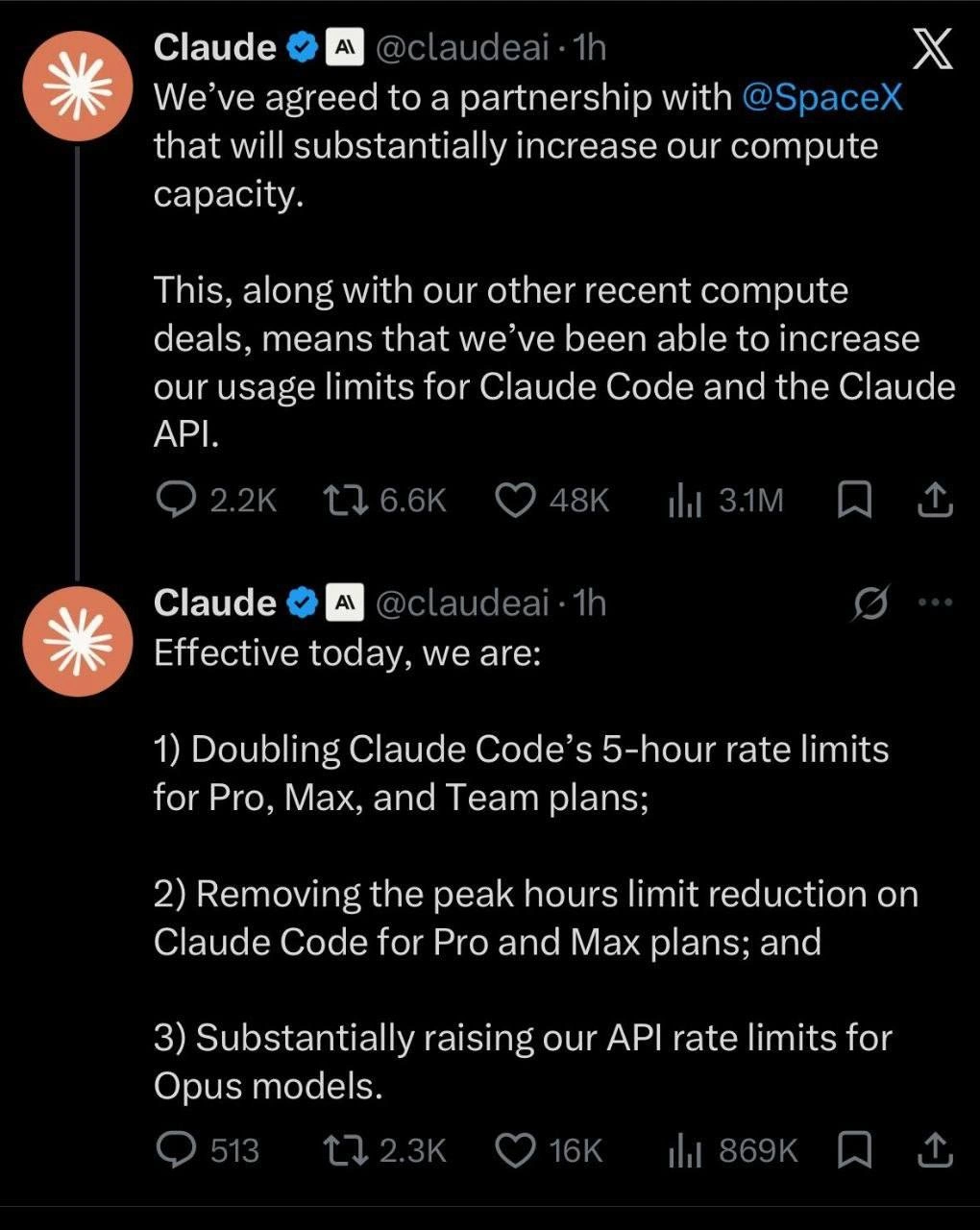
Screenshot of two X posts from the verified @claudeai account. The first post announces a partnership with @SpaceX that will 'substantially increase our compute capacity', enabling raised usage limits for Claude Code and the Claude API (2.2K replies, 6.6K reposts, 48K likes, 3.1M views). The threaded follow-up lists the changes effective today: 1) doubling Claude Code's 5-hour rate limits for Pro, Max, and Team plans; 2) removing the peak hours limit reduction on Claude Code for Pro and Max plans; and 3) substantially raising API rate limits for Opus models (513 replies, 2.3K reposts, 16K likes, 869K views). The content is notable for developers who live inside rate-limit windows, and for the eyebrow-raising pairing of Anthropic with SpaceX as a compute provider



Comments
34Comment deleted
The industry's hardest capacity-planning problem, solved the enterprise way: when you can't scale up or scale out, scale orbital
Nothing says "defensible AI moat" like enabling multi-tenancy for your main competitor.
Spaceship shareholders paid 250B for this btw 🌚🤝 Comment deleted
Just to make it super clear It’s not just same non-busy capacity of Grok, it’s much more than that We’ve signed an agreement with SpaceX to use all of the compute capacity at their Colossus 1 data center. This gives us access to more than 300 megawatts of new capacity (over 220,000 NVIDIA GPUs) within the month. This additional capacity will directly improve capacity for Claude Pro and Claude Max subscribers. Comment deleted
Do they measure compute capacity in watts and unspecified GPU models, rather than FLOPS or some generic OPS at least? 😳 Comment deleted
Big number go up Comment deleted
They are Americans, it's always number of feet&hamburgers instead of FLOPS and meters Comment deleted
I mean, I’m all-in for as long as we can have a chance to get back something similar to Opus 4.5 that we had at the end of December 2025 but it’s unlikely to happen anyway 🥲 Comment deleted
The enterprise market is growing faster than they can produce new compute, and they will always prioritise enterprise, I imagine the usage limits are going to go down by the end of the year and the prices are going to go up for individual users Comment deleted
The economy of hope Comment deleted
spacex remembers they're the only AI company that actually builds stuff Comment deleted
And powers it with illegal gas turbines which literally poison the air we all breathe, giving nearby communities higher rates of cancer in the future https://www.theguardian.com/technology/2026/jan/15/elon-musk-xai-datacenter-memphis Cool! Good Comment deleted
The sad thing is, I am not even surprised Comment deleted
Idk, sounds like a capitalism issue if buying gas for turbines is cheaper than doing nuclear Comment deleted
i mean obviously the whole incentive structure for organizing production in society has gotta be pretty fucked up if that's the case yeah Comment deleted
Well safety is a concern too. a gas turbine blowing is small in comparison Comment deleted
What? Nuclear is literally the safest and greenest form of energy (apart from water dams) Comment deleted
would you trust random unregulated companies to build reactors? Comment deleted
Fella, im saying that the margins are so big on nuclear electricity in the us its easier to buy turbines and and gas, and thats a pricing issue that should be controlled by the goverment Comment deleted
No it isn't, greenest and safest is solar. Comment deleted
Can we count production of the panels in please 😕 Comment deleted
no Comment deleted
if we count building and storage of the nuclear waste Comment deleted
can't that be reused to make more fuel Comment deleted
it might be, but there is no proper scaling for that as of now Comment deleted
thats how fuel works, you burn it, energy goes out, replace the energy in it and its good to go again Comment deleted
but can it melt steel beams? Comment deleted
... and jews melted steel beams Comment deleted
Yeah, if we count that then nuclear is greener Comment deleted
still no :D the standard way to handle nuclear waste is, well we have no long term solution. And concrete is extremely bad for the environment Comment deleted
Your entire lifetime will generate 14 grams of nuclear waste dw about it lmao, its long term viable Comment deleted
dams fuck the water ecosystem up pretty badly, so no, dams are not greener Comment deleted
I suppose so. After all having gas now is easier than having to build new reactors, both in terms of time and resources spent. Comment deleted
Fisrt time? Comment deleted