New Framework, Old Habits: The Bookshelf Anti-Pattern
Why is this Learning meme funny?
Level 1: Using Tools the Wrong Way
Imagine you got a brand new LEGO spaceship kit with all sorts of cool special pieces and an instruction book. You’re super excited to build it. But since you don’t know how to use those weird new pieces (and maybe you don’t feel like reading the instructions), you just grab the LEGO blocks and start stacking them the way you always do. Instead of making a spaceship, you built a weird, lopsided block wall. To support that wall, you even used the instruction book itself as a prop on the side, and then you put some heavy random objects on the shelves of your wall. The result looks silly: the booklet that’s supposed to guide you (and normally just sits on the side) is now crushed under your creation, and the cool spaceship pieces are just stuck on top as decoration rather than used correctly. It hasn’t completely fallen apart, but it’s definitely not how things were meant to be used.
This is funny because anyone can see the tools and parts are being used the wrong way around. It’s like trying to use a hammer to screw in a bolt, while using a screwdriver to hammer a nail – everything is backwards! The meme makes us laugh because the person had something new and useful but didn’t know how to use it, so they ended up doing a crazy makeshift solution. It’s a bit like if you had a high-tech oven but didn’t know how to turn it on, so you stacked books to make a “stove” and tried to cook on top of that – pretty absurd, right? The bookshelf with books holding it up and bricks on the shelf is just a goofy picture of someone using a tool in the wrong way. Even a kid can tell you that books are for reading and bricks are for building walls, not the other way around! The humor comes from seeing this obvious mix-up and thinking, “Oops, that’s not how you’re supposed to do it!” It reminds us of times when we or our friends used something new totally incorrectly and ended up with a funny, if not totally workable, result.
Level 2: Bricks Instead of Books
At this level, let’s break down the technical joke more simply. The term framework refers to a ready-made software structure or platform that provides a foundation and common features so you can build your app more easily. Think of a framework as a template or skeleton for a project – it gives you standard ways to do things (like a login system, or data management, UI components, etc.), so you don’t have to code everything from scratch. Popular examples of frameworks include Angular or React for building web front-ends, Django or Ruby on Rails for web back-ends, and many others. Each framework comes with special features and conventions. A feature might be something like an ORM (which automatically handles database records as objects), a routing system (to handle URLs in a web app), or pre-built UI components. These features are the reason developers use the framework – to save time and get a well-structured app.
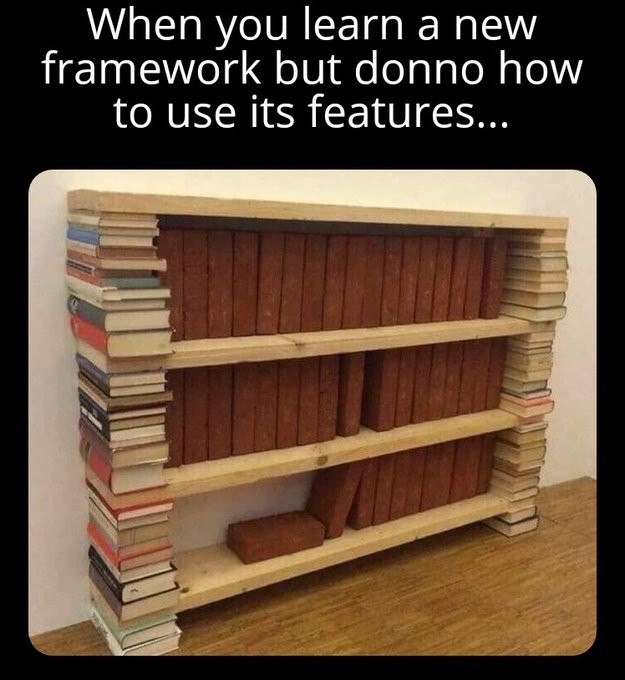
Now, the meme text says: “When you learn a new framework but donno (don’t know) how to use its features...” and the image shows a bizarre bookshelf where books are acting as the supports on the sides, and bricks are lined up on the shelves. Normally, it’s the opposite: you’d have a sturdy frame (maybe wood or bricks) holding up shelves, and you’d put books on those shelves. The image is a visual metaphor for a developer who has adopted a new framework but isn’t actually using it correctly. In this analogy:
- The framework itself is like the bookshelf structure. It’s supposed to hold the “weight” of the application’s basic needs. If used right, it provides solid support (just like a well-built shelf holds books easily).
- The framework’s features are like the strong building materials (bricks or proper wooden supports) that are meant to be placed in certain ways. For example, a framework might have a feature to handle user logins. Using that feature is like using a proper shelf bracket or a brick in a wall – it’s doing what it was designed to do.
- The developer’s own code or old methods are represented by the books. In a normal scenario, your custom code (books/content) sits on the framework (shelf). But here the books are doing the job of the shelf supports, implying the developer wrote a lot of custom code to do things the framework should have done.
So, “bricks instead of books” means the person filled the shelves with heavy bricks (the new framework components are just sitting there doing trivial stuff, or being used in the wrong place) and they used books to hold everything up (meaning they relied on their existing knowledge or old techniques to glue the system together). The phrase ToolMisuse comes to mind: this is a clear case of using a tool the wrong way. The developer had a new tool (the framework) but not the know-how, so they essentially used it in name only, doing things manually as if they never had the tool.
Let’s put it in a more concrete tech example. Imagine a beginner hears about a cool JavaScript framework that can make dynamic web pages easier. They install it, so now their project has this fancy framework included – but they haven’t learned how to use the framework’s components or its style of programming. Say the framework has a feature to automatically update the web page when data changes (this is a common feature in modern frameworks). If the newbie doesn’t know that, they might ignore that feature and instead write a bunch of old-style code that manually manipulates the web page every time something needs updating. The app might still work (the page updates), but the whole benefit of the framework – which could have handled those updates more cleanly – is wasted. They essentially re-created what the framework would do, but probably in a clunkier way. That’s like our bookshelf: it’s standing and holding bricks (the page does update), but it’s doing so in a convoluted manner (books as supports, bricks as content).
We often talk about learning curves with new technology. A learning curve is how much you have to learn over time – frameworks often have a steep learning curve at first. If the developer is impatient or under pressure, they might not get past the initial hard part of understanding the new concepts. They’ll instead fall back to what is familiar. This is a relatable developer experience (DeveloperExperience_DX is about how a dev feels working with a tool). If the DX isn’t good for newbies, they end up misusing the tool. It’s like if someone gave you a complex Swiss Army knife with 15 attachments, but you’ve only ever used a simple knife before. Faced with this complex tool, you might just use the main blade for everything and ignore the other 14 attachments because you don’t know what they do. That’s essentially using a Swiss Army knife to hammer a nail because you didn’t realize there’s actually a folding screwdriver in there. In programming terms, that’s using a new framework as if it were the old one, missing out on the specialized attachments (features) that come with it.
The meme is a relatableDevExperience for many of us. We chuckle because we remember being junior developers misusing a tool, or we’ve had new colleagues who proudly present a project in a new framework that turned out to be messy under the hood. The phrase FrameworkFatigue also ties in here: developers often jump between trending frameworks, and many of us have felt a bit of fatigue trying to keep up. Sometimes that leads to dipping into a new framework without fully committing to learning it, which in turn causes these misaligned expectations – thinking the new framework would automatically make things better, only to realize it’s not magic. If you don’t use a tool properly, you can’t get its benefits. The shelf won’t be stable if you don’t assemble it as designed. Using books as pillars might kind of hold it up, but any engineer (or anyone, really) can see that’s not sustainable. Similarly, using a framework incorrectly might produce a working app, but any experienced developer can see the cracks in that approach.
In summary, the meme uses the bookshelf and bricks as a humorous metaphor: the developer treated the new framework (shelf/bricks) like it was their old toolkit, leading to a backwards implementation. It highlights the importance of truly learning how to use new tools. If you don’t, you could end up with a Frankenstein solution – one that’s funny to onlookers but potentially frustrating to work with. And for a junior developer reading this, the lesson is: when you learn a new framework, take time to explore its features and recommended practices. Don’t be the person stacking bricks on a shelf supported by books – build the shelf correctly so you can enjoy how much easier it makes holding up those books (or in coding terms, how much easier it makes building your app).
Level 3: New Framework, Old Habits
"When you learn a new framework but donno how to use its features..."
This caption sets the stage for a scenario all too familiar to senior developers. A team picks up a shiny new framework with great excitement – maybe to improve performance, developer experience, or just to follow the latest trend – but they end up using it exactly like their old stack. In other words, new framework, old habits. The meme’s image of a bookshelf held up by books with bricks on the shelves brilliantly satirizes this. The proper roles are reversed: it’s like building an application with a cutting-edge framework but writing the code in the same old way as before, completely ignoring the new framework’s powerful features. The result technically “works” (the shelf is standing, after all), but it’s fundamentally misguided and precarious (one of those books slips, and the whole thing could collapse!).
Seasoned devs have witnessed this framework misuse time and again. It usually starts with enthusiasm: “Let’s rewrite everything in XYZ framework, it will solve all our problems!” But if the team doesn’t climb the learning curve and truly adopt the framework’s patterns, they often just recreate their previous architecture in a clunkier form. Consider some real-life examples that insiders chuckle (or cringe) about:
- A new hire insists on using React for a web app (because everyone says it’s great), but continues to manipulate the DOM directly with
document.getElementById, treating React like it’s just a sprinkle of jQuery. The whole point of React’s virtual DOM and state management is lost, analogous to filling a shelf with bricks but letting books carry the weight. - A team migrates a project to Django, a Python web framework that has an ORM (Object-Relational Mapper) and lots of built-in admin features, yet they bypass all that. They write raw SQL queries for every database operation and hard-code admin pages from scratch. Essentially, they’re using Django as a basic router and doing everything else manually – the equivalent of using books to support the shelf while the robust bricks (Django’s features) are ignored.
- A company dives into microservices architecture for scalability and resilience. They containerize everything with Docker/Kubernetes, but then keep a single, shared database and entangle all the services so tightly that it’s a distributed monolith. They adopted the form of microservices without the substance of independent, decoupled components – much like building a “modern” shelf but arranging the parts completely wrong.
To highlight this pattern across different contexts, here’s a comparison table of intended features vs. rookie misuse:
| New Tech | Key Feature | Misuse Example |
|---|---|---|
| React (UI library) | Virtual DOM & state management | Directly altering DOM with innerText or jQuery calls |
| Django (web framework) | ORM for database, admin interface | Writing raw SQL for everything, manually coding an admin page |
| Microservices architecture | Independent services with clear APIs | All services share one DB and codebase (a distributed monolith) |
In each case, the developer or team stuck to old habits, effectively using the new tool as if it were the old one. The humor (and horror) for experienced devs comes from that “I’ve seen this before” feeling. We chuckle because the bookshelf looks ridiculous – and we laugh (perhaps a bit bitterly) because we remember a project where something just as absurd happened in code. The meme speaks to framework fatigue and misaligned expectations. Often developers jump onto a new framework expecting magic, but without investing time to learn its idioms. When deadlines loom or frustration builds, they fall back to familiar techniques. It’s relatable: maybe you recall inheriting a codebase where the previous dev proudly used, say, Angular, but all the data was managed in a single giant JavaScript object and manually updated – totally bypassing Angular’s two-way binding and component system. The code “worked” but any Angular expert looking at it would facepalm, just like seeing bricks lined up on a shelf while books do the load-bearing.
This kind of tool misuse leads to systems that are fragile and hard to maintain. The new framework’s promised benefits (better structure, less boilerplate, improved developer experience or DX) never materialize, because the framework wasn’t actually leveraged. Instead, you get a Frankenstein monster of the new tech’s shell filled with old-tech guts. It’s funny in retrospect because the solution is so over-engineered and backward, but it’s also painful for those who have to fix it. The one brick tumbling onto the floor in the image is a perfect metaphor for that inevitable bug or crash that happens because the implementation is fundamentally unsound.
Yet, there’s a sympathetic angle here too: learning a big new framework is hard! There’s documentation to read, new patterns to absorb, and sometimes poor mentorship or rushed timelines. The developer in this scenario “did their best” under those pressures – and ended up with a creative but wonky outcome. Seasoned devs laugh because we’ve been that person early in our careers, proudly demoing a shelf supported by books and wondering why others are raising eyebrows. The meme cleverly encapsulates that mix of pride and embarrassment when you realize you’ve built something the wrong way round. It’s a comedic reminder that knowing when and how to use a tool is as important as the tool itself. After all, adopting a new framework without adopting its mindset is like buying a fancy bookshelf kit and using it to prop up the books you already had – technically a shelf exists, but you missed the point of the whole exercise.
Level 4: Abstraction Inversion
In software architecture, there's an anti-pattern known as abstraction inversion – when a high-level tool or framework is used in such a low-level, unintended way that you effectively reinvent the wheel inside it. This meme’s bookshelf scenario is a perfect physical analogy to that concept. A framework is supposed to provide a ready-made structure and handle common tasks (like how a real bookshelf is designed to hold books on its shelves, and bricks are meant to build the frame of a wall). But here we see an inversion of roles: the books, which should be the content, are instead load-bearing like the structure, and the bricks, which usually form the structure, are sitting on the shelf as content. In tech terms, the developer is ignoring the framework’s built-in features (the bricks that should form the foundation) and is relying on their own ad-hoc solutions (the books) to hold everything up. This is essentially a case of incorrect abstraction use where the dev has inverted the intended use of components.
One theoretical concept at play is Inversion of Control (IoC). Modern frameworks often employ IoC – meaning the framework calls into your code at certain points, managing flow for you. If you don’t understand IoC, you might circumvent it and try to control everything yourself. That’s like refusing to let the bookshelf hold the books, and instead propping the bookshelf up with the books. The framework’s features – analogous to strong bricks or supports – remain unused or misused, while the developer’s own improvised code carries the load. This mirrors the inner-platform effect, where someone builds a new system on top of a platform that basically duplicates what the platform already provides (usually poorly). For example, a dev might use a powerful web framework but then write a ton of custom code to do what the framework could have done automatically, essentially building a mini-framework within it. This results in a “framework in name only” – just as our shelf is a bookshelf in name only, since books are acting like support beams and bricks are acting like books.
The misalignment of abstraction here isn’t just humorous – it has real consequences in code. By not using a framework’s intended abstractions and capabilities, you often end up with more complex, fragile systems. It’s as if someone ignored a proven engineering design and improvised their own unstable structure. The meme captures this absurdity visually. The books (think of them as out-of-place code or old methods) are under strain holding up the shelves, just as a misused framework forces your own code to do heavy lifting that the framework was meant to handle. Meanwhile the bricks (the powerful built-in components that could have provided structure) are reduced to useless filler, akin to a robust framework feature that’s just sitting there unused or employed in a trivial way. This reversal highlights a fundamental truth: abusing abstractions leads to systems that are backward by design, often causing technical debt and maintenance nightmares. Seasoned engineers recognize this as a classic folly – a textbook case of a fancy tool being used exactly like the old tool it was supposed to replace, resulting in a convoluted, leaky abstraction stack. It’s both hilarious and painful because it violates the very premise of why we use frameworks: to simplify and organize, not to create an even bigger mess by ignoring the framework’s paradigm.
Description
A meme depicting a bookshelf with a caption at the top that reads, 'When you learn a new framework but donno how to use its features...'. The image shows a crudely constructed set of shelves made from light-colored wood planks for the horizontal surfaces. However, the vertical supports of the bookshelf are not wood but are instead stacks of actual books. The shelves themselves are filled with red bricks, standing upright in rows like books would be. The entire structure is a visual metaphor for misuse and misunderstanding. The technical context of this meme is a critique of developers who adopt a new technology or framework without understanding its intended architecture or features. They end up misusing its components, much like using books for structural support and bricks for content on a bookshelf. This often results in creating an anti-pattern: a solution that is inefficient, difficult to maintain, and negates the very benefits the framework was supposed to provide. It's a common scenario in software development, where the pressure to use trendy tools can lead to superficial adoption rather than deep understanding

Comments
8Comment deleted
This is what happens when you use React, but instead of hooks and state, you just use jQuery to manipulate the DOM directly. It stands up, but it's fundamentally wrong and everyone's afraid to touch it
Our Kubernetes “microservices” rollout: one 400 MB monolith in a lone pod while a dozen empty sidecars keep the YAML symmetrical - books holding up bricks, but hey, it’s technically cloud-native
Using React's Context API to pass a single boolean three levels deep, then wondering why the entire app re-renders when you sneeze
This perfectly captures the senior engineer's nightmare: watching a junior dev import an entire enterprise framework just to use it as a glorified string concatenator. It's like buying a Tesla for the cup holders - technically functional, but you're missing the autonomous driving, regenerative braking, and the entire point of the engineering investment. We've all seen codebases where React is used without hooks, Spring without dependency injection, or Kubernetes deployed to run a single static website. The framework does the heavy lifting, but not in the way its architects intended - it's load-bearing in the organizational sense, propping up a solution that fundamentally misunderstands the abstraction layers it provides
Inversion of control means the shelf holds the books - if the books hold the shelf, you’re using the framework like a library
Using a framework without understanding IoC is like building a bookshelf out of books and storing bricks on it - you’ve turned libraries into scaffolding and shipped the same monolith with prettier annotations
You've memorized every page of the framework docs, but production code? Still a 500-line God component because 'patterns are for interviews'
😂 Comment deleted