The Senior Developer's Recursive Warning
Why is this MentalHealth meme funny?
Level 1: Brain Overloaded
Have you ever tried to do too many things at once and then realized you forgot something obvious? This meme is basically about that feeling. Imagine you’re trying to finish your homework while also worrying about a test and your room is a mess. You’re so stressed out that you might suddenly forget what you were just thinking about. For example, you run to your room to grab a book but, once you get there, you stand in the doorway going, “Uh, what did I need again?” Your brain was juggling so many worries that it just dropped one!
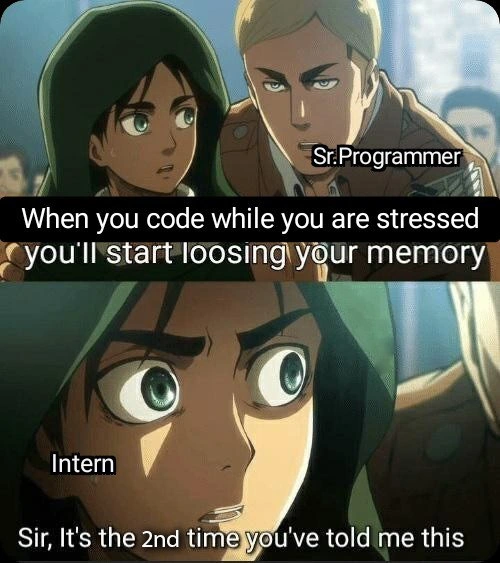
In the picture, a very experienced coder (like a big brother or a teacher in a serious mood) is telling a young coder, “If you try to code when you’re super stressed, you’ll start forgetting things.” That’s a bit like saying, “If you try to study for a test when you’re really upset or scared, you might forget the stuff you just read.” And the funny part is, right after giving this advice, the experienced coder forgets that he already said it and says it again. The young coder responds, basically, “Sir, you already told me that.” It’s a playful way to show that the big guy is so stressed himself that he can’t remember he just gave that warning. It’s like a teacher who’s so frazzled that they repeat instructions to the class, or a parent who’s really busy and asks you the same question twice without realizing it. We find it funny because we know it happens in real life sometimes: when people are overworked or anxious, they can become a bit forgetful and loopy. The core idea is simple: if you overload your brain with stress, it’s going to misfire a little – just like trying to carry too many groceries at once and dropping a bag. The meme gives us a laugh and a gentle reminder that taking a moment to calm down might save us from these silly slip-ups.
Level 2: Brain Out of Memory
This meme highlights in a playful way how coding under pressure can lead to forgetfulness. In the image (which borrows art from the intense anime Attack on Titan, hence the green cloaks and serious faces), we see a senior programmer character giving advice to an intern. The text on the top panel says, “When you code while you are stressed you’ll start losing your memory.” In simpler terms, that means if you try to write code while you're really stressed out, you might begin to forget things you normally wouldn’t – like what you were just working on, or even telling someone the same thing twice by accident. The bottom panel shows the intern, looking alarmed, replying, “Sir, I think you already told me this.” This implies the senior developer already gave that exact warning before but didn’t remember doing so. In other words, the mentor is unintentionally proving his own point: he was coding under so much stress that he forgot he’d already shared this advice!
Let’s break down some of the concepts and roles here. The Sr. Programmer (Senior Programmer) is an experienced developer, someone who's been coding for years and likely mentors others. The Intern is a beginner, maybe a student or new hire, just learning the ropes of software development. In real software teams, a senior dev often gives guidance to a junior dev or intern. Here the guidance is about stress and memory: basically, “Don’t work when you’re extremely stressed, or you’ll start forgetting stuff.” It’s common guidance related to developer productivity and mental health: people know that when you’re frazzled and anxious, you tend to make mistakes or can’t recall information as well.
Now, the humor is that the senior dev himself is so stressed that he’s become forgetful – he’s repeating his warning without realizing it. This scenario is funny to developers because it’s relatable. For example, a programmer might be juggling so many tasks – fixing one bug, reviewing code, answering a teammate’s question – that they lose track and maybe explain something twice or re-do work. If you’ve ever been neck-deep in coding while a deadline is looming (imagine trying to finish a school project the night before it’s due), you might recall a moment where your brain just blanked on something you knew, or you had to ask, “Wait, did I already do this?” That’s what’s happening here in a comical way. The intern politely saying, “This is the 2nd time you’ve told me,” is akin to a friend saying, “You already mentioned that,” when you’re so tired you forgot you told that story.
You might also notice the caption text has a little typo: it says “loosing your memory” instead of “losing your memory.” This is likely just a spelling mistake – one that many people make – but in the context of the meme it ironically fits the theme. It’s as if even the caption creator was a bit exhausted (one of those DeveloperExhaustion moments) and lost their spelling skills for a second. In tech, we often joke that such small mistakes (like typos in code or comments) happen more when you’re tired or stressed. So the misspelling kind of reinforces the point: stress can lead to slips and forgetfulness, whether it’s forgetting a semicolon in code or an “o” too many in losing.
In day-to-day developer life, stress management is important because programming isn’t just typing code; it’s heavy mental work. Your short-term memory (sometimes jokingly likened to a computer’s RAM) holds all the little details of what you’re doing: the variable names, the logic you’re juggling, the error you need to fix next. When you get overloaded with stress – say you have a manager pressuring you, an impending deadline, and a production issue all at once – that short-term memory can overflow. You might forget why you wrote a certain piece of code or have to constantly remind yourself what the next step was. Newer developers (and even experienced ones) learn quickly that if you try to debug a complex problem when you’re panicking, you’ll probably miss obvious things and keep going in circles. That’s why a lot of programming advice includes “take a break when frustrated” or “don’t pull too many all-nighters.” It’s not just fluff – stepping away to relax can actually help your memory and concentration reset.
This meme uses an anime scene to dramatize that idea. In Attack on Titan, the characters are usually discussing battle strategies or dire warnings with very intense expressions. By repurposing that serious imagery for a workplace anecdote, the meme exaggerates how serious and epic a simple forgetful moment can feel when you’re in a high-stress coding situation. It’s like saying, “Coding while stressed is so bad it’s an epic crisis!” – obviously tongue-in-cheek. But beneath the humor, it’s advising developers (especially those new in the field) to be mindful: working in a panicked headspace can come back to bite you. You might end up repeating yourself, forgetting crucial details of the code, or even introducing bugs because you forgot what you were doing a moment ago. In summary, working under pressure without pause can make your brain act like a computer that’s out of memory – it starts failing to store new information properly. The intern’s quip is a lighthearted reminder that even the best of us are not immune to that effect.
Level 3: Memory Leak IRL
In this two-panel anime meme, a battle-hardened Sr. Programmer gravely warns, "When you code while you are stressed you'll start losing your memory." (Yes, the caption even misspells it as "loosing" – perhaps a meta-joke illustrating how stress can make you sloppy with details!) The bottom panel reveals an Intern wide-eyed, replying: "Sir, I think you already told me this." This punchline hits close to home for seasoned devs: the senior is so stressed that they've literally forgotten their own advice, demonstrating the very memory loss they're warning about. It's a humorous exaggeration, but it resonates because high-pressure coding sessions absolutely can mess with your head.
From a veteran coder’s perspective, this is developer humor grounded in reality. We’ve all seen it (or lived it): you pull an all-nighter trying to patch a production bug, and by morning you can’t recall half of what you did. The brain under stress starts acting like a program with a memory leak – allocating attention to new problems without freeing up space from the last. Each urgent issue or late-night Slack ping grabs a chunk of your mental RAM, until boom! you’re out of memory and forgetting things you literally just knew. In tech terms, it's like your brain’s cache keeps getting invalidated. You context-switch frantically between tasks (bug_123, feature_xyz, that on-call alert) and each switch flushes out a bit of short-term data. The result? Context thrashing: variables (like “did I already say that?”) get swapped out of your mental stack, and you accidentally duplicate work or repeat yourself. The intern’s gentle reminder – “it's the 2nd time you've told me” – is the real-world equivalent of a log message pointing out a redundant operation. It’s both funny and a little painful: funny because we recognize it, painful because we know why it happens.
Let’s dig into why stress does this. When crunch time hits, your body floods with cortisol (the stress hormone). Elevated cortisol can mess with the hippocampus, the part of your brain that handles forming new memories. It’s like putting your brain in emergency mode: higher-order functions like recall and learning get deprioritized in favor of pure survival reflex. In coding terms, imagine your system enabling safe mode or pausing background garbage collection when CPU temp is critical – it keeps you alive, but non-essential tasks (like remembering variable names or whether you voiced a thought aloud) might get dropped from the queue. The result is those embarrassing senior moments: “Wait, did I already explain this design pattern? Oops.” A stressed brain is essentially a CPU under heavy interrupt load: each new alert (deadline, bug, email) is an interrupt that jumps in, leaving partial tasks in limbo. No wonder stuff falls out of memory.
Consider a quick pseudo-code of the scenario for laughs:
stress_level = "HIGH"
advice_given = False
def warn_about_stress():
print("When you code while stressed you'll start losing your memory")
# Senior programmer gives advice under high stress
if stress_level == "HIGH":
warn_about_stress()
advice_given = True
# Some time passes, and the stressed Sr. Programmer forgets they gave the advice...
if stress_level == "HIGH" and not remember(advice_given):
warn_about_stress() # repeats the warning
# Intern responds after hearing it twice
print("Sir, I think you already told me this")
In the code above, remember(advice_given) is figuratively broken – our stressed senior dev doesn’t recall setting that flag. It’s a tongue-in-cheek way to show a logical bug caused by stress-induced memory loss. Every experienced engineer recognizes this “brain-fart”: you’re so overworked you might write the same function twice or remind your team about a problem you solved yesterday because it feels new again in your foggy mind.
Importantly, this meme’s dark humor points to a real mental health concern in tech. Constant stress and developer burnout can seriously impair memory and concentration. Seasoned devs often learn the hard way that pushing yourself to the brink leads to diminishing returns – you write worse code and you forget what you were doing. It’s why sane teams encourage taking breaks and stress management in tech: a calm mind is far more productive and less error-prone. The joke lands so well with veteran programmers because it’s a shared truth: after too many back-to-back stressed-out coding sessions, even a Sr. Programmer might start behaving like a glitchy program – repeating instructions, forgetting commit messages, and introducing new bugs by mistyping something as simple as losing. We laugh, but we know that feel. This meme is essentially a friendly warning wrapped in humor: if you don’t take care of your brain, you’ll inadvertently printf the same wisdom twice.
Description
A two-panel meme using a scene from the anime 'Attack on Titan'. In the top panel, a character labeled 'Sr. Programmer' (Erwin Smith) is speaking earnestly to a younger character labeled 'Intern' (Eren Yeager). The caption reads, 'When you code while you are stressed you'll start loosing your memory'. The bottom panel is a close-up of the intern's shocked and concerned face as he replies, 'Sir, It's the 2nd time you've told me this'. The humor lies in the senior programmer's immediate demonstration of the very symptom he's warning against, creating a moment of dramatic irony. This meme is highly relatable to experienced developers who have felt the cognitive effects of stress and burnout, such as forgetfulness and mental fog, making the senior's plight both funny and a little too real. The typo 'loosing' for 'losing' is preserved as part of the original meme's text
Comments
11Comment deleted
My brain's garbage collector gets way too aggressive during crunch time; it starts reclaiming pointers to what I was just saying mid-sentence
Twenty years of on-call later and I’m basically a human memory leak: every Sev-1 allocates new context, and by stand-up nobody remembers to free it - including me
The real memory leak isn't in your code - it's the senior architect who's explained the same microservices pattern five times this sprint while complaining about documentation debt they created in 2019
The senior developer's warning about memory leaks becomes a self-fulfilling prophecy - they've clearly been coding under stress so long they're experiencing their own garbage collection failures. The intern's polite reminder that this is the second iteration of the same advice perfectly captures the recursive nature of technical debt: we keep warning about the same issues we ourselves perpetuate. It's the programming equivalent of 'do as I say, not as I do' - except the senior dev can't even remember saying it the first time. Perhaps they should have used RAII instead of manual memory management for their own cognitive resources
Stress coding is like running prod with GC disabled: memory leaks everywhere, dangling references to requirements, and the only thing retained is the pager number
Coding while stressed is like switching your brain’s GC to Epsilon - allocates panic instantly, frees nothing, and OOMs at code review
Stress turns senior devs' brains into heap leaks without GC - interns are the OOM killer spotting the infinite loop of repeated wisdom
it's the second time this meme has been posted Comment deleted
because admin is senior and he forgets Comment deleted
Nice memory Comment deleted
the first time was with him saying it the 5th time, too Comment deleted