A Developer's Brain: Trust, But Google
Why is this Debugging Troubleshooting meme funny?
Level 1: Brain Won’t Sleep
Imagine you have a tough homework question that you just can’t solve on your own. Every time you get stuck, you ask a friend or look up the answer in the back of the book. One night, you’re trying to fall asleep, but your brain won’t quit talking. You whisper, “I think I finally know how to solve that hard problem from school.” Then your brain, like a cheeky little goblin, replies, “No you don’t! You always check the answers or ask someone for help first.” It’s like your mind is teasing you for not figuring things out alone. This scene is funny because it’s so true to life. We often get late-night worries about things we didn’t finish or problems we haven’t solved. And sometimes our own brain can be a bit of a troll, reminding us of our habits in a playful but annoying way. In the end, the kid (or the developer in the meme) just has to sigh, accept that they’ll need help (like looking up the answer or searching online) tomorrow, and try to get some sleep despite that nagging, chatty brain.
Level 2: Google to the Rescue
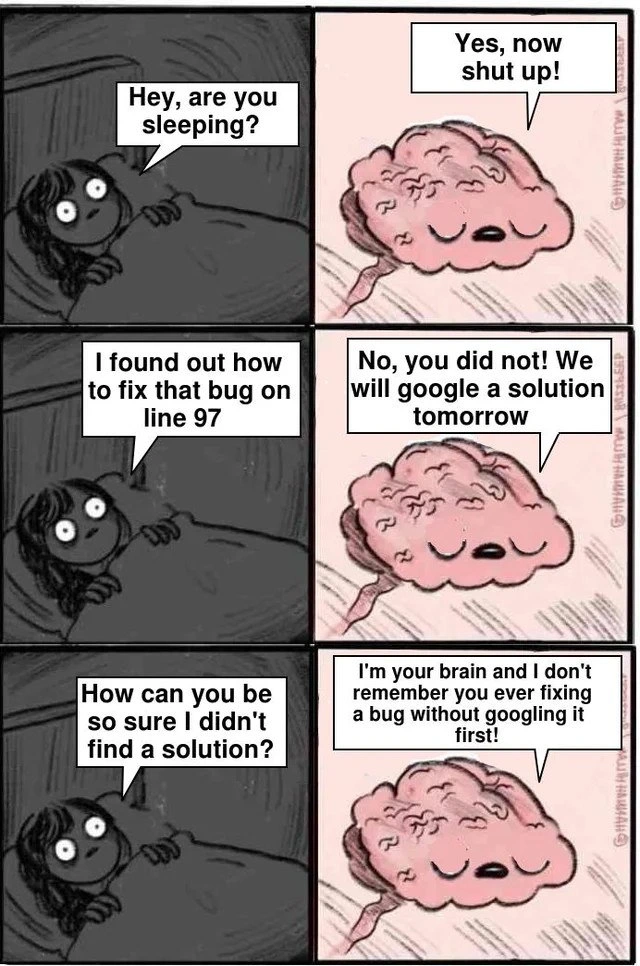
Let’s break down what’s happening in this comic in simpler terms. On the left, we have a tired programmer lying in bed at night. On the right, their brain is depicted as a pink cartoon character. This setup shows a common situation: the developer is trying to sleep, but their mind won’t stop thinking about a bug (an error in the code). Specifically, the dev says they “found out how to fix that bug on line 97.” In programming, saying a bug is “on line 97” means the error is located at the 97th line of the code file. Developers often refer to bugs by the line number where the problem happens, because error messages in logs often show something like “Error in module X at line 97.” The brain’s response, “No, you did not! We will google a solution tomorrow,” is a funny (and slightly rude) reply. It suggests that the programmer’s late-night confidence in a fix isn’t convincing – the brain knows they’ll have to Google the issue the next day to really solve it. Google is the world’s most popular search engine, and “googling a solution” is shorthand for searching the internet for answers or fixes.
Why is that the immediate plan? Because in real life, debugging (figuring out why code isn’t working and fixing it) often involves looking up information. Programmers don’t always know the answer offhand, especially if the bug is tricky or involves technology they’re less familiar with. Instead, they use resources like Google or Stack Overflow to find how others solved a similar problem. Stack Overflow is an online question-and-answer forum specifically for programming issues. If you encounter an error or a bug, chances are someone else has run into it too and asked about it on Stack Overflow (or a similar site). For example, if a developer gets stuck with an error message, they might type that message into Google. Almost magically, a list of results appears, often with a Stack Overflow page right at the top containing an explanation or a snippet of code that can help. This has become such a normal part of a developer’s life that it’s practically a reflex. A lot of beginners quickly learn that “just Google it” is the fastest way to unblock themselves when facing a weird error. It’s not that you’re doing something wrong by searching online – even very experienced developers do this daily. The meme is playing on that relatable developer experience: relying on the internet as a crutch for bug fixing.
The conversation in the meme also highlights late-night coding worries. The developer is having what we call an intrusive thought at night – a random worry or idea that pops up when you’re trying to sleep. In this case, the intrusive thought is about a piece of code that isn’t working right. Many programmers have been in this situation: you stop working for the day, but your brain keeps chewing on the problem. Maybe you suddenly think, “Ah! I recall how to solve it now!” as you’re lying in bed. It’s that eureka moment – or at least it feels like one. But the brain character here immediately throws cold water on that excitement, basically saying, “Who are we kidding? We never solve these things without looking it up.” This is a nod to how dependent developers can be on external help. It’s not that programmers are clueless; it’s that software development is a huge field, and no one memorizes everything. There are thousands of programming languages, libraries, and error messages. Even a skilled coder often doesn’t remember the exact fix for a specific bug, especially if it’s something they haven’t seen in a while. So the sensible approach is to use the tools at hand: search online, read documentation, or find an answer on Q&A forums.
The humor of the meme comes from how blunt the brain is. It’s funny to imagine your own brain being a snarky, separate character telling you off. The brain says, “I’m your brain and I don’t remember you ever fixing a bug without googling it first!” — that’s the punchline. It exaggerates to make a point: nearly every time this developer fixed a bug, they started by searching the web. For a junior developer or someone new to coding, this scene is both reassuring and comical. It’s reassuring because it tells you that needing to Google for help is completely normal in programming. If you often find yourself copying error text into Google or looking up how to do something, you’re not alone – in fact, you’re just being a programmer. And it’s comical because the brain is essentially breaking the fourth wall, reminding the dev (and all of us reading) of a truth we might sheepishly recognize in ourselves. This strong dose of honesty packaged as a joke is exactly why so many find the meme relatable. Whether you’re a newbie struggling with your first code assignment or a seasoned engineer with decades of experience, you’ve probably had a moment where your best solution was simply to turn to Google or Stack Overflow. The meme simply dramatizes that moment as a cheeky bedtime conversation, capturing the mix of frustration and relief that comes with knowing the answers are out there on the internet (just not currently in your own head!).
Level 3: Cache Miss at Midnight
In this meme, a developer’s brain acts like a sassy 3 AM co-pilot, illustrating the classic late-night debugging anxiety. It humorously merges intrusive thoughts at night with the realities of modern coding. The developer in bed suddenly thinks, “I found out how to fix that bug on line 97,” and their brain immediately shoots it down: “No, you did not! We will Google a solution tomorrow.” This scenario is painfully familiar to experienced engineers. Why? Because our brains are like cache memory – if a solution isn’t already stored up there, we inevitably end up performing an external lookup (hello, Google). A cache miss at midnight means the brain didn’t have the bug fix internally, so it’s telling the dev to fetch from the internet first thing in the morning. The humor hits home for senior developers who’ve spent countless nights tangled in debugging frustration, only to admit that even their best late-night epiphanies usually require confirmation from Stack Overflow or official docs the next day.
The meme brilliantly satirizes google-dependent debugging as an open secret in the programmer community. The brain’s snarky claim, “I don’t remember you ever fixing a bug without googling it first!” is an exaggeration with a grain of truth. Seasoned developers know that feeling – no matter how many years you’ve coded, you still paste error messages into a search box more often than you’d like to admit. In fact, leveraging search engines and community Q&A has become a core developer skill. We’ve all embraced the reality that memorizing every API or language quirk is impossible (tech moves faster than anyone’s memory). Instead, we cultivate Google-Fu: the art of finding quick answers and relevant code snippets online. The veteran perspective here is a mix of sarcasm and relief – sarcasm because the brain is basically calling the dev out for leaning on external help, and relief because every experienced dev knows everyone does this. It’s a shared industry truth that softens the sting of imposter syndrome. After all, when production is on fire or a bug is hiding at line 97, even the most battle-hardened coder will calmly open a browser and search for a solution (likely landing on that familiar Stack Overflow thread). The brain in the comic is essentially voicing what senior engineers jokingly remind each other: “Documentation, Google, and community forums are our real-time extensions of memory.”
This comic also pokes at the developer experience (DX) of being unable to switch off. The protagonist is wide-eyed in the dark, a scene any on-call veteran recognizes. You close your eyes, but an unresolved bug starts nagging like a pager alert in your head. Ever had a day where a pesky bug (maybe an off-by-one error or a mysterious crash at line 97) follows you home? You lie down, and suddenly your brain schedules a high-priority thread: “Hey, are you sleeping? Guess what, you forgot to fix something!” It’s practically an operating system interrupt to your attempt at sleep mode. Here that interrupt takes the form of a sarcastic brain harping on the developer’s reliance on external knowledge. The dark humor is that even your own mind is trolling you for not solving the problem by sheer intellect alone. Yet, from a senior vantage point, we chuckle because the brain isn’t wrong – we’ve learned that “knowing how to find the answer” often outranks “knowing the answer by heart.” The meme resonates strongly with any experienced programmer who’s made peace with the fact that Google and Stack Overflow are part of the team. It’s a candid nod to the real workflow behind most bug fixes, wrapped in the relatable absurdity of a late-night internal dialogue. In short, the comic’s scenario is developer humor at its finest: it underscores a ubiquitous reality (debugging often involves online research) using the well-known trope of the brain that won’t let you sleep, leaving seasoned devs smirking in agreement (and perhaps recalling a dozen nights when their own brain pulled this exact stunt).
Description
A six-panel comic strip illustrating a common developer experience. The left panels, in grayscale, show a person with wide eyes lying awake in bed. The right panels, in color, show a personified pink brain. In the first row, the person asks, 'Hey, are you sleeping?' and the brain replies, 'Yes, now shut up!'. In the second row, the person has a revelation: 'I found out how to fix that bug on line 97,' but the brain dismissively says, 'No, you did not! We will google a solution tomorrow.' In the final row, the person asks, 'How can you be so sure I didn't find a solution?' The brain delivers the punchline: 'I'm your brain and I don't remember you ever fixing a bug without googling it first!'. The meme humorously captures the 'eureka' moment of solving a problem at an inconvenient time, contrasted with the self-doubt and ingrained reliance on search engines and community knowledge (like Stack Overflow) that is a universal part of the modern software development process. It speaks to the feeling that a solution isn't real until it's been validated by an external source

Comments
7Comment deleted
My brain has a strict TDD policy for epiphanies: No solution is considered valid until it passes a Google search with at least one upvoted Stack Overflow answer
Turns out my brain runs an over-eager GC at 3 a.m. - it frees the actual bug fix but hangs onto a strong reference to the Google query that’ll rehydrate it tomorrow
After 20 years in the industry, I've learned that the brain's 3am 'solution' is usually just moving the null pointer exception from line 97 to line 98 - but at least now it's someone else's problem in tomorrow's code review
The brain's right, of course. We've all evolved into distributed systems where Stack Overflow is our external memory cache and Google is our primary index. Why waste precious neural RAM on bug solutions when you can just maintain a pointer to the internet? It's not technical debt if it's an architectural decision
Senior move: write the Stack Overflow answer tonight so future‑you can Google it tomorrow and call it “knowledge sharing.”
Your brain's distributed cache: evicts all fixes at bedtime, forcing a full Google reindex come morning
My brain isn’t lazy, it’s stateless - bug fixes are offloaded to Google, and we just wait for eventual consistency between the 2am hunch and tomorrow’s Stack Overflow link