UDP Joke: Delivery Not Guaranteed
Why is this Networking meme funny?
Level 1: The Unheard Joke
Imagine you want to tell your friend a joke. You shout across the playground, “Hey, want to hear a joke?” and they shout back, “Sure!” Now, instead of walking over and telling it to them, you write the joke on a paper airplane and fling it in their direction without seeing if they catch it. You assume it’ll reach them, so you go do something else. A bit later, you come back and ask your friend, “So, did you like my joke?” But your friend looks at you totally confused and says, “What joke?” Turns out, that paper airplane never arrived – maybe the wind took it away or it fell short. The funny part is that you thought your friend heard the joke, but in reality they never got it at all. The whole situation is humorous because it’s a big miscommunication: one person sent a joke that the other person never received. It’s like the joke vanished into thin air, so of course your friend has no idea what you’re talking about. The meme is just a techie way of showing that feeling when a message goes missing and nobody realizes it until later – resulting in a very confused “What?” from the person who was left out.
Level 2: Lost in Transit
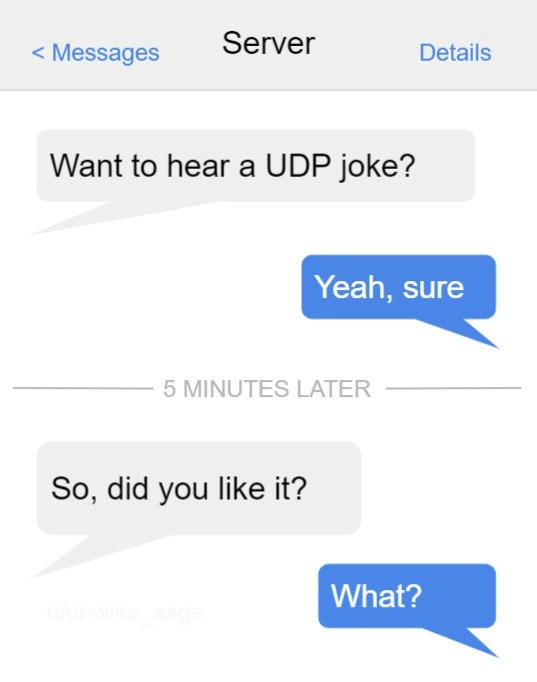
Let’s break down the joke in a more straightforward way. The conversation is between a server (gray text bubbles) and a client (blue text bubbles). In networking, a server is like the guy telling a story, and a client is the one listening. The server says, “Want to hear a UDP joke?” UDP stands for User Datagram Protocol. It’s one method computers use to send messages to each other, part of the family of NetworkProtocols that make the internet work. The important thing about UDP is that it’s designed to be super simple and fast. It sends out a datagram (which you can think of as a small packet or bundle of data, like a short message) and doesn’t wait to see if anyone got it on the other end. There’s no “Are you there?” handshake, and no “Got it, thanks!” reply required.
So in the meme, when the server presumably sends the actual joke after the client says "Yeah, sure," it’s symbolizing a UDP packet being sent. But (here’s the catch) with UDP there’s no guarantee that packet will reach its destination. Networks can be unreliable – sometimes data gets lost or dropped due to things like congestion or errors. UDP won’t try again, and it won’t even inform the sender that something went wrong. It’s a stateless, no-acknowledgment protocol. That’s why 5 minutes later the server has to ask, “So, did you like it?” The server didn’t get any feedback (because UDP never provides feedback by itself). The client’s response, “What?”, shows the client never received any joke at all. In other words, the UDP message (the joke) got lost in transit and neither side knew until the server got suspicious and checked manually.
For a bit of context, compare UDP to the other very common transport protocol, TCP (Transmission Control Protocol), which most web traffic uses:
| UDP (User Datagram Protocol) | TCP (Transmission Control Protocol) |
|---|---|
| Connectionless (no initial handshake to set up a link) | Connection-oriented (uses a handshake to establish a connection before sending data) |
| Unreliable delivery (no guarantee the message arrives or in what order) | Reliable delivery (guarantees all data arrives and in the correct order, or you get an error) |
| No built-in acknowledgment (sender doesn’t wait for a “got it” from receiver) | Uses acknowledgments (receiver sends back ACKs to confirm receipt of data) |
| No automatic retries (if a packet is lost, UDP itself won’t resend it) | Automatic retries and recovery (lost packets are detected and resent by TCP) |
| Lower overhead (faster, minimal extra data being sent) | Higher overhead (extra packets and data for managing connection and delivery) |
| Common uses: live video/voice streaming, online games, DNS queries (where speed matters and occasional loss is OK) | Common uses: web pages (HTTP), file transfers, emails, messages (where you need all the data reliably) |
In short, UDP is like sending a postcard: you drop it in the mailbox and hope it gets there, but you don’t find out if it was delivered unless the recipient tells you later. TCP is more like certified mail: the recipient has to sign for it, and you get a receipt saying “delivered” (or an alert if it failed). Both approaches are useful in different situations.
Now, back to the meme: it’s using a chat format to show UDP’s no-guarantee behavior in a funny way. The “Server” didn’t do the TCP-style thing of making sure the client was ready and got the data. It just sent the joke blindly. When the server asks “Did you like it?”, that’s the first time it’s actually checking if the client received the joke. This is exactly what a programmer might have to do when using UDP: if the app cares about missing data, the programmer must build a check or ask for a response, since the protocol won’t do it automatically. The client saying “What?” is essentially the client going, “Uh, I never got your message.” It’s a simple illustration of packet loss – where a message gets lost in the network.
For someone new to this, the key takeaway is: UDP doesn’t guarantee delivery. It trades reliability for speed. That’s why the joke failed to land (literally, the joke message never landed on the client’s side). This meme turns that technical concept into an easy-to-see scenario: one message went missing, and the misunderstanding that follows is the exact kind of thing that UDP’s design can lead to. It’s a playful way to remember that if you ever use UDP in your projects, you might need to double-check important messages actually arrived!
Level 3: You Might Not Get It
For experienced developers and network engineers, this meme is an instant classic because it embodies the old one-liner: “I’d tell you a UDP joke, but you might not get it.” 😄 Here, the joke is literally happening in a text chat format. The Server asks, “Want to hear a UDP joke?” and when the client says “Yeah, sure.”, the server presumably sends over the joke… using UDP. In true UDP fashion, that joke never arrives (it’s lost in the ether of the internet), and the server doesn’t get any hint of the failure. A few minutes later, the server checks in: “So, did you like it?” The client’s baffled “What?” is both the punchline and the proof that the UDP transmission fell flat on its face.
This perfectly captures UDP’s personality: no delivery confirmation, no connection, no guarantees. It’s what we call a connectionless protocol — essentially the server just blasted out the data without handshaking or negotiating a reliable channel. In developer lingo, UDP is often described as a “fire-and-forget” transport. You fire off the packet and forget about it, because there’s no built-in mechanism to remember or check on it. That’s great for scenarios where you want minimal delay (gaming, streaming, etc.), but it can lead to comical situations like this if you actually expected a response.
The humor here hits close to home for anyone who’s dealt with network code. If you’ve been around the block, you’ve probably encountered that moment when something you sent via UDP didn’t arrive. Maybe it was a logging message that never showed up, or a heartbeat packet in a distributed system that got dropped, causing a false alarm. In those moments, you’re essentially the server going, “Hello...? Did you get that?” and the silence (or a “What?” from the other side) is your answer. This meme exaggerates that scenario in a DeveloperHumor kind of way. It anthropomorphizes the server and client, turning a low-level network event (a dropped packet) into a relatable human conversation. That’s why it’s so funny to tech folks – we personify servers and protocols all the time in jokes, and here UDP is the scatterbrained friend who tells a joke while you weren’t listening and then asks if you liked it.
There’s also a clever use of the iOS Messages format. In a real iMessage chat, if a message fails to deliver, you usually see a "not delivered" notice or an alert. Here, though, the “chat” is really acting under UDP rules, not iMessage rules. No delivered checkmarks, no read receipts, nothing – just the illusion that everything’s fine. Networking pros recognize this as a tongue-in-cheek twist: normally, our messaging apps behave more like TCP (ensuring messages get through eventually), but this one plays out with UDP’s ¯\_(ツ)_/¯ attitude toward delivery. The 5 MINUTES LATER divider only adds to the comic timing – it implies the server was confidently waiting for laughs that never came. How many times have ops teams waited for a response from a heartbeat or ping that got lost? That awkward pause is so relatable.
In essence, the meme is poking fun at stateless protocols and the classic problem of packet loss. It resonates with the inner network engineer in us. We laugh because we’ve seen real systems where a crucial packet didn’t make it and someone had to manually ask, “Hey, did you get that data?” It’s the tech equivalent of telling a joke to an empty room. Everyone in on the joke (pun intended) knows that UDP can be a bit of a blind comedian – tossing punchlines out rapidly but never sticking around for applause (or even to check if the audience is there!). “You might not get it” isn’t just the tagline; it’s literally what happened to the poor client in this scenario.
Level 4: Datagram Delivery Dilemma
At the most granular level, this meme is highlighting a fundamental quirk of network design: UDP’s lack of delivery guarantees. In networking theory, UDP (User Datagram Protocol) is a transport layer protocol that is connectionless and unreliable – in the technical sense that it provides *no acknowledgments, no handshakes, and no built-in retransmission. When the "Server" in the chat says, "Want to hear a UDP joke?", we can imagine it’s preparing to send a UDP packet containing the actual joke. UDP sends that packet off into the network with a fire-and-forget approach: it doesn’t wait around to see if the packet made it to the destination. Unlike its cousin TCP (Transmission Control Protocol), which performs a three-way handshake (SYN, SYN-ACK, ACK) to establish a connection and then expects an ACK for each chunk of data, UDP just yeets the data and moves on. If the joke-packet gets lost due to congestion or routing issues, the server will never know – there’s no feedback mechanism at the protocol level. This design goes back to the early Internet principles (see the end-to-end principle): keep the core network simple and push complexity (like error handling) to the endpoints if needed.
Why would anyone design a protocol that doesn’t even check if data arrived? Performance and simplicity. UDP’s minimal overhead means no extra packets for setup or acknowledgments, which translates to low latency. For certain applications, that trade-off is gold. Think of real-time systems: live video streams, voice calls, online gaming, or the DNS queries your computer makes hundreds of times a day. In those cases, a dropped packet here or there is usually preferable to the delay of constantly checking and retrying. (One lost video frame is better than your stream pausing, right?) RFC 768 (1980), which introduced UDP, intentionally kept it lean and stateless for exactly these scenarios. So UDP is a stateless protocol – it maintains no persistent session info between sender and receiver. The "Server" in this meme doesn’t do any setup or follow-up; it’s behaving exactly like a UDP transmitter would: send the data out and assume it’s all good.
Now, the conundrum (and the punchline) comes when you actually care whether the message arrived. Since UDP won’t tell you, the responsibility shifts to the application or the user. In the meme, after an awkward pause (“5 MINUTES LATER”), the server asks, “So, did you like it?” From a networking standpoint, this is hilarious because it’s basically an application-level acknowledgment check. The server had to explicitly ask the client if the message got there — a manual ACK! The client’s confused reply, “What?”, serves as a de facto negative acknowledgment (NACK) indicating, “I got nothing, please resend.” This is exactly what developers end up doing if they need reliability on top of UDP: implement their own acknowledgments, timeouts, or sequence numbers. We’ve essentially re-invented a mini-TCP on the spot. Seasoned network engineers recognize this pattern: if you truly need every packet delivered, you either use TCP or bolt your own reliability onto UDP. The meme cleverly exposes that truth by showing the server “bolting on” a check (“did you like it?”) after the fact.
From a theoretical perspective, it’s a witty demonstration of what happens in an unreliable transport scenario. There’s an almost academic elegance here: the absence of an ACK led directly to a human moment of “uh, did my message even reach you?” It echoes real-world distributed systems challenges where messages can vanish into the void. In networking courses, professors often joke that UDP stands for “Unreliable Data Protocol” (it’s actually User Datagram Protocol) to drive home this exact behavior. The humor lands because it turns an abstract concept — packet loss on a connectionless protocol — into a relatable, almost sitcom-like exchange. This is NetworkHumor on a high level, where understanding the NetworkProtocols yields a special appreciation: the server-client chat is essentially acting out a lost datagram scenario. In summary, the meme tickles those of us who know the nitty-gritty: it’s a perfect illustration of the datagram delivery dilemma — great for speed, as long as you don’t mind the occasional joke (or packet) vanishing without a trace.
Description
A screenshot of a text message conversation that cleverly demonstrates the nature of the UDP protocol. The contact name at the top is 'Server'. The Server initiates with, 'Want to hear a UDP joke?'. The recipient replies, 'Yeah, sure'. A timestamp below indicates '5 MINUTES LATER'. The Server then follows up with, 'So, did you like it?', to which the confused recipient replies, 'What?'. The humor is a direct analogy for the User Datagram Protocol (UDP), a core networking protocol known for being 'fire-and-forget'. UDP sends data packets without establishing a connection or guaranteeing their delivery. In the joke, the actual 'joke' packet was never sent or was lost, but the server, in true UDP fashion, doesn't know or care and proceeds as if it were received, perfectly capturing the unreliability of the protocol for anyone who has worked with network programming
Comments
14Comment deleted
The real joke is thinking you can build a reliable system on UDP without implementing your own handshake and retransmission logic, at which point you've just badly reinvented TCP
Implementing critical alerts over UDP is the fastest way to learn the difference between at-most-once delivery and at-most-once employment
The real UDP joke is when you implement retry logic and accidentally reinvent TCP, but with worse congestion control and none of the battle-tested edge cases handled - basically every game developer's networking journey
This is the networking equivalent of explaining CAP theorem to stakeholders - you can have Consistency and Availability, but when you choose UDP for Partition tolerance, don't be surprised when half your messages end up in /dev/null. The real joke is that production systems still use UDP for DNS queries, proving that sometimes 'good enough' beats 'guaranteed delivery' when latency is your actual SLA
UDP for on-call alerts: if you don’t get paged, congratulations - either the system is healthy or the NAT timed out
UDP in prod: fire‑and‑forget the punchline, then build a “did you like it?” polling service because you forgot ACKs live in TCP
UDP: the protocol architects pitch for 'low latency' until production VoIP calls turn into awkward silences mid-sprint demo
I know a great TCP joke, which I can repeat unless you don't get it. Comment deleted
RST Comment deleted
SYN ACK Comment deleted
LISTENING Comment deleted
For eternity Comment deleted
Server: I know an http joke, but first you should ask me Me: so what? Server: 404! AHAHHHAHAAAHH!! Comment deleted
lmao Comment deleted