Skip to content
DevMeme
7490 of 7506
When Your Agent’s Memory File Knows Everyone

When Your Agent’s Memory File Knows Everyone

Why is this AI ML meme funny?

Level 1: The Digital Confidant

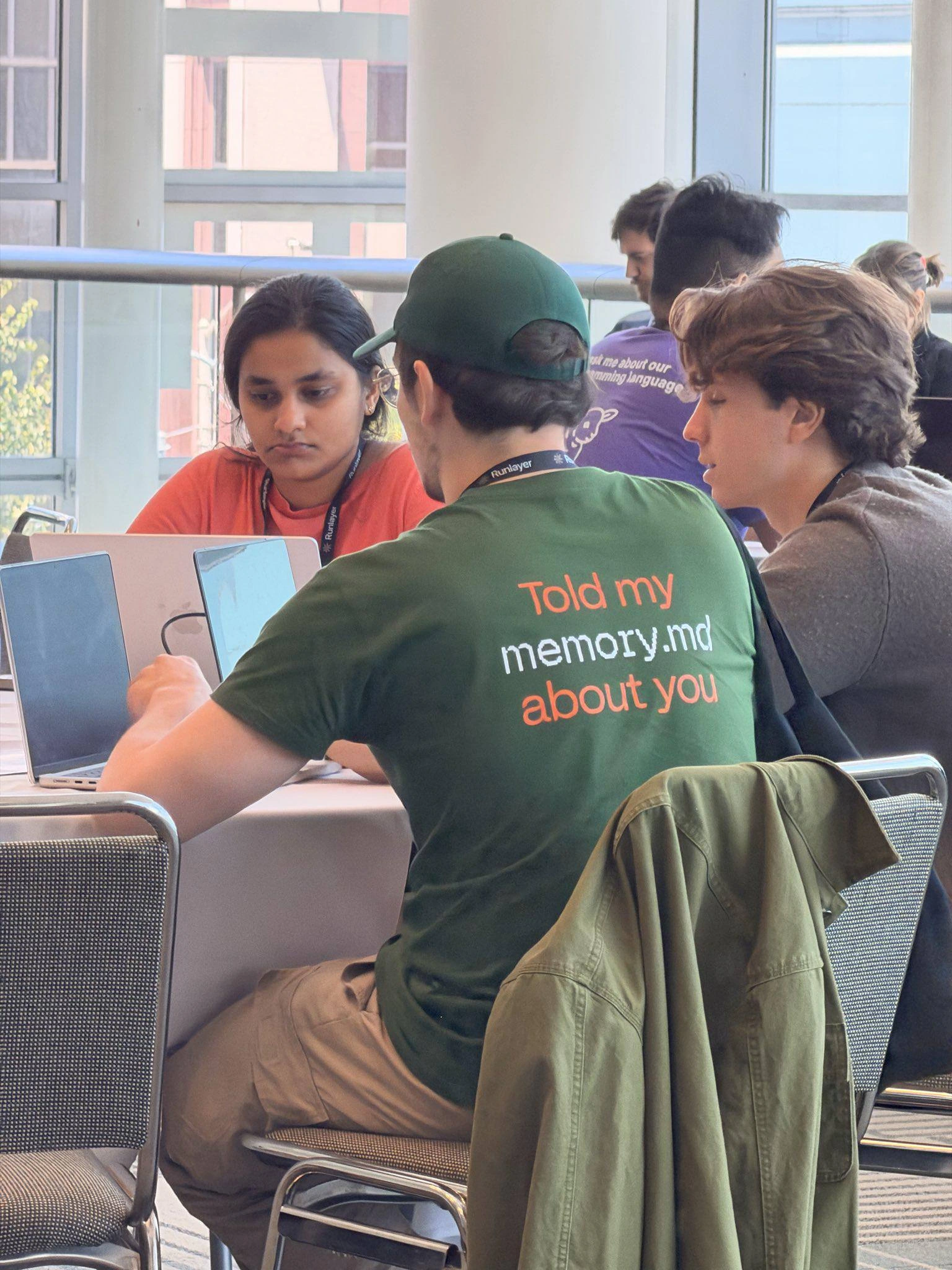
Imagine someone saying, “I told my diary about you,” except the diary can help with tomorrow’s homework and its name ends in .md. The people and laptops make it look like a normal group work session, while the giant message on the green shirt reveals that one person’s favorite gossip partner is a computer file. It is funny because a cold little document is being treated like the friend who now knows everything.

Level 2: Markdown Remembers

Markdown is a lightweight way to structure text using characters such as # for headings, - for lists, and backticks for code. The .md suffix in the large shirt print identifies that format. Some coding assistants are configured to load a project memory file at the start of work, giving the model written background beyond the current prompt.

That is a persistence mechanism: information is saved somewhere durable instead of existing only in a temporary conversation. It is also knowledge management, because someone must decide what deserves to be saved and how it should be organized. A useful entry might say, “Run tests before changing the API schema.” A less useful entry might say, “Alex always breaks deployments,” which is where the shirt’s social threat becomes funny—and where a real team should pause before turning an opinion into institutional memory.

The visual gag needs no software interface on screen. The cap, conference lanyards, cluster of laptops, and programmer-style filename establish a community where a text file can be treated like another attendee. To a newer developer, the practical lesson is simple: an LLM does not remember like a person by default. A surrounding tool repeatedly supplies saved text, and the model responds as though it remembers because the relevant note has been placed back into its working context.

Level 3: Gossip as Infrastructure

Told my
memory.md
about you

The shirt turns an ordinary social warning—“I told someone about you”—into an AI-agent workflow. A memory.md file is plain Markdown that an agent or its surrounding tool can read to recover durable notes: project conventions, decisions, preferences, and other facts that would otherwise disappear when a chat ends or its context window is replaced. Calling that file “my memory” anthropomorphizes the agent, while “about you” makes a documentation update sound like delicious gossip.

The setting sharpens the joke. The wearer is seated among other developers, open laptops, and visible Runlayer lanyards, so the slogan is not floating in a generic stock photo; it is being worn inside the sort of technical gathering where agent configuration and persistent context are plausible conversation topics. The person literally has nearby humans to confide in, yet the shirt chooses a Markdown file as the trusted confidant. Friendship has acquired a file extension.

There is also a real engineering tension under the wordplay. Saving useful context can make an AI assistant more consistent, but whatever is written becomes future input. A vague, stale, or overly personal note can bias later behavior just as surely as an accurate project rule can improve it. Teams therefore need to treat durable memory as maintained knowledge rather than mystical cognition: keep entries scoped, reviewable, and easy to correct; distinguish observed facts from preferences; and avoid storing secrets merely because Markdown feels harmless. Version control can reveal who changed the agent’s “recollection,” but it cannot make the recollection wise.

The joke lands especially well in developer culture because memory.md collapses two long-running habits into one artifact: documentation that nobody promises to update, and machine context that everybody hopes will somehow remain perfect. The file may be persistent; human intent remains delightfully eventually documented.

Description

A candid vertical photo shows several young developers gathered around open laptops at tables in a bright conference or hackathon venue. The central attendee faces away in a dark green cap and matching shirt whose orange-and-white back print reads, "Told my memory.md about you"; black lanyards around multiple attendees read "Runlayer." A purple shirt in the background carries the partially obscured line "Ask me about our …mming language" above a small mascot graphic, while a green jacket hangs over the foreground chair. The main shirt turns the Markdown file used to preserve an AI agent's durable context into a human confidant, treating an update to machine memory like telling a friend gossip about someone.

Comments

1
Anonymous ★ Top Pick Real friendship is getting promoted from chat history to version-controlled memory.
  1. Anonymous ★ Top Pick

    Real friendship is getting promoted from chat history to version-controlled memory.

Use J and K for navigation